Pages

Showing posts with label Brooklyn Historical Society. Show all posts

Thursday, March 8, 2018

Thursday Night in Brooklyn Heights: "The World Only Spins Forward: The Ascent of Angels in America" at the Brooklyn Historical Society

(Video courtesy Brooklyn Historical Society)
We saw Angels in America on Broadway at a Wednesday and Saturday matinee in early May 1994. At the time we were living in Gainesville, Florida. Having taken our only final on the first day of exams at the University of Florida Law School (our other courses required only papers), we had two weeks before graduation and were staying at a friend's apartment on the Upper West Side.

We just walked up to the box office and paid $20 each for the cheapest seats available on these matinee days. The play was an incredible experience, probably our most profound experience in the theater. Most of the original Broadway cast were still playing their parts, although on Saturday, there were two understudies for Jeffrey Wright and Joe Mantello. (We actually knew the understudies from soap operas.)

We still have very clear moments from the play in our head. Weirdly, the next day, we were doing laundry in the basement of our friend's apartment, and David Marshall Grant, who played Joe, was doing his laundry at the same time. It seemed . . . natural. Back in Florida, we read the play in the paperback edition.

Tonight's panel brought back many memories of this wonderful play by Tony Kushner.

Wednesday, March 17, 2010

Wednesday Night in Brooklyn Heights: "Rites and Ceremonies of the Brooklyn African Disapora" at the Brooklyn Historical Society


This evening we attended an interesting panel discussion, "Rites and Ceremonies of the Brooklyn African Diaspora" at the Brooklyn Historical Society in the Heights.

Part of the Brooklyn Arts Council's yearlong Black Brooklyn Renaissance extravaganza of countless programs (presented in partnership with the Bedford-Stuyvesant Restoraion Corporation) - performances, exhibitions, screenings, symposia and more - celebrating the last fifty years of African-American arts and culture in Brooklyn.

The large panel included Dance Africa Elder Rahkiah Abdurahman, who discussed her work and that of Dr. Chuck Davis and the evolution of DanceAfrica from its 1958 origins; Doris Green, one of the premier historians of African dance and one of the first teachers of it in Brooklyn - a Fulbright scholar, an innovative Brooklyn College instructor we remember from back in the day, she talked about her pioneering work in notating African dance and traditional-instrument music; Pam Green of the Weeksville Heritage Center; Peggy Alston, the longtime theater actress and director of performing arts at Bedford Stuyvesant Restoration Corporation, who discussed tha annual Pre-Opening Ceremonies for DanceAfrica; Baba Mpho of the annual Tribute to the Ancestors of the Middle Passage at Coney Island, which takes place by the Atlantic, "the world's biggest burial ground of Africans," the second Saturday in June;

Jeff King of the annual Central Brooklyn Jazz Consortium and Brooklyn Jazz Festival; Brenda Greene of Medgar Evers College's Center for Black Literature and National Black Writers Conference, who announced that Nobel Prize-winning author Toni Morrison (our teacher at the 1977 Bread Loaf Writers Conference)will be Honorary Chair for the Tenth National Black Writers Conference from March 26-28, and its theme, taken from the WWII novel by founder John Oliver Killens, is "And Then We Heard the Thunder: Black Writers Reconstructing Memories and Lighting the Way "; Segun Shabaka of the International African Arts Festival; Jean Alexander of the West Indian-American Day Carnival Association, Inc, which presents the spectacular, word-famous annual West Indian American Day Parade; and Joy Patel of 227 Abolitionist Place, and the annual Juneteenth Celebration.

We learned an incredible amount about the traditions of the event from these accomplished people and are looking forward to attending more Black Brooklyn Renaissance events.

Thursday, October 8, 2009

Thursday Afternoon in Brooklyn Heights: Dave Frieder and "100 Years of the Manhattan Bridge" at the Brooklyn Historical Society


After having a great lunch at a Korean restaurant near Ground Zero with our friend Ken, an attorney who we met forty years ago in a Men's Health Ed class at Brooklyn College, we took the 5 train one stop from Bowling Green to Borough Hall to go to a 2 p.m. lecture and slide show, "One Hundred Years of the Manhattan Bridge" with Dave Frieder, bridge historian and master photographer, at the Brooklyn Historical Society.

Before an audience of about 40 or 45, mostly seniors, "Dave the Bridge Guy" spoke for about an hour while he showed slides of Manhattan Bridge history and his own breathtaking photographs (on sale at his website) which will make a handsome coffee-table book one day. Here is Dave at the top of the bridge by one of the purely decorative spheres:

Obviously, as he said, he has no fear of heights and is an expert climber. Dave had eight years of unlimited access to the bridges until 9/11, with the total cooperation of the Port Authority as well as great help from the Department of Transportation, the Triborough Bridge and Tunnel Authority, and Amtrak.

Dave began by speaking about the history of the Manhattan Bridge, the somewhat unappreciated sister to the celebrated Brooklyn Bridge, but our own personal favorite East River crossing, probably because it's the one we used the most for a trip from our neighborhood in Flatlands/Old Mill Basin straight up Flatbush Avenue into lower Manhattna.

Recent rehabilitation of the Manhattan Bridge seems to be completed, with just a few more small projects, but of course the 1909 bridge is under constant repairs. We can recall as a sophomore at the Franklin School in 1965-66, we'd drive in every morning with our dad (he took us as far as his workplace near 14th Street and we took the M10 bus the rest of the way to 89th and Central Park West). Even back then the lower roadway was closed for most of the year.

Dave noted that a common mistake, as in the Wikipedia entry on the Manhattan Bridge, is that Ralph Modjeski was involved in its design; he wasn't. The Manhattan Bridge was designed by Leon Moisseiff, who unfortunately is known best as the designer of the Tacoma Narrows Bridge, whose swaying destruction into Puget Sound we've all seen:

Dave explained that there were two possible designs for the bridge, an eye-bar like the Queensboro Bridge and the parallel wire cabled suspension bridge we have today.

Both upper roadways of the bridge originally had four tracks for trolleys, later removed to convert the roadways for vehicular traffic as cars proliferated. The
Manhattan Bridge was the first suspension bridge to use flexible steel towers, unlike the Williamsburg and the George Washington, which used braced steel towers. The Manhattan bridge was the first modern steel suspension bridge to use a Warren type stiffening truss and to use two suspender ropes straddled over the main cables to attach to the floor beams.


As Dave writes on his website:
"My work on this long-term project has been exhilarating and fascinating as I began to study bridges and began to realize they are engineering marvels. It came to my attention that in order to be able to capture a subject on film, paper, or canvas, one must understand your subject fully. For me, being able to 'Feel The Steel' was a way of understanding how and why bridges work and function. My vision of the great structures was getting better every year! For most of my images I take on the Bridges, I use a Hasselblad Camera in conjunction with a 'Gyro' stabilizer."

He showed us old cable wire and rivets from the bridge which were replaced in recent years and discussed his experiences as well as the history of the Manhattan Bridge, whose main design flaw seems to be that the four subway tracks on the lower level were placed on the outside rather than the center of the bridge.

Some of the engineering stuff Dave talked about frankly was as much above our head as is the bridge itself when we are strolling down DUMBO's streets, but he spoke about the deflection and resistance of the bridge and how the train tracks were really built when both people and trains were smaller and less heavy.

He showed all kinds of great photos he's taken - all with film, nothing digital - of the Manhattan Bridge, from the anchorage to what seemed like every conceivable spot and angle going up to the top.

He discussed the bridge's roadways, its construction, its color (we love the blue, but it was once gray) as well as his work habits and how he came to his love of bridges as a childhood devotee of Gilbert erector sets (the best).

We were enthralled by his photographs and amazed at Dave the Bridge Guy's knowledge, not just of the Manhattan Bridge, but of every bridge in the city. He's a real living resource for New York history as well as a supremely talented artist. We're grateful to the Brooklyn Historical Society for giving us the opportunity to see Dave Frieder and his work and to listen to his engaging talk.

Thursday, October 2, 2008

Thursday Evening at the Brooklyn Historical Society: Reception & Launch of the Park Slope Neighborhood & Architectural History Guide


This evening at 6 p.m. we arrived at the Brooklyn Historical Society for a reception celebrating the launch of the Park Slope Neighborhood & Architectural History Guide, the latest in the BHS's series of wonderfully written and lavishly photographed neighborhood guides.

Written by the noted architectural historian Francis Marrone, the author of The Architectural Guide to Brooklyn whose Thursday New York Sun "Abroad in New York" columns we'll miss, the guide is compelling and fascinating little book and well worth the $10 we paid for it as we went into the reception room tonight. We've been reading around in it, and looking at both the archival photos and the exquisite contemporary ones taken by Etienne Frossard. It reads like a wonderful collection of stories about a neighborhood that's had an interesting place in New York and American history.

After about fifty people in the crowd enjoyed the nice spread of food and drinks on the tables, we sat down to hear Kate Fermoile, the Society's vice president for exhibits and education, discuss the guide as part of its ongoing series devoted to the history of various neighborhoods.

Starting in the 1990s with the waterfront communities - Fulton Ferry/DUMBO/Vinegar Hill, Red Hook/Gowanus, Williamsburg, Greenpoint, Bay Ridge/Ft. Hamilton - the series has moved inland this year with its guide to Flatbush and now to Park Slope. These books highlight Brooklyn's rich history and can serve not just as a source of great information and photos but also a good companion on a walking tour of our borough's neighborhoods.

Kate Fermoile, as others would later do, thanked the sponsors of the project, American Express and The Trust for Architectural Easements, one of the largest preservation easement holding organizations in the nation, and the additional support of the New York State Council on the Arts and Constance and Henry Christensen.

Then Tim Gunn of the Trust came up and thanked various people who worked on this "very terrific project," most of all Frances Marrone, whom he called "quite amazing." Mr. Gunn said the guide showed that Park Slope was more than a collection of aesthetically pleasing buildings or a terrific neighborhood to live in, that it is a historic part of not just New York, but the entire nation.

The main presentation of the evening was by the book's author, Francis Marrone, who - inspired by a recent Brooklyn Paper story which asked him to choose his favorite buildings in Brooklyn Heights - discussed his favorite Park Slope buildings and other sites, accompanied by a slide show of photographs, historic and contemporary, from the guide.

Mr. Marrone's delectable selections included the obvious - the Old Stone House, the Litchfield Villa, the Prospect Park Boathouse, the Montauk Club - and others that some of us pass all the time and whose splendor isn't always obvious in our rush and routine - for example, P.S. 39 on Sixth Avenue and Eighth Street; P.S. 107 on Eighth Avenue and 13th Street; the Garfield Temple; and a pair of homes on Montgomery Place flanked by two very different style houses, which somehow blend in to make these four structures one of the most beautiful parts of one of Brooklyn's most beautiful blocks.

There were also photographs of lost buildings, some sadly torn down, and some - like the original Beaux Arts Brooklyn Public Library at Grand Army Plaza - never completed and replaced by the more contemporary Art Moderne structure we love, which Mr. Marrone called a great American public building.

His talk, and the guidebook, also go into such fascinating history as the story of how Prospect Park was created and how it was rescued from decline just as the whole of Park Slope, which we thought of as a "bad neighborhood" back in the 1960s, was revived by intrepid brownstoners, civic leaders, longtime residents and bohemians.

Our own experience with Park Slope as a Brooklyn kid growing up in the more suburban southeast of the borough was mostly to feel sorry for people who lived there. We didn't go there very often, except to Prospect Park, where we adored the zoo - then an old-fashioned animals-behind-cages 1950s zoo which we associated with the much-loved smell of peanuts - and the "mountain climbing expeditions" our dad took us and our brother on by the Flatbush Avenue side of the park.

Because our mother had fallen down the stairs in her seventh month of pregnancy and went to be checked out that day at her gynecologist/obstetricians Dr. Jacob Levine (who had delivered Mom herself) and Dr. Stanley Silverman (Beverly Sills' older brother), whose office was on Plaza Street, we were in the neighborhood on December 16, 1960, the day the plane crashed just a few blocks away on Seventh Avenue and Sterling Place. The guide has photos of the crashed plane, and we tell our story in "The Boy Who Fell to Brooklyn."

In junior high we occasionally went to Wollman Rink for ice skating with friends, but we rarely ventured into the neighborhood, and when we did, it seemed creepily seedy. During the 1965-66 school year we attended a private school in Manhattan for most of tenth grade and so would drive up Flatbush Avenue early in the morning with our dad; that's when we noticed the Cinderella Project storefront from Brooklyn Union Gas Company, which was trying to show off the virtues of the inexpensive "brownstones" (the first time we'd heard the word) nearby.

Our reaction was basically to wonder who would be stupid enough to buy those crappy houses in a bad neighborhood.

Then, when we were Brooklyn College students in the early 1970s, we used to rent bikes near the Parade Grounds and ride through the park, but it was still kind of dangerous. One Saturday when we were invited along to ride with a bunch of guys from the Alpha Phi Omega service fraternity - the only non-APO person there - some in the group got mugged. We really started coming to Park Slope when we met fellow BC students who lived there.

In particular, we spent a lot of time at the house of a friend we met in our sophomore year as the girlfriend of a friend; when her grandfather died that year, her mother inherited his house, which like many Park Slope houses, including many brownstones, was chopped up then into little rooms for boarders, usually single men - a phenomenon Francis Marrone writes about in the guidebook.

That's when we began to explore and hang out in the neighborhood. We'd drive our friend's brother - who now lives in the family house with his wife - over to J.J. Byrne Park to buy nickel bags from the drug deals who hung out there. We knew nothing about the Old Stone House back then. Gentrification had started years before, of course, but things were still so unsafe that our friend's brother and his wild pals used to act as vigilantes, with one guy acting as mugger bait and the others hiding until they set upon the hapless robber and beat the crap out of him.

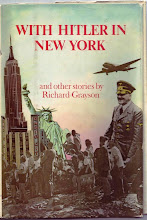
Our friends' mom - on whom we based the character Mrs. Judson in our 1978 story "With Hitler in New York," which became the title story in our first book published the following year - was the kind of mom whose house became a hangout. Even after Linda moved to the West Coast, we continued to hang out there with her mother and brother and other friends, we'd spend every Christmas there, and so we got to know Park Slope better and come to love it.

We had favorite spots, like the old Camperdown Elm restaurant and The Leaf and Bean (we also used to go hang out at their Montague Street location in the Heights) and Circles Cafe. And when we lived in Florida in the 1980s and stayed in New York only in the summer or sometimes in the fall, we still used to spend lots of time in the Slope with our friends who rented apartments in brownstones. We were part of a writers' group in the late 1970s that met at our friend's apartment at the corner of Polhemus Place (one of the members was Joel Agee), where we once had a car accident driving down that narrow street.

But the only time we lived in Park Slope was from August to November 1985, when we temporarily took over the bedroom of a three-roommate duplex apartment on President Street between Fifth and Sixth Avenues, while our friend Judd Lear Silverman was directing plays out of town in Pennsylvania. (Judd's current directorial project, "Evilution," three dark comedies by Edward Musto, is playing this weekend at the 78th Street Theatre Lab.)

Even then, we rarely went to Fifth Avenue because it seemed dangerous. There weren't stores and places to hang out like on Seventh Avenue, where we frequented Roma Pizza (we loved their "baby pizza," a small round cheeseless pie with fried onions, cut into quarters), Grand Canyon, the Community Bookstore, the new health food store, and other places to shop and eat and hang out - some still there, many gone in the intervening 23 years.

Over the years we had many good friends on other blocks in the Slope - like Susan Mernit, now the CEO of Peoples Software Company, who lived on Sterling Place; the writer and food and travel blogger Peter Cherches, who still lives on Garfield Place; and Pete's and our Brooklyn College MFA program director, the novelist Jonathan Baumbach, who lived on Montgomery Place (for a fictionalized film version of his home, see Noah Baumbach's The Squid and the Whale; for the interior of his real house in a fictional film, watch Mike Nichols' Heartburn.) And Judd - with his partner, the artist Barry Steely, has been living on President Street since 1979 we first met him when he was straight out of Brown and one of our friend Satnam's roommates.

In our many years living out of state, no visit to New York City was complete without coming at least once to Park Slope, and when we moved back to the area in May 2006, it was one of the first places we came back to as we gave a reading at Barbès, at which the majority of the audience were six of our friends, all of whom live in the neighborhood. And last year, we made the Park Slope 100 at Only the Blog Knows Brooklyn.

The Brooklyn Historical Society guide tells the stories of the pioneers like the developer Edwin Litchfield, who essentially once owned most of the neighborhood; and more recent "pioneers" like the Ortners, who were instrumental in Park Slope's revival, starting in the mid-1960s; the Park Slope Food Co-Op; the lesbian community; and so much more. They've also got a walking tour to accompany the guide and a great podcast, part of which Francis Marrone played this evening in which the voices were those of three generations of the Rubin family who have lived at 641 Carroll Street since 1971. And the photographs are great, better than the stuff we have here, which are, unfortunately, not from the guide.

It was a great evening and it's a great book that we learned a lot of cool new-to-us stuff by reading. (Did you know that the horsecar, perhaps more than anything else, was responsible for Park Slope's amazing growth in the late 19th century? Do you know what a horsecar is?) If you love Park Slope, you owe it to yourself to get to the Brooklyn Historical Society or its website and get a copy.

Wednesday, September 10, 2008

Wednesday Evening at the Brooklyn Historical Society: Opening Reception for "Counter/Culture: The Disappearing Face of Brooklyn's Storefronts"


This evening we went to Brooklyn Heights to the opening reception for the great new exhibit of photographs by James and Karla Murray, "Counter/Culture: The Disappearing Face of Brooklyn's Storefronts" at the Brooklyn Historical Society.

A trip to the Historical Society is always a treat, and last evening when we arrived around 6 p.m. there were literal treats: several tables of finger food and drinks. Since this is the 19th anniversary of us losing nearly 50 pounds (though we are prouder of having kept all but 10 pounds off in the ensuing years; for our obsessive secrets, see The Silicon Valley Diet), we limited ourselves to a plain little breadstick.

Kate Fermoile, the BHS vice president for exhibits and education, came to the microphone as most of us got into seats. She explained that "Counter/Culture" is the first in the 2008-09 series of exhibits in the Public Perspectives series in the Independence Community Gallery downstairs.

Every April there's an open call for proposals for exhibits, and three proposals are selected by a panel of cultural and community representatives. The winners receive an honorarium and technical assistance from the BHS in developing and mounting the exhibit.

(Future exhibits in this year's round are "From Hand to Eye: Drawn Views of Brooklyn," starting next January, and "Brooklyn and the History of Chinese Immigration," which will open next May.)

Then James and Karla Murray came up and discussed their exhibit and how they started their photographic exploration of Brooklyn's old mom-and-pop storefronts began in the late 1990s and how the project evolved to include the interviews in the current exhibit. (You can actually hear this in the Murrays' own words in their podcast on the BHS website.)

Jim and Karla were documenting graffiti art in far-flung New York City neighborhoods. Since graffiti is somewhat ephemeral as it's written over, they made repeated visits to places and started noticing that the old mom-and-pop stores were disappearing, in some cases, surprisingly fast.

Like many of us, the Murrays loved the old store signs and the way they were made, and after they began photographing the storefronts, they were interested in finding about the stores. So instead of just asking for permission, they did interviews asking about when the stores were founded and how they involved.

Most of the stores are now run by second- or third-generation family members from the original people who started the businesses, including many college-educated professionals like teachers or police officers, who left their positions to carry on their family tradition when their parents died or retired.

These mom-and-pop stores, as we all know, are often endangered by gentrification, redevelopment, skyrocketing rents (the luckier storeowners also own their buildings and thus are not at the mercy of landlords) and the lack of a younger family who will take over when people get too old or too sick to keep up the long hours.

Often storeowners spend as much as 80 hours at work. Jim mentioned the exhibit's title, "Counter/Culture," is based on the waist-high counters at the family-owned stores, which act as homelike kitchen tables in contrast to the shoulder-high counters at modern chains like Duane Reade, which are more impersonal. People hang out at mom-and-pop stores and they serve as de facto neighborhood community centers.

This great exhibit made us wish that we'd taken a photo of our great-great-grandparents' candy store on Stone Avenue (now Mother Cabrini Boulevard) in Brownsville, which Sam and Sylvia Shapiro started in the 1920s. As a kid, when we'd drive by with our grandfather, Herb Sarrett, he'd point out that his grandparents-in-law's storefront still looked exactly the same although a new family took over in the late 1930s. The store suddenly disappeared in the 1960s when the block was razed for the Tilden projects.

We do have pics of two Brooklyn family stores where we toiled in our retail youth. Starting when we were 14, we worked with Grandpa Herb and Carlos and Joe and Marty downtown at The Slack Bar on Fulton Street long before it became a pedestrian mall.

The store was owned by our Uncle Matt, Grandpa Herb's son, (we wrote a little about our experiences in "The Boy Who Could Draw Dr. King"), who also owned with our father and three other men - Syd Siegel of the Sid's Pants chain (the yellow-signed Sid's Pants were ubiquitous in the 1960s and 1970s) and his two brothers-in-law, Jack Lubel of Jack's Slacks on 86th Street in Bensonhurst and Jimmy Saracino of Jay's Slacks in Flushing - a bunch of stores called The Pants Set.

The Pants Set began around 1964, when women started wearing slacks more and more (when we were kids, girls were not allowed to wear anything but skirts to public high schools unless the temperature was below 20 degrees), and they had a store in Bensonhurst on 86th Street between Bay Parkway and 21st Avenue, where we worked occasionally. (We can recall saying "Huh?" to our psychologist Dr. Bob Wolk when he asked us if we ever wanted to try on the women's clothes - not that there's anything wrong with that.)

Anyway, we're glad to say we have pics of that Pants Set store and also the one on Fordham Road in the Bronx and the second Slack Bar store on Roosevelt Avenue in Flushing, though we worked at them only when they opened. Both family-owned stores closed decades ago; the 22-store Pants Set chain, mostly in malls like Kings Plaza, was sold to the national chain G&G, and we don't think G&G exists anymore either. Our mom worked in Kings Plaza, our stepcousin Merryl worked in Green Acres in Valley Stream, and various other relatives of the families that owned the stores worked elsewhere.

There were other old-time stores owned by friends or relatives that we loved, like the candy store/luncheonette on the corner of Church Avenue and East 43rd Street owned by our great-great-uncle's sister, Mrs. Mogg, where we hung out for hours - stores whose facades we wish were preserved in images as skillful as those of James and Karla Murray (whose Burning New York Burning is also one amazing book of groundbreaking photography and interviews).

The Murrays' photographs of storefronts were done "old school," like the stores themselves, not with digital photography. The ones in the exhibit (as opposed to some pictured here) have no cars or people in the foreground: just pure storefront, giving viewers the perspective as if they were standing right in front of the stores.

Their most amazing works are block-long sequences of stores, done with the aid of computers, like the stretch of stores on Bedford Avenue between North 7th and North 8th Streets. Some of those stores, like others of those in the exhibit, are gone just two or three years after the photos were taken.

Perhaps the most fascinating part of the exhibit, lending resonance to the beauty of the visuals are the skillful video interviews with second-generation Brooklyn storeowners like Gennaro Aliperti of Emily's Pork Store on Graham Avenue in Williamsburg (just a few blocks away from Dumbo Books HQ; he almost makes us want to stop being vegetarians) and Giovanni Lanzo of Luigi's Pizza in Greenwood Heights:
Counter/Culture- The Disappearing Face Of Brooklyn's Storefronts by James and Karla Murray
really connects our past and present and fulfills the Brooklyn Historical Society's mission of making Brooklyn history vibrant and relevant. Until the Murrays' book of mom-and-pop storefronts in all five boroughs is finally published, this is your only chance to see these amazing photographs. "Counter/Culture" runs until December 28. For more information, see the BHS website.