
Showing posts with label Church Avenue. Show all posts
Showing posts with label Church Avenue. Show all posts
Friday, December 9, 2016


Thursday, September 29, 2016


Friday, April 22, 2016


Sunday, January 16, 2011
Sunday Morning in Downtown Brooklyn: Free Shuttle Bus MTA Sightseeing Tour for F/G Train Riders from MetroTech to Kensington

Every winter, the MTA offers G train riders free sightseeing tours of Brooklyn and sometimes Queens on weekends. Last year we greatly enjoyed trips from downtown Brooklyn through Fort Greene, Bed-Stuy and Williamsburg, and on another day, a trip from Williamsburg through Greenpoint to Long Island City and the Queensboro (Ed Koch) Bridge. This morning we again went on one of these shuttle bus tours that start outside the Jay Street-MetroTech subway station in downtown Brooklyn.

These G train shuttle bus tours have become so popular that they were expanded this weekend to include riders of the F and R trains, which also were not running normally. With a panoply of various tours offered outside, and with limited time, we opted for the nonstop trip to Kensington's Church Avenue subway station with great views of New York Harbor and the skyline.

The R train shuttle buses were elsewhere (only a month ago did the Lawrence Street R stop join the A/C/F Jay Street-Boro Hall stop to become the Jay Street-MetroTech stop with free transfers), and presumably the F/G shuttle buses making all the stops at subway stations were going down Smith Street, across 9th Street, by Prospect Park Southwest, Fort Hamilton Parkway and McDonald Avenue or something.

We went down Jay Street and turned right on Livingston Street, passing one of the old Board of Ed buildings and other stores

and onto Boerum Place, passing the New York Transit Museum

and then we quickly went across Atlantic Avenue to its end (we get carsick if we try to take pics while moving, at least if we're looking at the phone) by the piers.

The bus wasn't very crowded, and everyone seemed in a good mood despite what must have been an inconvenience for some. We were going to ride on the highway!

Except when we're in Arizona where our 2000 Chevy Cavalier is, we don't get to ride on highways much, so we were glad for the chance to get on Sufjan Stevens' favorite expressway, the BQE.

Lately we've only seen the road from Brooklyn Bridge Park or the Promenade, but we drove this stretch regularly in the 1970s in our '69 Pontiac Custom S and '73 Mercury Comet.

There were no traffic delays at all, so we whizzed by

and before we knew it we were high up on the elevated Gowanus roadway where you have to get over to the left to take the Prospect Expressway or the right to stay on I-278 and go to Staten Island or on the Belt. In the fall of 1979, when we had only about an hour to go from teaching at the fabulous School of Visual Arts (where we have been teaching again since 2006) to a class at the wonderful Kingsborough Community College, we used to hesitate here. Go with the Prospect and Ocean Parkway down to Brighton Beach or take the Belt? The next year, in his Kissinger-hating novel Good as Gold, Joseph Heller examined the same dilemma.

Of course today the bus was taking the Prospect Expressway and turning right on Church Avenue before the road turned into Ocean Parkway proper. But before we did, the tall overpass provided a nice view of the harbor, the Bayonne and Verrazzano Bridges, and the Statue of Liberty. On the other side, was the F/G track over the Gowanus Canal and the poor, high Smith-9th Street station, which won't be fit for humans for a while.

We also sped like wildfire on the short Prospect Expressway, which to us as a kid never seemed to get any respect (faring worse, in our adolescent imagination was only the Interboro -- now the Jackie Robinson -- which was reviled for its twists and turns and blinding spots of sun glare). We were stuck here on this highway in the summer of '77 ("summer of Sam" and the blackout) when the asphalt buckled in 100-degree heat. Today was a lot cooler.

We liked looking out from our dirty right-side window at Bishop Ford H.S. and the houses and stuff.

The bus was making incredible time, but we got slightly backed up at the first light at the end of the highway, at Church Avenue where Ocean Parkway begins. In the fall of '79, we looked at renting an apartment on this street, but eventually we took one in Rockaway.

We made the right turn onto Church Avenue by the landmark giant yeshiva or whatever it is. We were almost at our destination. Ocean Parkway is where East 6th Street should go

and McDonald Avenue is really East 1st Street and here, the end of the East nth Street grid and the start of the grid with numbered streets and avenues in western Brooklyn.

When we rode the B35 bus on Church Avenue three years ago from Brownsville to Sunset Park, we traveled this route in Kensington, and we've done it since. We like it around here.

We stopped just across McDonald, at Kabir's Bakery. It's one of three in Brooklyn, and the veggie samosas are to die for, and the little Bangla pastries are sweet sweet sweet.

Well, we had no business in Kensington, so we crossed Church when the light on McDonald turned red

and got on the express shuttle bus back downtown. We figure the ride here was maybe 17 minutes, not bad in comparison with the subway that would make eight stops.

We again got a seat on the right by the window. It's funny, but we lived in and drove around Brooklyn for years, but only in 2007 did we realize that Church Avenue breaks the grid and starts going diagonally southwest/northeast west of Flatbush Avenue and especially after Ocean Avenue. Here Church Avenue intersects the start of Beverly (or Beverley, take your pick) Road, which runs parallel to Church for several miles in Flatbush and East Flatbush.

We left McDonald and the subway station just at 9 a.m. There was more traffic going east on Church Avenue this time, but not much,

and we made the light for a left at Ocean Parkway to get on the Prospect Expressway again.

The bus driver seemed like he was trying to break his own record, because we just whizzed along until we were again on the high overpass. We exit the Prospect on the right, so it's easy to turn back onto the BQE.

We took some photos without looking at the phone to avoid carsickness on the BQE. We don't know why we have this problem; we are among the few that cannot read on the subway, either, without immediately getting queasy.

It's only one exit to Atlantic Avenue and with no traffic, we were at Long Island College Hospital before we knew it. Sometime in the late 1980s our grandmother spent a week or so in the psych unit here, where they got her started on the Prozac that quelled her depression for the rest of her life.

This time we were able to snap some pics on Atlantic Avenue. We spent tons of time in this neighborhood in the 1970s and in summers for much of the 1980s. Several of our friends lived here, as did one of our shrinks, a social worker we call Mrs. Ehrlich in our diary books, and we had lots of stores that we went to.

This is Hicks Street. Boerum Hill is to the south of Atlantic, Brooklyn Heights to the north. One store remember for some reason now is The Warlock Shop, run by Wiccans, we guess, between Hicks and Henry in the early 70s. We bought sandalwood here once from the warlocks, and when we left the store, our girlfriend said, "They were looking at your crotch the whole time." We guess we would have been flattered had we hadn't assumed she was mistaken or kidding.

We passed the new Barney's Co-op and the bank Trader Joe's and turned left on Boerum Place.

It was a straight ride up to Morton's, where everyone on the sightseeing bus got a free steak lunch, courtesy of the Transit Authority.

No, actually, we all walked in that little alley between Morton's and its building and the Brooklyn Marriott back to Jay Street.

Most people got on the subway to Manhattan or Queens, but we headed for some oatmeal and iced tea at the NYU/Poly Starbucks. The sections of the Sunday Times that came early this morning were with us, still in their blue plastic wrapper. There was plenty of time to waste. In two weeks, when we start teaching on Sunday afternoons and evenings, it won't be like that.

But we're grateful to the MTA and the work on the tracks and stations for our little excursion this morning.
Thursday, August 5, 2010
Thursday Afternoon in Flatbush: "A Collection of Local Memories" by Gabriel (Specter) Reese at the corner of Ocean and Parkside

Since we came back to live in Brooklyn four years ago, we've gone to Prospect Park many times, but always with buses or trains that let us off at the stops at Seventh Avenue or Fifteenth Street (F and G trains), Prospect Park (Q/B/Franklin Avenue shuttle), or Grand Army Plaza (2,3,4,5). This afternoon we took the Q to Parkside Avenue to get to the Oriental Pavilion and were delighted to come across the three-sided mural on the corner of Parkside and Ocean Avenues, A Collection of Local Memories by Gabriel (Specter) Reese.

Reese, who specializes in amazing urban art installations that use public space in an extraordinary way. (We've admired his work before, most notably at MoCADA's Pink Elephant Speaks exhibit on gentrification.) For this work, he interviewed 800 senior citizens in Flatbush, who told him about neighborhood characters, houses, and storefronts, many of them long gone.

Back in the 50s, 60s and 70s we shopped at Bohack's (the Philip Howard apartments south of the Junction with their statue of a goddess in front of it and the supermarket next to us we called "Our Lady of Bohack"), department stores like E.J. Korvette (our family's Art Pants Company's best customer and a pretty good place to buy books as well as everything else) and Mays (we met our great-great-uncle Dave Tarras there one day when he was looking for something for his trip to Washington to be honored by the National Endowment for the Humanities), Woolworth (lots of them, with our favorites on Flatbush and Ralph Avenues; we even sat at their lunch counter and ate hot dogs), and other places in the murals.

In this neighborhood we also miss Dubrow's Cafeteria, Jahn's, the fabulous theaters (Kenmore, Astor, Albemarle, and others in addition to the majestic Loew's Kings), the My Friends bookstore on Clarendon Road (where we got our old comic books), the old little Macy's on Flatbush (now Staples) and The Bookworm next to the old Dutch Reformed Church, and lots of little candy stores on Church Avenues like the one owned by Mrs. Mogg, the one-armed sister of our grandfather's aunt's husband, who gave us free pretzels and malteds. And we really miss riding the Church Avenue trolley with our great-grandmother.

Here's a great New York Post article about A Collection of Local Memories by our friend Helen Klein, whose talent for writing was obvious even back when we met in 1970 when she was a freshman and we were a sophomore at Brookyn College.
Friday, June 13, 2008
Thursday Evening in Flatbush: Brooklyn's Fifth Annual Children of Abraham Peace Walk
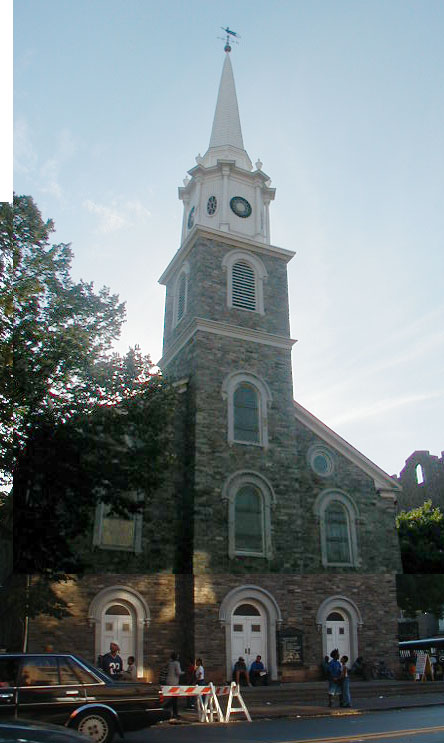
We were a bit tardy yesterday for the 6 p.m. start of Brooklyn's Fifth Annual Children of Abraham Peace Walk, which got started at the Flatbush Dutch Reformed Church on the corner of Church and Flatbush Avenues, on whose steps we used to hang out as junior high students (next door was a tiny bookstore, The Bookworm, where we got out under-a-dollar paperbacks of Franny and Zooey, God Bless You Mr. Rosewater and The Crying of Lot 49). Blame the B48 and B41 buses for the long trip from Dumbo Books HQ in Williamsburg.
We hadn't been inside the church since about 1968, when we attended one Sunday service as our 17-year-old self decided to explore the borough's various congregations before choosing atheism. Throughout the evening the crowd on the Children of Abraham Peace Walk ranged from about 150 to 200. We'd missed the words of welcome from Rabbi Ellen Lippmann, the much-admired Debbie Almontaser, Carol Horowitz and Rev. Tom Martinez, and found ourselves listening to Dr. Kurt Johnson, scientist and co-founder of the Coalition for One Voice, who discussed a recent meeting with the Dalai Lama and his call for the biggest movement in world history, to go beyond interfaith cooperation to achieve "the essence of religious experience, love."
The ActorCor Chorus, "New York's only choir of 100% actors" (maybe some are 95%?), sang prayers in English, Hebrew and Arabic, and then the church's pastor gave a brief history of the church. Built in 1796, it is the successor to a church that was
built in 1702 and which in turn is successor to a church that was built in 1654 by special order of Gov. Peter Stuyvesant, back when Flatbush was farms and wilderness.

George Washington marched by just before the Battle of Brooklyn (he should have stopped in to pray and maybe would have done better). The cemetery in the back is one of the area's oldest. We also learned about the history of the Dutch Reformed Church in general and its successor church. Today the congregation are mostly of West Indian and West African descent and they stopped holding services in Dutch about a zillion years ago.
After acknowledging the help of Deputy Inspector Ralph Monteforte, Commanding Officer of the 70th Precinct, Detective Nasser and other members of the NYPD, the walk began after we lined up, water bottles and lime-colored flyers in hand, behind a large banner held up by half a dozen little kids. The banner had the Children of Abraham Peace Walk logo with three colorful doves, "peace" written on each in Hebrew, Arabic and Latin (English on the bottom of the banner).
We marched on the south side of Church Avenue west, past the great West Indian fruit stores and other emporiums and the Brighton line Q/B station (M/D in our youth). The last time we marched for peace by the Flatbush Dutch Reformed Church was on October 15, 1969, for the Vietnam Moratorium.
As we walked, an evangelical truck slowly made its way following us. We assume it was an uninvited guest, since its calypso music was loudly proselytizing. At Temple Beth Emeth on the corner of Marlborough Road at the start of Prospect Park South's Victorian homes, all of us sat in the pews and listened to a talented singer and guitarist and heard a talk from Brooklyn Borough Historian Ron Schweiger, a member of the congregation on the history of Beth Emeth.

The synagogue got started in 1911 and moved to the present location three years later; in the 1990s, after many of the area's Jewish residents had moved (along with us) to what Mr. Schweiger called "that new New York City suburb, South Florida," Beth Emeth merged with two other nearby Reform temples and now has about 100 families and a very long official name.
As in the church, a rabbi explained the basics of the congregation's mode of worship. Interestingly, the churchlike stained glass panels featuring Moses and David are not traditionally Jewish practice, but they did serve as backdrops to episodes of such TV shows as "Law and Order" and Richard Dreyfuss's short-lived "Education of Max Bedford."

Behind a police officer and the kids with the banner, we all marched south the one block of Marlborough Road (some purple-robed Buddhist monks waved to us from their house) and west on Albemarle Road to the Albanian American Islamic Center at the corner of Rugby Road.
Taking off our shoes and leaving them on the porch, we all went inside to the mosque, where we learned that the Albanian American Islamic Center started in 1963 and bought the house here in 1971. Naji Almontaser introduced an imam who discussed some of the basics of Muslim worship and the way in which Islam mixes faith with practice in dealing with others. He also discussed Islam as a global religion, with the Albanian Americans being of European descent while others are not only Arab but African, South Asian, East Asian and people all over the globe.
(Photo courtesy of Kate Anne's Flickr photostream of the Children of Abraham Walk)

Thanks were given to many people who worked on the march, including other clergy members of all three faiths, as well as Mohammad Ravi, director of the Council of People's Organizations (COPO), which has done such good work since 9/11 in the community here, especially with the businesses on what the New York Times called Brooklyn's "highway of tolerance," Coney Island Avenue.
After assembling on the porch for some delicious food and thanking everyone for the Peace Walk, we walked on Albemarle Road toward Coney Island Avenue, passing the home and office of our friendly neighborhood child psychiatrist from the mid-1960s, Dr. Abbott A. Lippman, M.D., F.A.C.P., whose faded sign is still up

on the office attached to the once-grand dwelling that housed his collections of African art and rare orchids. For some reason, the site of our adolescent encounters with Freud is in horrendous state of disrepair.

We know the rabbi talked about tikkun olam - "repairing the world" - but someone's fixing up 929 Albemarle Road would be a good start.

However, as we made out way to the F train, we were really glad we went on the night's Children of Abraham Peace Walk. Isn't life wonderful!
Subscribe to:
Posts (Atom)













