Showing posts with label John Gardner. Show all posts
Showing posts with label John Gardner. Show all posts
Friday, September 29, 2017


Monday, February 8, 2016

Friday, February 5, 2016

Monday, January 24, 2011
"BREAD LOAF DIARY: The 1977 Writers Conference" by Richard Grayson now available at Amazon Kindle store

Richard Grayson's BREAD LOAF DIARY: The 1977 Writers Conference is now available at Amazon's Kindle Store for 99¢ from its publisher, Art Pants Company.

Here is the promo material for the 41-page $5.99 paperback edition from Superstition Mountain Press:
In 1977, Richard Grayson, an aspiring writer from Brooklyn who had published a few stories in little magazines, got a scholarship to the venerable Bread Loaf Writers Conference in Middlebury, Vermont.
That year's staff included Toni Morrison, who read from her then-forthcoming Song of Solomon; John Irving, who read from his manuscript for the unpublished World According to Garp; John Gardner, celebrated for his philosophical novels and his advocacy of "moral fiction"; the poets Maxine Kumin, William Meredith and Marvin Bell; Geoffrey Wolfe, unveiling his forthcoming Duke of Deception; a young Tim O'Brien; the comic, sardonic novelist Stanley Elkin; the warmly sympathetic Hilma Wolitzer; and others.
Grayson's fellow attendees included a number of writers who would go on to fame, such as Ron Carlson and Leslea Newman, and many who probably published nothing. Somewhere in the middle, Grayson here records his observations and thoughts in the daily diary entries he's been writing for over forty years.
BREAD LOAF DIARY originally appeared online at Edward Champion's Reluctant Habits and was previously collected in Sixteen Attempts to Justify My Existence.
Tuesday, March 11, 1980
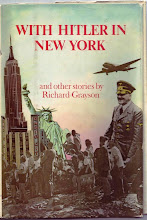
Fiction International reviews Richard Grayson's WITH HITLER IN NEW YORK

Fiction International reviews Richard Grayson's With Hitler in New York in its current issue:
Fiction International
Issue 12 (1980)
pp. 284-285
Richard Grayson, With Hitler in New York
(Taplinger)

"If you have any complaints about With Hitler in New York," the author declares in his dust jacket copy, "address them to the anarchist whose bomb snuffed out the life of the Czar. I take no responsibility for this." This incident, according to Richard Grayson, "led to the Russian pogroms and to the anti-Semitic May laws of 1882." To these latter events, Grayson claims that we owe the myriad contributions of Jewish people to American culture: from Woody Allen and Lenny Bruce to Al Jolson and the Ziegfeld follies; from Nathanael West and Philip Roth to Father Coughlin; and from Mark Spitz to the condominium culture of southern Florida." And last, but presumably not least, to that sequence of events we can attribute this book of stories by Richard Grayson.
Perhaps Grayson should have included the Marx Brothers in his list, for it is their brand of zany humor which this collection frequently – though often unsuccessfully – endeavors to achieve. In the title story, a German character named Hitler visits friends in New York. Together, they do the ordinary things Americans routinely do, such as watch television, swim, and go out to dinner. In this anomaly lies the humor but also the failure of this story. It is amusing, certainly, to see Hitler as an ordinary tourist. Yet it is also disappointing, especially to the reader of Ishmael Reed, E.L. Doctorow, and other contemporary writers who have given us such memorable and outrageously hilarious treatments of historical figures in fictional settings. The mere title "With Hitler in New York" creates expectations which the story fails to satisfy.
It is worth noting that despite its title, this book does not belong on the growing list of works which have recently taken a serious interest in the personalities and/or victims of the Third Reich. (Aside from the countless popular novels on Third Reich themes, there have been such works by a number of highly regarded writers: Sophie's Choice by William Styron, The Führer Bunker by W.D. Snodgrass, and several poems from Ai's recent book, The Killing Floor, just to name a few.) It is certainly appropriate that serious writers are becoming concerned with the consequences of fascist thought and practice. This being he case, Grayson's deadpan treatment of Hitler comes across as, at best, cute.
Cuteness is frequently a shortcoming among these stories. Often, clever ideas are not adequately developed. Consequently, some stories such as "Chief Justice Burger, Teen Idol," "Classified Personal," and "The Finest Joe Colletti Story Ever Written (So Far)" seem facile.
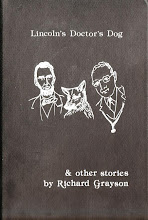
Yet some of these pieces are successful. "Lincoln on the Couch" is a skillful portrait of the sixteenth President; and while it may be implausible as history, the story effectively presents an unexpected view of Lincoln as something other than epoch-making paradigm. "But In a Thousand Other Worlds" is perhaps the most successful of the humorous pieces. It is the story of a mediocre story that strives to be published. In the course of its odyssey, "But in a Thousand Other Worlds" is condemned as immoral by John Gardner. It retaliates by biting Gardner on the leg.
Despite his preoccupation with nihilist humor, Grayson is at his best in his serious pieces. "Wednesday Night at Our House," "The Princess from the Land of Porcelain," and "Kirchbachstrasse 121, 2800 Bremen" are the strongest stories in the book. All of them sensitively probe the dynamics of personalities and relationships.
David Lionel Smith
Sunday, December 23, 1979
Minneapolis Tribune reviews Richard Grayson's WITH HITLER IN NEW YORK


The December 23, 1979 issue of the Minneapolis Tribune features a review of Richard Grayson's With Hitler in New York:
HOW BAD ARE THESE STORIES?
With Hitler in New York and Other Stories, by Richard Grayson (Taplinger, 190 pages, $7.95)
Reviewed by D.G. Wnek
For weeks and weeks I have tried to think of an ingenious way to say “With Hitler in New York” has no literary merit whatsoever. Inferior quality, unfortunately, does not inspire ingenuity. To put it bluntly: this is the worst book I have read in my life.
Richard Grayson’s anthology of short stories is unbelievably bad, bad, bad.
How bad is it?
Well, after a writer reviews his chosen book, he gets to keep it…I am not keeping this one. I want to give it to someone I really despise.
If that sounds harsh then consider this: the author himself refuses to accept responsibility for writing these stories. Grayson blames their existence on “the anarchist’s bomb that killed Czar Alexander II in Petersburg in 1881 (which) led to Russian pogroms and to the anti-Semitic May laws of 1881.” These events, he says, eventually led to his presence in this country as a writer. He also advises readers to address negative criticism to the anarchist who planted the bomb—not him. How fortunate for him and his mailman.
Grayson’s stories have no real plot, no meaningful action, no memorable characters; they do little more than exist. In “Infant Sorrow” a celebrated weightlifter feels unloved and remembers when he was constipated. In “Notes toward a Story for Uncle Irving,” the author begins a tribute to his uncle, then ends with, “And it’s a shame on you, Uncle Irving, you ignorant, boastful, cowardly, neurotic, foolish old man.” In “Princess from the Land of Porcelain” a married woman finally finds contentment in her dreams—as a lesbian. In “The Mother in My Bedroom” a mother who once hid under her son’s bed as he entertained various lovers, must spend the rest of her life in her son’s bedroom. And in “With Hitler in New York” Hitler returns to America to smoke joints, watch television and eat at McDonald’s.
The remaining 22 stories—sometimes confusing, usually boring, and always absurd—impart nothing of any significance to the reader.
Grayson writes about meaningless lives, meaningless actions, trying to uncover something meaningful. He never does. He only shows that those who embrace the monotony of existence become monotonous figures.
Even his better stories, “Chief Justice Burger, Teen Idol” and “Classified Personal” are not, in fact, short stories. They are nonsensical fragments, inchoate exercises from his coffee-stained notebook, perhaps funny little things Grayson, instructor of creative writing, might show his classes at Long Island University and Kingsborough Community College. Grayson knows this. He also knows that his other works, those which most resemble short stories, are decidedly fifth-rate.
In “A Thousand Other Worlds,” Grayson the protagonist writes a short story of the same name that literally comes to life. The story, a touchy thing on a low-cholesterol diet, sees a Truffaut double bill at the Carnegie Hall Cinema with its author, then demands to be sent to The New Yorker. Grayson obliges. The story is rejected.
The following week he takes it to the Bread Loaf Writer’s Conference where John Gardner criticizes it: “To me, it’s just nonsense. And it’s not only nonsense, it’s immoral. Immoral.”
So the story bites him in the leg.
So Grayson realizes his anthology is a cornucopia of crap but would rather laugh about it. He would rather write another silly little story that parodies his own work than accept the responsibility of working harder to express meaningful ideas written in traditional literary form. Gardner was right: this nonsense exemplifies stream-of-consciousness with no conscience.
Call it avant-garde departure from traditional literary structure. Call it playful exercise with traditional literary form. But do not call such nonsense literature, for such literature makes “Betty & Veronica” a selection in The Classics Club.
And now, I must find someone I really despise.
D.G. Wnek, a journalism graduate, is currently working for Northwestern Bell.
Subscribe to:
Posts (Atom)