Showing posts with label Midwood High School. Show all posts
Showing posts with label Midwood High School. Show all posts
Sunday, June 28, 2020


Monday, January 5, 2015


Saturday, March 8, 2014


Thursday, May 6, 2010
Forty Years Ago Today in Brooklyn: May 6, 1970: Brooklyn College reacts to Kent State

From our diary:
Wednesday, May 6, 1970
A cold, hairy day. I relaxed for a change this morning. I did pass by Midwood [High School, our alma mater], which was on strike. When I did get on campus after 2 p.m., I went to the office and did some work. We'll have to postpone, or as things turned out, cancel the elections.
Paul and I went to a crammed meeting of concerned faculty who voted to strike indefinitely. The black and Puerto Rican students want the school kept open, however.
I was in the liberated President's office when a bomb threat call was received, and Boylan Hall was evacuated. Meeting were held everywhere: Student Government in SUBO, strike steering committee at Whitman, blacks at Roosevelt.
Kneller called the Concerned teachers "unrepresentative" but called off classes for the rest of the week. We had to lock our office so that it won't be taken over.
Things are pretty confused. Strikes are going on all over the country and there's a Washington demonstration scheduled for this weekend. Various people around the campus that I've been speaking to - Richard Pontone, Esther, Mitch and others - are not sure of what's happening, and neither am I.
Dad's Bronx store [on Fordham Road] was closed due to the Fordham demonstrations.


The New York Times the next day featured a story by McCandlish Phillips, "City High Schools Join in Protests," which began
Demonstrations, protests and boycotts hit at least 20 of the city's 90 public high schools yesterday.
Thousands of students reacted with anguish or anger to the military sweep into Cambodia and to the deaths of four Kent State University students, shot by National Guardsmen at the school on Monday. . .
High schools situated near college campuses were the most heavily affected. . . Lines of pickets from Brooklyn College formed outside Midwood High School in Brooklyn, affecting attendance there. About 1,500 students from Brooklyn Technical High School went to the Long Island University auditorium on the downtown Brooklyn campus, at the invitation of L.I.U. students.


Wednesday, March 31, 2010
Wednesday Morning in Gramercy Park: Breakfast at Stuyvesant Square

It was gloomy this morning when we got off the L train on our two-stop trip from Williamsburg, and kind of chilly still, but at least it had stopped raining on this last day of the rainiest recorded March in New York City weather history.

We got an iced tea and oatmeal at the Starbucks that's part of Stuyvesant Town on First Avenue and on our way to teach Twelfth Night to our students at the fabulous School of Visual Arts - which, incredibly, we were doing this semester exactly thirty years ago, during the Carter administration and Iran hostage crisis -

we stopped off to sit and have breakfast on the east side of Stuyvesant Square.

It was pretty deserted and quiet at this early hour. We put our blue plastic New York Times wrapper down on the bench and sat down and looked around, hopefully, for signs that spring is coming.

Antonin Dvorak was noncommital.

All the rain should make things green. This tree, by Beth Israel hospital, offered some welcome greenery.

And the flowers looked good to our winter-hating eyes.

We could go over to St. George's Church to pray for better weather, we guess.

But we had to go to work and explore Illyria, trying to do as good a job as Mr. Neil Berger did with Shakespeare when we were in 8SPE2 at J.H.S. 285 in East Flatbush back in the spring of the 1964 World's Fair or as Mr. Joseph Grebanier did four years later in Midwood High School in our honors class in that tumultuous spring of 1968. Fat chance, but we'll strive to please every day.

Saturday, July 12, 2008
Friday Night at J.J. Byrne Park: The Piper Theatre's "A Midsummer Night's Dream"

What revels are in hand? Is there no play,
To ease the anguish of a torturing hour?
After leaving Desert Island's comic book nirvana last evening, we made our way to the recently-unveiled chrome-and-glass Kellogg's Diner Redux and walked down to our wonderfully reliable weekend G train to get to J.J. Byrne Park for the Piper Theatre's amazing production of Shakespeare's A Midsummer Night's Dream.
Thanks to the MTA's scheduling, we barely had time to glance at the sardonically-changed subway advertisements (our favorite so far was when some benign wit changed the tagline for the [very funny] film Forgetting Sarah Marshall's rather cruel tag line YOU DO LOOK FAT IN THOSE JEANS to YOU DO LOOK GREAT IN THOSE JEANS) or stand on the Smith St.-Ninth St. platform contemplating the lambent sky before we were approaching the park where we, more than thirty years ago, used to drive by with our friend's younger brother to purchase nickel bags and take them back to the brownstone on Ninth Street where our friends and rolling papers were waiting.
We were motivated to head for the park by Louise Crawford's this glowing report at Only the Blog Knows Brooklyn (from which we also purloined one of Hugh Crawford's excellent photographs of the performance by Hugh Crawford):

A rollicking, frolicking Midsummer Night's Dream delighted a large opening night crowd on the green in JJ Byrne Park on Thursday night.
And what a night it was. The weather was glorious, the sky clear, the half moon luminous and bright.
Directed by John P. McEneny, who teaches drama at MS 51 and runs the Piper Theater, this version of MSND takes place in 1908 Coney Island, a natural setting for the play. "The parks at Coney Island symbolized a reachable escape, a place where almost anyone could go for a day and get lost in the crowd. It was a place where everyone was searching for fun and often found it in the exotic displays or seemingly death-defying rides," write Rosa Schneider, Piper's dramaturg.
Indeed, Shakespeare's popular play is all about magic, escape, identity, and the fantastical. What better way to bring it home to a Brooklyn audience then to set it in our very own urban dreamland.
There were many highpoints in last night's show, which will run this weekend and next in the park located at Fifth Avenue and Third Street in Park Slope, but the cast's high energy, high octane performance of the play surely gave it the kind of bigger than life impact that works wonders in an outdoor show.
Still, the fairy dances were gently rendered even as airplanes passed overhead. A strong cast really packed a wollop in a production that was alternately bawdy, poetic, magical, sexy, acrobatic and really fun in all the right ways.
Owen Campbell, a 14-year-old professional actor was notable in the role of Puck. But all the actors brought great energy and joie de vivre to Piper's memorable version of the play. The lovely set by Lila Trenkova, complete with life guard chairs and twinkling lights, transformed the park. Costumes by Deirdre Cavanaugh were also a treat, as was the sound design by Andy Christian.

Louise pretty much describes the joyous experience we had, though we'd add that we were really impressed by Owen Campbell, too, as well as Sean Phillips as one of the best Oberons we'd ever seen. And we didn't hear any airplanes (perhaps the major carriers all went bankrupt today?).
This wasn't the first time we'd seen A Midsummer Night's Dream in a park. Back on Thursday evening, July 23, 1970 [this is why you should keep a diary too] we saw the fondly-remembered BACA Repertory doing the play in Prospect Park at Wollman Rink, very intimate and informal, with teens and twentysomethings making magic, though without the kind of advanced production values the Piper Theatre's got going on now.
We took two young members of our household, 9yo Jonny and 6yo Jeanette, to that show,

 and the kids were as enchanted and quiet as nearly all the many kids sitting on the lawn at J.J. Byrne Park last night. (And the next week, at Riis Park's Bay 1, we got to put our beach blanket next to the blanket of the boy playing Oberon!)
 Back when Robert Wagner was mayor and Abe Stark borough president, we Brooklyn kids were introduced to Shakespeare early.
Our fantastic eighth-grade English teacher at Meyer Levin Junior High, Mr. Neil Berger, had us read Twelfth Night in preparation for viewing a production at Grady Technical High School in Sheepshead Bay that we still remember. (In the summer of 1990 we went to a star-studded production of Twelfth Night at Central Park -- it featured Michelle Pfeiffer, Jeff Goldblum, Gregory Hines, Mary Elizabeth Mastrontonio, Stephen Collins, Fisher Stevens, John Ames, et al. -- and our 8SPE2 classmate, author/literary agent Linda Konner, with us that night along with her boyfriend, longtime Newark Star-Ledger theater critic Peter Felicia, agreed that the version we'd seen in a Brooklyn high school in 1964 was superior.)
In ninth grade, Mrs. Hazel Sanjour had us read Julius Caesar. We each memorized and delivered a soliloquy, put out a Roman newspaper, saw the 1950s film version at the Eighth Street Playhouse and learned a lot more about Mrs. Sanjour's favorite writer, "the inimitable Bard," as she called him.
And in our senior year at Midwood, we took a fall-semester Shakespeare course with the legendary teacher Mr. Joseph Grebanier. We sat up front and center and can still picture Mr. G in front of us reading the parts of everyone from Polonius to Prince Hal to Sir Toby Belch with enthusiasm. (He told us Polonius's famous advice to Laertes was fatuous: "Why should you never a borrower or a lender be? And plenty of people who are true to themselves who constantly lie to others!") Can we be wrong in thinking we read 24 Shakespeare plays in the fall of 1967?

We miss Mr. Grebanier, but we still have our Brooklyn College 1973 Ottilie Grebanier Drama Award, received for the best play by an undergrad, in honor of the mother of Mr. Grebanier and his less-nice BC English professor brother (their French-sounding family name came from Reinberg, only backwards).
Now we are lucky enough to get to teach Shakespeare to college students. And still go to see great crepuscular productions like Piper Theatre's Midsummer Night's Dream. Catch the magic at J.J. Byrne Park this weekend or next. Thy love ne'er alter till thy sweet life end!
Sunday, July 6, 2008
Sunday Evening at the McCarren Park Pool: Ronnie Spector

As we walked the few blocks up Lorimer Street from Dumbo Books HQ to the McCarren Park Pool at 5:30 p.m. last night, we were thinking about a boy we knew who graduated Meyer Levin Junior High School 285 in East Flatbush on the last Monday in June 1965.
Richie had just turned 14. Since the boys in the sixteen ninth-grade classes marched in and sat down, as did the girls on the other side of the auditorium, in size place, he was first out of the 250 of so boys. Next to him was the second-shortest boy, a Negro he'd never noticed before, and he didn't know what to talk about with him. In Richie's experience, you were probably best off talking baseball or music with Negro kids, since they were things everyone had in common, though he knew enough not to talk about the Beatles or Herman's Hermits.

There were fewer people than last week at the pool, and a few more people with gray hair. We don't have gray hair, but we might as well since everyone assumes we dye it. An older man, seeing our maroon Brooklyn College T-shirt with gold lettering, says, "I used to go there too." We talk to this elderly person and discover that when he was an undergrad, we were serving on the alumni association board of directors.
Getting some Fuze diet white tea at the booth near the dodgeball players, we notice the skinny sky-blue JellyNYC balloon figures are up again, swaying in the wind. They weren't here last week. Or were they and we just don't remember?

With nine members of the band already onstage, Ronnie Spector enters holding a mike. She's shapely in a zaftig way, in a black pantsuit. All the nine band members are wearing black too. "I dream about the boys," she sings. Her hair is a modified 21st century beehive. The song is "I Wonder." Crowds move forward, and we go closer too.
Ronnie Spector, after the first applause dies down, says that when she woke up she was afraid of it being rainy: "But, no, not in Brooklyn. This is where I started.
The Brooklyn Fox with Murray the K shows. I'll never forget them."
And she starts singing again:
Why do they say that we're too young to go steady?
Don't they believe it, that I love you already?
Gee the moon is shining bright
Wish I could go out tonight
Why don't they let us fall in love?

Waiting on line in their black caps and gowns outside Whitman Auditorium at Brooklyn College that hot June morning, the two boys at the head of the junior high graduation procession started talking about the Murray the K special "It's What's Happening, Baby!"
It was going to be on channel 2 that night from 9:30 to 11:00 p.m. They'd taped some it at Fabian's Fox Theatre on Flatbush and Nevins, the one-time movie palace where Murray the K put on his famous rock 'n' roll shows: a segment with Richie's favorite, The Four Tops, singing his favorite song of theirs, "I Can't Help Myself."
The Negro boy said he heard the Ronettes would be on it too. Other girl groups sang about boys, but the Ronettes sang to boys: "Be My Baby," "Born to Be Together," "This Is What I Get for Loving You."
The Brooklyn Fox was demolished around January 1971, but it had been out of business for years. It was where the Con Ed building now is. The Ronettes also appeared as part of Clay Cole's Twist-A-Rama tour at the Town Hill Club on Eastern Parkway at Bedford Avenue, now a WaMu bank branch. Clay Cole was where Richie mostly saw the Ronettes, on his weekly afternoon TV show on channel 11; he also saw them on Dick Clark's "American Bandstand" on Saturday mornings on channel 7. On both shows, the kids were integrated.

Ronnie Spector will be 65 next month, so she seems a little tired. She sits down after the first song, but gets up again after a few bars into the next song.
"I love applause," Ronnie Spector says, when the crowd claps. "Even after all these years in the business..." A few hipster kids sitting near me on the floor of the empty pool are talking. A girl and her gay-guy friend are tickling each other and giggling.
"Nineteen sixty-six!" Ronnie Spector shouts, with surprising exuberance. And she sings:
Do I want you for my baby
Do I want you by my side
Do I wanna run and kiss your lips
Say you're my loving guy - oh oh...

The Ronettes did appear on 1965's "It's What's Happening, Baby!" The show was done in conjunction with the Office of Economic Opportunity, the war-on-poverty agency headed by Sargent Shriver, who was not, Richie once exasperatedly explained to his best friend, an actual army sergeant. ("You think if someone were just a sergeant, they'd be so proud of it, they'd call themselves by it all the time?!") The show's serious aim was to tell drop-out teenagers and ones without jobs about all the government programs like Job Corps that could help them.
On the Murray the K TV special, the Ronettes were shown walking down Mott Street in Little Italy, wearing plain white blouses and blue jeans and baseball caps, carrying really long overstuffed hero sandwiches. Murray the K was playing stickball. The Ronettes sang the song Richie knew they'd sing, "Be My Baby," which had come out a year and a half before, around the time President Kennedy was assassinated. The world had changed since then -- the British invasion had come out of nowhere -- but you still couldn't beat "It's My Baby."

Ronnie Spector says she loves doowop, like Frankie Lyman, and she'd come home from school (she lived in Washington Heights with her grandmother and future fellow Ronettes, her sister and cousin) and listen to the radio till she got the voices in her head.
She sits down after each song and says at one point, "Woo, if you guys think it's hot down there, it's hot up here, oh my God." Actually, it feels cool on the floor of the pool where we're sitting, but we're in the shade. There's a nice little breeze.
She starts "He Did It" sitting down but then seems to get her second wind and gets up, more energetically, on this line:
People let me tell you
I don't understand his alibi
I don't understand his reasons why
I don't understand him right or wrong
But he, oh he did it and he's gone
Oh how he fooled me
When he used me
And then he, he accused me
Let me tell you oh
"I think you all know who I'm talking about," Ronnie says after the applause dies down.
We bet some don't. We'd like to poll a random sample of hipsters here, including the two boys standing in front of me, who were lip-syncing and finger-snapping along with the song. Phil Spector? Wall of sound? One blogger, we see, has already posted that something about her being with the Rhondelles.

Two days after "It's What's Happening, Baby!" appeared on CBS, Richie and his friends -- fellow members of the Sultans like Eugene, Arnie, Billy, Jerry and Steve -- were walking over the Ocean Avenue foot bridge across Sheepshead Bay to go to Manhattan Beach and hang out. Arnie's little red transistor radio had on WMCA, 560 AM, home of the Good Guys. Some of them preferred WABC and Cousin Brucie, but Richie liked Harry Harrison the most. The Sultans played a lot of ball and listened to a lot of music. Their secret password was Teragram-Nna, which was Ann-Margaret's name backwards.
Walking to the beach, Richie mentioned a Herald Tribune article he'd read that morning about Republican senators denouncing "It's What's Happening, Baby!" Senate Minority Leader Everett Dirksen said "It's What Happening, Baby!" was "immoral" and "lousy, double lousy" and called for a federal investigation although the Johnson administration said no government money paid for the show.
Senator Gordon Allott of Colorado said it was such a degrading and shameful show he called Dr. Stanton at CBS right away. "I told the president of the broadcasting company, 'I am about to throw up,'" Senator Allott said. "Every American who saw the show must be sick. The whole program was tuned to the lowest type of beatnik appeal."

Maybe we're wrong about the hipsters. People are asking her for requests. She sings several more songs, wipes her face a lot with a black hanky, sits down a lot. Ronnie says she's glad it didn't rain, "but I could deal with a little rain now." She's older than our grandmothers were when we bought Ronettes 45s on Church Avenue near Utica, on our way to our grandmothers' apartments after school. So we feel sorry for her. But then she says, "But since it's not raining..." and she gets up and belts out "Walking in the Rain."
We listened to this walking in drizzle one dreary summer afternoon on the boardwalk in Rockaway, one hand holding the transistor radio to our ear, the other holding an orange creamsicle we kept licking.
Ronnie Spector's voice gets thin at times and then gets strong. She's clearly tired, but she's a trouper, her hand at her hips as she shakes and sings some more. She says "Oh my god" about four times in a row and precedes one song by talking about its producer, Joey Ramone. It was the last music he produced before he died.
The highlight of the show, of course, is "Be My Baby," which the crowd loves. One boy standing in front of me with his arm around another boy's shoulder exaggeratedly lip-syncs "Be my baby" with her as he looks at his friend.

In the fall of 1966, Richie was fifteen. After spending tenth grade in two different schools, Madison and the private Franklin School on the Upper West Side, where he wore a school blazer and rep tie and carried an attache case on the three trains and a bus every day, Richie was in his junior year at Midwood, pretending to have moved in with a police lieutenant and his wife, friends of his parents, who lived across the street from the school.
Richie was messed up, confused, but at least he'd gotten his parents to let him see a psychiatrist. They'd just started, though, and he wasn't getting less messed up. He was reading Franny and Zooey and The Crying of Lot 49 on his own but in danger of failing Miss Shapin's English class because she hated Richie for some reason.
"Don't worry, she's just a bitch," the black girl in the next seat whispered to him when the teacher was concentrating on the other side of the room.

She goes off, saying, "Good night, I love you, good night, I love you," to applause that somehow doesn't seem appreciative enough for how hard it is to do this when you're old. Louder applause gets the band, and then Ronnie, water bottle in one hand, mic in the other, back for an encore of one song: the Ronettes' final single, "I Can Hear Music," released in late 1966. Soon after, Spector closed the Philles label and the group disbanded.
I can hear music
I can hear music
The sound of the city baby seems to disappear
I can hear music
Sweet sweet music
Whenever you touch me baby
Whenever you're near
"Goodnight everybody," Ronnie Spector says after the song and we mostly file out, but a lot of people are just still hanging out since it's only 6:45 p.m.
We were near enough to Ronnie Spector tonight to hear her music and so we are old but we're happy.
Isn't life wonderful.

Saturday, June 21, 2008
Saturday Afternoon at the After The Jump Festival: papercranes, Alex and the Horribles, The Bloodsugars, Lissy Trullie, Dinowalrus, etc. etc.

We had a great time this afternoon and are grateful for After The Jump. Isn't life wonderful!
After an early lunch today, we walked over to the After The Jump Festival, which all day was featuring -- for free -- about ten zillion bands out on the closed-off North 6th Street between Wythe & The Edge, uh, we mean Kent Avenue. Two stages were set up in Galapagos (Williamsburg will miss it, we who've performed there will miss it, but the Dumbo space is incredible), one stage in the Music Hall of Williamsburg (some of the climactic scenes in the title story of our And To Think That He Kissed Him on Lorimer Street, versions of which appear here and here, take place at a punk show at Northsix, the Music Hall's former incarnation), and one stage out in the street.
Although we know about as much about indie bands as we do about opera or any other genre of music (notwithstanding our old story from the 2000 collection The Silicon Valley Diet, "Boys Club," about the queercore scene), we went from one venue to another, seeing some incredibly good bands. Among them:
Outside, we first saw papercranes, a band from Gainesville whose vocalist, Rain Phoenix, was a little girl when we last saw her at some alt-music event during our years as a UF law student and staff attorney in Hogtown. The band plays some really sweet, subdued, sophisticated pop-rock. They're now in New York a lot and you should try to catch their nuanced, translucent sound.
Alex and the Horribles, a quintet of Rutherford, NJ, high schoolers whose influences range from The Pixies and Nirvana to Weezer and The Ramones, played early at the Music Hall to a sparse crowd. They deserved a bigger audience, as we were very impressed with "Eskimo Girl" and some of their other songs. Alex, the vocalist, is poised and earnest without being pretentious, and the others know what they're doing. At home, we listened to the CD they gave us and we didn't have second thoughts.

Performing on the street stage, Lissy Trullie was truly outstanding. Lead vocalist Lissy Trullie, with her celebrated boyish and pixieish swagger, and stunning bassist Harley Viera-Newton ("Marry me, Harley!" and "I love you!" were cries from people standing near me) aren't just pretty faces. The band backs up any hype with jewels like "Self-Taught Learner," and the drummer, Josh, is one of the best we've seen lately. Next to us a toddler in diapers was dancing with his toy truck. We were really sorry when their set ended and hope to see them again.
At Galapagos' main room, we liked what we saw of The Bloodsugars, a sweet but not too sweet Brooklyn synth-pop/garage-rock band that plays stuff that's both intelligent and danceable, bouncy and soulful. We liked their "Breakfast on the BQE" an awful lot: Jason Rabinowitz's Costelloesque vocals are flawless, eerie and haunting. We came in somewhat late on their set and would have liked to hear it all.
Dinowalrus, another smart local Brooklyn band, performed at the Music Hall, and they showed off an incredible range in their instrumentation. A drum-and-drone trio that wickedly employs self-sustaining electronic devices like the optical theremin and G-d knows what else they have up there to expand their sound, Dinowalrus' improvisational-sounding riffs kept us curious waiting for what was coming next.
After the Jump is the joint effort of 20 New York City music bloggers whose sites attract over one million readers a week. Founded last year in support of underfunded city school music programs, After the Jump has planned and staged concerts in association with the massive South by Southwest Music Festival in Austin and the CMJ Music Marathon here in New York City as well as the all day and night festival last summer in Brooklyn. Today's events are a terrific reprise of that event.

Those of us born in the Truman administration got the benefit of a superb public-school music education (Miss Ferrara at P.S. 203, Mrs. Sanders at J.H.S. 285, and a Midwood High School teacher who told us about this kid Bob Dylan) that's been decimated in recent years. You can support music education in city schools by checking out After The Jump and going to this evening's benefit show at the Music Hall of Williamsburg, starting at 7:30 p.m. and featuring Health, Titus Andronicus, Pattern is Movement, Mixel Pixel and lots more.
We had a great time this afternoon and are grateful for After The Jump. Isn't life wonderful!
Health performing "Crimewave" at After the Jump (courtesy Baeble Music)
Thursday, May 29, 2008
Thursday Night at the Strand: Sean Wilentz and “The Age of Reagan”

We went to the Strand Bookstore on Thursday at 7 p.m. after hanging out in Union Square Park following dinner on a perfect warm and clear evening. Sean Wilentz, the distinguished historian, Princeton professor, Democratic party eminence grise and Bob Dylan scholar spoke about his latest book, The Age of Reagan: A History, 1974-2008.
What’s always remarkable about Prof. Wilentz when we see him is how we can still detect so much of the brilliant kid who sat across from us in homeroom at Midwood High School forty years ago and beyond. His hair is now grayer than it was blond, but he’s still got the same hairline he did at 17! Sean – we called him Robert back in the Johnson administration – was not only one of the smartest students in our school but also an incredibly nice guy. No wonder our friend, a certain literary agent also in our graduating class, used to make us listen to how she had a big crush on him.
Probably the last times we saw him were in the mid-1970s to mid-1980s, when we used to catch him and his sister Amy Wilentz (who's also produced some amazing nonfiction books) a few blocks south in Greenwich Village, at their family-owned E.S. Wilentz’s Eighth Street Bookshop, our favorite bookstore of all time in New York (and the only one besides Gotham Book Mart to carry our little chapbook, Disjointed Fictions, back when it came out thirty summers ago in 1978). Since then he’s produced one incredibly good book after another, combining rigorous scholarship with a terrific style that makes him a pleasure to read; he deservedly won the Bancroft Prize for his magisterial The Rise of American Democracy

Sean’s current book title, to those of us of a certain age, recalls first of all Arthur Schlesinger’s The Age of Jackson, and while we haven’t finished it yet, it probably sums up our age, at least as far as public policy and the national mood are concerned.
Why is Ronald Reagan the defining political figure of our times? Why has the conservative ascendancy lasted far longer than any previous period of conservative or liberal political dominance? How did Reagan manage to change the dynamic of political discourse and move the country to the right for so long that only now is his era fading away?
In a forty-minute fascinating talk, interspersed with brief readings from the book – among them Jerry Ford’s musing on the bicentennial even as Reagan almost defeated him for the Republican nomination in 1976 and a telling moment from Reagan’s second term, prefiguring the Iran/Contra fiasco, when he insisted on paying tribute to fallen Nazi soldiers at Bitburg – Prof. Wilentz laid out the argument of his book.
Probably we can’t do his thesis much justice here – read the book for yourself, and you can start with reviews like this one -- but Sean worked a lot like a fiction writer, telling a fascinating narrative with all kinds of compelling characters, like the young White House chief of staff with the very strange views he discovered in letters and documents in the Richard B. Cheney papers at the Gerald Ford Presidential Library. (“Being a historian means you get to read a lot of dead people’s letters,” said Sean, “but for this book I got to read some living people’s letters.”) Did you know that Cheney and Rumsfeld back in the 1970s tried to get Robert Bork installed as CIA director? (The job ultimately went to George H.W. Bush.) Sean Wilentz’s book is filled with interesting details like that, along with an analysis of how Reagan first transformed himself from a sunny, surprisingly sophisticated performer who worshipped FDR into the star and the firmament of the American conservative movement, starting with the little part that made Reagan Reagan, his 1964 speech on behalf of Goldwater, “A Time for Choosing.”

Maybe it takes a liberal Democrat like Wilentz – to fairly appraise Reagan’s presidency amid a passel of Reagan books that are either hagiography or demonic portraits.
Sean spent a long time taking maybe twenty questions, including his recent opinions on the “insanity” of the Democratic nomination rules (OK, we were there in Miami Beach at the 1972 convention when everything started to change). Tina Brown, sitting in the first row with Harold Evans, asked an interesting question wondering how Reagan managed to reconcile his buoyant man-of-the-world Hollywood temperament with his very right-wing, rather callous political worldview. Sean said, “He was the first Reagan Democrat, a little ahead of his time.”
Reagan’s age is over, our historian tells us, even if McCain wins the Presidency. But we’ll never get back to a 70% top income tax rate, and so parts of Reagan’s legacy aren’t going to go away for quite some time to come.
Sean Wilentz is a graceful stylist whose books are not the usual dry fare of the academic historian. But, hey, he’s from Brooklyn before most of today’s Brooklyn writers were born. Even people who hated Ronald Reagan will enjoy The Age of Reagan.
Tuesday, April 22, 1997
Richard Grayson letter in The New York Times: "Don't Blame Social Studies for History's Demise: Rigorous Standards"

Richard Grayson has a letter in the New York Times today (Tuesday, April 22, 1997), responding to an op-ed column by his former Midwood High School classmate, Princeton history professor Sean Wilentz, on the decline of the history curriculum in American public schools.
Monday, June 4, 1979
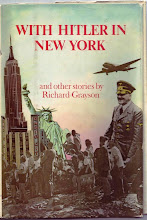
Mill Basin Civic News congratulates Richard Grayson on the publication of WITH HITLER IN NEW YORK


The current (June 1979) issue of The Mill Basin Civic News congratulates Richard Grayson on the publication of With Hitler in New York.

Subscribe to:
Posts (Atom)