Showing posts with label Smith Street Stage. Show all posts
Showing posts with label Smith Street Stage. Show all posts
Sunday, June 11, 2017


Friday, June 29, 2012
Friday Night in Carroll Gardens: Smith Street Stage presents "Twelfth Night" at Carroll Park


Thursday, July 14, 2011
Thursday Night in Carroll Gardens: Smith Street Stage presents "Macbeth" in Carroll Park

Tonight we had the great pleasure of attending a first-rate production of Macbeth at Carroll Park, presented by Smith Street Stage, the troupe that brought us last year's terrific Romeo and Juliet in the same Carroll Gardens venue.

Directed by Jonathan Hopkins, this swift-moving, crafty and suspenseful interpretation of Shakespeare's Scottish play featured a small cast of first-rate actors in contemporary dress, accompanied by two excellent musicians. It was a pleasure to behold.

(Our quick trip to Carroll Gardens on the G train, incidentally, featured a Shakespeare appetizer: two actors performed this scene from Romeo and Juliet from Metropolitan Avenue to Bedford-Nostrand and then dashed off to the next car.) When we got out at Carroll Park, we were pleased to see a good-sized crowd, a lot bigger than the audience we saw Romeo and Juliet with last year; we were particularly impressed, as we were last weekend, how really little kids just sat transfixed and quietly paying attention to the onstage action.

In the background, the inevitable kids' playground noise eventually faded into the background as the action unfurled in front of and around the park's field house, we actually could hear every line of dialogue crisply, a tribute to the skillful actors and probably the lone benefit we know from the loss of the B-75 bus route up Smith Street.

Macbeth, for us, has always seemed the most problematic of Shakespeare's major tragedies; it resists the kind of devotion we have for Hamlet, King Lear or Othello, and this may be our own difficulty. Making the transition from premeditated murderer (with some qualms) to mad nihilist -- which to us is what the text calls for -- is hard for an actor to pull off successfully.

Ben Horner does a really good job at making the transition credible. His Macbeth seems slightly off mentally from his first appearance onstage; it's not going to take much to drive this Thane of Cawdor over the edge, much as he tries hard to present the appearance of a strong leader but who is "a walking shadow" from the start.

Throughout the play, usually when Macbeth is trying to be decisive or show leadership, Horner's voice kept cracking like a young adolescent boy whose voice is changing. He's not presented as a weak tool of Mary Cavett's devastatingly icy, Nancy-Reaganesque Lady Macbeth. They're both too out of control for that, but that seems to heighten, rather than detract from, the play's pathos.

The couple's intense sexual attraction and their deep codependence seem products of two delusional people who have never quite been in touch with reality and who are almost always on the brink of hysteria, whether it's fear or triumph they're facing together. They're not monsters; they're wrecks.

All that gives the play, as staged by director Jonathan Hopkins, who was terrific last year as both Romeo and Lady Capulet (yes), a forceful momentum and the thrill of watching a speeding vehicle come to its inevitable bloody disaster. The music, provided by Matthew Glogowski and Andrew Sell, effectively highlighted the action.

The supporting cast was superb, and it was good to see actors who were in last year's Carroll Park production, like Sam Rosenberg, who made for a stolid, slightly obtuse Banquo and a ghost so scary that his entrances caused the young woman next to me screamed (twice).

The actors playing the the three weird sisters each played at least three roles. Leal Vona, alternately hulking and determined, also played Ross and one of the two Murderers, the hired killers enlisted by Macbeth. Patrick Harvey was totally awesome as the Porter in a soliloquy that froze time for a moment; he also played the Doctor, the Captain, and one of the Murderers in a series of lightning-quick transformations.

The third of the prophesying witches, Beth Ann Leone (who made interesting choices last year as Juliet; she's the artistic director for the Smith Street Stage), also made a nervous gentlewoman and pulled off the adolescent mixture of brightness and self-involved distance of Fleance beautifully, reminding us of how she played Benvolio so effectively last summer.

An interesting aspect of this production for us was how we weren't sure that Scotland's ship of state was ever sailing smoothly, before or after the treacherous plotting. Timur Kocak as Duncan seemed less royal than plebeian, with a pedestrian lack of imagination and the air of an affable office bureaucrat. His grand gestures were somehow empty.

MacDuff (Gordon Tashjian) seemed earnest, with a clear sense of right and wrong and intent on revenge, but we got the feeling he could have easily become the usurper of the rightful throne that the man he ultimately kills had been.

Everyone in this play seemed slightly sinister. Malcolm (Jason Loughlin) appeared to be hiding just how cold and calculated he could be; the initial sympathy for him as the wronged son of a murdered father turns, on second thought, into a wariness as to whether he'll be much better at ruling Scotland than his immediate predecessors.

We're sure other people saw the play differently and probably found its moral stance less ambiguous than we did, but we loved the thoughtfulness that went into Macbeth and are just as sure that nearly everyone in the audience appreciated it as much as we did.

MacBeth is playing in Carroll Park from July 13-24 (except for next Monday, July 18) at 7 p.m. If you want to experience some terrific Shakespeare in the park without having to stand on line at dawn, just bring a blanket or chair (we just sit on the newspaper ourselves) and you'll enjoy yourself.

At the end of the Cold War, Frank Rich wrote, "Nice as it might be were Macbeth to go out of fashion, it never does. The Ceausescus may come and go like the Perons and the Marcoses and so many before them, but there are always successors waiting in the wings." It's a play that's always relevant; yesterday's Scotland could be today's South Sudan. We're grateful to everyone at Smith Street Stage (including those who supervised the thoughtfully chosen music, costumes and fights) for this illuminating production.
Tuesday, August 17, 2010
Tuesday Evening in Carroll Gardens: Smith Street Stage presents "Romeo and Juliet" at Carroll Park

We took the G train ten stops from Williamsburg to Carroll Gardens this evening for the opening of Smith Street Stage's truly lovely production of Romeo and Juliet in Carroll Park.

Directed shrewdly by Robbie Sublett, this Romeo and Juliet is a bit of a tour de force since it's performed seamlessly with just five - count 'em, five - talented and versatile actors taking all the roles in Shakespeare's tragedy of young lovers.

Having seen this play performed outdoors twice in the past twelve days by other companies, we're always surprised that each new good production can bring out different aspects or nuances in the text. (As a writer and a literature teacher, we come at Shakespeare more from the text than anything else; as we show every time we write about seeing the play, we don't have much theater background or knowledge other than Harris Sarney's advanced drama classes in our senior year in Midwood in 1967-68.)

What the Smith Street Stage production made new for us in this Romeo and Juliet was the fierce intelligence both behind the text and in the characters. This was a thoughtful, even cerebral, production of the tragedy even though the fight scenes (old fashioned rapiers) were so skillful they stopped passing basketball players from the park frozen in place.

But in the performances, there was an element of self-awareness even when the young characters are acting most rashly, explosively and self-destructively: Tybalt, Mercutio, Benvolio, and of course Romeo and Juliet. The actors' intelligence made the characters seem as if they could envision what would happen five seconds into the future, which somehow caused everything to seem more poignant.

The main action took place by the centerpiece of Brooklyn's third-oldest park, the 1920 World War I Soldiers and Sailors Monument. It was a nice stage, but Carroll Park is pretty noisy on an early summer evening - the play started at 6:30 p.m. - behind the audience at the basketball courts, there were heavy-duty games going on, and since the park is just a few blocks square in the middle of a heavily-trafficked area, there were sirens from police cars, fire engines and ambulances and annoying motorcycles.

But except for a passing helicopter, the one time the actors made the good choice to pause for a moment, they did very well in coping with that. All the outdoor productions have these distractions and both the cast and crew and the audience learn to live with them.

This was the first production where we did see something actively malicious and stupid interfere: someone, from where we and we don't think anyone else could tell, hurled a water balloon onstage in front of the actors playing Romeo and Juliet (and a couple of feet in front of us). We don't know what to say about that except it's really sad and that the Smith Street Stage handled it expertly - which is to say they ignored it (except at the end, when a cast member, in thanking the audience and giving the usual plea for the donations that keep these plays going, said, "I hope nobody got wet.")

That cast member was Jonathan Hopkins, who was truly brilliant as Romeo, and yes, as Lady Capulet. His Romeo, like Beth Ann Leone's Juliet, seemed very 21st-century: they were street-savvy but also seemed more sophisticated than a teenage innocent. They've been around the block and they also radiate, especially in Hopkins' Romeo, a surprising degree of intellect and self-knowledge. It was a pleasure to watch them.
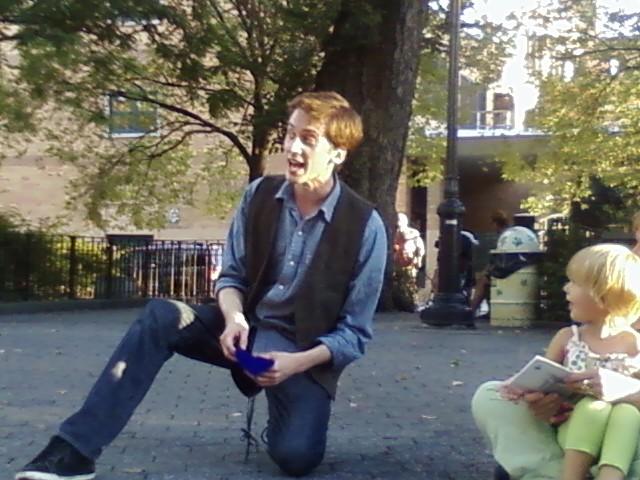
Hopkins, in switching from the role of Juliet's lover to that of her mother, was - like the other cast members - pretty damn amazing. Just watching his hands and feet as the petulant, distracted Lady Capulet was interesting.

Leone as Juliet seemed to have inherited a little of her mother's distractedness, which was an interesting choice, as was the director's choice to have the actors play the balcony scene without an enormous amount of face-to-face dialogue. Juliet sometimes seemed as if she was a little bit elsewhere in her fast-moving mind. Although Romeo kills Tybalt in the heat of passion over Mercutio's death, that action seems measured; in this production, Juliet seemed to us the rasher one of the two and just slightly manipulative.

As a twitchy Benvolio in a hoodie, Leone also proved interesting to watch. The other three actors, taking multiple parts, were a joy. In the beginning we wondered how they were going to pull it off with just a cast of five, but they did so quite effectively, in part by eliminating some scenes, particularly those of Paris and the Prince. (Lord Capulet arranges Juliet's marriage in a phone conversation with Paris, and you realize how little you miss the latter's replies; Paris and the Prince are pretty much banished from the end of the play, and nothing seemed lost.)

When we left, we told Sean Dillon, "You were great," and we meant it. As the Nurse, he was incredible, resisting caricature, very funny but it wasn't just the obvious drag (hairy legs, etc.) but a poignancy that came from the Nurse's character. With his fan (actually pretty handy on a warm night), the Nurse was a wonder: this was a pretty smart Nurse, loyal and easily annoyed, she seems in some ways to have more common sense than anyone in Verona. Dillon also made a fine business-like Prince in early scenes and also played Balthasar.

Joby Earle was equally effective as a talky, impulsive but always intelligent Mercutio. By the middle of his Queen Mab speech, he seems to know he should stop talking but plows ahead because, well, because he can and he damn well will - and this Mercutio likes to needle even the friends he so obviously cares for.

The actors work really well in these scenes. Earle's Lord Capulet was debonair, a decent guy who's found himself in a position just slightly above his capabilities. He also played Friar John in the one scene with the hapless messenger.

We loved Sam Rosenberg's dithering, nature-loving Friar Laurence, played with a yarmulke and we guess a Mexican-style poncho or maybe a serape (that, given his headgear, couldn't help seeming like a tallit). This Friar was funny, and like some of the other characters here, seemed sometimes to be thinking of something else, like one of his trees that needed pruning.

It was neat to see him morph into the cocky Tybalt - whose aggression always seems well-motivated - as well as the Capulets' incompetent servant.

Ruark and Blaise Downey worked really well as the musicians, coming onstage at the play's beginning and dominating its brilliantly conceived conclusion. The music was subtle but no less vital to getting the play to end on a high note. (By the way, as it got later, it got much quieter; although there were still a lot of basketball games, they just don't make as much noise in the dark.)

Director Robbie Sublett performed wonders with this production. Stage manager was Cynthia Vazquez; fight designer, Jessica Weiss; costumes by Laura Waringer; and publicity by Victoria Haynes. We showed up on Monday night, only to find it raining hard when we got out of the G train, so last night's opening was, obviously, postponed. We're really glad we came back.

Smith Street Stage's Romeo and Juliet will be playing tomorrow through Friday and then again August 26-28 next week. The new Brooklyn company's artistic director, tonight's Juliet and Benvolio, Beth Ann Leone, said the challenge of doing this play was "it's so familiar, that there's a risk it'll become commonplace, which would be an incredible shame."

She needn't have worried. This Romeo and Juliet is anything but commonplace, and it's definitely worth a trip to Carroll Park whether you're in the neighborhood or anywhere you can get an F or G train.
Subscribe to:
Posts (Atom)












