hi richard, can you give me a little legal advice? i got arrested from american apparel about a week ago and have a court date, 9/11. i just have some small questions. thank you, taowe couldn't have imagined that the incident would make for a best-selling book and now a movie that deserves a wide and appreciative audience. Of course, our imagination is limited by senescence and being a lawyer. The only friend we had who wanted to be a marine biologist was Mike, who's worked at Woods Hole Oceanographic Institution for decades.


This slick yet affecting novel depicts the manically self-absorbed days and nights of "Dakota Fanning" and "Haley Joel Osment." That the two share names with famous child stars, and that the title references a celebrated novelist, indicates our specific moment in time, but otherwise this is not a book "about" either the actors or the author. Born in 1983, Lin (Shoplifting from American Apparel) portrays a generation unable to engage and left lost, lonely, and dangerously obsessive as a result. Gmail chat and text message appear in heavy rotation, as the young lovers become more and more incapable of anything beyond their melancholic fixation with each other. The prose is rhythmic and lean, but strangely captivating, ultimately serving to echo the lack of interest the characters seem to have in anything other than themselves. Following them proves disconcerting and exhausting, especially as nothing keeps happening. Lin's sensibility is hip and ironic, but also feels ominously clairvoyant. As the author himself has become something of an icon to the very generation he portrays, one gets the sense that the disaffected youth are in on something the rest of us can only read about; given how bleak that world appears, reading about it feels relentless enough.


On Dec. 3, now known as "Black Wednesday," several major American publishers were dramatically downsized, leaving many celebrated editors and their colleagues jobless. The bad news stretches from the unemployment line to bookstores to literature itself.

Traffic at many bookstores nationwide has evidently slowed to a trickle. Book orders have reportedly fallen off a cliff. It's now being said that, in this Christmas season, no popular book is selling so well as to be unavailable. In other words, if you want it, it's going to be at your local Barnes & Noble. For publishing, that's like an obituary.


I first discovered Washington Square Park the summer I turned 18, the summer of Woodstock, of Stonewall, and of the first moon landing.
(For those of you wondering about what you may consider superfluous prepositions -- or the length of my blog posts in general -- it is my understanding that upon his return, Jeff will be paying me by the word.)
The West Village, and Washington Square Park in particular, was still a favorite hangout nine years after 1969, during the summer of Son of Sam with its blackout riots and Yankee Stadium dramas.
But that was two or three decades ago, and those fun-filled days watching hippies dance in the fountain under the influence of LSD are long gone, as are favorite neighborhood haunts like the Eighth Street Bookshop, The Postermat, Orange Julius, The Bottom Line, the Eighth Street Playhouse and Art Theatre, and restaurants like Shakespeare's and The Cookery, where a stoned dinner companion would embarrass me by calling out "Sing it, Alberta!" I met a boy named Frank Mills standing right here in front of the Waverly but unfortunately I lost his address...
I had my March 1983 publication party for I Brake for Delmore Schwartz at the old B. Dalton Bookstore on the corner of Sixth Avenue and Eighth Street (now, inevitably, a Barnes and Noble, albeit one with neither a cafe nor a public bathroom). But by the time I spent most summers living on the Upper West Side in the late 1980s, I stopped hanging out in the West Village and in Washington Square Park. AIDS had taken most of my friends from neighborhood, and the vibrant shopping street on West Eighth that I knew from the 1960s and 1970s had become filled with discount shoe stores -- the stores that weren't boarded up, that is.
By the 1990s all the action had moved east to St. Marks Place and the rest of the East Village, and more recently, retail has decamped half a mile uptown to what seems like Manhattan's center of gravity, Union Square -- which in 1969 was filled with nasty old ladies carrying DON'T BUY JUDY BOND BLOUSES shopping bags and drug addicts attempting to auction off their children to passersby.
In those days my wardrobe was heavy on tie-dyed T-shirts, bleached jeans with floral appliques, a headband and a peace symbol dangling from my neck.
This evening I'm wearing a sensible Woody Allen plaid sports shirt, ugly old-man cargo shorts and orthotics in my New Balance walking shoes. Hobbled by an uncooperative sacroiliac, I unsteadily make my way into Washington Square Park for yet another of my continuing unappreciated efforts to let blog readers across the country know what New York literary events are really like -- as if you care.
Back in the day, this park was filled with furtive, teasing cries of "Loose joints!" Today my own joints are more interested in ibuprofen and capsaicin cream than cannabis -- although, come to think of it, I do support medical marijuana.
Any-way, due to the excruciating twinges at the base of my pelvis as I hobble past the chess hustlers, the dog run, a band of high school boys playing Beatles songs and the fountain where I spent many happy hours reading Ramparts and dodging Crazy Judy's entreaties to "let me crash at your pad, man," I find I am somewhat late to Opium Magazine's Literary Death March -- sorry Literary Death Match.
(Focused on the past, for some reason I was thinking of Bataan -- in World War II -- for those young'uns: the one with Hitler.)
A San Francisco version of this event a few evenings ago apparently had its acrimonious side, but tonight's New York Death Match will prove as mellow a literary time as Washington Square has ever seen -- well, if you don't count Catherine Sloper's first date with Morris Townsend.
At first I don't see any evidence in the park of a Literary Death Match. But then some people who look slightly literary -- don't ask me how I can tell -- seem to be congregating aimlessly by the statue of Garibaldi sheathing or perhaps unsheathing his sword. (My MFA thesis at Brooklyn College was titled "Garibaldi in Exile," its title story about life in Staten Island noting that the Italian patriot shot thrushes and made candles while living there.)
By the time I make my way to the edges of the crowd (naturally, as I walk, I get hit in the knee by a 10-year-old's Spaldeen), the master of ceremonies -- he's got a beard and cool wrap-around shades but I don't catch his name, sorry -- is introducing the judges: Ben Greenman of The New Yorker and McSweeney's fame; fiction writer Leigh Newman; and musician/writer Wesley Stace, who doesn't want his bio note read aloud.
Ben will be the literary judge, Wesley the performance judge, and Leigh the judge of intangibles (here insert pun using the adjective "touching"). Apparently Clarence Thomas, he of the $1.5 million HarperCollins advance, was unable to serve as the hotness-factor judge.
But who needs Clarence? Ben, Wesley and Leigh are every bit as qualified as any appellate panel from the United States Court of Appeals for the Fourth Circuit -- with the sole caveat that none of them has ever been an active member of the Federalist Society.
The first semi-final round will have the debonair Tony O'Neill, representing 3:AM Magazine, facing off against the fetching Maureen Tkacik (pronounced "Tay-sick," the announcer is told), representing The Crier or something.
After a short intermission, the second semi-final round will pit the charming Irina Reyn (a substitute for the previously announced Joshua Mandelbaum, who presumably injured himself at practice), representing Ballyhoo Stories [to whom we express thanks for the pics], against the lovely Tao Lin, representing Opium Magazine.
Wait a minute. Isn't Opium sponsoring this match? How can they do that and still be one of the contestants? Oh, why should I give a shit? After all, they once published my story "G-d Is My Fuckbuddy," even if they did remove it from their archives. Who cares about conflicts of interest? After all, 3:AM has also published me, both a story and a poem accepted by their poetry editor Tao Lin, and that won't make me lose my journalistic objectivity here. (Go Tao! And whichever magazine you're pretending to represent!)
The man standing next to me, holding a violin for some reason, says, "This should be good."
I turn and stare at him, wondering why he's missing a bow.
Tony O'Neill, wearing a short-sleeved dress shirt, black dress pants and shoes and a loosened skinny tie, will read an early chapter of his novel Digging the Vein, entitled "This Is What Killed Hemingway." (Full disclosure: Tony is one of my 13,576 friends on MySpace.)
Some people here at the back of the crowd of about 65 (some younger folks whose lumbar discs have not yet ruptured are squatting on the floor with a semicircle of us in standing room at the back) start to leave as soon as Tony begins to read.
It's much easier to walk out (i.e., away) from a reading held outdoors than one in an indoor venue with chairs, I note. Too bad New York City has such terrible weather nine months a year.
But due to my vast and eclectic reading habits, I am already familiar with this excerpt from the O'Neill ouevre and consider it a masterpiece, so I can listen to Tony's excellent account of crazed druggies in London in his storied past while allowing my mind to wander a bit -- like to the intriguing headline in the tabloid of a nearby loiterer: "Cat predicts hour of patients' deaths."
Tony clutches the mike (attached to a stand) with one hand, reads from his manuscript pages in the other. I guess if he had brought the book in which this chapter appears, he would not have an extra hand to clutch the mike. (Am I supposed to spell it "mic"?)
Tony's a little hard to hear, what with the competition from squealing toddlers and the drum accompaniment to musical stylings of the faux Fab Four. The guy next to me is eating what looks like an interesting combination of yogurt, granola and chocolate syrup.
A guy on a bike comes up on my right. "What's this?" he asks.
"A literary death match," I say. "One of these people will die before the night is over." I hand him my leaflet, printed off the Internet.
"Cool," he says, looking it over. "I know who Ben Greenman is." Then he rides away on his bike.
I try to focus on some of the highlights of Tony's chapter:"We spent it, asshole, on fucking drugs."
"We're fucked."
"Any crack left?"
"Motherfucker, my fucking car, man!"
"We were officially fucked."
Sitting at the base of the Garibaldi statue, Judge Ben is furiously taking notes. Judge Wesley is looking pensive. Judge Megan has her hand on her chin and is swaying back and forth. You can hear that Beatles melody in the background.
Tony finishes on a high note (though pretty much the whole story was told on a high note) and gets a well-deserved enthusiastic round of applause.
Next up: Maureen Tkakic, who comes up smoking a cigarette. "I have no business participating here," she says modestly. "I'm a blogger who blogs about women's magazines. My story is about my attempt to become a real writer."
I happen to know that Maureen has published in such places as Time, The Wall Street Journal, Crain's New York Business, and Philadelphia and Boston magazines -- publications that have readers with a paucity of body art -- so I can understand her feeling that as a writer she is an imposter.
But as her story, whose title I don't catch, proves, Maureen is the real deal. It's a road trip story, with a first-person female narrator who with her fuckbuddy Schwartz encounters an Iraq war deserter named Sanchez -- a relative of the Gen. Sanchez disgraced by the Abu Ghraib tortures -- who wants to be driven to Juarez to this camp where Kellogg Root Brown guys and other deserters are training Mexicans for the war on terror or something.
Maybe Sanchez is a con man. Maybe he's not. The story begins with a quote from Cosmo about sex and includes a funny email about why the narrator would rather be in the Hamptons than on this road trip. To my mind, this story is an unalloyed masterpiece. I am enthralled.
Maureen's story involves Lexis/Nexis searches at truck stops, a former manager of a Payless shoe store, and attempts to drive to both Crawford, Texas, and Hope, Arkansas. In other words, it's filled with both trenchant social commentary as well as sexy scenes involving suppurating wounds.
Looking around, I notice I am not the oldest person in the crowd. A lady of about eighty is leaning on a cane and nodding appreciatively. Maureen is very animated and acts out the parts when she does dialogue.
This line, said at a tense moment in the story, gets a big laugh: "This is exactly what happened to Judith Miller because she trusted the wrong people."
I am also impressed by Maureen's ability to hold both a cigarette and the mike in one hand and her manuscript pages in the other. One of the backs of her manuscript pages is in color and I wonder if she is poor and has to use the backs of papers from her office in her printer. My heart goes out to her -- I think I took my Plavix this morning -- and I join the thunderous applause and hoots when Maureen finishes with a flourish.
The MC says that they're going to forgo the scheduled break because they're running late and reminds readers to limit themselves to eight minutes or fewer. (He actually says "less," but I don't want to embarrass this guy, whoever he is.) I think that was directed toward Maureen.
The crowd stands there (or squats, the lucky few -- also, a few non-participants are leaning up front) while the judges confer in animated whispers. The MC says, "The atmosphere is tense with anticipation." Some teenage boys eating fries come over near me until one of them points to the fountain and says, "Hey, what's over there, dude?" and they leave.
I take advantage of the free time and attempt one of my less conspicuous sacroiliac-joint stabilization exercises. A white woman pushing a stroller with a black child and a black woman pushing a stroller with a white child eye me suspiciously. (Dear reader, you are a racist if you assume only one of them is a nanny.)
Washington Square Park actually still seems like a good place to hang out. I'm happy to see that and will have to come here sometime when there is no literary death match scheduled.
Judge Ben Greenman comes to the mike and starts commenting on the first-round contestants. He says Tony and his story were both "likable" and that the piece has a clear sense of purpose. It went to extremes, but in a good way, like with the needle sticking out of a woman's body part (I forget which one).
Ben says that last year the park officials came over to complain about the profanity in the stories, but this year no one did, thanks to a new policy laid down by Parks Commissioner Adrian Benepe that profanity is okay with him.
Ben says that the performance judge thought Tony's accent moved from place to place over the course of the reading. It sounded British to me. Overall, Ben says, the performance judge was impressed by Tony's drive.
Now the judges go into a huddle. They ask Maureen, who's now in the back of the crowd near me, with a friend who gave her "a real cigarette" to replace the one she had, which I now see was an unlit prop, what the name of her story is.
She hesitates. "Untitled," she finally says. Someone sitting on the ground, a fan of untitled stories, applauds.
Ben says that at first they thought the two stories were like apples and oranges but then after a while they didn't seem so much like apples and oranges but more similar -- like pluots and apriums, I guess.
The judges appreciated the details in Maureen's story, like the reference to some things that can't be Googled -- a highly original concept that seems unthinkable. The bold use of an actual telephone number whose prefix was not 555 also seemed daring. Ben said he wanted to try dialing the number when he got home and asked Maureen if she would give it to him privately later, as he didn't quite get all the digits.
The road trip story is always a good form, the judges said, and the performance judge was impressed by the cigarette.
The winner of the first round, Ben said, was Tony. There is scattered applause.
With no break, Tao Lin is introduced. He is not smoking a cigarette, nor would he ever.
Tao says he is going to read from his new memoir, "Fishing With My Family."
Now here I have to interrupt and say that in April, when I got to a reading at Galapagos Art Space early and Tao let me sit next to him, he asked, "What do you think I should read?"
"The whale story," I told him, knowing that it would amaze his friends and confound his enemies -- who, as a result of a shrewd public relations campaign, currently outnumber his friends fourteen to one.
Tao took my advice that night and had a big hit with the story. So I am prejudiced in favor of it in advance.
Without a manuscript, Tao is reading from one of his three published books.
Of course, I would no more reveal the ending to Tao's story -- some may call it a poem, but honestly, who knows the difference? -- than I would reveal that after Voldemort kills Harry Potter, he convinces the Bancroft family to sell him their Dow Jones stock at $47 a share (just kidding!) -- here's a version that appeared in Monkeybicycle.
I think tonight Tao is doing a version that condenses the opening but somehow lasts exactly eight minutes. He looks at his watch a couple of times.
Those of you too lazy to hit the last link won't understand this, but the key to a successful performance of this story is to remain deadpan. I can detect Tao's struggle to keep from smiling as the audience members around me look on slack-jawed.
A young Hispanic man in the middle of the crowd is the only heckler of the evening. "Tonight you gonna eat pig!" he yells out as he leaves.
That's not true, of course. Tao is a vegan.
Eventually he cracks up, but he gathers his composure within a few seconds.
"I know how this story ends," I whisper conspiratorally to Maureen, now standing next to me and smoking. She nods. We can hear the sounds of an amplified Michael Jackson singing "Thriller" coming from the fountain.
I'm curious as to what Ben Greenman is writing as Tao's story goes on and on. Megan is still swaying, but now back and forth rather than side to side. Wesley is still pensive.
The story -- naturally, I consider it a masterpiece -- ends, and Tao gets a very enthusiastic response in the form of applause and a few coughs.
"Going toe to toe with Tao," the MC says, "is Irina Reyn." He says that his paper says she wrote "What Happened to Baby Yaga" for Ballyhoo Stories but he knows that is a typo and her title is actually "What Happened to Baba Yaga."
Irina, the first contestant wearing a dress, says, "This will be apples and oranges." Though, it turns out, her story, like Tao's fishing memoir, is about a childhood humiliation.
The story takes place at a bizarre Queens Jewish day school, and having taught at an even more bizarre Phoenix Jewish day school (the headmistress was Protestant! two-thirds of the boys were named "Zach"! they had a Republican club but no Democratic one!), I can attest to its versimilitude.
Irina's narrator, who has just transferred into this bizarre school (which to my ears sounded suspiciously like the Solomon Schechter School on Parsons Boulevard, teaching at which I wouldn't wish on a dog) where the kids are divided into four cliques: popular Americans, popular Israelis, loser Americans and loser Israelis.
As a recent transplant from Russia to Rego Park, she learns the Russian kids must fit into one of these four categories and she stakes her quest to be popular to this amazingly cool Russian boy called Koshchey the Deathless, who cannot be hurt unless the narrator can find his secret soul.
The narrator pines for Koshchey the Deathless to invite her to the sixth-grade dance and seems to be making progress when he finally speaks to her after she brushes him on the playground. Unfortunately, what he says is: "Sinner! Do not touch the King!"
(I may be getting this wrong. At his point in the evening my ibuprofen was starting to wear off and it was affecting my memo-pad handwriting.)
But when the narrator breaks a tie in Bible class about which Carvel (I bet you didn't know it was kosher) product to order, the Lollapalooza or the Flying Saucer, in favor of the frozen UFO, Koshchey the Deathless approves and tells her: "Fine choice for a mortal."
(If Tao had written this, the preferred Carvel product would have been Fudgie the Whale.)
Need I say that Irina's story is a masterpiece? She finishes to thunderous applause and a few hoots.
There's another break while the judges confer. I look around. By the fountain there's a guy with long blond hair and a guitar. I remember him being in that exact spot on Good Friday in 1972.
Turning back to the judges, I see an animated discussion and what appears to be sharp disagreement, though it may only be about where to have dinner afterwards.
This time Ben will not be the only judge to speak, although he goes first, sort of like John Roberts. Here my notes appear to read: "promotion el announcement for reliable turn." So I have no idea what he was saying.
But he does praise Tao's story for its consistent tone. And he admired the audience's reaction to it as well. Ben wondered if Tao was showing off, reading from a book rather than loose pages of manuscript, and there is a discussion of whether Tao actually was reading from the book or had memorized the story and was holding the book as a prop to give his hand something to do.
Ben says Irina's story was the best of the four he'd heard. Isn't Greenman a Jewish name? Maybe I can hit him up for a blurb.
Oh, actually I see my notes were messed up here and it was actually Wesley who said Irina's story was the evening's best. Note how easy it is to become a self-hating Jew. Of course I have had years of practice.
And it was also Wesley who made the comments about Tao reading from his book. Really, what Ben said was indecipherable to me. I guess he has good editors at MacAdam/Cage.
Leigh announces her judgment of the intangibles, but first admits, "I think I'm the worst intangibles judge ever." How touching. (I'm tired and in pain and I couldn't resist.)
She said the first reader (that's what she calls Tao) had a tightly constructed story with one line repeated endlessly to the point of strangeness. This could be seen either as gimmicky or quirky, Leigh says.
The second reader (that's what she calls Irina) read a story that was delicious and finely crafted; she didn't expect it to be as funny as it turned out to be.
Both stories were very good, Leigh says.
Now the judges confer. It is a split decision, Ben announces, but the winner is Irina. Magnanimous in total defeat, Tao vigorously applauds the woman who has vanquished him.
This literary death match, I now understand, is really a contest about character -- and all of the writers have been winners, blah blah blah.
Now we go to the quick final round betwen the two finalists. It's an on-the-spot literary improvisation. Tony and Irina each must compose a haiku in three minutes, and it has to be on the theme of "sin and redemption." I sense a morally uplifting conclusion to a perfect evening.
"On your mark, get set, GO!" says the announcer, whose name I really apologize for not finding out.
Now, watching two people attempt to write a haiku -- for members of the audience, the MC has explained that it's a Japanese lyric of three lines of five, seven and five syllables -- is not very exciting. But an enterprising Parks Department employee kicks a colorful beach ball into the crowd and the literary people have fun kicking it back and forth while poetry is being hastily written.
Finally time's up. Tony is first. His poem, he explains, is autobiographical. I wouldn't expect anything less. It is titled "Shoplifting at Urban Outfitters" (I see Tao start to take notes):I didn't do it
I didn't know it was in my bag
Okay, I'm sorry
Irina, going not for the autobiographical but the postmodern, reads her haiku, titled "This Exercise":This is torture
Like living under Stalin
But slightly better
Could Anna Akhmatova have described her feelings any better?
Ben says he doesn't think the judges will be very draconian about the syllable count but he sounds a bit suspicious that either poem added up to 5-7-5.
The audience will be the final judge, like you know what TV show. The MC calls for applause, first for Tony's haiku, then for Irina's.
Both get a lot of claps and some hoots and even a whistle or two. It's too close to call, and so there's a do-over. It still sounds pretty even to me, but then I went to one Kiss concert too many. (That is, I went to one Kiss concert.)
Ben is called upon to decide. Based on his legendary acute hearing, it is decided that Irina is the winner of this Literary Death Match. Everyone applauds wildly. I feel a chill up my spine. I wonder if my sacroiliac problem is actually an infection rather than an inflammation.
Irina is presented with a medal that has a red, white and blue ribbon and is round and gold. It reminds me of the one Bert Lahr got at the end of The Wizard of Oz.
"I love everybody!" Irina says.
"Sorry there weren't any chairs," the MC says. "Thanks to Opium Magazine." It might have been better had he made clear that this was two sentences rather than one, but it's been a great evening. It's 8:15 p.m.
I need to get home to bed. As I make my way across Washington Square Park, a teenage boy returns to his friends who are tossing a frisbee in the fountain. "While you two were engaged in this mindless violence," he tells them, "I was over there enriching my mind. I heard two haikus and the word draconian."
His companions look thoughtful, and then their attention turns to two girls in halter tops spinning hula hoops to James Brown singing "I Feel Good."
A unicyclist circles the fountain atop his lofty perch, as if in celebration of the written (and spoken) word or something.
* * * * *
FRIDAY MORNING UPDATE: Tony O'Neill and Tao Lin, bless their hearts, congratulate Irina Reyn on her victory.

May 16 is 3:AM Magazine Night at Galapagos Art Space
5/16 back $tbd
7pm doors
7:30 show
9:30 end
3:AM MAGAZINE NIGHT
3:AM Magazine authors and editors will read stories and poetry about hot sex, insane violence, and coke fiends.
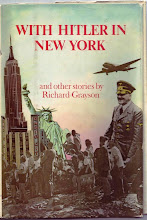
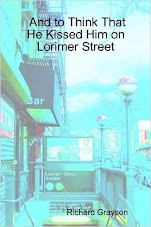
Richard Grayson is a retired teacher and lawyer who was born in Brooklyn in 1951. He is the author of a dozen books, including With Hitler in New York, The Silicon Valley Diet, I Brake for Delmore Schwartz, And to Think That He Kissed Him on Lorimer Street, and WRITE-IN: Diary of a Congressional Candidate in Florida's Fourth Congressional District.
Ellen Kennedy is the author of a collection of prose and poetry, yesterday i was talking to myself and i told myself that i was going to write a book and give it to you so i put paper in my bag and put a pen in my bag and rode my bike to the river bank and then sat on the ground and thought 'i will never write a book' and watched ducks swim away from me , which can be read at bearparade.com. She has been published in Mipoesias, Elimae, 3 am magazine, and Juked. She lives in Manhattan.
Tao Lin is the author of a novel, Eeeee Eee Eeee (Melville House), a story-collection, Bed (Melville House), and a poetry collection, You Are A Little Bit Happier Than I Am (Action Books). He has been published by Nerve, Noon, and Spork and he lives in Brooklyn. His web site is called Reader of Depressing Books. He is 3:AM Magazine's poetry editor.
Kim Chinquee's work has recently appeared in Noon, Denver Quarterly, Conjunctions, Fiction Magazine, New Orleans Review, Notre Dame Review, Fiction International, 3:AM, the Pushcart Prize anthology, and several other places. She teaches creative writing at Central Michigan University.