The Maryland literary magazine
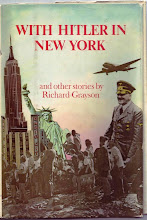
The Mill has published a review of Richard Grayson’s
With Hitler in New York in its sixth issue (1980):
 With Hitler in New York, by Richard Grayson. Taplinger, 188 pp., $7.95.
Some basically nice people cross the pages of this, Grayson’s first full-length collection of stories. They could be your next-door neighbors; indeed, if you live in a Jewish neighborhood in New York City, they may very well
be your next door neighbors. The people are very nice people, ones you would be pleased to see succeed and be happy. But they won’t be, and that is what is so sad. Life will see to it that they can’t be happy.
Life starts the grinding down process at a very early age. Grayson repeatedly returns to the traumas of childhood. One story that illustrates this point, an example even more pathetic because it is highly ignoble, is “Infant Sorrow”:
When he was very young he was very constipated. Sometimes he did not go to the bathroom for weeks. His grandmother would cry that the boy’s appendix must be on fire. They gave him malt-flavored syrup to put in his milk. And raisin bran. And thermometers. And sometimes they would give him glycerin suppositories too.
In the summer people would come into his grandmother’s bungalow to watch him straining at the stool. The bathroom door would be wide open and sometimes people would bring their guests for a weekend barbeque. They wanted to see this boy that had such trouble going to the bathroom.
Success, when it comes, is not all it’s cracked up to be:
When there was a bowel movement, his grandmother would make a party. It was more for the adults than for him.
Grayson’s stories are replete with ignoble events. But life is more than merely ignoble. It can also be cruel. It wounds people. The Grayson narrator is often in therapy. Many of his characters are in therapy. Ann, in “Aspects of Ann,” finds life complicated due to relationships:
“I don’t want to fall in love again,” she told her mother.
“Nonsense,” her mother said. “One day it’ll happen and you’ll be happy like everyone else.”
Ann decided it was wiser not to respond to that.
People are trying to connect with each other, but failing. In “Classified Personal,” the poignancy of this failure comes through ads placed by people looking to meet other persons for sexual or other kinds of rendezvous. In “The Princess from the Land of Porcelain,” Leslie discovers love only at the end of the story, and then only in a dream. The story ends: “She stirred out of sleep. She tried to get back into the dream.”
Life cruelly dashes the dreams of the characters in these stories. The characters are nice people; the world, on the other hand, is not nice. Grayson’s stories, of course, contain much more than I’ve been discussing here. I’ve been following this line of argument because I have a thesis concerning Grayson, namely that the impulse behind his work is social criticism. That thesis would explain the repeated use he makes of pathos. Pathos debases the world in order to criticize it. Characters caught in such a world fail or suffer due to no fault of their own—if anything, such characters are too good for the world they inhabit, possessing virtues, a delicate sensibility, that make it impossible to adapt to the debased world. They suffer because the world is flawed. Seeing the pathetic fall of the characters makes the reader want to rise in opposition to the world, thus achieving the goals of Grayson’s social criticism.
–Kevin Urick