Pages

Showing posts with label soap opera. Show all posts

Friday, September 23, 2011

Friday Afternoon in Williamsburg: After 41+ Years, Watching the Last Episode of "All My Children"


We were 18 years old and in our first semester at Brooklyn College on Thursday, December 11, 1969 when we read this article in The New York Times:

SOCIAL ACTIVISM GRIPS SOAP OPERA

Heroine on Serial on A.B.C. to Be a Mother for Peace


By George Gent

The daytime serial, or soap opera, is in the process of going activist.

Behind the agonized cries emanating from the traditional themes of troubled marriages, misalliances and fortune-hunting males, a soul engagé is apparently struggling to emerge and, if the signs are right, its time may have come.

The latest indication of what may be a trend comes from the American Broadcasting Company, which has announced that it will televise, starting Jan. 5 at 1 P.M., a new daily daytime series entitled "All My Children," whose heroine will be a peace activist married into a wealthy conservative family.


We were then involved in the antiwar movement, having worked in the New York headquarters of the Vietnam Moratorium in October, and active politically as a volunteer in Mayor John Lindsay's re-election on the Liberal Party line a few weeks before. The week All My Children premiered, we were in the viewing audience most days, except when we had our draft physical and French final.

We also loved soap operas, which had gotten us through some hard times in our teenage years and which we'd be watching for the rest of our life.

After a few weeks, All My Children didn't seem all that radical. A Sunday Arts and Leisure article in the Times dealt with the Vietnam War storyline, but clearly the usual soap opera plots held sway in Pine Valley. That was fine with us, too, and we kept watching -- not totally faithfully, but periodically and sporadically, as we moved into our twenties, thirties, forties and fifties.

Wherever we moved to, whatever our problems, we could turn on ABC at 1 p.m. or 12 p.m. or whatever time All My Children was on in that TV market, and we'd see familiar faces from our past.

Now we're 60 years old and All My Children aired its last TV episode this afternoon. (It will reappear next year as an online serial from Prospect Park (a different one than we've been going to since the 1950s).

Heavy rain and an age-related sports injury (torn gluteal muscle) prevented us from getting up to the Upper West Side to Soap Opera Digest columnist Carolyn Hinsey's farewell viewing party at Blondies Sports Bar, just a few blocks from the apartment where we used to watch the show in the 1980s.

But it was nice to see the finale at home by ourselves, the way we usually watched the show.

Tuesday, July 8, 1980

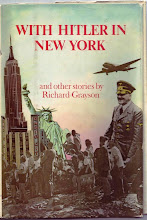
Bellingham Review reviews Richard Grayson's WITH HITLER IN NEW YORK


The Summer 1980 issue of the Bellingham Review has a review of Richard Grayson’s With Hitler in New York on pages 48-49:

Book Review by Richard Dills

WITH HITLER IN NEW YORK AND OTHER STORIES, by Richard Grayson, Taplinger Publishing Company, New York, 1979, 190 pp., $7.95 (cloth).


Richard Grayson’s fictions in With Hitler in New York are marked by comic exuberance and sympathy. But they also raise the question: can an author be too playful for his own good? Don’t misunderstand, there is a lot to like in this exceptionally readable book ; it’s just that some of the pieces lack resonance because the author at times too much enjoys the sound of his own voice. Which may explain Grayson’s fondness for puns. An example from “What Really Happened in Cambodia”:
“We’ve got to find a nook or a cranny to hide out in tonight or we’re doomed,” says one refugee to his wife.

“But I don’t see a cranny,” she cries. “And I certainly don’t Sihanouk.”

And there are plenty more where that came from. In most of his stories Grayson uses a “patchwork” device wherein the story is pieced together with bits of dialogue, revery, incongruous observation and all-purpose non-sequiturs. This technique seems particularly appropriate for comedy, as it tends to emphasize absurdity and encourage puns and one-liners. It does not work as well—with one exception—with serious pieces unless fragmentation and loss of wholeness is essential to the story.

But, to the stories.

The despair and prurient interest of the personal ads we’ve all read in The Village Voice if not in our own hometown dailies is nicely captured in “Classified Personal.” And there are some nice ironies:
Love! Love! Love! Who’s got it to give? Lonely, love-starved W/M, 21, affectionate, handsome, muscular and understanding seeks guy with boyish good looks and smooth body for lasting relationship. Write OCCUPANT, Box 44, Carteret, N.J. 07915

“Occupant” seems just about right. But, even though the rest of the 37 or so personals carry the same degree of authenticity and/or irony, the piece as a whole escaped me. With two or three exceptions, the order of the personals appear to be just as random as that of a newspaper’s. The point, of course, is that Grayson has a significantly different audience—or, if not—at least an audience with significantly different expectations. (I will argue this point.) The author, then, must be more than a typesetter.

In “‘Go Not to Lethe’ Celebrates Its 27th Anniversary,” we discover a character named Grayson Richards who portrays a character in “GNTL” named Richard Grayson. The danger of such a story—aside from cuteness—is that by reducing a life to the commercially dictated structure of the daytime soap opera, the author risks the criticism often leveled at the soaps: that they entertain by trivializing serious emotional and ethical questions. I think Grayson just gets by here because even while his story raised these kinds of questions, I enjoyed reading the story. Also, I think it’s because the story is near the end of a volume full of comic invention, and read in that context “GNTL” has a place as a bit of extended tomfoolery.

“The Princess of the Land of Porcelain,” a non-comic piece, is a different story altogether. Here, idea and technique blend perfectly. In this story, fragmentation and loss of wholeness is the point. Leslie, a career woman, cannot resolve the conflict between her desire for freedom and her need to be taken care of. Leslie and her friends share the same beliefs, the same lifestyle, almost the same life.

However, her fears and her dreams separate her from her husband, Evan, and her lover, Ken. Even so, it is hard for Leslie to change or escape, for on the face of it she has what she wants:
. . . Evan was too involved with Sari to intrude on Leslie’s business. There were private things that did not require any discussions between them. Leslie and her husband operated on trust. They both had lots of psychic space. Everyone did. Ken had his Senate page, apart from Leslie. Sari was living with a radical therapist who rather liked Evan. It was all in the open.

Open and convenient, but lacking that sense of belonging and commitment which Leslie—to her own surprise—finds she needs but with the open-spacers regard with anathema. When her lover informs her that he is leaving town, Leslie is “. . . surprised at how surprised she was.” She does not, of course, make a scene or ask him to stay, but later that night she has nightmares even though she cannot fall asleep. She lies in bed with a cold, half-awake, half-asleep, feeling guilty because she wants to be taken care of.

“The Princess from the Land of Porcelain” shows Grayson at his best as he combines material with technique to produce a story with telling sympathy. If good stories make you think and make you care, then this is one of them.