Pages

Showing posts with label Adolf Hitler. Show all posts

Thursday, April 30, 2009

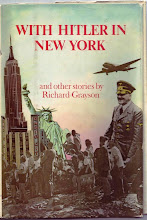
Michael Butter's "The Epitome of Evil: Hitler in American Fiction, 1939-2002" analyzes Richard Grayson's "With Hitler in New York"


Just published, Michael Butter's new book, The Epitome of Evil: Hitler in American Fiction, 1939-2002, analyzes Richard Grayson's "With Hitler in New York" in a chapter on Steve Erickson's novel Tours of the Black Clock
Negotiating what American culture associates with the figure of Hitler, Tours of the Black Clock echoes Richard Grayson's short story "With Hitler in New York," published ten years earlier, in 1979. Grayson's story achieves a very similar effect by way of very different formal means.

Erickson's Hitler is obviously a version of the historical Hitler, although the novel withholds the name. Grayson attaches Hitler's name to a character that seems to have little or nothing in common with the historical figure. "With Hitler in New York" persistently evokes and questions the image of Hitler as the epitome of evil that the reader is familiar with.

The story is set in the 1970s and revolves around Hitler's trip to New York where he visits his Jewish girlfriend Ellen and an unnamed male narrator. The narrator and Ellen pick Hitler up at the airport, and over the following days they go sightseeing, have dinner with Ellen's parents, and sit outside "on the stoop smoking a joint and eating vanilla ice cream" (15).

The sense of the ordinary thus created, however, is persistently undermined by the presence of the name "Hitler." The participation of a figure named Hitler in these everyday activities compels the reader to view otherwise harmless events in a different light.

Hitler's comment about the heat in the airport's arrival hall — "It's like a bathroom" (14) — for example, inconspicuous if uttered by anybody else, takes on a darker meaning, as the phrase echoes the lie Jews were told on their way to the gas takes on a darker meaning, as the phrase echoes the lie Jews were told on their way to the gas chamber, namely, that they were going to take a shower.

In addition, the narrator frequently compares the Hitler he chaperones around New York with the image he previously had of Hitler. Realizing that Hitler "looks handsomer than [he] remembered him as being" or that he "never realized [Hitler] was so witty," he adjusts his view (14, 16). And the reader, of course, constantly compares the version of Hitler the story presents to what he or she knows about the historical figure.

The effect the story thus produces, however, is not, as Alvin H. Rosenfeld has argued, "the neutralization of the historical Hitler and the normalization of a new image of the man" (72). To claim that "With Hitler in New York" presents a "de-Nazified Hitler" means to read the story realistically and to determine that the character it features is indeed an aged version of the historical figure (73). The story of course invites but simultaneously discourages this identification.

However, it is ultimately interested neither in the historical nor in its own "Hitler." Instead, "With Hitler in New York" explores what is commonly associated with Hitler. It denaturalizes connections between Hitler on the one hand, and evil, sadism, or anti-Semitism on the other, urging its readers to acknowledge how stereotypical these connotations have become.

And yet, "With Hitler in New York" does not attempt to reconfigure the meaning of Hitler for U.S. culture. The story neither offers a different set of associations nor does it invite a revisionist interpretation of the historical Hitler. By contrast, Tours of the Black Clock pushes its critique several steps further, since the text, as I have argued above, questions the validity of the category "evil" as such.

Wednesday, February 16, 2005

Gavriel D. Rosenfeld's THE WORLD HITLER NEVER MADE analyzes Richard Grayson's story "With Hitler in New York"


Gavriel D. Rosenfeld's The World Hitler Never Made: Alternate History and the Memory of Nazism, published this year (June 2, 2005) by Cambridge University Press, contains an analysis of Richard Grayson's "With Hitler in New York" appears on pages 234-236:
Several years later, [Michel] Choquette’s tale ["Stranger in Paradise"] was itself surpassed by the most normalized of the decade’s narratives – American writer Richard Grayson’s 1979 short story, “With Hitler in New York.” Set in an indeterminate year, Grayson’s work recounts an unnamed narrator’s several days of socializing, partying and walking the streets of New York with Adolf Hitler. The Hitler described by the narrator is a contemporary Everyman, indistinguishable from others of his generation. A tall, dark and handsome individual who wears a leather jacket, Hitler is quick-witted, gregarious and popular. Nothing of much importance happens in the story, which is more a chronicle of banal events than a sustained plot. Its most intriguing aspect, indeed, is its vagueness regarding whether the Hitler in the story is in fact the “real” Hitler or simply another man coincidentally possessing the same name. By the end of the tale it is clear that the man is, indeed, the (allo)historical Hitler. The hostile reactions toward him by other characters in the story show that he continues to suffer from a sullied reputation due to unspecified historical misdeeds. The mother of Hitler’s girlfriend, Ellen, dislikes him and will not speak to him; a patron in a coffee house “recognizes Hitler [but] everything is too mellow for him to make a scene.” Yet Hitler’s negative image is complicated by the fact that his girlfriend is Jewish and he enjoys strolling around Brighton Beach listening to elderly Jews sing old Yiddish folk songs. The historical significance of this allohistorical Hitler remains ambiguous. The narrator’s drunken observation at a party that Hitler deserves to win the Nobel Peace prize is as cryptic as his concluding question to him whether he “ever feels bitter.” Hitler’s cryptic response – that he feels “useless” – suggests some kind of grand past that has given way to a banal present, but nothing more.

Grayson’s portrayal of Hitler’s survival in an alternate New York City, like Choquette’s, was notable for its complete abandonment of a morally grounded framework. Unlike the tales of [Brian] Aldiss, [George] Steiner, and [Pierre] Boulle, which still depicted him as unrepentant for his crimes, Grayson’s story left unspecified which historical misdeeds he may have committed – or whether he committed any at all. Without a clear criminal background to be held accountable for, Grayson’s Führer is no fugitive but merely another human being who blends into the crowd in New York City. And yet it would be a mistake to see Grayson’s humanization of Hitler as an act of rehabilitation. Rather, Grayson’s tale imagines an alternate world that has largely forgiven Hitler for his crimes and forgotten them. Such a world – in which the narrator can ignore his grandfather’s own death to get stoned with Hitler and can muse, “I wonder if I am beginning to fall in love with him” – is a callous, unfeeling one, in which historical consciousness has either atrophied completely or become irrelevant to most human beings. In short, it is a nightmarish world of total amnesia. In all probability, this is the primary point Grayson was looking to make. Evidence for this reading is provided at the very end of the autobiographical introduction to With Hitler in New York (which immediately precedes the story by the same name) where he describes his adolescent withdrawal from his family and concludes “I just lay in my bed trying to sleep. When I slept I had nightmares.” Given this de facto premise to the short story “With Hitler in New York,” Grayson’s account of a world in which Hitler hardly differed from anyone else was meant to be seen as a bad dream.

In offering this conclusion, Grayson’s story can be taken as a complex response to the Hitler Wave. Like Boulle and Choquette, Grayson was strongly influenced by the Hitler Wave’s de-demonization of the Führer and drafted the most humanized portrait of him yet to appear in postwar alternate history. Yet Grayson was also concerned about, and tried to counteract, the Hitler Wave’s progressive normalization of the deceased dictator. As a writer of Jewish background who grew up around Holocaust survivors in Brooklyn, Grayson was concerned by the increasing fascination with Hitler and aimed to show, in reductio ad absurdum fashion, its dangerous endpoint – a Hitler who was regarded as any other human being. The author’s decision not to bring Hitler to justice in “With Hitler in New York,” then was animated by different aims from those that shaped the tales of Aldiss, [Gary] Goss, Steiner, Boulle, and Choquette. For while these narratives were less overly committed to remember the Nazi past for its own sake, Grayson’s story was intended as a plea not to forget the Nazi past for its historically specific horrors. Still, in effect, “With Hitler in New York” did not differ substantially from these tales insofar as it, too, dramatically challenged the limits of representing Hitler and offered a radically altered portrait of him as a “regular guy.”

Taken together, the tales of Aldiss, Fadiman, Goss, Steiner, Boulle, Choquette, and Grayson all reflected the broader phenomenon of normalization. This was most obvious in their de-demonization of Hitler as a character. The fact that, in nearly all of the narratives, Hitler’s enduring capacity for evil was overshadowed by his average human traits represented an increasing willingness, in the wake of the Hitler Wave, to view the Führer in non-judgmental terms. The motives underlying many of these narratives also reflected an increasingly normalized view of the Nazi past. These writers showed Hitler evading justice in order to offer universal conclusions about the human condition – most of them pointing to the continued existence of contemporary political crises. For all of their moral evidence on liberal-left politics, however, the effect of their tales was to divert popular attention from Nazism as a specific historical phenomenon.

Sunday, September 15, 1985

Alvin H. Rosenfeld's IMAGINING HITLER analyzes Richard Grayson's story "With Hitler in New York"


Alvin Rosenfeld's Imagining Hitler, published this year (1985) by Indiana University Press, is, according to the New York Times review of the book "a brief but forceful survey of . . . works of fiction, ranging from books by established authors - George Steiner, Beryl Bainbridge - to pulp thrillers and curiosities such as Richard Grayson's 'With Hitler in New York.'"

Rosenfeld's analysis of "With Hitler in New York" appears on pages 71-73:


. . . Compared to the Wandering Jew, who in most versions of the archetype is pictured as solitary and companionless in his misery, the Wandering Gentile doesn’t have it so bad.

In Richard Grayson’s astonishing story, “With Hitler in New York,” he has it, in fact, pretty good. Grayson gives us a Hitler in blue jeans, who backpacks his way to New York on Laker Airlines to spend some time with his Jewish girlfriend. As the story opens, the narrator is waiting at the airport with Ellen, Hitler’s girl, for the flight to come in. Hitler arrives from Germany wearing a work shirt and leather jacket, and they go off to the city. It’s summertime, and New York is in the grip of a heat wave. They watch T.V., eat ice cream, smoke a joint together. The narrator notes that “Hitler had a nice air about him” and admires the way he moves (“He is so comfortable with his body”). Hitler is jet-lagged and dozes off on the couch. “What do you think of Hitler?” Ellen asks. “I kind of like him,” the narrator says. “I never realized he was so witty.”

As the story progresses, these early good feelings about Hitler increase. “I think I would like to be like him,” the narrator muses. And later, “I wonder if I am beginning to fall in love with him.”

Hitler is uncomfortable in the oppressive heat of New York and is catching a cold, but he doesn’t want to put a damper on things and rallies his spirits. They go off to have breakfast at McDonald’s, watch a movie together on Channel 9, have dinner in the Village. It’s a little like the threesome in Jules and Jim. They gather a fourth, Libby, and go to Washington Square and sit around the fountain. The next day they swim, have dinner at Ellen’s parents’ house (the narrator’s mother “seems to like Hitler,” even if Ellen’s mother doesn’t), walk the boards of Brighton Beach, and eat eggcreams. Nearby some Russian Jews are enjoying themselves singing Yiddish folksongs. Hitler listens intently, understands the slightly bawdy lyrics, then walks off before he can be recognized by the old Jews.

The friendship between Hitler and the narrator deepens as the days pass. As an expression of his affection, Hitler gives the narrator a present, a book of Rilke’s poems.

The remainder of their days together in New York are spent in pretty much the same way. The three friends have dinner together at a Szechuan restaurant in Brooklyn Heights, sample the carrot cake at a healthfood place on Atlantic Avenue, look at the brownstones, joke around.

In the midst of it all, the narrator’s grandfather dies in Florida, but the narrator does not want to skip out on a going-away party for Hitler, who will be flying back to Germany in two days, and does not tell anyone about the death. He feels bad about it, but it’s Saturday night, their time together now is very short, and he joins the other guests at the party.

Hitler is a big hit, holds his beer well, and is as friendly and as witty as can be. The narrator’s admiration has by now turned to love, and it is clear they have become the best of friends. They get drunk and joke about winning the Nobel Prize together, Hitler for Peace, the narrator for Literature. “We would have to wear ties,” Hitler says. “No, tuxedos,” the narrator replies. “And top hats and canes.” They joke some more about doing vaudeville together.

At the story’s end, the narrator confides in his new friend that his grandfather has just died, and begins to cry. Hitler consoles him by telling him funny stories. It helps some, and the narrator drives Hitler home feeling a little better. And there the narrative ends.

Substitute almost anyone else for Hitler, and the story would fail. With Hitler in it, though, it is a fictional tour de force, the furthest extension to date of the neutralization of the historical Hitler and the normalization of a new image of the man. The evil monster is gone, as is the murderous anti-Semite. One neither fears nor loathes this Hitler, for in developing him Grayson has eliminated from his narrative virtually every trace of the Nazi Führer and put in his place a regular guy – likable, affectionate, funny, fun to be with. In costume, manner, taste, and overall affability, he fits in; in fact, he is something of a swinger and the epitome of the late-60s casual style. If one identifies at all with the narrator (and the story is designed to bring about an alignment of the reader’s feelings with the narrator’s), by story’s end one hates to see Hitler go.

It is not difficult to see what Grayson has done in writing his Hitler story, but at the same time it is not easy to know why he has done it or how he wants his readers to understand it. Unlike other fictions that manipulate the survival myth, Grayson has put “With Hitler in New York” under no obligation whatever to explain how Hitler has survived the siege of Berlin and his own suicide and is still around today. The story, in fact, is free of all references to the war years, the Nazi regime, the persecution and murder of the Jews, bunkers and bombs. In all of these respects, the story is unanchored in the history of the Third Reich and without the taint of any of its crimes. If there is any suspicion that this Hitler is sadistic, it is only because he throws his girlfriend around the swimming pool. Otherwise, there is nothing at all brutal or mean-spirited about the man. Were his name not Hitler, indeed, one would not even pause to inquire about the possibilities of a mean streak, for this fellow is a softy, not a sadist.

He is also not an anti-Semite, as his affectionate ways with his Jewish girlfriend show clearly enough. There are indications that the narrator is also a Jew, and yet Hitler and he become the best of buddies. It is true that Ellen’s mother does not take to him, but he gets along well enough with her father and is invited to share a meal at the family table. Hitler’s ways with the Jews are, in sum, by and large natural and easy and bear no resemblance to the mad anti-Semitic passions of the Führer of the Third Reich.

Grayson, one comes to understand, has de-Nazified Hitler, pacified him, and projected him as normative. At some very deep level of the imagination he has removed him from history, recast him in anti-apocalyptic terms, and made him safe to behold. His name and nationality aside, Hitler might as well be someone else, someone one need not fear to touch or tangle with romantically. There are no ironies here, weak or strong, only erasures so complete as to disarm the historical sense altogether and eliminate it as a factor in reading. In its representation of Hitler as a pure fiction, “With Hitler in New York” carries us beyond the transcendental leaps of the religious imagination, beyond the counterfeit claims of the revisionists, beyond the “alternative” possibilities and fictitious endings of popular formula fiction, and into a realm of imagination that all but dissolves historical memory. Whatever its author’s intentions might have been, his story succeeds in showing us just how much is lost when the name Hitler gives up its force and no longer evokes anything of consequence from the past.

“Forgetfulness,” Nietzche wrote, “is a property of all action. . . . One who would feel everything historically would be like a man forcing himself to refrain from sleep, or like a beast who had to live by chewing a continual cud.” The fictions reviewed in this chapter are a diverse lot, but all have in common a will to forgetfulness, a desire or ambition to spit out the historical cud.