Pages

Showing posts with label literary criticism. Show all posts

Thursday, April 30, 2009

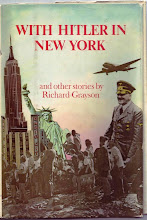
Michael Butter's "The Epitome of Evil: Hitler in American Fiction, 1939-2002" analyzes Richard Grayson's "With Hitler in New York"


Just published, Michael Butter's new book, The Epitome of Evil: Hitler in American Fiction, 1939-2002, analyzes Richard Grayson's "With Hitler in New York" in a chapter on Steve Erickson's novel Tours of the Black Clock
Negotiating what American culture associates with the figure of Hitler, Tours of the Black Clock echoes Richard Grayson's short story "With Hitler in New York," published ten years earlier, in 1979. Grayson's story achieves a very similar effect by way of very different formal means.

Erickson's Hitler is obviously a version of the historical Hitler, although the novel withholds the name. Grayson attaches Hitler's name to a character that seems to have little or nothing in common with the historical figure. "With Hitler in New York" persistently evokes and questions the image of Hitler as the epitome of evil that the reader is familiar with.

The story is set in the 1970s and revolves around Hitler's trip to New York where he visits his Jewish girlfriend Ellen and an unnamed male narrator. The narrator and Ellen pick Hitler up at the airport, and over the following days they go sightseeing, have dinner with Ellen's parents, and sit outside "on the stoop smoking a joint and eating vanilla ice cream" (15).

The sense of the ordinary thus created, however, is persistently undermined by the presence of the name "Hitler." The participation of a figure named Hitler in these everyday activities compels the reader to view otherwise harmless events in a different light.

Hitler's comment about the heat in the airport's arrival hall — "It's like a bathroom" (14) — for example, inconspicuous if uttered by anybody else, takes on a darker meaning, as the phrase echoes the lie Jews were told on their way to the gas takes on a darker meaning, as the phrase echoes the lie Jews were told on their way to the gas chamber, namely, that they were going to take a shower.

In addition, the narrator frequently compares the Hitler he chaperones around New York with the image he previously had of Hitler. Realizing that Hitler "looks handsomer than [he] remembered him as being" or that he "never realized [Hitler] was so witty," he adjusts his view (14, 16). And the reader, of course, constantly compares the version of Hitler the story presents to what he or she knows about the historical figure.

The effect the story thus produces, however, is not, as Alvin H. Rosenfeld has argued, "the neutralization of the historical Hitler and the normalization of a new image of the man" (72). To claim that "With Hitler in New York" presents a "de-Nazified Hitler" means to read the story realistically and to determine that the character it features is indeed an aged version of the historical figure (73). The story of course invites but simultaneously discourages this identification.

However, it is ultimately interested neither in the historical nor in its own "Hitler." Instead, "With Hitler in New York" explores what is commonly associated with Hitler. It denaturalizes connections between Hitler on the one hand, and evil, sadism, or anti-Semitism on the other, urging its readers to acknowledge how stereotypical these connotations have become.

And yet, "With Hitler in New York" does not attempt to reconfigure the meaning of Hitler for U.S. culture. The story neither offers a different set of associations nor does it invite a revisionist interpretation of the historical Hitler. By contrast, Tours of the Black Clock pushes its critique several steps further, since the text, as I have argued above, questions the validity of the category "evil" as such.

Sunday, April 12, 2009

Adding It Up: We review the April 12, 2009 Sunday New York Times Book Review


The New York Times Book Review for April 12, 2009 is 28 pages, 4 pages more than all but one issue this year, and no wonder (spoiler alert): a full 8 pages of the 28 are devoted to ads! On this Easter Sunday, we shout Hallelujah! The New York Times Book Review has risen!

Is the Great Ad Drought over? Why is tonight's book review different from all other recent book reviews?

Easter and Passover congratulations to the Times display advertising department on this great leap forward. We are sending you a dozen currant rolls from Lords Bakery by the Junction in Brooklyn!

Saturday, January 18, 1997

Richard Grayson essay in NEIL SIMON: A CASEBOOK: "'The Fruit Brigade': Neil Simon's Gay Characters"


Richard Grayson has an essay, "The Fruit Brigade: Neil Simon's Gay Characters," in Neil Simon: A Casebook, edited by Gary Konas, published by Routledge on January 1, 1997:


"The Fruit Brigade":
Neil Simon's Gay Characters


As a playwright who has achieved popular acclaim as well as artistic success over the past twenty-five years, Neil Simon provides an instructive example of changing middle-class American attitudes toward homosexuality. While he sometimes employs gay stereotypes in the service of an easy laugh, Simon's gay characters are by and large sympathetic and admirable, although somewhat pathetic. If Simon's portrayal of them evinces an imperfect understanding that rarely goes beyond the superficial, the evolution of his thinking about homosexuality since the 1970s approximates the earnest, well-meaning tolerance of his audiences.


Simon's first gay character appears in The Gingerbread Lady (1971). Jimmy Perry is one of the two misfit friends of the protagonist, Evy Meara, an alcoholic nightclub singer whose life has spun completely out of control. Jimmy is the first character seen onstage when the play opens, and the stage directions describe him as "in his early forties, portly and probably homosexual. Probably but not obviously" (5). The "probably" there seems to refer to whether his sexual orientation is immediately obvious, for the play's dialogue leaves no doubt that Jimmy is exclusively gay. When first seen, Jimmy is fussily and nervously straightening up Evy's apartment for her long-awaited return.

Jimmy is a down-on-his-luck, lonely, impoverished actor still struggling after years in the theater. A young Hispanic delivery man insults Jimmy by saying, "I know the kind of people you like, meester," and then makes two kissing sounds with his parted lips (8). This comment has to be understood in the context of Jimmy's insinuations that the delivery man is a thief and his later use of the slur "spic." It is typical of the insults to gay characters in Simon's plays in that it expresses ridicule but not hatred or even harsh disapproval. Moreover, Jimmy himself is not without his prejudices, and the taunting reinforces the notion of Jimmy as pathetic victim rather than as bigoted. Simon's audiences are more likely to be comfortable with a middle-class gay man than a young working-class Puerto Rican. In any case, when the delivery man returns and Evy flirts with him, he shows Jimmy he meant no malice by saying, "Okay, we're good friends again, alright?" and then winking at him
(20-21).

Jimmy fusses over Evy, who has returned from drying out in the sanitarium and throughout the play functions as her confidant, the nervous mother hen who hovers over the friend whom he idealizes as a beautiful, tragic heroine. Since Evy's relationship with heterosexual men is self-destructive in the extreme, Jimmy's homosexuality functions as a way of reminding the audience that the play's heroine can have a positive relationship with a man who is not interested in her sexually. And even that is ambiguous.

At one point, Evy puts her arms around Jimmy, affectionately asking him why he doesn't marry her, to which he responds: "Because you're a drunken nymphomaniac and I'm a homosexual. We'd have trouble getting our kids into a good school" (21).

After kissing her lightly, Evy asks for a "real kiss" and the stage directions say "he kisses her with feeling" (21). It's not clear if any sexuality is involved in this:
Jimmy: God will punish us for the terrible thing we're doing.
Evy: Don't get depressed, but you get me very excited.

Jimmy breaks away, telling Evy to stop confusing his hormones (22).

Mostly, however, Jimmy's sexual orientation reinforces Jimmy's image as a loser, and it allows Simon to make references to what he sees as a gay man's inability to please a woman sexually and his promiscuous nature. For example, when Evy says that in the hospital she dreamed first of sex and then of Jimmy's tongue and swiss sandwiches, Jimmy tells her that he can make her the sandwich but "The rest I can't help you with" (12). When Jimmy leaves for a walk in Central Park, he says, "If I'm not back in an hour, I found true happiness" (77) -- clearly a reference to anonymous cruising for sex.

Although Evy has a gay man as her best friend, she's capable of looking out the window and saying, "I don't see any men on the streets. Little boys, fags, hippies, but no men" (16). But this emphasizes the pathology in Evy's relationships with men: she does not consider non-threatening, non-abusing men like gay Jimmy or a gentle hippie to be men.

It is the one point in the play when Jimmy stops being Evy's protector and wallows in self-pity, coming close to a breakdown over his failed acting career, that provides the critical occasion for Evy to fall off the wagon as Jimmy fails to realize that she is drinking with him until it is too late. When Jimmy walks out, saying he's through with watching Evy destroy herself, she pleads, "Jimmy, don't leave me, you're the only man in my life" (60), acknowledging his manhood. Later, faithful Jimmy returns after Evy's ex-boyfriend has beaten her up, and he reproaches himself for forgetting that he can't leave [Evy] alone for two seconds" (75).

Jimmy, like Evy and their friend Toby, is one of life's losers who cannot help one another because of their inability to help themselves. In Simon's adaptation of the material for the film Only When I Laugh (1981), the character of Jimmy is less self-centered and more insightful, although also more prone to enjoy making bitchy comments about other people.


Sidney Nichols, the British antique dealer who appears in the "Visitors from London" playlet in California Suite (1977) and in the "Diana and Sidney" playlet of London Suite (1995), is a more polished, more confident version of Jimmy Perry, although he too is defined mostly in regard to his relationship with a woman -- in Sidney's case, his wife Diana, a successful actress. In some respects the British couple is a Jimmy and Evy who have gotten married, with the expected limited success of that union.

In California Suite, Sidney, then in his early forties, is clearly an appendage of his wife, who has come to Los Angeles as an Oscar-nominated actress. Before the ceremony, Sidney's role is, like Jimmy's, that of a caretaker; he makes sure Diana doesn't get too nervous. Diana's anxiety allows the playwright to joke about the supposed feminine interests of the gay male, as when she complains about her gown and says to her husband, "Damn it. I wish you didn't have such good taste" (62). When Diana wonders why she didn't wear her black pants suit, Sidney replies, "Because I'm wearing it" (62).

But clearly their marriage has to some degree worked for both of them. When Diana says that if Sidney puts his arm around her, people will "think we're still mad for each other after twelve years," Sidney tells her, "Oh, I thought we were. I keep forgetting" (63). Their mutual affection is real, and each spouse's bitchiness complements the other (and in the process allows Simon to make dry wisecracks).

But it's also evident that Sidney has been unfaithful. Sidney is never at his antique shop in the afternoons, and when Diana wonders where he goes, he deflects her queries with jokes (70). He alludes to his infidelities when he says, "You've put up with me and my shenanigans for twelve harrowing years, and I don't know why. But I'm grateful. You've had half a husband.... You deserve the full amount of everything" (71). Diana's response is simple: "I love you, Sidney" (71).

Unlike Jimmy, Sidney early on abandoned a career in the theater to become a devoted confidant to a woman; what he got in exchange was the prestige of heterosexual marriage to a successful actress, with financial security and stability. When Diana wonders why a promising actor would give up his career, Sidney replies with a joke that doesn't quite mask his bitterness at playing second fiddle; he says he would not have wanted to compete with Diana for roles like Juliet or Roxanne (70).

In the second scene of "Visitors from London," both Diana and Sidney are bedraggled and somewhat drunk after she has lost the Oscar race and vomited on the wife of an important studio executive. Like Jimmy and Evy, the British couple argue about which of them is the more promiscuous, but in the context of a marriage, this bickering is darker and much more dangerous. Diana calls Sidney an asshole and he tells her she behaved abominably (76-77).

Diana counters by asking the identity of "that adorable young actor" who Sidney was chatting with all evening. After some perfunctory repartee, Sidney warns his wife, "Careful, darling... Let's not get into shallow waters" (81). But being drunk and disappointed by her Oscar loss leads Diana to persist: "Did he happen to carve his phone number in the butter patty for you?" At that point the exasperated Sidney says, "Oh, go to hell" (83).

After some forced banter about who would have looked better in the gown Diana wore, Sidney tries to return to the denial that has made their marriage work. Since they keep up a front for everyone else, Sidney wonders why they can't do it for themselves (83). He says that he has never hidden behind doors but has always been discreet, for Diana's sake. They argue about each other's infidelities, which leads Diana to ask Sidney why he doesn't love her rather than men like the actor he met that evening (84). When Sidney evades the question, Diana reminds him that it is her prominence that allows him to meet such men (85).

Finally Sidney puts it like this: "I've never stopped loving you...in my way." Diana replies; "Your way doesn't do me any good," and she calls him a faggot (86) and says she hates "bisexual homosexual[s]" (87).

Why does the pair in California Suite remain married? For one thing, both agree that they "have fun" together despite their sexual incompatibility. Through his marriage, Sidney gets "a wider circle of prospects" like the handsome actor he has met that evening, and he does love his wife as much as he can love any woman. Diana genuinely likes her witty, supportive husband, although she might not yet understand that her lack of self-esteem causes her to settle for less than she might get. The playlet ends tenderly and plaintively, as the couple are about to make love, with Diana imploring Sidney not to close his eyes, as he usually does: "Let it be me tonight" (89).

That such a strategy for deception cannot be maintained forever is underscored in London Suite (1995, unpublished as of this writing), where "Diana and Sidney" reappear in an eponymous playlet. It is seventeen years later, and both society and Simon view homosexuality as less aberrant. The couple meet in a London hotel room to rehash what they have meant to one another across a quarter of a century. The present finds them long divorced, Sidney having left Diana for a younger man with whom he has spent the last six years living with on Mykonos. Diana is about to begin her ninth season as the star of a successful American TV series. Still in love with Sidney, she is knocking back double vodkas for breakfast and has difficulty pulling herself together despite the fact that she clearly has the upper hand in this failed relationship, at least financially. This proves important because Sidney has come to beg for financial aid from Diana, ostensibly to support his dying lover. By the end of the playlet, it is revealed that the one who is dying is actually Sidney, from a cancer that is presumably AIDS-related.

Once again, Simon tries for the witty, sophisticated repartee of a Noel Coward or an Oscar Wilde, and he manages to reproduce some of that, including the inherent sexual confusion, in the dialogue between these two sophisticated characters. In London Suite, however, Simon also tends to idealize Sidney in the same manner that the playwright has idealized certain female characters whose nature he finds unfamiliar. Sidney seems far too dreamy, noble and idealistic to be the same sarcastic, sophisticated Londoner who was at home with cutthroat celebrities at the Academy Awards that he was in California Suite.

While Simon's oblique references to the AIDS crisis are well-meaning, by unconvincingly bringing the disease into the plot only makes it seem manipulative, as if the author is saying that Sidney is entitled to an audience's patronizing pity and admiration for his attempt at soldiering on with a stiff upper lip. Although the Sidney of London Suite is more openly gay and less ambiguous than in his California Suite appearance, this portrayal apparently makes it harder for Simon to delineate him as a credible homosexual character. Nevertheless, the Sidney Nichols that emerges from the two playlets remains one of the most likeable of Simon's characters.


Biloxi Blues (1986) features another admiring portrait of a gay character, one that may be more successful precisely because he is completely closeted to the other characters and to the audience until a climactic scene in Act Two, after which he disappears from the stage.

Pvt. James Hennessey is a minor player in the saga of the early Army experiences of Simon's alter ego, Eugene Morris Jerome, and several things set him apart from Eugene's other fellow soldiers. Unlike everyone else in the platoon, Hennessey is not introduced in the first scene when the others ride the train to their camp in the deep South; he is already on the base when the new recruits arrive. Also, unlike Eugene's other platoon colleagues, there is nothing crude, obnoxious, or obviously peculiar about Hennessey. First seen in the mess hall, he gives the newcomers advice that foreshadows his own fate in the Army: in speaking of a young soldier who "went nuts" and attacked an officer, Hennessey reports that the boy will go to prison because "They don't crap around in the army, you find that out real fast" (23). On KP for not eating all his soup, he warns
Eugene and the others to be careful about their behavior.

In the barracks, Hennessey gamely agrees to join the competition Eugene has suggested, the soldiers telling what each would do with the last few days of his life, but thinks it "morbid" (32) and has trouble coming up with a fantasy: "I can't think of anything." After listening to stories involving sex with women, Hennessey finally he says he would spend his last days with his family, a fantasy Eugene rates as "not interesting but at least it's honest" (35). While Hennessey says, "I'm learning a lot about you guys tonight" (36), his bunkmates learn little about Hennessey's inner life. Indeed, unlike the others, Hennessey appears to have no dreams, no aspirations, no obsessions; there is no defining oddity about him as there is about the other soldiers.

Hennessey is admirable when he stands up for Arnold Epstein when another soldier makes an anti-Semitic remark: "Cut it out... What difference does it make what religion he is?" (39). Hennessey is aware, if the audience isn't, that he is even more" different" than a Jew. When Sgt. Toomey comes in, Hennessey is the fall guy for the fighting among the soldiers because he tells the sergeant that nothing was going on; his punishment is one hundred push-ups. When Hennessey later defends Epstein against charges that he's a thief, Wykowski calls him a Mick, and Hennessey corrects him: "Half Mick, half Nigger...My father's Irish, my mother's colored" (41). Told he can't be black because otherwise he wouldn't be with the others, Hennessey claims he'd never told anyone. When Wykowski says he'd guessed, that he knew there was something "wrong" with Hennessey, the latter says, "I'm black Irish, that's as colored as I am. But now we know how you think, don't we, Kowski?" (42).

In his lie about being black, Hennessey has not only exposed a racist but has also told a truth about himself: he is different from the others, although in a way that would be even more shocking and unacceptable than being biracial. However, he has also called attention to himself for the first time. Hennessey, who has trouble telling the truth (as when he can't think up an acceptably interesting fantasy), may find it easy to lie, because he's been living a lie as he pretends to be heterosexual. In this scene, Simon's empathy with a gay man is remarkable, as the playwright does seem to comprehend the difficult self-imprisonment and deception of the closet.

When the soldiers contemplate the women they will have sex with during their two-day pass, Hennessey cautions, "I'd be careful. You know what you could get." ("Yeah. Relief," Selkirk replies) (41). Returning from his weekend pass, Hennessey remarks, "Wow, what a weekend. How'd you guys do?" He never quite lies but has to pretend to be one of the boys.
Hennessey protests on privacy grounds when the others feel entitled to read Eugene's private journal, comparing it to opening someone's mail. Perhaps he fears what would happen if his own mail were opened. He leaves rather than hear the contents of Eugene's journal and berates Arnold for his disloyalty to his friend (60). Later, when Selridge physically attacks Eugene for what he has written about him, Hennessey tells Selridge to let Eugene go (63).

The last revelation from Eugene's diary is his "instinctive feeling that Arnold [Epstein] is homosexual, and it bothers me that it bothers me" (65). Epstein is infuriated that his closest friend thinks he's a "fairy" (65-66). Simon ascribes to the character who is a stand-in for the playwright the assumptionthat being a fussy whiner and sharp-tongued wit correlates with homosexuality -- yet he also notes his discomfort with his ownhomophobia.

When Sgt. Toomey wakes everyone up with the news that another sergeant found two soldiers in the act of fellatio, his attitude is businesslike, without any epithets: "When I was in the Boy Scouts, that kind of thing came under the heading of 'experimentation'....In the wartime U.S. Army, it is considered a criminal offense, punishable by court-martial, dishonorable discharge and a possible five year prison term" (68). Toomey urges the soldier who has managed to escape without being identified to confess before the captured soldier names "the man he consorted with tonight" (69). Sgt. Toomey throughout the play never makes a single slur against homosexuals; instead, he is businesslike about what is to him an unpleasant business.

With all suspicions on Epstein, the soldiers quarrel among themselves. Hennessey takes up Carney's suggestion that they let "the Army take care of it" and not getting involved. He says there's nothing they can do about it that night and suggests they all go to sleep. Ironically, it is the crudest soldier, Selridge, who provides an oddly tolerant, if self-serving, attitude while glaring at Epstein: "I don't see what's such a big deal. A guy should be able to do what he wants to do...Just as long as he doesn't do it to me" (70).

When Sgt. Toomey calls out Hennessey's name as the supposed homosexual, the stage directions tell us the sergeant "is not happy about the task he is about to perform" and says, "Come on, son. I don't like this any better than you do" (71). Simon's stage directions get at the isolation the lone gay man must feel: "HENNESSEY looks at the others for help. There is none forthcoming." As he dresses,he suddenly begins to sob as the lights go out onstage (72).

When the lights come up again, Eugene, the narrator, tells the audience, "I feel real lousy about Hennessey" (72). He reports a second encounter with Rowena, the prostitute, that is less satisfying than his initial coupling, perhaps because Rowena expresses no sympathy "for their kind," whom she views merely as competition for her services as a prostitute (72). Thus, Hennessey's experience indirectly leads Eugene to give up going to prostitutes because it "cheapens the whole idea of sex" and allows him to find love with Daisy.

When Hennessey gets three months in prison -- supposedly a "light" sentence -- even the crudest members of the company are sympathetic. With a dishonorable discharge, Wykowski says, "no one in this country's gonna give him a job" (88). Selridge agrees: "The army's nuts. They shouldn't let guys like that out. They should keep them together in one outfit. 'The Fruit Brigade'...Make them nurses or something" (89).

Refreshingly free of homophobic comments – perhaps unrealistically so, especially given the play's World War II setting -- Biloxi Blues also scrambles what might be a middle- class audience's notion of how a gay man behaves. Unlike Jimmy or Sidney, Hennessey has no stereotypically "feminine" characteristics or interests. It is the whining, sarcastic Epstein who is more like Jimmy or Sidney, and it is no accident that Eugene, Simon's alter ego, reflects on his younger self's perceptions, for they are much the same perceptions seen in earlier Simon plays. The play reflects the time of its creation, and its author's 1980s sensibility toward homosexuality, more than it does its 1940s setting.

We never do discover if Arnold Epstein is gay, only that he ended up missing in action (90). (Interestingly, in the film version of Biloxi Blues, the screenplay makes it clear that Epstein survives the war to become a successful attorney and a married -- and presumably heterosexual -- father of two.) This ambiguity adds to the increased sophistication with which Simon treats the issue of sexual orientation.


Another indication of the changes in Simon's attitude toward gay characters occurred in 1993, when the playwright deleted all gay references in the musical version of The Goodbye Girl before the play's New York opening. In the original script Simon followed his 1977 screenplay in which the actor protagonist is forced by a gay director to play Richard III as a lisping homosexual. Although the character's homophobic scorn for the director clearly did not represent Simon's viewpoint and was more a reaction to the director's silliness, Simon nevertheless realized the material might be considered offensive in the 1990s and made a change in the storyline that probably weakened the show's humor: Simon turned the director into a manic Hungarian. (This conjures up memories of the remark Sam Goldwyn supposedly made when told the characters in the novel The Well of Loneliness, which he wanted to film, were lesbians: "So we'll make them Austrians.")

That Simon would sacrifice laughs to avoid offending the gay community showed that he and his audience have come a long way from his references to homosexuality in his early plays in which gay people were regarded as freakish, and therefore inherently comical, as when Paul in Barefoot in the Park (1964) tells Corie about their weird neighbors: "Mr. and Mrs. J. Bosco are a lovely young couple who just happen to be of the same sex and no one knows which one that is..." (31). Other references to homosexuality equate it with physical weakness or sexual immaturity. In God's Favorite (1975) Joe Benjamin talks about his impoverished childhood in a tough slum, when he was forced to wear clothing made out of curtains. To his son, Joe describes the ultimate humiliation: "Fairies used to beat me up" (24). Similarly, in I Ought to Be in Pictures (1981), Herb tells his daughter about his rough upbringing: "I grew up in a tough neighborhood. A fiften-year-old virgin was considered gay" (66). (This is Simon's first use of the term "gay").

The Odd Couple (1966) is sometimes thought to have a gay subtext, but no cogent reading of the play can miss the fact that Oscar and Felix and their card-playing friends are blatantly heterosexual. Felix, despite being fussy and having a "feminine" interest in furniture and food, is strongly attracted to females. When he and his wife were happy, he still stared at women on the street "for ten minutes" and used to take the wrong subway home "just following a pair of legs" (52). In addition, Oscar's threat to would call up Murray's wife and tell her that Murray was in Central Park wearing a dress (11) would not get a laugh if the audience thought that the middle-aged policeman Murray was a transvestite or a homosexual. (As in California Suite, Simon here deliberately conflates cross-dressing and homosexuality.)

Much of what is funny about the relationship between Felix and Oscar in The Odd Couple is the incongruity of both tender feelings and spouse-like bickering between heterosexual men. If this relationship had any homoerotic overtones, the play would be devoid of humor. For example, when Felix gets a nerve spasm, saying that only his wife knows how to rub him so he can get relief, Oscar nevertheless succeeds in easing Felix's pain when he massages it (31); the comedy in the scene comes from the fact that is one of the very few times that one of them avoids rubbing the other the wrong way. Similarly, when Oscar suggests that Felix move in with him, the way he does it is not the way it is done between lovers: "I'm proposing to you. What do you want, a ring?" (37). At end of Act I, when Felix calls Oscar "Frances," his wife's name, the audience understands that it means only that Felix is settling into the same patterns in his (non-sexual) relationship with Oscar that led to the destruction of his marriage (40).

On the other hand, an oblique reference to the tenderness between homosexual lovers appears two decades later in Broadway Bound (1987), when Stan tells Eugene about a meeting with their estranged father, who had abandoned the family (much as Simon's own father had abandoned his). Stan and his father are having lunch, he reports, in Louie's Restaurant on Madison Avenue when his father asks if Stan's mother, his ex-wife, is all right. Then the father starts to cry: "He grabbed my hand and held it. He sat there for half the lunch holding my hand. The waiter looked at us like we were a couple of lovers" (112). That an emotional bond between father and son can be mistaken for homosexual affection in Simon's universe signifies the playwright's later understanding that gay men are not all that different.

Wednesday, March 3, 1993

ZYX Magazine features critical article, "The Case of Richard Grayson"


ZYX Magazine's current issue (#5, Spring 1993) features a critical article, "The Case of Richard Grayson" (misspelled as "Greyson") by Arnold Skemer.

Friday, August 17, 1990

Laughing Bear Newsletter reviews Richard Grayson's NARCISSISM AND ME


Laughing Bear Newsletter #29 (August 1990) reviews Richard Grayson's Narcissism and Me:


Narcissism and Me
by Richard Grayson
($5.00 + $1.00 p&h;
Mule & Mule, Publishers,
350 West 85th Street,
New York, NY 10024-3822)


Grayson's humor is best presented straight-forward and deadpan. This book's coated white cover and bold black type are clean, sharp, and demand attention.

Richard's work deserves a well-designed showcase. His experimental fiction combines humor with tragic touches to create real stories instead of jokes, and he's willing to take chances rather than go for an easy laugh. At the heart of his work, he can create sympathetic characters. Humor without strong characterization falls flat. Richard's short fictions are full of real people who stumble into the surreal and surreal people who happen to be real.

Wednesday, May 11, 1983

ISRAEL TODAY May 6 issue features "The Writings of Richard Grayson"


The Friday, May 6, 1983 issue of ISRAEL TODAY features an article on page 13called "The Writings of Richard Grayson" by Mark Bernheim:

The Writings of Richard Grayson

MARK BERNHEIM


Which is the harder job – writing literature or writing about it? For those of us committed to writing about writers, we face the challenge to determine who has something to say and who has nothing, when the voice of the genuine writer is to be heard above the copyist or the mimic. At what point does a "promising talent" metamorphose into an established literary presence? For the greats even, when did they enter that state; when were they no longer "new voices" looking for an ear?

Of the many ambitious new writers whose works I receive, I could point to one Florida-based author, Richard Grayson, who seems genuinely posed for flight with a recognizable voice and content his own. A couple of years ago Grayson brought out a collection of sketches whimsically called Lincoln's Doctor's Dog, since he had read that the best selling books of recent times dealt with three subjects – presidents, animals, and diseases – and as a combination, well, a sure thing. Over the past few years he has brought out an impressive number of stories written in a widely experimental range of forms in small magazines. They are important efforts by virtue of their innovative voices and treatments of anxiety. Grayson is able to create a full range of masks from behind which the artist peers out to make his criticisms of artificial modern life. Among young writers born in the mid-point of our century, he holds an important place.

Many readers where drawn into his penultimate publication, commissioned by the Florida Arts Council, the flamingo-colored Eating at Arby's, which I thoroughly enjoyed last year. Grayson sounds a genuinely original voice in this slim volume that punctures the pretensions of never-never land life in what passes as America's idyll. The book is written in a deceptively simple, primitive style which invites our judgment on vacuity as the substitute for human contact. Florida may never be the same again after his portrayal of it in its plasticity and gaud. Underneath the shiny surface, the absence of human values becomes apparent, and Grayson looks everywhere in the exploding population of immigrant – the old, the ethnic, the outcast – for signs of some spirituality:
"Let's make friends with those Haitian refugees. Let's take them with us to eat brunch at the Rascal House."

"Oh Manny," cried Zelda. "You are so silly. Haitian refugees do not come here to eat brunch at the Rascal House. They come here for freedom. You cannot get freedom at brunch at the Rascal House."

"Zelda, you are right. I made a silly mistake . . . someday I hope those Haitian refugees will have brunch at the Rascal House. We should give them free Danish and onion rolls so they know they will be welcome here in South Florida."

"Oh, Manny, you are being silly again. Even in South Florida there is no such thing as a free brunch."

Perhaps the echoes here of Albee and Ionesco will be a bit strong for critics who might term Grayson derivative, but for those who are familiar with the peculiar anxieties of contemporary life – and especially Jewish life, for Grayson comes directly from an observant tradition – his aim is right on focus.

His newest work, I Brake for Delmore Schwartz, is particularly impressive as a collection of pieces written and rewritten over a period dating back to the mid-seventies. To my mind, Grayson is best when he distances himself what only appears to be personal involvement but probably isn't. Nonetheless, when he is clearly creating fictional portraits of other disturbed people of all backgrounds, he is very sharp, and some of his characters will burn themselves into your memory. Did I say characters? One of the best in the new collection puts the narrative on the cold – yes, cold – that killed William Henry Harrison after the shortest term on record as U.S President back in 1841. In some respects, the story is typical of Richard Grayson – the unexpected insight into a cliché, a commonplace of the mind that we have never seriously thought about before. His best voices --- whether a two-page sketch of this pompous cold that saved a nation from an incompetent or a full-length picture of the gloomy artist who would brake – and probably break, too – for a broken figure like the poet Delmore Schwartz – these voices matter.

Grayson has written, "It's the pedestrian realities that are unchanged in my fiction, while the emotions go through great metamorphoses." It is these emotions that make the challenge of writing about writers a promise, never a discouragement.

Monday, May 17, 1982

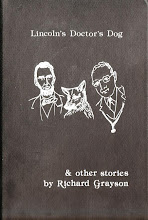
BOGG Magazine reviews Richard Grayson's LINCOLN'S DOCTOR'S DOG


BOGG Magazine has a review of Richard Grayson's Lincoln's Doctor's Dog in issue #49 (1982) by editor/publisher John Elsberg:

Lincoln’s Doctor’s Dog, by Richard Grayson, White Ewe Press, PO Box 996, Adelphi, Md. 20783, 1987 pp., hdbk., $11.95.


Richard Grayson’s third collection of short stories proves that the magician’s hat is far from empty. I must confess that the lead-off story does little for me, but after that Grayson’s funnier than Steve Martin. His characters are troubled, ridiculous, and poignant with a capital P. They run the gamut from a lawyer who collects Time magazine covers, to Blanche “Spongecake” Bernstein, Patty Hearst imitators, and Sparky, Lincoln’s doctor’s dog (Sparky allows Grayson to roll that publishing canard about best sellers being books about Lincoln, doctors, or dogs, into one impossible alloy.) Grayson constantly loses control of his stories and his characters (reminiscent of Pirandello and Flann O’Brien) and they do or say things that reveal mischievous facets of their author’s personality. Or do they? Grayson is a sharpie. It’s impossible to tell how many layers we would have to peel away before we arrive at the real Grayson. We begin to believe that all of the characters are really him. We believe they are telling us the truth. That’s where the art comes in.
"Some orgasms are better than others," I tell my fiancee.

"So what?" she says.

– from “Roominations”

Grayson pumps his stories full of topical details. Everything from products (Tropicana), songs, films, t.v. shows, to news items (swine-flu shots, recipes), and all sorts of personalities (Yuri Gagarin, Van Johnson, Larry Flynt, John Gardner, Steve McQueen, et al.) to provide a cornucopia of everyday life in the US. He tops it off with outrageous puns. In this book we meet a boy who lives with a porpoise, another who goes to his first X-rated movie and falls in love with the star, still another who really gets involved with the calls he answers as a switchboard operator. But this book also contains three stories that are serious departures from anything I’ve seen in the past – “Early Warnings,” “Cross in the Water,” and “I, Eliza Custis” (the latter being the first-person story of George Washington’s granddaughter) are adventures in more traditional storytelling.
"Y'know, just living longer gives you confidence. . . That's one ting you'll find out here."
– from "18/X/1969"

The 22 stories in this beautiful black hardback do just that: we can count on Grayson to show us how to live from day to day.

Tuesday, May 1, 1979

Kirkus Reviews reviews Richard Grayson's WITH HITLER IN NEW YORK


Kirkus Reviews today (May 1, 1979) reviews Richard Grayson's With Hitler in New York:

Grayson, Richard
WITH HITLER IN NEW YORK
And Other Stories
Taplinger $7.95
6/15 LC: 78-20695
SBN: 8008-8406-X


Grayson has little more to offer than a lot of youthful energy in this collection; he gives each of his story ideas a good shove -- but that's about it. Hitler, for example, arrives in Brooklyn to no great effect: "Ellen's mother doesn't talk to Hitler except to say 'Pass me that salt bagel.'" -- and it's that one joke over and over. In Grayson's vignettes of normal Jewish family life, his autobiographical hand isn't so shy to show itself, but it does nothing with the raw material. Other pieces fall into a flat, modish style: "Mara wants to go to the North Sea., Helmut has too much work to do. Go alone, he tells her. But she wants to know how he will get up in the morning without her. Helmut sighs and says he can manage it. But Mara feels guilty and decides to stay home." There's the requisite self-conscious humor: a short story crticizes back its idle readers, a character named Placenta cries, "You're the narrator, you do something." What Grayson lacks most seems to be patience and follow-through; after offering an outrageous premise or a few jokes, he doesn't know what to do -- so he merely repeats them. A bit of promise, then -- but as a storytelling craftsman, Grayson has a long, long way to go.

Tuesday, December 12, 1978

Aspect Magazine features Susan Lloyd McGarry's "Twenty-Seven Statements I Could Make About Richard Grayson"


The latest issue (#72/73, 1978) of Aspect magazine features Susan Lloyd McGarry's "Twenty-Seven Statements I Could Make About Richard Grayson" on pages 88-91.