Pages

Showing posts with label humor. Show all posts

Saturday, January 19, 2008

Kirkus Discoveries reviews Richard Grayson's WRITE-IN: DIARY OF A CONGRESSIONAL CANDIDATE IN FLORIDA'S FOURTH CONGRESSIONAL DISTRICT

Kirkus Discoveries has reviewed Richard Grayson's WRITE-IN: Diary of a Congressional Candidate in Florida's Fourth Congressional District:

WRITE-IN
Diary of a Congressional Candidate in Florida's Fourth Congressional District


Author: Grayson, Richard


Review Date: JANUARY 18, 2008
Publisher:Dumbo Books
Pages: 128
Price (paperback): $9.95
Publication Date: February 22, 2007
ISBN (paperback): 978-0-6151-4111-4
Category: AUTHORS
Classification: NONFICTION

A witty campaign diary by a wannabe Congressman far too clever to ever be elected.

In the spring of 2004, Grayson announced (mainly to himself) his bid to unseat the firmly entrenched Republican incumbent in Florida’s fourth Congressional district. Grayson’s long-shot run was made even longer by a number of factors: First, a South Floridian, Grayson had neither the time nor the money to travel to the Florida fourth, located on the Georgia border. Second, unable to afford the $9,000 filing fee, he could only run as a write-in candidate. Third, he was a gay, pro-choice, anti-war, anti-death-penalty liberal running for office in the state’s most conservative district. These insurmountable challenges—and the biting humor with which Grayson faced them—led one sympathetic journalist to call him “every seasoned politician’s worst fear: a verbose, unknown, unrestrained, write-in mock-challenger.” Grayson chronicled his efforts as a “mock-challenger” in a series of postings on McSweeney’s Internet Tendency website, and here he collects these postings in a slim, delectable volume. The author’s wry deadpan punctuates almost every entry, and his commentary is equal parts funny, sad and true. He benefits as much from his own droll intelligence as from the fact that American politics seem to have devolved into a theatre of the absurd; some of the best laughs come from Grayson’s merely transcribing passages from election questionnaires, publicity packets and political journalism that he encounters during his “campaign.” Nonetheless, the critique of election politics that his run represents is as hilarious as it is completely legitimate; gerrymandering and the incredible advantages of incumbency have resulted in a system where challengers for U.S. House seats—both “mock” and real—are defeated the vast majority of the time. And after reading this, one is left with the sinking feeling that even a thousand Graysons might never change this broken system.

Funny and devastatingly incisive.

Thursday, June 3, 2004

ÜBER features Richard Grayson's "Naming a New Cabinet"


ÜBER features Richard Grayson's "Naming a New Cabinet" today (Thursday, June 3, 2004).

Monday, January 12, 2004

Richard Grayson's "Girl With Pearl Drops Toothpaste" at YANKEE POT ROAST


Richard Grayson's "Girl With Pearl Drops Toothpaste" appears today (January 12, 2004) at Yankee Pot Roast:


Girl with Pearl Drops Toothpaste (1978)

One of the finest of Ed Kligenstein’s commercials for Doyle Dane Bernbach, this sixty-second spot creates a mood defined by the radiant, all-American glow of the girl as she turns toward the viewer to hawk the tooth-whitening product. Her ash-blonde hair and the blue blouse that clings to her ample teenage bosom enhance her completely disarming row of glistening teeth.

In a departure from the time-honored practice of TV toothpaste ads, Klingenstein has eschewed the usual white background, instead placing the girl in front of a plain black wall that suggests the blackboard of a high school classroom. Instead of the traditional headshot (as in the classic Close-Up commercial featuring a young John Travolta), the money shot here presents a bust-length portrait of the girl, her body accentuated by the three-dimensional effect of the receding dark background.

In its immediacy and image, “Girl With Pearl Drops Toothpaste” demonstrates how different Klingenstein’s approach was from other commercial directors’ of the period. Avoiding an extreme close-up, the camera relies on the actress’s subtle gaze to suggest an altogether fresh but somewhat bratty demeanor that could indicate that we are in the presence of a girl who would not be caught dead with Marlboro-stained teeth.

Also evident is the patient manner Klingenstein must have employed doing the shoot; here, the TV does not merely delineate the forms of youthful bleached incisors but instead embodies and defines them.

Klingenstein’s lines are even more freely executed, as when the girl asks the viewer, “How do your teeth feel?” and, barely waiting for the reply, suggestively flicks her tongue over the top row of her spotless teeth and intones the timeless Pearl Drops slogan, “Mmmm... It’s a great feeling.” The composition of these five words, coming immediately after the flitting tongue movement, creates an unforgettable icon, complete with fresh breath, a sparkling smile, and an invitation to a kiss.

While the girl’s pose suggest a portrait, the features here are purified so that the viewer does not think the actress represents a specific female; instead she is presented as an idealized version of the American teenage girl. This refined figure of Klingenstein’s mature work for DDB stands as an eternal reminder of his place in 20th Century advertising.

Monday, April 17, 2000

Publishers Weekly reviews Richard Grayson's THE SILICON VALLEY DIET


In "Notes on Fiction," the current (May 15, 2000) issue of Publishers Weekly has a brief review of Richard Grayson's The Silicon Valley Diet:

Compulsively talky and engaging disjunctive, the 12 stories in The Silicon Valley Diet, Richard Grayson's ninth collection, flash snapshots of gay men in their 20s, 30s and 40s battling it out in an online world. Lighter and funnier than much gay fiction, the stories riff on contemporary consumer culture (I'm wearing Calvin Klein chhinos like the sexy adolescents I spotted this morning in full-pages in Wired and Swing) and introduce sweet, mixed-up characters like Terence, who has a child "slept with a teddy bear -- even when he was practically, by his own admission, a teenage prostitute." Grayson knows New York City -- where many of these stories are set -- inside and out. (Red Hen,$14.95 paper 182p ISBN 1-888966-23-4; June)

Friday, August 17, 1990

Laughing Bear Newsletter reviews Richard Grayson's NARCISSISM AND ME


Laughing Bear Newsletter #29 (August 1990) reviews Richard Grayson's Narcissism and Me:


Narcissism and Me
by Richard Grayson
($5.00 + $1.00 p&h;
Mule & Mule, Publishers,
350 West 85th Street,
New York, NY 10024-3822)


Grayson's humor is best presented straight-forward and deadpan. This book's coated white cover and bold black type are clean, sharp, and demand attention.

Richard's work deserves a well-designed showcase. His experimental fiction combines humor with tragic touches to create real stories instead of jokes, and he's willing to take chances rather than go for an easy laugh. At the heart of his work, he can create sympathetic characters. Humor without strong characterization falls flat. Richard's short fictions are full of real people who stumble into the surreal and surreal people who happen to be real.

Saturday, July 4, 1987

Richard Grayson's Funhouse column in the Hollywood Sun-Tattler reports on an epidemic of humorlessness


Richard Grayson's Funhouse column in the Hollywood Sun-Tattler today (Saturday, July 4, 1987) reports on an epidemic of humorlessness.

Saturday, June 4, 1983

Gargoyle Magazine reviews Richard Grayson's LINCOLN'S DOCTOR'S DOG


The Washington, D.C.-based Gargoyle reviews Richard Grayson's Lincoln's Doctor's Dog on page 78 of issue 22/23 (1983):

___________________________________
Lincoln's Doctor's Dog, by
Richard Grayson, White Ewe
Press, P.O. Box 996, Adelphi, MD
20783, 1982, 187 pp., $11.95,
Hdbk.
____________________________________


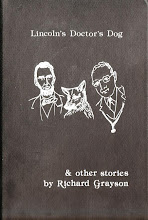
Don't let the cover picture or the title of Lincoln's Doctor's Dog, Richard Grayson's third collection of short stories, mislead you. Despite the realistic line drawing of Abraham Lincoln, a doctor, and a dog on the cover, the title story and the rest of the stories have nothing to do with a dog running to get Lincoln medical help or performing other heroic doggy deeds. Grayson couldn't care much less about Lincoln, his doctor, or his doctor's dog. This is bad news for all of you readers in search of sentimental mush about famous pets, but good news for those in search of a confirmed tongue-in-cheek.

In the title story, Richard Grayson thinly disguises a comic opera as a shaggy dog story. He shows off many of his favorite tricks: writing about writing; terrible plays on words ("Lincoln's doctor's dog's mother was a bitch"); a determination to involve the reader ("First of all, congratulations on your good taste in reading this story. . . But. . . I'd like you to consider if there's something else you should be doing at the moment."); manic speed (Grayson manages to race through all of the dog's life and describe a day in his own life in four pages); and using Richard Grayson as a major character.

One of the pleasures of reading Grayson is just watching him crank up his imagination and run with it. He experiments with different formats: question and answer, short paragraphs headed by adverbs, numbered fragments, and straight narratives. He tries writing about all sorts of different situations. His characters get paralyzed from flu shots, find work with the women of their dreams in x-rated movies, and have intimate relationships (including joketelling sessions) with porpoises. Going farther and father into an idea brings outstanding moments, such as this one in "Why Van Johnson Believes in ESP":
When Van Johnson first left Hollywood, his sister cried. He took her aside. . . and asked her, "Mabel, do you believe in dragons?" That was an old thing between them.

"Yes," his sister answered.

Then she didn't cry anymore and it was okay for Van Johnson to leave for Hollywood.

Grayson usually mixes up similar concoctions of absurdity and realism, with a dash of neurosis thrown in. My favorite stories capture an alienation, a sense of the individual as hopelessly puzzled as he or she stumbles through life. Expressed in "For the Time Being":
They do it with mirrors. That is how other people live. They have tricks I do not know about.

Not all of his efforts succeed. But you have to admire his reach (although you might wish he had exerted a little restraint by keeping the failures out of this collection). "I, Eliza Custis," the first-person tale of woe of George Washington's step-granddaughter, must have been a lot of fun to write in its ornate pseudo-eighteenth-century, self-pitying style ("But I feel it is important to me, having passed the age of fifty, to recount the events of my life for those who wish in the future to know the full story of my existence upon this planet."). But twenty-four pages of this quickly becomes tiresome. Also, Grayson's characters, despite the variety of their external circumstances, are very similar in internal circumstances.

But these are minor objections. Lincoln's Doctor's Dog is a lot of fun to have around the house and requires less effort than any other type of pet.

—Susan Lloyd McGarry

Wednesday, December 22, 1982

Library Journal reviews Richard Grayson's LINCOLN'S DOCTOR'S DOG in "Small Press Roundup: Best Titles of 1982"


In its December 15, 1982, Library Journal features a brief review of Richard Grayson's Lincoln's Doctor's Dog in its "Small Press Roundup: Best Titles of 1982":


Library Journal
December 15, 1982

LJ's SMALL PRESS ROUNDUP: Best Titles of 1982
By Susan Shafarzek

Pages 2303-2308


THE TIME is long past—if indeed it ever existed—when the small press world could be regarded simply as a haven for the beginning. True, the beginner often finds a place there, but, increasingly, so does the season talent, to whom the major publishing houses can no longer offer a venue. It appears that the alternative presses have become just that, and they are an alternative for the libraries, as well. Those interested in keeping to the front of aesthetic and literary trends will find the small press world a rewarding, supplementary source.

Not everything from the small presses is outstanding, of course. Many are still the province of the cranky and the refuge of the uninteresting, but looking over more than 300 small press books seen this year, more were found that were valuable than not. This review aims to provide a rounded sample of the best of these. (2303)

. . . .

Humor is also the hallmark of Richard Grayson's excellent collection, Lincoln's Doctor's Dog and Other Stories (White Ewe, $11.95, cloth). These range from the surreal and punning to the poignantly reflective. (2306)

_____________________________________
Susan Shafarzek, co-editor of the Washout Review, is on the staff of the Graduate Office of the State University of New York at Albany, in addition to her doctoral studies in the writing program there.

Thursday, April 29, 1982

Kirkus Reviews reviews Richard Grayson's LINCOLN'S DOCTOR'S DOG


Kirkus Reviews reviews Richard Grayson's Lincoln's Doctor's Dog in its May 1, 1982 issue:


Kirkus Reviews


May 1, 1982

Grayson, Richard
LINCOLN'S DOCTOR'S DOG
And Other Stories
White Ewe $11.95
5/5 LC: 81-69117
ISBN:978-0-917976-13-1


Grayson's two story collections--With Hitler in New York (1979) and this new one--together suggest the literary equivalent of a kid's messy room: cozy for the kid, junk strewn everywhere, but a little horrifying to anyone standing at the doorway. Grayson's most constant character here is himself-as-writer: "Please: you can see I'm a sick person. What would it take, a few pages in your lousy literary magazine, to make me happy? . . . If I can't have your respect, I'll settle for your pity. . . ." And pitiful indeed are many of these stories--cheap, silly, little more than names, puns, and jokes about the author's desperation for readers (hence the title). Still, there is something boorishly, oddly charming about Grayson's ability to stop in the middle of some childishly junky piece to ask, sincerely: "When I write myself into a corner, as I have done once more, do you have to give me credit for trying?" And there are two real short stories here--"A Hard Woman," "What Guillain-Barre Syndrome Means to Me"--which, though sketchy, indicate that Grayson can be a writer when he wants. For the most part, however: juvenile literary clowning, only faintly--and erratically--amusing.

Tuesday, June 26, 1979

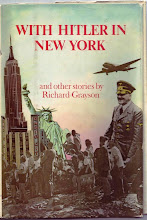
Daily News' Liz Smith column features Richard Grayson's WITH HITLER IN NEW YORK


Today's Daily News has a mention of Richard Grayson's With Hitler in New York in Liz Smith's column:

Daily News (New York)

Tuesday, June 26, 1979

Page 5


BABY RAVE: While Steve Martin's "Cruel Shoes" is going through the roof in book sales, let me point out another really funny book of short stories published at the same time, titled "With Hitler in New York," These tales by Richard Grayson are populated by Farrah Fawcett-Major, Sarah Lawrence of Arabia, Abe Lincoln and Hitler, to name a few.

I read Richard's book after the 27-year-old author wrote me a letter. "I live with my parents in Brooklyn. We are very poor, but we are honest and good and gossip-minded people." How could I resist?