Pages

Showing posts with label 20001. Show all posts

Thursday, October 29, 2020

Richard Grayson Letter in The New York Times: Electoral College Tie


Today, Thursday, October 29, 2020, The New York Times published readers' letters to the editor predicting the results of the 2020 presidential election.

To the Editor:

Although Joe Biden will win the popular vote, the Electoral College will be a 269-269 tie, and the selection of the new president will be in the hands of Congress, as last happened in the 1824 election. The Constitution provides for the House to pick the president if there is no clear winner, with each state delegation getting one vote, and the Senate to pick the vice president, with each senator getting one vote. 

The House will have a majority of Republican state delegations and so will re-elect President Trump. The Senate, with a new Democratic majority of 51 or 52 seats, will elect one of its own, Kamala Harris, as vice president. The United States will have a president and vice president of two different parties for the first time since the mid-19th century. 

Richard Grayson 

Philipsburg, St. Maarten


Tuesday, December 6, 2005

ROLL CALL covers Richard Grayson's DIARY OF A CONGRESSIONAL CANDIDATE IN FLORIDA'S FOURTH CONGRESSIONAL DISTRICT


Roll Call, the newspaper of Capitol Hill, today (December 6, 2005) has an article about Richard Grayson's WRITE-IN: Diary of a Congressional Candidate in Florida's Fourth Congressional District:


Life on the Campaign Trail

By Elizabeth Brotherton
Roll Call Staff

Tuesday, December 6, 2005


Remember the heated battle over Florida’s 4th Congressional district last summer?

You don’t?

Well, that’s probably because the race didn’t attract too much attention. But there was one.

It pitted incumbent Rep. Ander Crenshaw (R-Fla.) against writer Richard Grayson, a Democratic write-in candidate running on a platform in support of gay marriage, abortion rights, universal health care and immediate withdrawal from Iraq.

Keep in mind, this race took place in one of Florida’s most conservative districts.

So why did Grayson even bother?

“Voters are essentially disenfranchised,” said Grayson, now 54. “It’s frustrating, that yeah, we have a democracy, and yet most of the Florida Representatives were essentially unopposed. From both parties.”

Annoyed, Grayson decided to hit the campaign trail. He documented his journey in a series of diary entries published on McSweeneys.net, which have been put into a book titled “Diary of a Congressional Candidate in Florida’s Fourth Congressional District.”

Grayson was no rookie, either. He ran for president in 1984 and twice as a write-in candidate against Republican House Members, for similar reasons as in his race against Crenshaw.

“It was really a fun thing to do,” Grayson said of his latest campaign. “And I think having McSweeney’s publish the diary as I was writing it, with a couple weeks time lag, got attention.”

Grayson’s journey begins on May 7, 2004, the day the Florida Division of Elections posted his name as an official candidate in the race. But because he couldn’t afford the $9,000 filing fee, Grayson was listed as a write-in candidate. (Grayson notes in the book that in March 2004, Crenshaw had a war chest of $612,691.)

Throughout the diary, Grayson documents life on the campaign trail. Or rather, trying to get to there.

Grayson ran for the 4th district seat, a long, narrow stretch of land across the Northeastern part of the state that encompasses parts of Tallahassee and Jacksonville.

Even though he lived in South Florida.

See, in his home 22nd district, there was already a race under way between Republican incumbent Rep. Clay Shaw and Democrat Jim Stork. Grayson’s goal in running was to make a point, even if he didn’t stand much of a chance at getting elected.

“Every Congressional race in this country I would like to see have at least two candidates,” he said.

Grayson picked the 4th district because he noticed Congressional representation for Jacksonville was safely divided between the two parties, with Rep. Corrine Brown (D) holding the other seat.

“Basically, I had the feeling the two major parties pretty much like it the way it is,” he said. “They like the fact that the city of Jacksonville has one Democratic seat, one Republican seat.”

But since Grayson worked a normal day job from 8:30 a.m. to 5 p.m. Monday through Friday, he found it difficult to get to the Jacksonville area. He didn’t even set foot in the 4th district until Oct. 2 to do a television spot at a Jacksonville CBS affiliate.

So many of Grayson’s campaign efforts consisted of filling out surveys from various interest groups, ranging from the National Taxpayers Union to the Vision Council of America, and hoping somebody somewhere might hear of his candidacy and want to vote for him.

Then, he had to deal with people wanting to sell him everything from software programs to potholders.

“They don’t realize I’m running this campaign out of my studio apartment,” Grayson said. “What it tells me is that campaigns are very big business in this country. It’s sort of this whole class of people who make their money out of the election industry.”

As the months wore on, Grayson started to hit the trail a bit more, and it began to pay off. His proudest moment came in October 2004, when he was endorsed by the National Organization for Women Political Action Committee.

“I was actually touched by that, because it was probably the most serious organization that endorsed me,” Grayson said.

In the end, Grayson received 1,170 votes, which amounts to 0.5 percent of the total count. Crenshaw got the other 99.5 percent with 256,157 votes.

“I was sort of surprised. I got more votes than I expected,” Grayson said.

Grayson has not ruled out running again for office, although he admits his strong liberal views wouldn’t likely get him elected (“I think I’d have to find a new country,” he said).

And he got to do something in 2004 even many Members don’t get to do.

“I never had to pander for any votes, because frankly, I didn’t care if anybody voted for me,” he said. “I imagine some of the Members of Congress must envy that sort of thing.”

The “Diary of a Congressional Candidate” is available to purchase online at http://www.lulu.com/content/172015 or by visiting Grayson’s Web site at www.richardgrayson.com. The book costs $9.38, or $2.37 to download.

Saturday, June 4, 1983

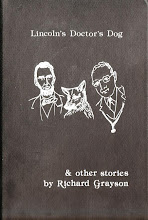
Gargoyle Magazine reviews Richard Grayson's LINCOLN'S DOCTOR'S DOG


The Washington, D.C.-based Gargoyle reviews Richard Grayson's Lincoln's Doctor's Dog on page 78 of issue 22/23 (1983):

___________________________________
Lincoln's Doctor's Dog, by
Richard Grayson, White Ewe
Press, P.O. Box 996, Adelphi, MD
20783, 1982, 187 pp., $11.95,
Hdbk.
____________________________________


Don't let the cover picture or the title of Lincoln's Doctor's Dog, Richard Grayson's third collection of short stories, mislead you. Despite the realistic line drawing of Abraham Lincoln, a doctor, and a dog on the cover, the title story and the rest of the stories have nothing to do with a dog running to get Lincoln medical help or performing other heroic doggy deeds. Grayson couldn't care much less about Lincoln, his doctor, or his doctor's dog. This is bad news for all of you readers in search of sentimental mush about famous pets, but good news for those in search of a confirmed tongue-in-cheek.

In the title story, Richard Grayson thinly disguises a comic opera as a shaggy dog story. He shows off many of his favorite tricks: writing about writing; terrible plays on words ("Lincoln's doctor's dog's mother was a bitch"); a determination to involve the reader ("First of all, congratulations on your good taste in reading this story. . . But. . . I'd like you to consider if there's something else you should be doing at the moment."); manic speed (Grayson manages to race through all of the dog's life and describe a day in his own life in four pages); and using Richard Grayson as a major character.

One of the pleasures of reading Grayson is just watching him crank up his imagination and run with it. He experiments with different formats: question and answer, short paragraphs headed by adverbs, numbered fragments, and straight narratives. He tries writing about all sorts of different situations. His characters get paralyzed from flu shots, find work with the women of their dreams in x-rated movies, and have intimate relationships (including joketelling sessions) with porpoises. Going farther and father into an idea brings outstanding moments, such as this one in "Why Van Johnson Believes in ESP":
When Van Johnson first left Hollywood, his sister cried. He took her aside. . . and asked her, "Mabel, do you believe in dragons?" That was an old thing between them.

"Yes," his sister answered.

Then she didn't cry anymore and it was okay for Van Johnson to leave for Hollywood.

Grayson usually mixes up similar concoctions of absurdity and realism, with a dash of neurosis thrown in. My favorite stories capture an alienation, a sense of the individual as hopelessly puzzled as he or she stumbles through life. Expressed in "For the Time Being":
They do it with mirrors. That is how other people live. They have tricks I do not know about.

Not all of his efforts succeed. But you have to admire his reach (although you might wish he had exerted a little restraint by keeping the failures out of this collection). "I, Eliza Custis," the first-person tale of woe of George Washington's step-granddaughter, must have been a lot of fun to write in its ornate pseudo-eighteenth-century, self-pitying style ("But I feel it is important to me, having passed the age of fifty, to recount the events of my life for those who wish in the future to know the full story of my existence upon this planet."). But twenty-four pages of this quickly becomes tiresome. Also, Grayson's characters, despite the variety of their external circumstances, are very similar in internal circumstances.

But these are minor objections. Lincoln's Doctor's Dog is a lot of fun to have around the house and requires less effort than any other type of pet.

—Susan Lloyd McGarry

Saturday, February 27, 1982

Washington Post Book World column "Book Report" features Richard Grayson and LINCOLN'S DOCTOR'S DOG


The February 28, 1982 issue of the Washington Post Book World features Richard Grayson and Lincoln's Doctor's Dog in its "Book Report" column:

Washington Post Book World column
Washington Post
February 28, 1982
Book World, page BW15

BOOK REPORT
By Michelle Slung

DOGS AND CATS


THERE USED TO BE a publishing joke, to the effect that the perfect mix of ingredients for a best-selling book would begin and end with the title Lincoln’s Doctor’s Dog. Doctors are still “in,” but maybe not so much as they used to be, before one of their number got murdered, and canines have been supplanted by felines. As for Lincoln, well, for a while, anyway, he had to take a back seat to the Nixon industry. Yet that hasn’t stopped one young writer, Richard Grayson, from calling his latest book exactly that — Lincoln’s Doctor’s Dog and Other Stories.

To be published in early May by Maryland’s White Ewe Press, it will join that column in Books in Print which features, among others, Lincoln’s Favorite Poets and Lincoln’s Religion, and perhaps in time a few ardent Lincoln scholars will find themselves ordering it by mistake. If so, they will encounter this sentence in the title story: “Lincoln’s doctor’s dog’s mother was a bitch.”

Meanwhile, in a contemporary variation on the same idea, Berkley-Jove has scheduled for next summer a trade paperback whose time may not have come and gone by then, The Preppy Cat. If that makes you want to stone the author responsible, you might find yourself hounded—excuse me—by the ASPCA, because the book is being listed as by Leland Stanford Cat VIII. In addition, Holt, Rinehart is proposing to bring out The Joy of Stuffed Preppies in the early spring. Here again, the authors are hiding behind fictitious identities, publishing as Randall C. Douglas III and Eric Fowler. The title, for sure, is open to a number of interpretations, and they’re probably right to protect themselves.

Tuesday, December 25, 1979

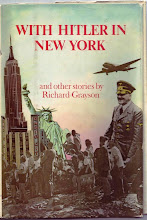
Washington Review of the Arts reviews Richard Grayson's WITH HITLER IN NEW YORK


The December 1979-January 1980 issue of the Washington Review of the Arts reviews Richard Grayson's With Hitler in New York on page 34:

WITH HITLER IN NEW YORK by Richard Grayson,

Taplinger Publishing Company, 200 Park Avenue South,

New York, New York, 10003, $7.95


The title story of this collection of stories by Richard Grayson begins:

"Hitler's girlfriend and I are waiting for him in the International Arrivals Building at Kennedy Airport. Ellen and I stand in front of the West Customs Area. My brother is standing in front of the East Customs Area. He is waiting for my parents. My parents and Hitler have each landed at the same time, at seven o'clock. My parents are flying KLM from Saint Maarten. Hitler is flying Laker from London and Manchester . . ."

Hitler arrives in a leather jacket. He suffers from jet lag. He has breakfast at McDonald's – he likes fast food. Hitler and friends have dinner at Shakespeare's in the Village and Hitler hopes for another New York blackout. Later Hitler dunks his girlfriend in the swimming pool:

"'You're a sadist, you know that?' Ellen says to Hitler after they get out of the pool. Hitler shrugs. 'He did the same thing to me in Greece last year,' she says."


This is the closest Grayson comes to characterizing the familiar Hitler. Otherwise Hitler drinks Becki's beer and makes jokes and tried to cheer the narrator up when his grandfather dies. The story ends, "Hitler put his hand on my shoulder and tells me to sleep well."

This story, "With Hitler in New York," is wry and funny and wonderfully imaginative. And Grayson avoids what might be expected – either intrusive fantasy or broad comedy. The tone instead is cool and neutral. Watching Grayson pull off this story is like watching a flying Wallenda. It is dazzling and dangerous.

"'What do you think of Hitler?' Ellen asks me as I take her to her parents' house. We are driving along the Belt Parkway at midnight with our car windows wide open, but there is not a hint of a breeze.

'I kind of like him,' I say. 'I never realized he was so witty.'

Ellen kisses me on the cheek at her parents' house. I watch to see that she gets in safely."


In its bland, neutral control, the story is chilling not only because of the subject but the irony of the setting. The setting is nice, everyday family. The friends seem genuinely friends. The narrator is touchingly grieved at his grandfather's death and sympathetic in his concern and observation of Hitler. The tone and realistic style of the story creates a jolting closeness. "With Hitler in New York" implies that the fantasy of the supermarket tabloid is close to true, closer than the news that's fit to print.

Richard Grayson is thirtyish, but he has published over a hundred and thirty stories, two of them "Understanding Human Sexual Inadequacy" and "Super Fab Senators," in the Washington Review. The dissimilarity of these two stories is not atypical. Grayson uses more diverse forms than any story writer I know. At the same time he maintains a distinctive quality that blends. Unlike many collections of short stories, which to read at once is like eating a quart of ice cream in one sitting, these stories are varied and spicy enough to urge you on. In fact, the numbers and versatility of Grayson's stories give the impression that stories must light on him like flies. If God is in the details, as someone said, it is also true that stories are in details, and Grayson seems not only good at detail but sees than even at varying levels when accumulated, they can make a story. Take "Peninsular People":

"The Weitzes, who live on the peninsula, are a five-surfboard family. They are aspiring or failed actors; they are psychology majors turned dancers; they are mountain climbers and real estate saleswomen and managers of Burger Kings. The Weitzes live above their means. All of them smoke marijuana, and are liberated, and are Unitarians, and are bored . . .

"There is Mrs. Vincente, who didn't listen to people and refused to put her mother in a home, and her son Louis, who keeps taking the law boards in hopes of scoring better and who is marking time in the meantime. They like living on the peninsula."


Grayson often uses "names" of our time, underlining, like Warhol, our perpetual consciousness of "names" and employing them, as Warhol did, as an emotional reflection of our culture. Presented here are stories on Justice Burger and Pol Pot. Appearing are Farrah Fawcett-Majors, Fulton J. Sheen, John Ashbery, and others. Grayson uses them best in a casual off-handed way as he does in "In the Lehman Collection." Or "Real People," a story based on the national game of "guess-who-I-saw-today":

"Betty Friedan is walking across City Hall Park. She is not wearing a bra . . ."

When the names themselves dominate the story as in "Chief Justice Burger, Teen Idol," the device is too obvious. The same is true, I think, in "Lincoln on the Couch," an historical flashback. The author seems forced to balance the obviousness of the device with an equal degree of outrageousness and irreverence. But even so, Grayson uses the incongruity of the language to create fresh and funny scenes:

"Yuck, thinks Mary Todd, looking across the breakfast table at her husband's face . . ."

In a different form of story, "Go Not to Lethe," a TV soap opera is celebrating its twenty-seventh anniversary with its twenty-seven year star Grayson Richards and his co-starring Jewish family. "Au Milieu Interieur," which first appeared in the anthology Statements 2 published by the Fiction Collective, is composed as a series of questions. It begins, "What is a dream?" The development of the story is the characterization of the narrator, which is both complex and fascinating. "Au Milieu Interieur" is an example of how fine an experimental or innovative form can be when handled by a writer who understands the organic development of a story.

Throughout all these stories Grayson's style is supermarket informational with intrusive irrelevancies. Though Grayson refuses to limit himself, especially in the Jewish family stories he will resort to a traditional setting and atmosphere. But commonly the irrelevant details is presented with as much weight as the supposedly "important" facts, making a scene as non-selective as experience itself (which is of course ironic since Grayson as the artist is ultimately controlling and selective). Some of the most successful stories are the scenes of the Jewish family. "Slowly, Slowly in the Wind" begins:

"Here we go again. Grandpa and Grandma have taken the newspaper coupons and the shopping cart and gone out to Pantry Pride. I am in the apartment watching Great-Grandma Chaikah. She is watching Dinah Shore.

'You know she's Jewish?' Great-Grandma Chaikah says. 'Southern but Jewish.'

I nod. The bell rings. It is Mrs. Brody, our neighbor."


There is also more to enjoy in this book than stories. The introduction by the author is so nice you want to run to the phone and urge Richard Grayson to begin his autobiography immediately. Even "A Note on the Type" is a lark:

"Few people have noticed the similarities between the fiction of James M. Cain and the poetry of Wallace Stevens. Of course, the common denominator is that both are set in Electra . . ." And "Exquisite pornography," it tells us, "is often set in Granjon."

I must admit that there are one or two stories in With Hitler in New York that I could have done without. "Ordinary Man," a sort of science fiction story, is one. And I wish Grayson would rewrite "The First Annual James V. Forrestal Memorial Lecture" because it begins marvelously and then disintegrates, which the story itself admits. I say that, knowing that probably fourteen new stories are buzzing around Grayson this instant. But I say it because Angela Cozzarelli, who is practicing to be the great intellectual figure of the 1990s and the nice Jewish boy who went to the Newman Club picnic to watch his heartthrob Eddie Dugan play softball without a shirt, deserve better. They are individual and real and wonderfully conceived. The fact is that even in a story one might quarrel with, Grayson is still so good there is always a lot to like and admire.

This is a terrific book. Read it. Give it to your friends.

– PATRICIA GRIFFITH

Friday, June 1, 1979

Gargoyle Magazine reviews Richard Grayson's DISJOINTED FICTIONS


The Washington, D.C.-based literary magazine Gargoyle reviews Richard Grayson's Disjointed Fictions in issue 11 (May 25, 1979):

Disjointed Fictions - Richard Grayson,
X, a journal of the arts, PO Box 2648,
Harrisburg, PA 17105. 42pp. perfect
bound, $3, 1978.


Grayson seems to crop up everywhere these days. Perhaps the most prolific short story writer in America. Of the six stories in this book, "Inside Barbara Walters" is hilarious, and "Progress" even better. Like Grayson says, "We are all children of television. My first word was Boraxo." Catch him quick, before his big new book comes out this spring from a major New York publisher.