Showing posts with label Lincoln's Doctor's Dog. Show all posts
Showing posts with label Lincoln's Doctor's Dog. Show all posts
Tuesday, October 21, 2025


Tuesday, December 11, 2018

Wednesday, January 10, 2018

Tuesday, November 21, 2017

Wednesday, August 23, 2017

Saturday, August 12, 2017

Saturday, August 5, 2017

Friday, July 28, 2017

Wednesday, July 19, 2017

Saturday, July 15, 2017

Saturday, July 1, 2017

Wednesday, June 28, 2017

Saturday, June 24, 2017

Saturday, June 3, 2017

Saturday, April 29, 2017

Saturday, April 15, 2017

Monday, December 6, 2010
Richard Grayson E-Books Now Available for Under $1 at Google E-Bookstore and Indie Stores like Changing Hands, Powell's, WORD and Greenlight Bookstore

With the launch today of Google's E-Bookstore, many titles of books by Richard Grayson are now available as Google eBooks for 95 cents each. We are working at getting other titles online as soon as possible.

You will soon also be able to buy Google eBooks by Richard Grayson at some of our favorite indie bookstores like Tempe's Changing Hands Bookstore, Fort Greene's Greenlight Bookstore, Greenpoint's WORD and Portland's Powell's Books.

Other favorite indie bookstores we've loved over the years that will be selling our Google eBooks are Books & Books in Coral Gables and Miami Beach, Elliott Bay Book Company in Seattle, Skylight Books in L.A., The Garden District Book Shop in New Orleans, and Kepler's in Menlo Park.
Saturday, February 21, 2009
Adding It Up: We review the February 22, 2009 Sunday New York Times Book Review

The New York Times Book Review for February 22, 2009 is back to where it was the first two weeks in February, at 24 pages, and sadly, the news about the book review's most crucial function - to bring in advertising revenue for the company - has reached its nadir.
The cover has no ads. Since other sections of the paper, including the front page, now have ads, we still think ads would be a good idea here. There's a lot of space devoted to an old B&W pic of the pool at the Fontainbleau (pronounced "Fountain-blue"). Feh. We always preferred the pools further north at the Carillon and the Sheraton Bal Habour, places where we could see old-time celebrities in bathing suits (Ronnie Dyson, cute; George Meany, not so much).
Page 2: Full-page ad for a Maeve Binchy novel published by Knopf, that publisher again coming thru to rescue page 2.
Page 3: Table of contents page has side ad for two Ana Grey mysteries by April Smith. Or maybe it's two April Smith mysteries by Ana Grey? Whatever. Counts as 40% of a page in our estimation.
Page 4: The Editors' "Up Front" flanked on the left by a decent-sized ad for a Little, Brown scary book or two. Counts as 60% of a page, which means we've so far got two full pages of ads out of four pages. If only the whole issue could be half and half! Alas, no.
Page 5: Boring letters and some "postcript," about Susan Sontag, whose heirs should have known better than to publish her immature diaries. But also a 40% right-hand ad from Henry Holt, another detective book.
Page 6: A left-hand ad for the New York Times Store. Counts as no ads.
Page 7: A little right-hand ad for some conference on Southern literature in Chattanooga. We can't afford choo-choo fare, but it counts as 25% of a page (we're in a generous mood).
Page 8: Pic of Crockett and Tubbs from our days in South Florida but no ads. From here on in, ads are going to be as scarce as pastel unconstructed sports jackets.
Page 9: No ads.
Page 10: No ads.
Page 11: No ads.
Page 12: Bupkis.
Page 13: Nada.
Page 14: Zilch.
Page 15: Nothing in the way of ads.
Page 16: Nope.
Page 17: No ads, but a nice pic of Miller Williams, whom we last saw in September 2001 when he and the missus joined us, our pal Crescent Dragonwagon and others at a Fayetteville restaurant for a bite after a poetry reading.
Page 18: No ads.
Page 19: We'll count this as 50% of a page, ignoring the New York Times Store ad for another food book. There's two Abraham Lincoln-related ads, and as we can personally attest, Lincoln always sells books. Apparently Honest Abe is good for ads too.
Page 20: No ads.
Page 21: Two right-hand is from NYTBR ad stalwart Other Press, who've earned a link (probably sausages too). Counts as 40% of a page.
Page 22: Um, on the left 40% of the page are two classified and an ad for Traveler's Language Courses, as well as to no-count ads for the New York Times Store. Let's count this as 30% of a page. We're in a good mood.
Page 23: An essay called "Can't. Stop. Writing." But. No. Ads.
Page 24: This is the shocker, folks. The back page: a primo space to put ads. And what do we have? An ad for a book about Ted Kennedy, whom we love, but it seems to be from The Boston Globe although the book's published by Simon & Schuster. It's by a team of Boston Globe reporters. The Boston Globe is owned by the New York Times Company, just as we own The Los Angeles World-Telegram & Star.
We need a decision from the ref. Ref?
He says it doesn't count as an ad! No ad on the back page of this week's New York Times Book Review! The crowd goes wild!
Adding it up: Last week we had seven and a half pages of ads out of 28 pages. This week, out of 24 pages, only 3.95 pages of ads. (Check our arithmetic and comment if we're wrong.) Last week we had 4 full-page ads alone. Sell your stock! As of yesterday, they're not giving dividends anyway.
We are sending a red velvet cake from Brooklyn's CakeMan Raven to the Times display advertising department to tide them over until the layoff notices arrive.
Don't forget to eat the crumbs, guys! It's going to be a long recession!
Monday, July 3, 2006
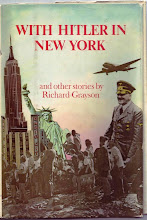
QueerType on Richard Grayson's WITH HITLER IN NEW YORK

Jameson Currier writes about "With Hitler in New York" at his blog QueerType on July 2, 2006:
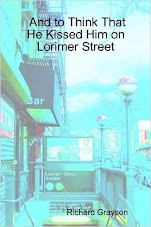
Three Discoveries: During the spring, works by three writers came to my attention that I can highly recommend, one is Richard Grayson's surreal and thought-provoking short story, "With Hitler in New York," which was also the title of a collection of his short stories that were published in the late 1970s and which has been recently reissued. In the story, Hitler becomes a stand-in for the alienation and discrimination many Germans felt in the decades after the war. The story is readable on-line via a link on Grayson's Web Site. (http://www.richardgrayson.com/) Grayson also has an impressive political background (in the 1980s he was a Presidential candidate), but it is his short fiction that intrigues me most. His other collections worth exploring are Let Slip the Dogs of War, Lincoln's Doctor's Dog and Other Stories, and his most recent collection, And to Think He Kissed Him on Lorimer Street.
Sunday, May 5, 1985
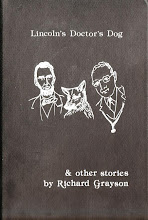
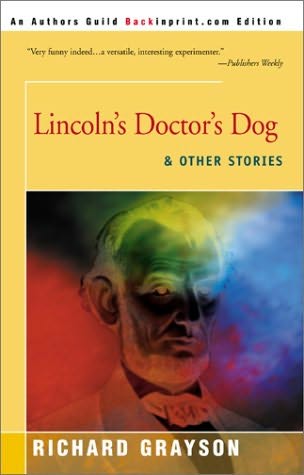
MENU MAGAZINE reviews Richard Grayson’s LINCOLN’S DOCTOR’S DOG & I BRAKE FOR DELMORE SCHWARTZ
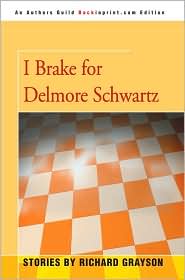
Menu Magazine’s first issue (1985) reviews Richard Grayson’s Lincoln’s Doctor’s Dog and I Brake for Delmore Schwartz:
Reading Richard Grayson is like banging your elbow hard on something: the pain is there, but the initial tingling feeling brings an involuntary gasp of laughter. In nearly all of the stories in Lincoln’s Doctor’s Dog and I Brake for Delmore Schwartz, Grayson presents painful situations of verying [sic] degrees but equal intensity. Shame, embarrassment, incompetency, greed and grief are the dominant emotions of his works. But that initial tingling feeling—the urge to laugh against what you know is bound to come—is created by Grayson’s uncanny, ironic perception of human nature in the most desparate [sic] of situations.
One is quite tempted to lump Grayson in the contemporary category of “confessional” writer. Most often, the central character in each story seems an extension of Grayson himself. Common themes deal with bisexuality, Judaism and writing. And if the reader lacks knowledge of Grayson’s personal background, the plotlines can seem downright nonsensical. That by the end of each book the reader feels a certain intimacy with the author is no mere coincidence, so completely does Grayson embody each character, theme and incident with shades of his own voice.
Or does he? That is the enigma, the final enigma, of each Grayson story. Each story smacks of “the voice” that so broadly comes forth in “Diarrhea of a Writer,” in which Grayson treats writing as if it were the ultimate indulgence. When the reader encounters a familiar story form in which the characters are active rather than passive, he is apt to read it warily, just waiting for “the voice” to address him directly. In one hilarious piece, “For the Time Being,” “the voice” interrupts a pathetic reminiscence by a pathetic adolescent who measures his worth through a collection of autographed magazine covers. “The voice” stops the action and confirms what the reader already suspects: “The ‘I’ of this story is really me, Richard Grayson, and not some literary device. You can call this fiction if you want to, but it is true.” What follows is an emotional tirade on the repeated rejections the writer must face.

The hook is established. One constantly searches for symbolism, and thanks to Grayson, is easily satisfied. But, thankfully, Grayson is not the Sylvia Plath of contemporary fiction; nor do his stories evoke the whining self-pity confessional writers thrive on. When Grayson recants [sic?] tales of his childhood (“Appearance House”), sexual awakening (“18/X/1969”), the shame of the Holocaust (“Reluctance”), the anguish of writing (“Nice Weather, Aren’t We”), he tempers the barest of human emotions with gentle twists of irony and sharply seasoned satire. Those are his structures, in the confines of which lie much deeper questions the reader must ask himself. In short, the passive technique Grayson so expertly employs invites action on the highest level by the reader. And that, though “the voice” would be hard-pressed to admit it, is what good fiction is about.
That Grayson so openly laughs at himself is what makes the tragedy of his stories so bearable. Through “the voice,” Grayson makes it quite clear that things are not always what they seem. Life is a prism to Grayson, and he sees through its spectrum by satire, siphoning the light colors from the dark, even though the dark may be the most brilliant. By repeatedly returning to adolescence (“Robin, Remontant,” “Only Time Will Tell”), Grayson goes back to a time when what we expect to be and what we are becoming are two different things. The pain that comes in recognizing and accepting that fact are the cornerstone emotions of those pieces. And Grayson’s penchant for history (“The Story of William Henry Harrison’s Cold,” “Summoning Alice Keppel,” “Lincoln’s Doctor’s Dog”) supremely shows the irony of fate against the sharpest calculations.
Considering Grayson’s skill at presenting the dark side of life so enjoyably, it is somewhat surprising that the story that captured this writer most was “The Smile in the Closet.” Here, Grayson writes of a man so totally alienated from “the voice,” the story seems strangely out of context: “Secretly, you see, he was happy. . . Perhaps, he kept thinking, one day he would go back to normal. But somehow he never did. And: “. . . there was no demarcation line, no DMZ between optimism and pessimism, no date that he could pinpoint the time when he finally decided that the good in life far outweighed the bad.”
Funny, touching and supremely talented, Richard Grayson is an author who draws equally well from the human heart’s strengths . . . and its weaknesses.
—Reviewed by Susan Kurnas
Subscribe to:
Posts (Atom)