Pages

Showing posts with label WRITE-IN: Diary of a Congressional Candidate. Show all posts

Friday, March 12, 2010

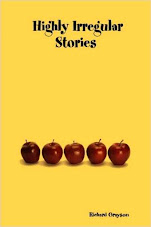
DIARY OF A CONGRESSIONAL CANDIDATE by Richard Grayson now available at Amazon Kindle store


Richard Grayson's Diary of a Congressional Candidate is now available at Amazon's Kindle Store for 99¢.

The product description is taken from the Kirkus Discoveries review of a previous print edition of the material:
A witty campaign diary by a wannabe Congressman far too clever to ever be elected. In the spring of 2004, Grayson announced his bid to unseat the firmly entrenched Republican incumbent in Florida’s fourth Congressional district. Grayson’s long-shot run was made even longer by a number of factors: First, a South Floridian, Grayson had neither the time nor the money to travel to the Florida fourth, located on the Georgia border. Second, unable to afford the $9,000 filing fee, he could only run as a write-in candidate. Third, he was a gay, pro-choice, anti-war, anti-death-penalty liberal running for office in the state’s most conservative district. Grayson chronicled his efforts as a “mock-challenger” in a series of postings on McSweeney’s Internet Tendency website, and here he collects these postings in a slim, delectable volume. The author’s wry deadpan punctuates almost every entry. Funny and devastatingly incisive.

Friday, June 13, 2008

Friday Evening at Desert Island: Johnny Ryan & Angry Youth Comix


This evening, on our way home to Dumbo Books HQ from dinner in Astoria, we got out of the G train at Metropolitan Avenue and stopped by Desert Island, our friendly neighborhood comic book store, to catch part of the party for the brilliant Johnny Ryan, who was signing copies of his newest Fantagraphics Books release of Angry Youth Comix #14.

We first discovered Johnny when giving a reading at Chicago's Quimby's Bookstore almost exactly seven years ago, when we were publicizing the Red Hen Press-published The Silicon Valley Diet. As a honorarium, we were given a $20 gift coupon, which we used to purchase . It had a wonderful story featuring a disgusting protagonist, Loady McGee, whose even more disgusting roommate, Sinus O'Gynus, invents many unneeded devices, such as an electronic Jew-detector.

However, we left our copy at the Ragdale Foundation's library for future artists, writers and composers at that artist's colony to enjoy, and in our mind the title somehow morphed to Angry Teen Comics. So we made a boo-boo when we published the last line of the preface to Dumbo Books' WRITE-IN: Diary of a Congressional Candidate in Florida' Fourth Congressional District.

If you wish to see our error in the WRITE-IN preface, a version of it is here.

Anyway, we were too embarrassed to mention this to Johnny Ryan or to tell him tonight that we didn't even remember the name. We will now. He's a talented artist and writer, and Desert Island has been a wonderful addition to our neighborhood for the crowd at the party tonight. They were all very nice, very hip and the most unatheletic group of people we've seen in a long time. Isn't life wonderful!

Saturday, February 9, 2008

Interview with Richard Grayson, Author of WRITE-IN, at Florida Book Revi

Tom DeMarchi has reviewed Richard Grayson's Write-In: Diary of a Congressional Candidate in Florida’s Fourth Congressional District and interviewed Richard at The Florida Book Review:

In 2004, fiction writer Richard Grayson campaigned as the Democratic write-in candidate against incumbent Republican Ander Crenshaw for Florida’s 4th Congressional District, a move roughly akin to Harvey Fierstein crank calling Evander Holyfield for the Heavyweight Boxing Title. (In the end, Crenshaw received 255,448 votes; Grayson received 1,167.) Grayson’s hilarious, informative account of his 2004 campaign first appeared as a blog on McSweeneys.net.

In 2007, Grayson compiled his blog entries and published them as Write-In: Diary of a Congressional Candidate in Florida’s Fourth Congressional District, through his own press, Dumbo Books. He plans on publishing books by other authors later this year. Write-In might be a collected blog, but it unfolds like much of Grayson’s fiction. On display we find suspense, humor, self-mockery, absurdity, telling details, deep knowledge of the subject matter, and a narrative voice informed by humility, fierce intelligence, and compassion. It makes you wonder what Grayson could accomplish if he took his campaign more seriously. Grayson has campaigned for Congressional office multiple times. A lifelong political activist, he’s currently running as the Democrat against incumbent Republican Jeff Flake for Arizona’s 6th Congressional District.

Florida Book Review: Are you a fiction writer who campaigns or a candidate who writes fiction?

Richard Grayson: Yes.

FBR: Throughout Write-In you admit that your chances of winning are slim and none. Your chances against Flake are equally bad. Why invest so much time, money and energy toward running in unwinnable races?

RG: For the same reason I write books of short stories that are unwinnable in the marketplace, I guess. Because I enjoy doing it.

But I really believe that contested elections are important in a democracy. One of the reasons we tend to have a partisan war with hysterics on both sides in Congress is that the vast majority of districts are safe seats. I testified at the state commission that did the redistricting in 1991, following the 1990 census, when they met in Gainesville. Karen Thurman, the current Democratic party state chair, was on that commission, and surprise, one of the districts created was one that centered around her state senate district and she got elected to Congress (a seat she lost after the 2000 redistricting).

The Ocala Star-Banner, Orlando Sentinel and Gainesville Sun ran stories on my testimony. I showed some drawings I'd made of my proposed districts. For the Orlando area, I'd created a Congressional district in the shape of Mickey Mouse ears. For Brevard County and the Space Coast, my district was shaped like a rocket ship. I had a gator-shaped district centered around Gainesville and a palm-tree-shaped district in Palm Beach County.

I was in my first semester of law school, and one of the members of the redistricting commission, former House speaker Jon Mills, director of UF Law's Center for Governmental Responsibility, asked for my drawings so that they could have them for the official record. Three years later, Jon became my boss when I went to work as a staff attorney at CGR, but he made sure he kept me out of any work we did on the electoral process!

John Anderson, whom I voted for in the November 1980 election for President—the only time since 1972 I didn't vote for a Democrat—and whom I mention in my book, is now a Nova Southeastern law professor whom I got to know during my four years as an administrator at the law school John has studied the issue with colleagues, and they've done some brilliant scholarly writing on the problem of the gerrymandering that has turned the vast majority of U.S. House seats "unwinnable," as you say, for one party or the other. He's also proposed several innovative solutions that work in other nations, such as multi-member districts (which we used to have in the Florida legislature when I moved to the state in 1980) and preference voting.

It annoyed me that so many Florida incumbents in Congress were "elected" on that day in May when they filed for reelection and no one bothered to oppose them. In 2002, living in Davie, I got a ballot I had gotten several times in the past: there's not even a spot for the U.S. House race. You'd think at least you could vote for the incumbent or not vote for him or her. But Florida doesn't do that, and I find it sad.

As a hopeless candidate, I don't have to worry about fundraising, currying favor with anyone or avoiding saying what I think for fear of losing votes. It's an ideal situation in many ways.

FBR: You open Write-In with a frightening statistic: "Over 90 percent of Americans live in congressional districts that are essentially one-party monopolies." These monopolies are maintained though a variety of tactics and conditions: redistricting, voter apathy, and patronage, among others. How do parties establish these monopolies in the first place?

RG: Through the redistricting process, which is first and foremost incumbent protection and sometimes ridiculously partisan. I recall being in Fort Worth in 2003 while Tom DeLay was getting the Texas legislature to redistrict the Congressional seats in a naked Republican power grab. The Democratic legislators fled to Oklahoma and New Mexico to avoid the vote, but they couldn't do it forever and the GOP could gerrymander state to create several more Republican safe seats Of course Tom DeLay's own seat wasn't safe after he was indicted on corruption charges.

FBR: One of Write-In's real triumphs is your humorous handling of the surveys you received from all those special interest groups and organizations. When the first one landed in your mailbox—from Gun Owners of America—-you wrote, "Surveys from interest groups are fun to fill out and can help the campaign." Within two months "questionnaires [were] coming in at a rate of about one a day," many of them exhaustive and tedious. Right-leaning Eagle Forum, a group that opposes same-sex marriage (their website's mission statement proclaims "We support constitutional amendments and federal and state legislation to protect the institution of marriage and the equally important roles of father and mother," and “Eagle Forum successfully led the ten-year battle to defeat the misnamed Equal Rights Amendment with its hidden agenda of tax-funded abortions and same-sex marriages") bludgeoned you with 69 questions; when their final question asked you to describe how you'd "support traditional marriage," you answered, "Kill Liza Minelli." Why is same-sex marriage such a polarizing issue?

RG: I think it's fading a bit. In 2006, Arizona became the first state to vote against an anti-same-sex-marriage amendment to the state constitution after that issue seemed to work everywhere else.

I was shocked last month when Jeff Flake, the very conservative Arizona Republican I'm now running against-—someone with a very poor record on gay rights (organizations like the survey-happy ones you mention but on the left, like Human Rights Campaign, had consistently rated him a zero based on his votes)-—ended up as one of the 35 GOP House members to vote for ENDA, the Employment Non-Discrimination Act. Flake, a religious Mormon, said it was the hateful rhetoric against gay people that made him inclined to vote for the bill.

Now, I happen to be one of those happily single people who, like Ralph Nader, believe that same-sex marriage is a crafty plot to force us all of into matrimony and couplehood. I was 18 and hanging out in Greenwich Village the summer of 1969 during the Stonewall riots, and to some of us back then, the only advantage of being gay was that you couldn't get married.

But I support choice, and there are really good policy reasons that we need same-sex marriage. Teaching in a religious high school a couple of years ago in Phoenix, I discovered that just about all the kids, including the kind of straight jocks you'd think would be very homophobic, just couldn't understand why there isn't same-sex marriage yet.

This issue will eventually fade as an electoral hot-button; right now people are more interested in demonizing immigrants.

FBR: Which presidential candidate do you support for '08, and why? Who do you think has the best chance of winning?

RG: I have no preferences among the Democrats. Due to a staff mix-up, I am actually listed as a candidate for President in the February 5 Arizona presidential preference primary:

I'm where I was back in 1988, when I headed a political committee called Florida Democrats for Undecided. In the Florida primary that year, "uncommitted" was listed along with Michael Dukakis, Paul Tsongas, Jesse Jackson and the other candidates, and I was one of those championing the unsure and the uncaring. I got publicity in the Florida Times-Union and other state papers and got on several radio shows, like Debbie Elliott's show on WNWS in Miami. I think 2008 will be a Democratic year no matter who the presidential nominee is.

FBR: You've been politically active since you were a teenager in the 1960s. What first sparked your interest in politics?

RG: My parents and grandparents talked about it a lot, I guess. My grandfather Herb Sarrett had been a big supporter of Eugene V. Debs, the five-time Socialist candidate for President. I just found politics interesting. When I was in kindergarten, I wore a Stevenson/Kefauver button with pictures of the Democratic candidates. Elections seemed like a lot of fun. Despite its ostensible serious concerns, politics is basically a comic enterprise.

FBR: I was born in 1969, so my sense of an author's cultural influence might be highly romantic, but it seems that during the sixties an author's political perspective mattered on a broader level than it does today, particularly to college students. I don't think it's a coincidence that Kurt Vonnegut was one of the best-selling authors on college campuses during the late sixties and early seventies. It's doubtful that Slaughterhouse-Five influenced Melvin Laird's policies, but Vonnegut's anti-war message spoke directly to a large segment of the population. Mainstream journalists went to people like Vonnegut, Mailer and Heller for statements about the Vietnam War. Many outspoken authors were, I think, household names, literary celebrities, even to casual readers, the way David Sedaris and J.K. Rowling are today. Rowling has a huge cultural influence—the cape industry is booming, kids are chowing down booger-flavored jellybeans, fundamentalist campers roast marshmallows over burning copies of Order of the Phoenix, etc—but I can't imagine Time asking her or Sedaris to offer a perspective on Iraq. And if Time did ask, I wonder whether readers would notice or care. Did the era of best-selling-author-as-motivating-activist ever actually exist? If so, what factors have led to its demise?

RG: Probably the same cultural factors that have made serious literature a marginal enterprise. We do have celebrities testifying before Congress, leading antiwar rallies, taking up causes—but they are all performers, since nobody but other writers know who leading authors are.

The closest thing now is Obama backer Oprah Winfrey, who is important in literary circles because her Book Club can move a lot of units—the term younger writers in New York now use for what we used to call books.

The writer-as-candidate was less unusual in the 1960s: James A. Michener and Gore Vidal ran for Congress; Mailer and William F. Buckley ran for mayor in New York.

I loved Vonnegut from the afternoon when I was 16 and picked up a copy of Cat's Cradle at the Walt Whitman Shopping Center in Huntington, Long Island, but it had nothing to do with politics. I don't recall him being political. To be honest, I went to probably a hundred antiwar rallies and can't really remember any writers speaking. I didn't go to the Pentagon in 1967, but Mailer's The Armies of the Night is one of my favorite books, one I've enjoyed teaching.

Today nobody cares what fiction writers or poets or playwrights think about politics...or anything else. Arthur Miller is dead.

FBR: Has your activism informed your fiction writing?

RG: I wouldn't think so. But it has taken time from my production of short stories, so it's been a boon to lovers of good literature all over the United States. I can perform a civic service and please discerning readers of fiction at the same time.

FBR: Between a crushing teaching load (seven classes!), campaigning, and blogging regularly, where do you find time to write fiction?

RG: Well, the seven classes was a one-time thing, and I'll hardly be teaching much in 2008. But I write fiction only when I enjoy it. I wrote a lot of stories in the fall of 2004, when I was running the campaign in Write-In, had a job as associate director of student services at Nova Southeastern University's Shepard Broad Law Center and taught two undergrad classes at night.

Right now I've stopped writing fiction with no plans to go back to it. My last couple of books got some nice notices, but they didn't sell many copies—to put it mildly!—and, as at other times in my fiction writing "career," usually after a book comes out, I get discouraged and decide that nobody's interested.

I did not write any fiction for years at a stretch—for example, between 1991 and 1994, when I was studying at UF law school and beginning my faculty job there, and most recently between 2001 and 2003, my first years on the job as director of academic resources at NSU Law before I took a lesser position that freed up my time.

There's no point in writing fiction unless it gives me pleasure. For now, I don't have anything to say in the genre. With almost 300 published stories and a bunch of books, I've probably written enough bad fiction for this lifetime—as some perceptive critics have suggested.

That said, I probably will one day decide to write another story.

FBR: What unique political challenges did Florida face in 2004 that it still faces in 2008?

RG: Probably there are more challenges now. In 2004 the economy was good and growth was still vibrant. At the Center for Governmental Responsibility back when I worked there, Jon Mills and other and the state's other policy institutes were working on how to manage the phenomenal growth.

But in the year ending July 1, 2006, Florida slipped to the 19th-fastest growing state, a huge drop from the 9th-fastest growing the previous year. Retirees now are more likely to head for the Southwest, Georgia or the Carolinas. The insurance cost crisis didn't exist in 2004. With the mortgage crisis and housing industry in a recession, Florida's can't rely on growth anymore.

There are other problems. Florida's educational system never really caught up; I remember Gov. Bob Graham's goal from the early 1980s of getting us into the top quartile of states in education spending, but Florida never made it.

My own feeling is that the constitutional bar to a state income tax has been a real detriment to Florida. I once headed a state political action committee called Floridians for a Personal Income Tax that went nowhere.

But the weather's great and Florida is breathtakingly beautiful. That's why I plan to buy a condo in a Sunrise senior citizen community now that I'm age-eligible.

If you want to follow Richard Grayson’s current Congressional campaign, visit his blog. For more information on Grayson’s 2004 Congressional campaign, fiction writing, astrological sign, favorite musicians and movies, and to see how much he has in common with Spiderman, visit: http://www.myspace.com/Richard_Grayson or http://www.richardgrayson.com/

Tom DeMarchi, Director of the Sanibel Island Writers Conference, lives and votes in Fort Myers, Florida

* * *

For those interested, here are the results of the 2008 Arizona presidential preference primary, according to Wikipedia:
Arizona Democratic presidential primary, 2008[2]
Candidate * Votes * Percentage * National delegates[3]
Hillary Clinton 229,501 * 50.37% * 31
Barack Obama 193,126 * 42.39% * 25
John Edwards 23,621 * 5.18% * 0
Bill Richardson 2,842 * 0.62% * 0
Dennis Kucinich 1,973 * 0.43% * 0
Sandy Whitehouse 632 * 0.14% * 0
Christopher Dodd 484 * 0.11% * 0
Edward Dobson 398 * 0.09% * 0
Mike Gravel 340 * 0.07% * 0
Richard Grayson 322 * 0.07% * 0

Saturday, January 19, 2008

Kirkus Discoveries reviews Richard Grayson's WRITE-IN: DIARY OF A CONGRESSIONAL CANDIDATE IN FLORIDA'S FOURTH CONGRESSIONAL DISTRICT

Kirkus Discoveries has reviewed Richard Grayson's WRITE-IN: Diary of a Congressional Candidate in Florida's Fourth Congressional District:

WRITE-IN
Diary of a Congressional Candidate in Florida's Fourth Congressional District


Author: Grayson, Richard


Review Date: JANUARY 18, 2008
Publisher:Dumbo Books
Pages: 128
Price (paperback): $9.95
Publication Date: February 22, 2007
ISBN (paperback): 978-0-6151-4111-4
Category: AUTHORS
Classification: NONFICTION

A witty campaign diary by a wannabe Congressman far too clever to ever be elected.

In the spring of 2004, Grayson announced (mainly to himself) his bid to unseat the firmly entrenched Republican incumbent in Florida’s fourth Congressional district. Grayson’s long-shot run was made even longer by a number of factors: First, a South Floridian, Grayson had neither the time nor the money to travel to the Florida fourth, located on the Georgia border. Second, unable to afford the $9,000 filing fee, he could only run as a write-in candidate. Third, he was a gay, pro-choice, anti-war, anti-death-penalty liberal running for office in the state’s most conservative district. These insurmountable challenges—and the biting humor with which Grayson faced them—led one sympathetic journalist to call him “every seasoned politician’s worst fear: a verbose, unknown, unrestrained, write-in mock-challenger.” Grayson chronicled his efforts as a “mock-challenger” in a series of postings on McSweeney’s Internet Tendency website, and here he collects these postings in a slim, delectable volume. The author’s wry deadpan punctuates almost every entry, and his commentary is equal parts funny, sad and true. He benefits as much from his own droll intelligence as from the fact that American politics seem to have devolved into a theatre of the absurd; some of the best laughs come from Grayson’s merely transcribing passages from election questionnaires, publicity packets and political journalism that he encounters during his “campaign.” Nonetheless, the critique of election politics that his run represents is as hilarious as it is completely legitimate; gerrymandering and the incredible advantages of incumbency have resulted in a system where challengers for U.S. House seats—both “mock” and real—are defeated the vast majority of the time. And after reading this, one is left with the sinking feeling that even a thousand Graysons might never change this broken system.

Funny and devastatingly incisive.

Monday, April 9, 2007

Askew Reviews reviews Richard Grayson's WRITE-IN: DIARY OF A CONGRESSIONAL CANDIDATE IN FLORIDA'S FOURTH CONGRESSIONAL DISTRICT


Askew Reviews has a review by Dennis Sheehan of Richard Grayson's WRITE-IN: Diary of a Congressional Candidate in Florida's Fourth Congressional District:

Richard Grayson is your average Joe who works for a living, enjoys music, and decides to run a write in campaign for Congress against an uncontested, popular incumbent Republican, Ander Crenshaw. Richard has no campaign dollars and no endorsements, but he has balls large enough to fight for what he believes is right and the guts to do something about it. The diary chronicles Grayson's campaign run from May 7, 2004 to Nov. 3, 2007. Grayson details several interviews he granted, the dealings with obnoxious surveys by nationwide political groups, and the coincidences of several political appointments of Crenshaw's staff. Along the way, Grayson also dives into the 2000 Presidential election, some personal life stuff, and thoughts on various social issues.

Richard Grayson is a Democrat's Democrat and whether you agree or disagree with his views, you have to admire his running for office against a very strong candidate. Political junkies will enjoy the easy flow of the book and the "normal" account of running for elected office. Republicans will throw their arms up in the air with Grayson's thoughts, but also gloat in his loathing over what happened with the national and Florida state elections in 2004. Dems will cheer on Grayson and agree 100 percent with his hatred and annoyance with the opposite party. Personally, I enjoyed the read and found it magnificently interesting, but some of his writing is a bit whiney in a sore loser kind of way. Concerning the results of the 2004 national and Florida state elections, Grayson writes "The people have spoken, the subhuman douche bags." The fairly large text font and paragraph spacing makes for a quick read, but Grayson minces no words and has a lot to offer in the 105 pages.

Monday, December 11, 2006

Matt Bell reviews Richard Grayson's WRITE-IN: DIARY OF A CONGRESSIONAL CANDIDATE IN FLORIDA'S FOURTH CONGRESSIONAL DISTRICT

Matt Bell reviewed Richard Grayson's WRITE-IN: Diary of a Congressional Candidate in Florida's Fourth Congressional District on his blog on December 4, 2006:

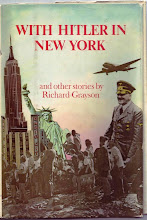
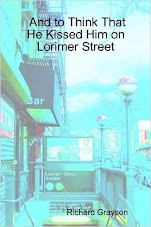
In 2004, Richard Grayson (author of With Hitler in New York and And To Think He Kissed Him on Lorimer Street) ran as a write-in Democratic candidate for the U.S. House of Representatives against a firmly entrenched Republican incumbent. His opponent, Republican Representative Ander Crenshaw, is almost abstract in his role as antagonist, having enough funding, support, and staff that defending his seat barely requires he even take notice of Grayson, who has no staff, no funding, and, at least, initially, no support. It's to Grayson's great credit that although he always knows what the outcome will be in his race for the House, he still puts an admirable amount of effort and time into reaching each potential supporter he comes across.

Grayson originally chronicled his race online for McSweeney's Internet Tendency (where you can still read the entire manuscript), and has republished his diary in book form. Here's an excerpt from the first entry from Grayson's book:
I'm the only registered Democrat in the race. But, unable to afford the nine-thousand-dollar filing fee to get the official party designation, I'm a write-in candidate. Under Florida's bizarre election laws, write-in votes count only if they're for "qualified" candidates like me.

If I weren't a candidate, Congressman Crenshaw's name wouldn't be on the November ballot. There just wouldn't be an election. Four of Florida's twenty-five House members were elected this afternoon when they did not get a primary or write-in opponent.

Over 90 percent of Americans live in congressional districts that are essentially one-party monopolies. Of Florida's twenty-five House seats, seven are safe for Democrats, and sixteen are safe for Republicans.

The Fourth is the most Republican district in the state. But I'm hoping to give anyone opposed to Crenshaw's positions a chance to vote for someone else.

In the last Congress, Crenshaw voted for more Bush tax cuts and the war in Iraq. He supported oil development in the Arctic National Wildlife Refuge, limiting the Patients' Bill of Rights, and banning "partial-birth" abortion. Crenshaw voted against campaign-finance reform.

As of March, his campaign committee had $612,691 in cash.

Mine had bupkis.

Grayson writes with a self-deprecating wit and a keen eye for the realities of both our overall political situation and that of Florida's Fourth District, where his campaign takes place. Times move fast, and after the semi-uplifting Democratic victory this past November, it may be hard to remember exactly how bleak things felt for progressive or Democratic voters in late 2004, but Grayson's diary, written in the heat of the moment, manages to chronicle not only the desperate backdrop of that election but also the awakening sense of progressive community that was nearly destroyed by the spirit-crushing reelection of George W. Bush and his Congress. Grayson writes much like he ran for the House, in that he isn't so much trying to convert us as voters as much as he is trying to show us that we do still have options when he vote, despite what our political situation seems to allow.

When asked what he'll do to support traditional marriage, Grayson says he'll kill Liza Minelli. His favorite part of living in Florida's beautiful Fourth District? "The hurricanes." He tells the same reporter that he's "too lazy to be in Congress," because "it's a lot of work." Openly transgressive when answering reporters and filling out lobbyist group questionnaire, Grayson couches every answer in a wit that's as cynically sarcastic as it is big-hearted, leading to the confusion of his interviewers and friendly recognition on the part of this reader, whose contradictory feelings of cynicism and optimism from 2004 were both crushed and vindicated by the final results of that election.

Clocking in at just over one hundred pages, Grayson's Diary of a Congressional Candidate in Florida's Fourth Congressional District is a deceptively quick read. Still, it's bigger than it looks. I finished the book in a single evening, but have found myself returning to it to enjoy not only the absurdity of the political situations but also the fine humor of Grayson's prose and the sense of comradery that permeates every page. He so openly shares the details of his ironic, winking candidacy that it's impossible not to cheer him on. Towards the end, a voter writes Grayson a letter thanking him for trying that the voter signs "your constituent," a sentiment that I too felt by the time I turned the final page. Although Grayson lost the race, his book tells it like a victory march, celebrating every small triumph won against impossible odds.

I couldn't agree more.

Tuesday, December 6, 2005

ROLL CALL covers Richard Grayson's DIARY OF A CONGRESSIONAL CANDIDATE IN FLORIDA'S FOURTH CONGRESSIONAL DISTRICT


Roll Call, the newspaper of Capitol Hill, today (December 6, 2005) has an article about Richard Grayson's WRITE-IN: Diary of a Congressional Candidate in Florida's Fourth Congressional District:


Life on the Campaign Trail

By Elizabeth Brotherton
Roll Call Staff

Tuesday, December 6, 2005


Remember the heated battle over Florida’s 4th Congressional district last summer?

You don’t?

Well, that’s probably because the race didn’t attract too much attention. But there was one.

It pitted incumbent Rep. Ander Crenshaw (R-Fla.) against writer Richard Grayson, a Democratic write-in candidate running on a platform in support of gay marriage, abortion rights, universal health care and immediate withdrawal from Iraq.

Keep in mind, this race took place in one of Florida’s most conservative districts.

So why did Grayson even bother?

“Voters are essentially disenfranchised,” said Grayson, now 54. “It’s frustrating, that yeah, we have a democracy, and yet most of the Florida Representatives were essentially unopposed. From both parties.”

Annoyed, Grayson decided to hit the campaign trail. He documented his journey in a series of diary entries published on McSweeneys.net, which have been put into a book titled “Diary of a Congressional Candidate in Florida’s Fourth Congressional District.”

Grayson was no rookie, either. He ran for president in 1984 and twice as a write-in candidate against Republican House Members, for similar reasons as in his race against Crenshaw.

“It was really a fun thing to do,” Grayson said of his latest campaign. “And I think having McSweeney’s publish the diary as I was writing it, with a couple weeks time lag, got attention.”

Grayson’s journey begins on May 7, 2004, the day the Florida Division of Elections posted his name as an official candidate in the race. But because he couldn’t afford the $9,000 filing fee, Grayson was listed as a write-in candidate. (Grayson notes in the book that in March 2004, Crenshaw had a war chest of $612,691.)

Throughout the diary, Grayson documents life on the campaign trail. Or rather, trying to get to there.

Grayson ran for the 4th district seat, a long, narrow stretch of land across the Northeastern part of the state that encompasses parts of Tallahassee and Jacksonville.

Even though he lived in South Florida.

See, in his home 22nd district, there was already a race under way between Republican incumbent Rep. Clay Shaw and Democrat Jim Stork. Grayson’s goal in running was to make a point, even if he didn’t stand much of a chance at getting elected.

“Every Congressional race in this country I would like to see have at least two candidates,” he said.

Grayson picked the 4th district because he noticed Congressional representation for Jacksonville was safely divided between the two parties, with Rep. Corrine Brown (D) holding the other seat.

“Basically, I had the feeling the two major parties pretty much like it the way it is,” he said. “They like the fact that the city of Jacksonville has one Democratic seat, one Republican seat.”

But since Grayson worked a normal day job from 8:30 a.m. to 5 p.m. Monday through Friday, he found it difficult to get to the Jacksonville area. He didn’t even set foot in the 4th district until Oct. 2 to do a television spot at a Jacksonville CBS affiliate.

So many of Grayson’s campaign efforts consisted of filling out surveys from various interest groups, ranging from the National Taxpayers Union to the Vision Council of America, and hoping somebody somewhere might hear of his candidacy and want to vote for him.

Then, he had to deal with people wanting to sell him everything from software programs to potholders.

“They don’t realize I’m running this campaign out of my studio apartment,” Grayson said. “What it tells me is that campaigns are very big business in this country. It’s sort of this whole class of people who make their money out of the election industry.”

As the months wore on, Grayson started to hit the trail a bit more, and it began to pay off. His proudest moment came in October 2004, when he was endorsed by the National Organization for Women Political Action Committee.

“I was actually touched by that, because it was probably the most serious organization that endorsed me,” Grayson said.

In the end, Grayson received 1,170 votes, which amounts to 0.5 percent of the total count. Crenshaw got the other 99.5 percent with 256,157 votes.

“I was sort of surprised. I got more votes than I expected,” Grayson said.

Grayson has not ruled out running again for office, although he admits his strong liberal views wouldn’t likely get him elected (“I think I’d have to find a new country,” he said).

And he got to do something in 2004 even many Members don’t get to do.

“I never had to pander for any votes, because frankly, I didn’t care if anybody voted for me,” he said. “I imagine some of the Members of Congress must envy that sort of thing.”

The “Diary of a Congressional Candidate” is available to purchase online at http://www.lulu.com/content/172015 or by visiting Grayson’s Web site at www.richardgrayson.com. The book costs $9.38, or $2.37 to download.