Pages

Showing posts with label gay fiction. Show all posts

Monday, May 9, 2011

Monday Night on the Upper East Side: "The Violet Mirror: How LGBT Literature Reflects Its Culture" panel at the 86th Street Barnes and Noble


We were lucky enough to attend a fascinating panel discussion tonight at the Upper East Side Barnes & Noble at 86th and Lex. Featuring the legendary Ann Bannon, whose books we have taught; gay publishing pioneers like editor Don Wiese, the prolific Eric Marcus and veteran activist Erin McHugh (who served as moderator); and the award-winning young literary YA novelist Nick Burd, "The Violet Mirror: How LGBT Literature Reflects Its Culture" proved to be a memorable 100 minutes of commentary and conversation.


We're grateful to the insightful and articulate panelists and to B&N for this strikingly interesting event.

Sunday, February 28, 2010

BONIATOS ARE NOT BORING by Richard Grayson now available at Amazon Kindle Store


Richard Grayson's Boniatos Are Not Boring is now available at Amazon's Kindle Store for 99¢.

Here is the promo material for the 125-page $7.99 paperback edition from Art Pants Company:

Some misguided souls think that boniatos - the tropical sweet potatoes beloved in South Florida - are boring.

Not Richard Grayson, author of BONIATOS ARE NOT BORING, who appreciates this Latin Caribbean tuber in all its morning glory. Out of boniatos and other supposedly ordinary things - the French game of Mille Bornes, a system for transmitting business data, a junior high production of "The King and I," out-of-the-way Vietnamese shopping malls in Silicon Valley, the display advertising department of the Village Voice and sunbathing in the middle of San Francisco - can be made magically inventive short stories, slices of American life as filling and satisfying as, well, boniatos themselves.

Saturday, February 27, 2010

SALUGI AT STARBUCKS by Richard Grayson now available at Amazon Kindle Store


Richard Grayson's Salugi at Starbucks is now available at Amazon's Kindle Store for 99¢.

Here is the promo material for the 124-page $7.99 paperback edition from Art Pants Company:

In this quartet of stories about late 20th century gay relationships gone awry, Richard Grayson's young male characters are always looking in all the wrong places. As The American Book Review wrote:

"They are young gay men trying to survive in a hostile or marginally accepting world. They conduct themselves with manic cheer. They possess a grace and courage that have to substitute for the acceptance and love that most people look for. Their successes in this sphere are meager; their disappointments, many.

Yet, despite a seeming similarity in their drives – and palpable coincidences of character and action – Grayson rarely palls. His young men are imbued with a sweet, endearing nuttiness that serves both to energize and individualize. He depicts our cyberspace and e-mail age, so convenient for rapidly dissolving and re-forming associations, invariably against a backdrop of the search for sincere love and the deaths that ravage gay men and their partners."

Friday, February 26, 2010

MOON OVER MOLDOVA by Richard Grayson now available at Amazon Kindle Store


Richard Grayson's Moon Over Moldova is now available at Amazon's Kindle Store for 99¢.

Here is the promo material for the 103-page $6.99 paperback edition from Art Pants Company:

MOON OVER MOLDOVA presents three stories by acclaimed writer Richard Grayson. In "Moon Over Moldova," while a Southern college town is rocked by a gay rights referendum, a grad student finds even a "backward" former Soviet republic a refuge from personal and political turmoil. In "Boys Club," a queercore band's bassist has a crush on the group's insufferably punker-than-thou lead singer. And "Anything But Sympathy" artfully conflates stories about elderly nursing home residents; the real-life power broker and "uncrowned king of Florida," banker Ed Hall; young actors and others dying too young of AIDS; and a thirtysomething teacher's affair with a teenage boy who seems to know a lot more than he does. Publishers Weekly called Richard Grayson's uniquely quirky narratives "lighter and funnier than most gay fiction" and The Sun-Sentinel noted: "Although memorial services for young men seem commonplace in Grayson's fiction, the stories are not tragedies. They are funny, intelligently written and original."

Monday, February 15, 2010

VAMPIRES OF NORTHWEST ARKANSAS by Richard Grayson now available at Amazon Kindle Store


Richard Grayson's Vampires of Northwest Arkansas is now available at Amazon's Kindle Store for 99¢.

Here is the promo material for the 149-page $7.99 paperback edition from Art Pants Company:

Ten stories by acclaimed short story writer Richard Grayson (WITH HITLER IN NEW YORK, I SURVIVED CARACAS TRAFFIC, LINCOLN'S DOCTOR'S DOG, I BRAKE FOR DELMORE SCHWARTZ, WHO WILL KISS THE PIG?: SEX STORIES FOR TEENS) spotlight gay men coping with unusual situations: a best friend and fellow former prostitute bitten by an Ozarks bat in the wake of 9/11; a boyfriend morbidly worried about an impending worldwide chocolate shortage; an Orthodox Jew who consults his rabbi because a lover refuses to ever remove his socks during sex; a young African-American college student on a homophobic campus who has to care for his Muslim roommate’s therapy monkey; a Wyoming cattle ranch manager dealing with an outbreak of leafy spurge on his land; a Brooklyn man with a younger Japanese lover reflecting on his Williamsburg neighborhood’s demographic transitions from Italian to Hispanic to hipster to yuppie; a writer confronting on his past affair with his much younger stepbrother and contrasting his adventures with those of the comic book superhero Green Arrow; a Puerto Rican teacher compelled to watch shirtless teabag-eating white boys online; a former babysitter of the actor Laurence Fishburne unable to understand the young gay Phoenix couple who are his tenants; and a Florida man haunted by the shuttered suburban movie theaters of his youth. Wickedly funny and weirdly profound, these talky stories weave a startling tapestry of quirky gay life in the America of the last two decades.

The pieces originally appeared in the such webzines (most now defunct) as VerbSap, Opium, Rio, Me Three, Apogee, The Magazine Shiver, The Rumpus and Pug Magazine.

Friday, February 5, 2010

VICTORY BOULEVARD by Richard Grayson now available at Amazon Kindle Store


Richard Grayson's Victory Boulevard is now available at Amazon's Kindle Store for $1.00.
"Victory Boulevard" originally appeared in Harrington Gay Men's Fiction Quarterly, Volume 7, Number 1 (Summer 2005).

From the promo stuff for the $7.99 paperback edition:
The author of such story collections as WITH HITLER IN NEW YORK, THE SILICON VALLEY DIET and I BRAKE FOR DELMORE SCHWARTZ sets his new novelette in 2005 Los Angeles and Staten Island.

It's a story about gay relationships, marriage, teenagers, competitive diving, race relations, basketball, real estate, minor league baseball, dentistry, the Episcopal church, emo music, San Fernando Valley traffic, old fashioned English tea shoppes, silent movie stars Fatty Arbuckle and Mabel Normand and the nature of contemporary narrative.


Already available in a $1.00 Amazon Kindle edition is Richard Grayson's short story collection I Hate All of You on This L Train.

Tuesday, April 17, 2001

American Book Review reviews Richard Grayson's THE SILICON VALLEY DIET


The March-April 2001 issue of American Book Review has a review of Richard Grayson's The Silicon Valley Diet:


American Book Review
March-April 2001

Defiant on Thin Ice
Henry Grinberg

The Silicon Valley Diet. Richard Grayson.
Red Hen Press, PO Box 902582, Palmdale, CA 93590.
182 pages; paper, $14.95.


Richard Grayson’s ninth collection of short stories achieves many goals, and he is clearly a master of the genre. It it equally clear throughout the twelve tales that, although the characters have different names, they are essentially the same – without strenuous attempts at disguise. They are young gay men trying to survive in a hostile or marginally accepting world. They conduct themselves with manic cheer. They possess a grace and courage that have to substitute for the acceptance and love that most people look for. Their successes in this sphere are meager; their disappointments, many.

Yet, despite a seeming similarity in their drives – and palpable coincidences of character and action – Grayson rarely palls. His young men are imbued with a sweet, endearing nuttiness that serves both to energize and individualize. He depicts our cyberspace and e-mail age, so convenient for rapidly dissolving and re-forming associations, invariably against a backdrop of the search for sincere love and the deaths that ravage gay men and their partners.

There’s more. Wherever Grayson casts his gaze, he manages to isolate panoramas of city and small town life in America from the 60s to the present, detailing not only the particular rebelliousness of these “outsiders,” but also the general collapse in the national fiber, of which they are part. These are connected to public events, such as the uncertain outcome in Korea and defeat in Vietnam, and are reflected in a spate of fragmented families, step-siblings galore, and a never-ending specter of impending divorces and split-ups. You get a picture of a psychologically maimed, dysfunctional society, some of whose members don’t give up trying for happiness.

Four of the stories employ a similar, interesting technique, that of alternating narrative with what at first seem like droningly dull passages from textbooks – a political-economic history of part of the former Soviet Union; a treatise on how to write; another on the invasion of ruinous, alien vegetation onto prairie land; and an excruciatingly obsessional description of a diet. These particular stories, “Boniatos Are Not Boring,” “Moon Over Moldova,” “Mysteries of Range Management,” and “The Silicon Valley Diet” (the title story of the collection, perversely presented last), are unusually effective.

But the effect is quite different from story to story, despite the shared technique. “Boniatos” achieves a wonderful sense of humanity, hovering brilliantly between the tragic and the wildly funny, by wickedly employing a deadpan, soulless mock-treatise on how to write that manages to crush the life out of the ostensibly creative act. “Moldova” is a little masterpiece, told by indirection. It tells of young gay man attracted to both partners of a homosexual relationship. Interspersed by chunks of a history of the former Soviet republic, the action is magically reinforced by what appears to be nothing other than a tedious narration. But that history manages to reflect, by means of the author’s plays of subtle implication, the pathos of a man absurdly drawn to both members of a couple, neither one of whom he may claim.

“Mysteries of Range Management” takes place in the wide open spaces of Wyoming, where we learn a gay life is possible too – not only in big cities. As with “Moldova,” we have another story together with interpolated extracts from a textbook. This time it is one describing the relentless spoliation of the cattle ranges by a non-native vegetation called “leafy spurge.” Again, the text interacts with the human story in richly ironic and half-crazy ways. More somberly than he did in “Moldova,” Grayson makes leafy spurge – the pest-plant, an insidious encroacher – symbolic of the workings of both anti-gay social contagion and the action of AIDS itself. He makes specific references to the recent murder in Wyoming of Matthew Shepard. This provides tangible menace in an outwardly tranquil tale.

“The Silicon Valley Diet” is yet another story that builds its effects by means of interspersed tutelaries – this time instructions for a weight-loss diet, so humorless and condescending in presentation as to be maddening if the effects were not so – I say again – wildly funny and compelling. And, again, it is another tale of the kinds of startling partners that gay relationships can involve. At times, it seems there’s nothing too grungy when one’s in love or in lust, as in many a straight relationship.

The remaining stories here are accomplished and make their points with enviable skill. They don’t come off with quite the same impact, in my judgment, as those I have described. They present similar explorations into the bittersweet frustrations of life, missed chances for meaningful connection, and the perceived necessity for choking off one’s real feelings. But they are very good, nevertheless.

In these and the other stories in the collection, Grayson makes one aware of how vulnerable his characters are. Beset by mortality, even as they seek affirmation, they truly remind us of those flying summer insects that extinguish themselves in a brief act of love. Everything is poignant. Much hurt is to be sensed beneath the wise-guy, tough-cookie exteriors. It’s Grayson’s way, moreover, that many of the pieces in the book are preceded by what you may think are charmingly bizarre preludes that anticipate the main action, but which turn out, slyly, to be the main show itself.

There are many layers to this detailing of the techno-ridden superficialities of our contemporary life, with its bar codes, microwave ovens, and cyberspeak. These are truly sagas of man versus machine. The fact that these are gay men serves to render them even more poignant because one senses that these characters may have hoped for some protection from the brutalities of modern life, through technology. Perhaps, even redemption.

Sunday, September 3, 2000

JOEY Magazine reviews Richard Grayson's THE SILICON VALLEY DIET


The Fall 2000 issue of JOEY Magazine (issue 3) features a review of Richard Grayson's The Silicon Valley Diet:

The Silicon Valley Diet
Richard Grayson
Red Hen Press - $14.95


A collection of twelve short “Seinfeldian” stories (i.e., funny, clever, lightly written and neurotic, while simultaneously about nothing in particular). Richard Grayson’s The Silicon Valley Diet delivers its strongest material in the twelfth story, the one from which the book garners its title. The final story is about a formerly fat Caucasian gay male trying to get his diet book published, while deciding whether or not he should date an English-language-challenged Vietnamese immigrant whose main goal is to return to his country of origin. (Still with me?) Peculiar as that set-up sounds, it works because the main character in the story, like the best of Grayson’s characters, balances his neurotic self-awareness with a genuine sense of empathy and healthy serving of humor. While the stories of various gay men don’t achieve any particular kind of character arc, that’s largely beside the point. Grayson offers up several “that’s-exactly-how-I-feel” moments in the snippets he reveals from his characters’ lives—bringing humor, reality and touching sadness to the small, if occasionally obscure, moments that fill their days. The other fun stories include a liberal who’s obsessed with the depleting supply of the world’s cocoa and dating a non-chocolate-eating conservative, a teenage junior college student who has a distinctly un-salacious affair with one of his professors, and an endearing bass-player in a gay punk band who writes crappy angst songs with titles like “You Fucked Me,” and battles with his ex-boyfriend/lead singer over various mediocre names for their band. The cast of characters entertain while often feeling eerily like people you know, love, hate, lust after, or happen actually to be from time to time
—James Sledge

Thursday, July 13, 2000

ECHO Magazine reviews Richard Grayson's THE SILICON VALLEY DIET


ECHO Magazine's August 17, 2000 issue features a review of Richard Grayson’s The Silicon Valley Diet in Ken Furtado's "Booked" column:


BOOKED

By Ken Furtado


. . . .
Arizona author Richard Grayson’s ninth short story collection, The Silicon Valley Diet (Red Hen Press, $14.95, trade pap.) contains a dozen works of fiction, having in common humor as dry as the desert and an assortment of nerdy-but-likeable Seinfeldian characters.

In “Willie 95,” the narrator reflects on his 30-year friendship with Willie, whose death he learned about on Compuserve, in sections titled after the menus of Microsoft Word.

“Salugi at Starbucks” is told via alternating narrative and e-mail exchanges, again spanning 30 years while Elihu waits in vain for his lover to move in.

The sections of “Anything but Sympathy” are named aftr words that can be formed from the letters S, P, O and T (spot, stop, post, etc.)

Many of the stories involve the inability to find or keep a boyfriend, an affinity for non-Caucasian lovers, and dissatisfaction with the narrator’s height (he’s short).

Grayson excels at a sort of Valley-speak mixed with stream of consciousness; his characters ramble on at length, brain-surfing from one topic or thought to another.

Many stories rely on a technique of alternating passages of complementary text with the narrative, as in “Moon Over Moldova,” in which we learn about Moldova while the narrator tells us about secretly loving this hot South American, then developing similar feelings for the guy’s lover. Effective for a single story, the technique loses its effectiveness when used repeatedly.

But Grayson’s humor will keep you turning the pages. His bullshit detector is dead-on, as in this sentence, from the title story: “I’d long ago given up going to slaughterhouses and trying to approach aspiring Abercrombie & Fitch catalog models emitting radiation from isotopes of unobtainium.”

Monday, April 17, 2000

Publishers Weekly reviews Richard Grayson's THE SILICON VALLEY DIET


In "Notes on Fiction," the current (May 15, 2000) issue of Publishers Weekly has a brief review of Richard Grayson's The Silicon Valley Diet:

Compulsively talky and engaging disjunctive, the 12 stories in The Silicon Valley Diet, Richard Grayson's ninth collection, flash snapshots of gay men in their 20s, 30s and 40s battling it out in an online world. Lighter and funnier than much gay fiction, the stories riff on contemporary consumer culture (I'm wearing Calvin Klein chhinos like the sexy adolescents I spotted this morning in full-pages in Wired and Swing) and introduce sweet, mixed-up characters like Terence, who has a child "slept with a teddy bear -- even when he was practically, by his own admission, a teenage prostitute." Grayson knows New York City -- where many of these stories are set -- inside and out. (Red Hen,$14.95 paper 182p ISBN 1-888966-23-4; June)

Sunday, December 30, 1979

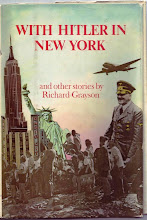
The San Francisco Voice reviews Richard Grayson's WITH HITLER IN NEW YORK


The current (December 29, 1979) issue of the San Francisco Voice has a review by Daniel Curzon of Richard Grayson's With Hitler in New York:


WITH HITLER IN NEW YORK and OTHER STORIES, by Richard Grayson.
Taplinger Publishing Co., 200 Park Ave. South, NY, NY 10003


Buy this book! It's wonderful. It costs only $7.95. Where else can you get as much pleasure -- both emotional and intellectual -- for so little?

At first I thought With Hitler in New York wasn’t very gay in its content, but the stories get gayer later in the book. Richard Grayson is a real writer, whether he’s writing on gay themes or not. He’s witty and deep, playful and honest. I don’t know whether he is gay or not. I hope he is, because we need all the first-rate writing we can get. If encouraged, Grayson might more explicitly gay-themed stories. (indeed, if all the gay writers wrote about gay life and left straight life to the straight writers, there’d be precious little straight stuff written)

If you’ve been reading the bulk of the books coming out of the big New York presses and finding yourself slowly starving to death for genuine artistic nourishment, buy this book. For the truth, dear friends, is that if readers who like soul-satisfying fiction don’t buy these books when they appear – less and less often, please note – then very soon they won’t be able to buy them at all. They simply won’t be published, and we can all die of literary malnutrition.

The situation in publishing is much worse than I suspected. I’ve always discounted the so-called American preoccupation with making money. But I’ve come to realize at last that vulgar is really all that publishers care about. The corporations are destroying literature. They must be stopped. They are robber barons, neither pure nor simple, who care only about profits, profits, and more profits, just like the oil companies. If you think this doesn’t matter, just remember that these corporations control what you read. They have a monopoly on the market. They must be required to publish quality fiction in the same way that the FCC requires TV and radio stations to broadcast some quality programming. No corporation should be allowed to keep true literature out of your hands just because they have the power to do so.

Don’t read With Hitler in New York all at once. The blunt, declarative sentences are best appreciated when spread out. I also think the author shouldn’t have included three stories about how hard it is to write a story. Two would have been enough.

But there is much here that is truly beautifully done, like the story about an uncle the narrator hates, and “The Princess from the Land of Porcelain,” which may be the finest story about a lesbian ever written.
Richard Grayson probably had to ill to get a collection of stories published by anybody in these disgusting days. The least the literate reader can do is avoid the chaff from Avon, Dell, and the like, and get this book, the real stuff.

-- Daniel Curzon / IGNA