Showing posts with label San Francisco. Show all posts
Showing posts with label San Francisco. Show all posts
Saturday, December 1, 2018


Thursday, September 15, 2011
Arthur Evans, RIP

Today we were saddened to read the New York Times obituary of Arthur Evans, a pioneering gay activist whom we knew in the early 1970s and greatly admired for his courage, resourcefulness, intelligence and his commitment to the gay rights movement and to his friends:
Arthur Evans, who helped form and lead the movement that coalesced after gay people and their supporters protested a 1969 police raid on the Stonewall Inn, a Greenwich Village gay bar, died on Sunday at his home in San Francisco. He was 68.
Arthur Evans and others created the Gay Activists Alliance in an effort to present a more assertive front than other groups.
The cause was a heart attack, his friend Hal Offen said. Mr. Evans was found to have an aortic aneurysm last year.
Mr. Evans was not at the Stonewall disturbances, but they fueled in him a militant fervor and inspired him to join the Gay Liberation Front, an organization started during the wave of gay assertiveness that followed.
For Mr. Evans and other militants [including Jim Owles], however, the group was not assertive enough. They worried that it was diluting its effectiveness by taking stands on issues beyond gay rights — opposing the Vietnam War and racial discrimination, for example. So in December 1969 they split off to found the Gay Activists Alliance, choosing a name to suggest more aggressive tactics.
Based in New York, the alliance became a model for gay rights organizations nationwide, pushing in New York for legislation to ban discrimination against gay men and lesbians in employment, housing and other areas. Mr. Evans wrote its statement of purpose and much of its constitution, which began, “We as liberated homosexual activists demand the freedom for expression of our dignity and value as human beings.”
To attract attention the alliance staged what its members called “zaps,” confrontations with people or institutions that they believed discriminated against gay people. Among other incidents, they confronted Mayor John V. Lindsay of New York, went to television studios to protest shows perceived as anti-gay, demanded gay marriage rights at the city’s marriage license bureau, and demonstrated at the taxi commission against a regulation, since abolished, requiring gay people to get a psychiatrist’s approval before they could be allowed to drive a taxi.
In the fall of 1970, Mr. Evans and others showed up at the offices of Harper’s Magazine in Manhattan to protest an article it had published sharply criticizing gay people and their lifestyle. It was Mr. Evans’s idea to bring a coffee pot, doughnuts, a folding table and chairs for a civilized “tea party.” When the editor, Midge Decter, refused to print a rebuttal as the group demanded, Mr. Evans erupted.
“You knew that this article would contribute to the oppression of homosexuals!” he yelled, according to the 1999 book “Out for Good: The Struggle to Build a Gay Rights Movement in America” by Dudley Clendinen, a former reporter for The New York Times, and Adam Nagourney, a current Times reporter. “You are a bigot, and you are to be held responsible for that moral and political act.”
Arthur Evans was born on Oct. 12, 1942, in York, Pa. His father was a factory worker who had dropped out of elementary school, and his mother ran a beauty shop in the front room of the family house. Mr. Evans attended Brown University on a scholarship and there joined a group of self-styled “militant atheists.”
He left Brown after three years and headed for Greenwich Village, having read in Life magazine that it welcomed gay people. In New York, he transferred to City College and switched his major from political science to philosophy. Graduating in 1967, he entered the doctoral program in philosophy at Columbia, where he studied ancient Greek philosophy and participated in antiwar protests.
But, becoming disenchanted with academia, he withdrew from Columbia in 1972 and moved to rural Washington State, where he and a companion, calling themselves the Weird Sisters Partnership, homesteaded a small patch of forest land and lived in a tent.
When the Washington experiment failed, Mr. Evans and his companion moved to San Francisco. There, he and Mr. Offen opened a Volkswagen repair business they named the Buggery.
While living in Washington, Mr. Evans had spent his winters in Seattle researching the historical origins of the counterculture. After settling in San Francisco, he wrote “Witchcraft and the Gay Counterculture,” a 1978 book tracing homophobic attitudes to the Middle Ages, when people accused of witchcraft, the book contended, were being persecuted in part for their sexuality, often their homosexuality.
He went on to write “Critique of Patriarchal Reason” (1997), arguing that misogyny and homophobia have influenced supposedly objective fields like logic and physics.
Mr. Evans is survived by his brother, Joe.
Growing up, Mr. Evans had hid his sexual orientation, though he himself was aware of it at 10, he said. By November 1970, when he was scheduled to appear on “The Dick Cavett Show” with other gay leaders, he had still not told his parents that he was gay. But, by his account, he did tell them he was going to be on national television. Thrilled, they told friends and neighbors to tune in.
Mr. Evans later said he regretted his handling of the matter.


We knew about his work with the GAA, but we first met Arthur Evans through our Brooklyn College friend and classmate, Jay Schraeter, who is the "companion" in the obituary.

Jay was the first of our friends to come out and he was one of the kindest, most gentle people we knew back then (and an art major, he also helped us a lot when we were in the same class in Northern European Renaissance Painting and were pretty clueless ourselves).
Jay and Arthur were the first male couple we saw kiss in public, and we admired both of them for their courage and their adventurousness when they moved out to Washington State for their rural experiment in living. (Eventually they moved to San Francisco and later separated.) We gave Jay our St. Christopher's medal before they left in April 1972, and he was gracious enough to accept it although he was the son and grandson of famous cantors. We didn't even know his name was Jacob, not Jay, until he passed away of AIDS in 1989.
(We also knew Arthur Evans' first lover, Village Voice writer Arthur Bell, briefly our neighbor, who was very kind in giving us a nice write-up on our first book. They had an acrimonious breakup, but later became friends again. Arthur Bell died of complications of diabetes in 1984.)
As the Bay Area Reporter noted, in later years in San Francisco, Arthur Evans became something of a conservative on neighborhood issues involving zoning and the homeless, but he was always an iconoclast from the start.

He wrote some wonderful articles for the Boston magazine Fag Rag, and he was a critic of the butch "clones" (a term he helped popularize) in the Castro in the late 1970s. Arthur directed a production of Euripides' Bacchae that he himself translated, and his books included The God of Ecstasy: Sex Roles and the Madness of Dionysus, Witchcraft and the Gay Counterculture and the gay-positive philosophy treatise Critique of Patriarchial Reason.

Arthur Evans was one of a kind, and although we met him only four or five times nearly forty years ago, we feel his loss deeply.
Sunday, February 28, 2010
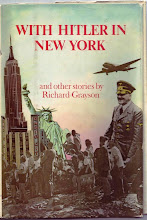
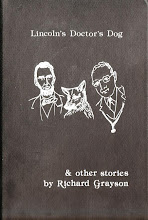
BONIATOS ARE NOT BORING by Richard Grayson now available at Amazon Kindle Store

Richard Grayson's Boniatos Are Not Boring is now available at Amazon's Kindle Store for 99¢.
Here is the promo material for the 125-page $7.99 paperback edition from Art Pants Company:

Some misguided souls think that boniatos - the tropical sweet potatoes beloved in South Florida - are boring.
Not Richard Grayson, author of BONIATOS ARE NOT BORING, who appreciates this Latin Caribbean tuber in all its morning glory. Out of boniatos and other supposedly ordinary things - the French game of Mille Bornes, a system for transmitting business data, a junior high production of "The King and I," out-of-the-way Vietnamese shopping malls in Silicon Valley, the display advertising department of the Village Voice and sunbathing in the middle of San Francisco - can be made magically inventive short stories, slices of American life as filling and satisfying as, well, boniatos themselves.
Tuesday, November 29, 1988
PROCESSED WORLD features Gary Richardson's "You've Got to Give Me Credit"

The San Francisco-based magazine Processed World has a story, "You've Got to Give Me Credit," by Gary Richardson in its current (Fall 1988) issue (#23).
You've Got to Give Me Credit
by
Gary Richardson
"The Nineties are going to be our decade," said Rick, over spinach salad at some too-expensive restaurant in Georgetown.
"I believe that," I said. "But first we have to get through the Eighties."
* * *
People wonder how I survive -- financially, that is.
It's a simple method in theory, though it's fairly complicated in practical terms. I live on credit cards.
Now I know everyone lives on credit cards, but I actually live on nothing else. I haven't had a full-time job for three years now.
The simple part: Each year I keep applying for more revolving credit on MasterCards (of which I currently have twelve), Visas (fourteen), Discovers (three), Choices (two), and other bank credit lines that access checks (four).
At the moment I have $87,550 in unsecured revolving credit from American banks.
At the moment I owe about $80,000 to them.
I also have about $30,000 in CDs, money market deposit accounts, savings and checking.
This money, like all my money, comes from cash advances from my credit lines.
As long as I keep the credit chassis going -- by paying my credit accounts every month and then borrowing back the money via teller machines, checks, or old-fashioned bank cash advances -- and as long as my credit limits keep getting raised to the amount of money I live on, I'm doing fine.
Better than most people who work.
* * *
Jerry, who is a systems analyst at a firm where he's stayed on too long -- three years -- doesn't approve of what I'm doing. He and my other friends worry about me.
"You've got no security," he tells me over dinner -- angel hair pasta with sun-dried tomatoes -- at Marvin Gardens on Broadway and West 83rd.
Jerry's father worked at the post office for forty years. Now he plays handball every day.
I play with my pasta. The sun-dried tomatoes always come up on me later.
"Besides, doesn't it terrify you owing all that money?" Jerry asks me.
"Does it terrify Ronald Reagan to be head of a country that has a trillion-dollar debt?" I ask.
"It's not the same thing," Jerry says.
I disagree.
* * *
Linda, editor-in-chief of a magazine for weight-watching women, tells me, "It all sounds a little sleazy," when we meet for brunch at the Fountainbleau in Miami Beach.
Linda is in Florida on a stopover to a travel writer's tour of Costa Rica. Several times a year she gets these free trips from PR agencies. She usually has to promise to write an article about Costa Rica, Ecuador, Hong Kong.
"I'm actually helping the American economy," I try to explain. "They're always worried about consumer growth slowing down. It's the consumers who have spent enough to make this recovery the longest one since World War II. I keep money moving -- borrowing on cash advances on one Visa, putting the money in the bank, paying back a MasterCard... I believe I'm behaving quite patriotically."
Linda doesn't buy it.
* * *
Well, I don't buy much myself, and in fact, that's the secret to my plan. I'm very, very cheap.
Unlike the Yuppies, who are patriotic in buying BMWs and Rolexes and condominiums, I hate to buy anything.
I haven't bought new clothes in several years.
I have only one pair of running shoes, which I replace every fifteen months or so at Kinney's. I don't own shoes.
Unlike Jerry, I don't need suits, dress shirts, or ties.
Carlyle, whose "Sartor Resartus" I was forced to read in graduate school a dozen years ago, said one smart thing. To enlarge the fraction of life, he explained, you could either increase the numerator or decrease the denominator.
My denominator is very low.
And life really is a fraction, not a whole number.
Otherwise the Yuppies would be right when they say your salary is life's report card. It's not. All numbers, even whole numbers, are fractions -- the relationship of one number to another.
I figure I'm way ahead of everyone.
* * *
"But you lie when you apply for credit," Jerry says. This is someone who works for a Fortune 500 corporation, albeit a lousy one.
He's right. I say I am the Director of Training of Information in Motion, Inc. and earn an annual gross salary of $103,500.
I suppose this is a crime, but I don't care.
Surviving the Eighties has made a hardened criminal out of me.
* * *
And in the summer of 1986, the First National Bank of Oklahoma failed. I had a MasterCard with them.
The bank I owed $1,987.66 to went broke before I did.
Maybe they were busy working on their numerator during the heyday of OPEC.
They were taken over by First Interstate Bank.
Now I have two MasterCards from First Interstate.
They may take over Bank of America next.
* * *
Yes, I was once -- literally, once -- a respectable working man.
I got my first full-time job when I was thirty, in 1981.
I was an English teacher at a community college. I had to teach fifteen hours a week, thirty-nine weeks a year. This meant I taught twelve sections of composition and remedial writing a year. Each section had 28 students in it; thus, I had 140 students a year.
By the law of the state in which I taught, I had to keep fifteen office hours a week in addition to my fifteen teaching hours.
Also by law of the state, my students had to write 6,000 words each semester. Our department chairman told us to get a clear and accurate word count on each student paper, because eventually the state would get around to auditing us.
Thus, I had to grade 6,000 times 140 words a year.
Every week, I had 140 five-hundred word themes to grade.
At five minutes to grade each paper... well, you can figure it out. Ask your calculator or your PC.
In 1981, my annual gross salary was $13,216.87.
I prefer living on credit.
* * *
Anyway, I was able, by virtue of being a full-time employee, to get my first credit card, a Visa from the First National Bank of Atlanta with a $700 credit line.
Now I have a $3,000 credit line from the same bank, or rather from First Atlanta Bank (Delaware), N.A., the new institution to whom I owe money.
Several dozen Visas and MasterCards later, I've learned a lot about the banking business.
Every month I go to the main branch of the public library in whatever city I'm living in and read that month's copies of "American Banker," a daily newspaper of banking news put out by the American Bankers Association.
A few years ago, at a college's friend's wedding, I was seated with the singles and was talking to a guy who was counsel to the House Banking Committee.
In the middle of our conversation, he stopped and said, "I thought Mark and Amy said you were a writer."
"I am a writer," I told him.
"You talk like a banking insider," he said.
You can be both, I've discovered.
* * *
I know about the FDIC, the FOMC, the FSLIC, the FHLBB, the Office of the Comptroller of the Currency.
I know about non-bank banks and MMDAs and jumbo CDs.
I know lots about the float. I have several accounts at out-of-state banks, such as Citibank (South Dakota), N.A.; Chase Manhattan Bank USA in Delaware; Zions First National Bank in Salt Lake City; and Virginia Beach Federal Savings and Loan (which is not a bank, of course, but it doesn't really matter).
I write checks to myself for thousands of dollars and mail them to an out-of-state bank for deposit.
For example, I write myself a $2,500 check on my Chase Manhattan money market deposit account and mail it for deposit to my Zions money market account. At the same time I can make out a check for the same amount on the Utah account and mail it to Delaware.
For three days -- because of the float -- I'm credited with the $5,000 in both accounts. And I earn top interest on it.
This isn't quite like kiting checks, which is what E.F. Hutton did and got a slap on the wrist from the government for.
(I believe their chairman is the brother-in-law of the Vice President of the United States.)
I do have the money in both accounts.
* * *
"But it's not YOUR money," Linda and Jerry and Mark and Amy tell me.
None of the banks know that.
My favorite thing when I'm living here in Florida is to go to the Publix Supermarket armed with a dozen credit cards.
Publix has an automatic teller machine called Presto. Not only does Presto give you directions in a pleasant female voice, but it is hooked up to a number of different ATM networks at which my credit cards are valid: Honor, Cirrus, American Express, Discover, Choice, Metroteller, Star.
My favorite thing is to stand in front of the Publix teller machine and take out card after card and get $200 in cash advances from each card (the daily limit on most of them, though Discover and Choice each allow $400).
Once I took out $2,000 in cash.
It looked like my money.
When I brought it into the bank in the same shopping center, they took it like it was my money.
They gave me a deposit slip that said it was my money.
It WAS my money.
* * *
Okay, maybe today it's not my money, but nothing is permanent.
I've never had a permanent, full-time job.
Even when I was full-time at the community college for three years, I was always TEMPORARY full-time. Temporary for each of the years I was there.
After three years, when I quit, in 1984, I was making $15,560.94 as my annual gross income.
I have more than that in my Citibank (South Dakota) High Interest Checking Account right now.
And of course all the adjunct jobs I had teaching at a dozen different colleges were all very temporary. Sometimes they were so temporary I got fired after the first week of class, when some tenured professor decided he didn't feel like coming in three days a week, say, and wanted to teach another class on Tuesdays and Thursdays.
Often I got hired after the term had been in progress for a week or two.
And they could never guarantee employment for the next term, especially not over the summer. But they would give you a letter saying you were reasonably sure of employment in the fall if registration was sufficient -- that was so you couldn't collect unemployment benefits.
Because a lot of students who go to college and take remedial English in the fall don't come back in the spring, someone always has to be let go.
I always volunteer.
"Non-reappointment," they call it. I get an official letter in December that says I won't be back next term no matter what.
Then I CAN collect unemployment benefits.
Since 1984, I've spent a total of 78 weeks collecting unemployment benefits.
Nice work if you can't get it.
* * *
So I can live in New York or Washington in the fall and teach at three or four colleges part-time. They always need people for remedial writing or composition. Most of the people who started with me, back in 1975, are out of the adjunct business. People like Jerry, who have become systems analysts earning half of what I tell the credit card applications I make as Director of Training for Information in Motion, Inc. -- about $50,000.
But in New York and Washington the colleges pay fairly well by the hour. They're up to close to $40 now, and if you teach remedial, they usually give you four hours' pay for three hours' work, because nobody wants to teach remedial.
Talking about the difference between "a" and "an" and "and" is boring.
You couldn't get a Yuppie to do that for anything.
And my department chairmen in New York and Washington lay me off after the fall semester, so in January I head for Florida to escape the winter.
In May I head back up North again.
And I always pay every credit card bill.
* * *
I've seen my credit reports from TRW, CBI, and Trans-Union, and I have no negative information on them.
I've never been even thirty days late with a payment.
(Actually, if you're one day late on your Visa bill, they count it as thirty days with the credit bureau. Most people don't know that.)
And I'm listed as Director of Training with Information in Motion, Inc., on the credit reports.
(Never call yourself anything as high as Vice President because they'll think you're self-employed -- the kiss of death in the credit business.)
* * *
In New York or Washington over the last few years, I've lived in a lot of places.
You'd be surprised how many Yuppies need to rent out their living room sofa beds.
An old college friend on the Upper West Side lives mostly with her boyfriend, but we split the rent, and she doesn't mind if I stay in her bedroom when she's not home.
Or I apartment-sit when people get jobs out of town directing a play or teaching one semester or whatever.
In Washington I've stayed at my cousin's apartment near DuPont Circle. He works for the FDIC and is out of town a lot dealing with failed banks.
In Florida you can always get a cheap furnished place for the winter season.
I don't own a stick of furniture.
Since 1984 I've never lived in a room where my suitcases (two) weren't out, ready to go.
So don't tell me anything is permanent.
Don't tell the crazy homeless people who make the Upper West Side an open mental ward. Don't tell my friends who got AIDS. Don't tell the Chairman of the Federal Deposit Insurance Corporation.
* * *
I've seen Yuppies wearing a T-shirt that says WHOEVER HAS THE MOST MONEY WHEN HE DIES, WINS.
I disagree.
To me, whoever OWES the most money when he dies, wins.
I intend to die a winner.
The losers: Citibank, Sears, First Interstate, First Atlanta, Chemical Bank, Mellon Bank, Bank One and the rest.
* * *
Revolving credit is like magic.
When you pay what you owe, you can borrow it again.
Sometimes I make minimum payments, but it's more fun to pay off the bills in full once in a while -- say, the $5,000 I owe on my gold Premier Visa from Chevy Chase Federal Savings Bank. A week after I mail in the payment, I borrow the whole amount again.
Magic.
* * *
And no, not all my money comes from cash advances and credit cards. I do keep teaching. I collect unemployment benefits. Occasionally I sell an article for some money. And I've done very well in the current bull market by specializing in regional bank stocks.
With nationwide interstate banking just around the corner, there are mergers and takeovers like crazy, and banks are paying three and four times book value the stock of other banks.
It's their money, right?
Until it's mine.
* * *
It did sort of shock me the morning of Thanksgiving 1985, when I caught this cable TV get-rich show featuring a guy who billed himself as The Credit Card Millionaire.
He was doing just what I was doing, only he said he was buying houses for no money down and investing in art and classic cars.
I figured that for an old English major, I wasn't so dumb to stumble on this all by myself. I didn't have to pay the $299 to get the books and tapes for The Credit Card Millionaire System.
The Credit Card Millionaire was a Vietnam veteran and high school dropout.
Unlike him, though, I have contempt for money. I see it's not real. I have $30,000 in the bank now -- maybe $40,000 at this very moment according to the banks, because I'm playing the float. My friends are half-right when they say the money really isn't mine.
The money isn't real at all. But it works. Money is now not really a medium of exchange or a store of value or any of the things you learn about in economics courses.
Money is just information that you have money.
That's why one of my community college night students came in late and said it was because he'd "lost" a million dollars in the computer that day. He worked at Southeast Bank, where I have a Preferred MasterCard account.
And that's why I'm the Director of Training for Information in Motion, Inc.
* * *
I didn't intend to live like this.
In 1968 I was a baby-faced 17-year-old who worked in the Gene McCarthy campaign and saw what was later described by the Walker Commission as a "police riot" by a few hundred men in Chicago.
In 1969 I was one of the kids who left Woodstock early: too much rain, too much mud, not enough food, too many people. But I knew what I'd seen.
In 1970, after the Cambodian invasion and the killings at Kent State, I slept in the college president's office we had taken over. We were "People's U" -- or so said the sign on our balcony until the Tactical Patrol Force came and cleared us out after five days.
In 1971, along with a few thousand people upset about Laos, I was held in Robert Kennedy Stadium overnight by then-Attorney General John Mitchell in what was later held to be an illegal action.
In 1972, I sat in the back of the auditorium at the Miami Beach Convention Center, not far from where I am now, as an alternate delegate supporting George McGovern for President.
In 1973, the year which is now generally held to be the end of the great post-World War II economic expanison, "Le Deuxieme Belle Epoque" as Herman Kahn called it -- the year of the Yom Kippur War and the OPEC oil boycott, the year of the Senate Watergate hearings, the last year in which the median family income of Americans rose in real dollars -- I graduated from college to face a world in which all the rules had changed.
I won't tell you about the miserable minimum wage jobs I had or all the little humiliations I faced; everyone has his or her own story. My story is your story, if you're like me and think a certain way and were born in certain years.
I knew it would be hard to get through the Eighties, so I changed some rules myself.
No, I can't say I'm proud of doing some of the things I did. I committed a felony when I voted for Walter Mondale twice, once in person in the District of Columbia and once by absentee ballot in the State of Florida. But did it matter? Did I really hurt anyone or anything in the long run? In the 1990s -- "our decade," as Rick called it -- will anyone care?
Stay tuned.
And keep those minimum payments coming in.


Subscribe to:
Posts (Atom)