Showing posts with label Wyoming. Show all posts
Showing posts with label Wyoming. Show all posts
Saturday, January 27, 2024


Friday, January 30, 2015

Monday, February 18, 2013
Richard Grayson's "WANDERYEAR" Now Available as Trade Paperback or eBook at Amazon Kindle Store


Richard Grayson has been keeping a daily diary compulsively since the summer of 1969, when he was an 18-year-old agoraphobic about to venture out into the world -- or at least the world around him in Brooklyn. His diary, approximately 600 words a day without missing a day since August 1, 1969, now totals over 9 million words, rivaling the longest diaries ever written.
But Grayson is not merely an eccentric with graphomania. His nonfiction has appeared in PEOPLE, THE NEW YORK TIMES, THE ORLANDO SENTINEL, THE SAN JOSE MERCURY NEWS, THE ARIZONA REPUBLIC, THE NEW YORK POST and numerous other periodicals.
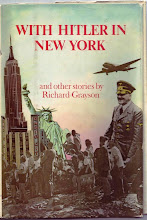
ROLLING STONE called Grayson’s first short story collection, WITH HITLER IN NEW YORK, published in 1979, “where avant-garde fiction goes when it becomes stand-up comedy,” and NEWSDAY said, “The reader is dazzled by the swift, witty goings-on.”
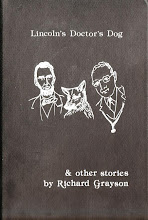
Grayson’s other short story collections have also received acclaim. LIBRARY JOURNAL called LINCOLN’S DOCTOR’S DOG (1982) “excellent” and said of I BRAKE FOR DELMORE SCHWARTZ (1983) that “Grayson is a born storyteller and standup talker.” THE NEW YORK TIMES BOOK REVIEW said Grayson’s I SURVIVED CARACAS TRAFFIC (1996) was “entertaining and bizarre” and “consistently, even ingeniously funny.”
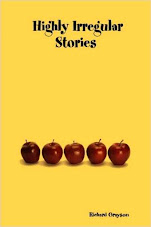
PUBLISHERS WEEKLY called Grayson’s THE SILICON VALLEY DIET (2000) “compulsively talky and engagingly disjunctive”; KIRKUS DISCOVERIES termed Grayson “an audacious and wickedly smart comedic writer” in its review of HIGHLY IRREGULAR STORIES (2005); and THE PHILADELPHIA INQUIRER, reviewing AND TO THINK THAT HE KISSED HIM ON LORIMER STREET (2006), said, “Grayson has a fresh, funny voice.”
Grayson’s nineteenth compilation of diary entries, Wanderyear, takes place between mid-1997 and mid-1998, when he quits his job as a staff attorney in social policy at a University of Florida law school think tank to move from place to place – South Florida, Brooklyn, Silicon Valley, Wyoming, Long Island, New Orleans, and suburban Phoenix, Los Angeles, Chicago and Philadelphia.
Grayson has published the first seven volumes of the diaries of his late teens and twenties as THE BROOKLYN DIARIES, featuring BOY IN BROOKLYN, 1969-1970; SUMMER IN BROOKLYN: 1969-1975; WINTER IN BROOKLYN: 1972-73; SPRING IN BROOKLYN, 1975; AUTUMN IN BROOKLYN, 1978; MORE SUMMERS IN BROOKLYN: 1976-1979; and A YEAR IN ROCKAWAY, 1980.
The second six volumes of his diaries have been published as THE EIGHTIES DIARIES, which include SOUTH FLORIDA WINTERS, 1981-1984; LATE SPRING IN SUNRISE, 1982; WEST SIDE SUMMERS, 1984-1987; INDIAN SUMMER: PARK SLOPE, 1985; SPRINGTIME IN LAUDERHILL, 1986; and EIGHTIES’ END: AUTUMN, 1987-1989.
WANDERYEAR: 1997-1998 is the sixth volume of THE NINETIES DIARIES, following SUMMER IN NEW YORK: 1990; LAST SUMMER IN ROCKAWAY: 1991; FIRST FALL IN GAINESVILLE: 1991; SPRING IN GAINESVILLE: 1992-1994; and AUTUMN IN GAINESVILLE:1994-1996.The book is also available on Lulu and on Scribd for free online reading.
Monday, February 15, 2010
VAMPIRES OF NORTHWEST ARKANSAS by Richard Grayson now available at Amazon Kindle Store

Richard Grayson's Vampires of Northwest Arkansas is now available at Amazon's Kindle Store for 99¢.
Here is the promo material for the 149-page $7.99 paperback edition from Art Pants Company:

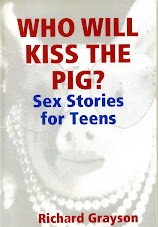
Ten stories by acclaimed short story writer Richard Grayson (WITH HITLER IN NEW YORK, I SURVIVED CARACAS TRAFFIC, LINCOLN'S DOCTOR'S DOG, I BRAKE FOR DELMORE SCHWARTZ, WHO WILL KISS THE PIG?: SEX STORIES FOR TEENS) spotlight gay men coping with unusual situations: a best friend and fellow former prostitute bitten by an Ozarks bat in the wake of 9/11; a boyfriend morbidly worried about an impending worldwide chocolate shortage; an Orthodox Jew who consults his rabbi because a lover refuses to ever remove his socks during sex; a young African-American college student on a homophobic campus who has to care for his Muslim roommate’s therapy monkey; a Wyoming cattle ranch manager dealing with an outbreak of leafy spurge on his land; a Brooklyn man with a younger Japanese lover reflecting on his Williamsburg neighborhood’s demographic transitions from Italian to Hispanic to hipster to yuppie; a writer confronting on his past affair with his much younger stepbrother and contrasting his adventures with those of the comic book superhero Green Arrow; a Puerto Rican teacher compelled to watch shirtless teabag-eating white boys online; a former babysitter of the actor Laurence Fishburne unable to understand the young gay Phoenix couple who are his tenants; and a Florida man haunted by the shuttered suburban movie theaters of his youth. Wickedly funny and weirdly profound, these talky stories weave a startling tapestry of quirky gay life in the America of the last two decades.
The pieces originally appeared in the such webzines (most now defunct) as VerbSap, Opium, Rio, Me Three, Apogee, The Magazine Shiver, The Rumpus and Pug Magazine.
Tuesday, April 17, 2001
American Book Review reviews Richard Grayson's THE SILICON VALLEY DIET

The March-April 2001 issue of American Book Review has a review of Richard Grayson's The Silicon Valley Diet:
American Book Review
March-April 2001
Defiant on Thin Ice
Henry Grinberg
The Silicon Valley Diet. Richard Grayson.
Red Hen Press, PO Box 902582, Palmdale, CA 93590.
182 pages; paper, $14.95.
Richard Grayson’s ninth collection of short stories achieves many goals, and he is clearly a master of the genre. It it equally clear throughout the twelve tales that, although the characters have different names, they are essentially the same – without strenuous attempts at disguise. They are young gay men trying to survive in a hostile or marginally accepting world. They conduct themselves with manic cheer. They possess a grace and courage that have to substitute for the acceptance and love that most people look for. Their successes in this sphere are meager; their disappointments, many.
Yet, despite a seeming similarity in their drives – and palpable coincidences of character and action – Grayson rarely palls. His young men are imbued with a sweet, endearing nuttiness that serves both to energize and individualize. He depicts our cyberspace and e-mail age, so convenient for rapidly dissolving and re-forming associations, invariably against a backdrop of the search for sincere love and the deaths that ravage gay men and their partners.
There’s more. Wherever Grayson casts his gaze, he manages to isolate panoramas of city and small town life in America from the 60s to the present, detailing not only the particular rebelliousness of these “outsiders,” but also the general collapse in the national fiber, of which they are part. These are connected to public events, such as the uncertain outcome in Korea and defeat in Vietnam, and are reflected in a spate of fragmented families, step-siblings galore, and a never-ending specter of impending divorces and split-ups. You get a picture of a psychologically maimed, dysfunctional society, some of whose members don’t give up trying for happiness.
Four of the stories employ a similar, interesting technique, that of alternating narrative with what at first seem like droningly dull passages from textbooks – a political-economic history of part of the former Soviet Union; a treatise on how to write; another on the invasion of ruinous, alien vegetation onto prairie land; and an excruciatingly obsessional description of a diet. These particular stories, “Boniatos Are Not Boring,” “Moon Over Moldova,” “Mysteries of Range Management,” and “The Silicon Valley Diet” (the title story of the collection, perversely presented last), are unusually effective.
But the effect is quite different from story to story, despite the shared technique. “Boniatos” achieves a wonderful sense of humanity, hovering brilliantly between the tragic and the wildly funny, by wickedly employing a deadpan, soulless mock-treatise on how to write that manages to crush the life out of the ostensibly creative act. “Moldova” is a little masterpiece, told by indirection. It tells of young gay man attracted to both partners of a homosexual relationship. Interspersed by chunks of a history of the former Soviet republic, the action is magically reinforced by what appears to be nothing other than a tedious narration. But that history manages to reflect, by means of the author’s plays of subtle implication, the pathos of a man absurdly drawn to both members of a couple, neither one of whom he may claim.
“Mysteries of Range Management” takes place in the wide open spaces of Wyoming, where we learn a gay life is possible too – not only in big cities. As with “Moldova,” we have another story together with interpolated extracts from a textbook. This time it is one describing the relentless spoliation of the cattle ranges by a non-native vegetation called “leafy spurge.” Again, the text interacts with the human story in richly ironic and half-crazy ways. More somberly than he did in “Moldova,” Grayson makes leafy spurge – the pest-plant, an insidious encroacher – symbolic of the workings of both anti-gay social contagion and the action of AIDS itself. He makes specific references to the recent murder in Wyoming of Matthew Shepard. This provides tangible menace in an outwardly tranquil tale.
“The Silicon Valley Diet” is yet another story that builds its effects by means of interspersed tutelaries – this time instructions for a weight-loss diet, so humorless and condescending in presentation as to be maddening if the effects were not so – I say again – wildly funny and compelling. And, again, it is another tale of the kinds of startling partners that gay relationships can involve. At times, it seems there’s nothing too grungy when one’s in love or in lust, as in many a straight relationship.

The remaining stories here are accomplished and make their points with enviable skill. They don’t come off with quite the same impact, in my judgment, as those I have described. They present similar explorations into the bittersweet frustrations of life, missed chances for meaningful connection, and the perceived necessity for choking off one’s real feelings. But they are very good, nevertheless.
In these and the other stories in the collection, Grayson makes one aware of how vulnerable his characters are. Beset by mortality, even as they seek affirmation, they truly remind us of those flying summer insects that extinguish themselves in a brief act of love. Everything is poignant. Much hurt is to be sensed beneath the wise-guy, tough-cookie exteriors. It’s Grayson’s way, moreover, that many of the pieces in the book are preceded by what you may think are charmingly bizarre preludes that anticipate the main action, but which turn out, slyly, to be the main show itself.
There are many layers to this detailing of the techno-ridden superficialities of our contemporary life, with its bar codes, microwave ovens, and cyberspeak. These are truly sagas of man versus machine. The fact that these are gay men serves to render them even more poignant because one senses that these characters may have hoped for some protection from the brutalities of modern life, through technology. Perhaps, even redemption.
Subscribe to:
Posts (Atom)