Showing posts with label Brooklyn Cyclones. Show all posts
Showing posts with label Brooklyn Cyclones. Show all posts
Saturday, June 7, 2014


Thursday, December 20, 2012
Thursday Morning in Coney Island: Breakfast on the Riegelmann Boardwalk


Friday, May 7, 2010
Friday Night in Dumbo: Novel-T Team 2 Opening Day Party with David Goodwillie & Sandy the Seagull at powerHouse Arena

Yesterday morning, when our dead-trees issue of Time Out New York arrived in our non-virtual mailbox, we turned to the "Your Perfect Weekend" section and saw as the first item for Friday, May 4:

We’re big fans of Novel-T
because we like books more than sports, and wearing a T-shirt emblazoned with a Tell-Tale Heart is the best way to show that literary spirit. Like-minded folks should stop by powerHouse Arena (37 Main St at Water St, Dumbo, Brooklyn;
novel-t.com; 7–9pm, free) for the launch party of the nerdy tee company’s “Team 2” series,
which salutes writers such as Kurt Vonnegut, Emily Dickinson
and the line’s first living author, Jonathan Ames (his emblem is the Brooklyn Bridge, natch). Once you’ve donned your Darcy tee ($25), stick around for a reading from Richard Grayson, or show off your baseball skills (sort of) in a Wii
home-run derby.


What that left out was the more exciting news that David Goodwillie, whose new novel American Subversive

has gotten spectacular reviews everywhere, was reading at the event and that there would be an appearance by Sandy the Seagull of the Brooklyn Cyclones.

powerHouse Arena is a great venue for just about anything, one of the coolest spaces in Brooklyn.

We arrived early and explored the intriguing green-themed art exhibit upstairs

and the selection of books and other stuff for sale downstairs.

The event tonight was co-sponsored by BrooklynTheBorough, which had their new print little magazine on display.

David Bukszpan and Michael Kravetsky, who are both the brains and brawn behind Novel-T,

introduced the evening's events, which began with an underwhelming reading of an allegedly comic Brooklyn baseball story written by the world's worst photographer. If you want to see non-sucky pics of this event, check out the professional photos at Facebook, taken by the talented Emile Dubuisson, who can even make meeskites look semi-okay.

Anyway, things picked up momentum considerably once David Goodwillie, a former minor league baseball player, read a funny and honest section of his rollicking memoir, Seemed Like a Good Idea at the Time, dealing with his failed post-college tryout with the Cincinnati Reds.

Free Novel-T Team 2 shirts and Cracker Jacks were catapulted into the bleachers.


A video of Jonathan Ames, in the T-shirt honoring him, introduced the new lineup of stylish Novel-T wear.

There was free beer (not much use to us teetotalers, but nice for normal people) and then the Wii tournament got underway with Sandy as the first contestant.

He is a better mascot than a player.

It was really a great evening, and we're grateful for being invited.

Also we're grateful that our old friends Ken, Paul (we know both of them from our freshman year at Brooklyn College forty years ago) and Janet and our students Tunisia, Clinton and Nadia were nice enough to show up. As for Sandy the Seagull (shown here with Paul), he's a great sport and the best big bird in all of Brooklyn baseball.

Again, if you want an idea what the Novel-T celebration of the release of its second team, The National Puncs, looked like without the fuzziness and blurring, see Emile Dubuisson's photos at Novel-T's Facebook page, like this one:

Wednesday, November 14, 2007
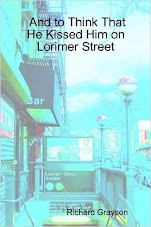
The PODler Reviews Richard Grayson's AND TO THINK THAT HE KISSED HIM ON LORIMER STREET
The PODler reviews Richard Grayson's And to Think That He Kissed Him on Lorimer Street today:

Richard Grayson is a prolific writer of over 200 stories, articles, and books. In the 80s, he staged a satiric run for the White House against Ronald Reagan. He has obtained a J.D. degree from University of Florida with honors and is, in addition, a master satirist and a keen observer of the American scene from his own and unique viewpoint. Grayson writes in a deceptively simple style that is, nevertheless, hard to imitate. Using this kind of autobiographical method, bordering on a confessional, Grayson looks through shifting viewpoints (gay and straight; white and black; American and immigrant; young and old) at the people, times, and palaces of a fictional Brooklyn.
In these fictions, Grayson meditates on various topics, mostly race, sexual identity, age, and change by using the device of popular culture, mixing in liberally the icons of pop culture with persons and places from memory to construct a solid literary edifice.
The collection is filled with resonant stories about the lives of ordinary people, and this focus is what makes them interesting and memorable. Somehow, though Grayson's master touch, the ordinary becomes fascinating and highly readable literature. Many of these stories, however, reflect a deep sadness that exists in the heart of the common man and his experience. Nothing seems to happen for the protagonists in these stories, their lives stupefying their subjects. Grayson reminds us with his fiction that our lives are, in the end, rather banal, revolving around the mundane, the ordinary, and the common. At the same time, there seems to be a kind of weird current of apathy that flows beneath the surface of the stories. In the title story, we wonder, for example, whether the narrator is incredibly open-minded about his son's sexuality and the kiss between the boys, or whether he's just too apathetic to care, and we wonder because the title seems to be a kind of subconscious expression of protest by the protagonist. Apathy, or more precisely, a kind of stupefaction, perhaps synergized by the bathos of pop culture, rears its head in "Shirtless Tea-bag Eating White Boys," in which two characters, one stupefied by Haldol, the other just tranquilized by American culture, watch internet videos, which somehow are appropriate for the mentally dysfunctional character and the young elementary school teacher; the first prefers to watch a purple hippo, and the latter prefers to view shirtless tea-bag eating white boy clips.
Some of these stories are biographical, and those are the stories that I like the best. Especially likable are "Branch Libraries of Southeastern Brooklyn," in which Grayson's character reminisces about the libraries that he had known and how they had evolved over the years-this one is probably my favorite story, as I do love libraries, and it seems that Grayson is a true lover of the library as well - and "The Lost Movie Theatres of Southeastern Brooklyn and Rockaway Beach," another story of nostalgia and memory, where we are treated to reminiscences about the various theatres that the author remembers. "1001 Ways to Defeat Green Arrow" deals with change in gay relationships and the longing and emptiness that result. "My Life in The New York Post" is a collection of strange but somehow funny clips from, apparently, the Post regarding a fictional Grayson's plots and schemes.
Other stories that I liked were "In the Sixties," a kaleidoscope-like summary of the Sixties; "Diary of a Brooklyn Cyclones Hot Dog," which deals with the life of a lesbian Uzbek immigrant who is promoted to being the Relish in a Hot Dog Race; and "Mohammad's Therapy Monkey," in which the protagonist, a college student with some issues is assigned a roommate with a pet monkey, which helps him find acceptance and a relationship of his own in a place that he detests.
Grayson chronicles the real through his funny, sometimes sad, but always genuine, if slightly offbeat, fictional world.

Richard Grayson is a prolific writer of over 200 stories, articles, and books. In the 80s, he staged a satiric run for the White House against Ronald Reagan. He has obtained a J.D. degree from University of Florida with honors and is, in addition, a master satirist and a keen observer of the American scene from his own and unique viewpoint. Grayson writes in a deceptively simple style that is, nevertheless, hard to imitate. Using this kind of autobiographical method, bordering on a confessional, Grayson looks through shifting viewpoints (gay and straight; white and black; American and immigrant; young and old) at the people, times, and palaces of a fictional Brooklyn.
In these fictions, Grayson meditates on various topics, mostly race, sexual identity, age, and change by using the device of popular culture, mixing in liberally the icons of pop culture with persons and places from memory to construct a solid literary edifice.
The collection is filled with resonant stories about the lives of ordinary people, and this focus is what makes them interesting and memorable. Somehow, though Grayson's master touch, the ordinary becomes fascinating and highly readable literature. Many of these stories, however, reflect a deep sadness that exists in the heart of the common man and his experience. Nothing seems to happen for the protagonists in these stories, their lives stupefying their subjects. Grayson reminds us with his fiction that our lives are, in the end, rather banal, revolving around the mundane, the ordinary, and the common. At the same time, there seems to be a kind of weird current of apathy that flows beneath the surface of the stories. In the title story, we wonder, for example, whether the narrator is incredibly open-minded about his son's sexuality and the kiss between the boys, or whether he's just too apathetic to care, and we wonder because the title seems to be a kind of subconscious expression of protest by the protagonist. Apathy, or more precisely, a kind of stupefaction, perhaps synergized by the bathos of pop culture, rears its head in "Shirtless Tea-bag Eating White Boys," in which two characters, one stupefied by Haldol, the other just tranquilized by American culture, watch internet videos, which somehow are appropriate for the mentally dysfunctional character and the young elementary school teacher; the first prefers to watch a purple hippo, and the latter prefers to view shirtless tea-bag eating white boy clips.
Some of these stories are biographical, and those are the stories that I like the best. Especially likable are "Branch Libraries of Southeastern Brooklyn," in which Grayson's character reminisces about the libraries that he had known and how they had evolved over the years-this one is probably my favorite story, as I do love libraries, and it seems that Grayson is a true lover of the library as well - and "The Lost Movie Theatres of Southeastern Brooklyn and Rockaway Beach," another story of nostalgia and memory, where we are treated to reminiscences about the various theatres that the author remembers. "1001 Ways to Defeat Green Arrow" deals with change in gay relationships and the longing and emptiness that result. "My Life in The New York Post" is a collection of strange but somehow funny clips from, apparently, the Post regarding a fictional Grayson's plots and schemes.
Other stories that I liked were "In the Sixties," a kaleidoscope-like summary of the Sixties; "Diary of a Brooklyn Cyclones Hot Dog," which deals with the life of a lesbian Uzbek immigrant who is promoted to being the Relish in a Hot Dog Race; and "Mohammad's Therapy Monkey," in which the protagonist, a college student with some issues is assigned a roommate with a pet monkey, which helps him find acceptance and a relationship of his own in a place that he detests.
Grayson chronicles the real through his funny, sometimes sad, but always genuine, if slightly offbeat, fictional world.
Thursday, February 15, 2007
New York Brain Terrain reviews Richard Grayson's AND TO THINK THAT HE KISSED HIM ON LORIMER STREET
Michelle Lin reviews Richard Grayson's And to Think That He Kissed Him on Lorimer Street at New York Brain Terrain on February 15, 2007:

I was a frequent peruser of the Daily Cal , the school newspaper, and The Heuristic Squelch, the campus humor magazine, during my first two years in college. Squelch was often too raunchy and perverted for my tastes, but I loved their fake news round-ups and the letters from the editor. One particular letter from the editor that stands out in my mind is the one addressed to the freshman in fall 2000: "College," the editor opined, "is like a hypercolor t-shirt. It starts out with a brilliant pink burst of excitement, before slowly fading away to a blur of resentment and apathy." The editor also instructed the freshmen, "If you're one of those students who asks questions in lecture every day, just remember, there's a special circle in hell for you people."
Richard Grayson's recent collection of short stories reminds me of The Heuristic Squelch, both in its smart humor and its ability to induce belly-aching laughs. Composed alternately of semi-autobiographical pieces and humorous shorts, Grayson weaves a picture of Brooklyn (and New York) that is rarely seen in New York literature nowadays.
A native of Canarsie himself, Grayson's characters inhabit the outlying middle-class neighborhoods in Brooklyn and Queens: Flatbush, the Rockaways, Bensonhurst, Brighton Beach, Canarsie, and the like. His characters are wonderfully diverse, much like the city itself, ethnic, immigrants, LGBT--you'll not find a single straight upper-class WASP in the book (not that there's anything wrong with that). The strengths of this book, I felt, lay in its humorous shorts.
A particular one that stands out in my mind is "Diary of a Brooklyn Cyclones Hot Dog," a tale of a lesbian Uzbekistani teen whose job is to dress up as Nathan's Relish Hot Dog. During each game, there is a race between Ketchup, Mustard, and Relish, and, much like the Trix Rabbit who never gets to eat Trix, Relish is never allowed to finish first in the race. However, like the Trix Rabbit, Relish starts out every race absolutely determined not to finish last, but some unfortunate incident befalls her each time.
The semi-autobiographical short stories, while well-written, were a bit too confessional for my tastes; however, they are still interesting reads. Grayson's handling of his characters' sexuality is deft and never overbearing. Highly recommended.

I was a frequent peruser of the Daily Cal , the school newspaper, and The Heuristic Squelch, the campus humor magazine, during my first two years in college. Squelch was often too raunchy and perverted for my tastes, but I loved their fake news round-ups and the letters from the editor. One particular letter from the editor that stands out in my mind is the one addressed to the freshman in fall 2000: "College," the editor opined, "is like a hypercolor t-shirt. It starts out with a brilliant pink burst of excitement, before slowly fading away to a blur of resentment and apathy." The editor also instructed the freshmen, "If you're one of those students who asks questions in lecture every day, just remember, there's a special circle in hell for you people."
Richard Grayson's recent collection of short stories reminds me of The Heuristic Squelch, both in its smart humor and its ability to induce belly-aching laughs. Composed alternately of semi-autobiographical pieces and humorous shorts, Grayson weaves a picture of Brooklyn (and New York) that is rarely seen in New York literature nowadays.
A native of Canarsie himself, Grayson's characters inhabit the outlying middle-class neighborhoods in Brooklyn and Queens: Flatbush, the Rockaways, Bensonhurst, Brighton Beach, Canarsie, and the like. His characters are wonderfully diverse, much like the city itself, ethnic, immigrants, LGBT--you'll not find a single straight upper-class WASP in the book (not that there's anything wrong with that). The strengths of this book, I felt, lay in its humorous shorts.
A particular one that stands out in my mind is "Diary of a Brooklyn Cyclones Hot Dog," a tale of a lesbian Uzbekistani teen whose job is to dress up as Nathan's Relish Hot Dog. During each game, there is a race between Ketchup, Mustard, and Relish, and, much like the Trix Rabbit who never gets to eat Trix, Relish is never allowed to finish first in the race. However, like the Trix Rabbit, Relish starts out every race absolutely determined not to finish last, but some unfortunate incident befalls her each time.
The semi-autobiographical short stories, while well-written, were a bit too confessional for my tastes; however, they are still interesting reads. Grayson's handling of his characters' sexuality is deft and never overbearing. Highly recommended.
Saturday, April 15, 2006
Kirkus Discoveries reviews Richard Grayson's AND TO THINK THAT HE KISSED HIM ON LORIMER STREET
Kirkus Discoveries has reviewed Richard Grayson's And to Think That He Kissed Him on Lorimer Street:

AND TO THINK THAT HE KISSED HIM ON LORIMER STREET
and Other Stories
Author: Grayson, Richard
Review Date: APRIL 13, 2006
Publisher:Dumbo Books (304 pp.)
Price (paperback): $16.95
Publication Date: 2006
ISBN (paperback): 1-4116-7595-9
Category: AUTHORS
Classification: FICTION
The dynamic Brooklyn cityscape serves as the backdrop in this beguiling collection of short stories.
Grayson’s tenth volume of fiction introduces a multicultural multitude of characters, including a teen lesbian from Uzbekistan who works as a Brooklyn Cyclones hot-dog mascot and a gay black student whose Pakistani roommate’s pet monkey helps him find acceptance on a mildly homophobic campus. Most, though, are slight variations on the quasi-autobiographical persona of a middle-aged white man reminiscing about the friends, families, lovers and locales that have populated his life. Grayson often constructs his loose, episodic narratives with a pop-culture scaffolding, as in “Seven Sitcoms,” in which the narrator meditates on his relationship with his family’s black housekeeper through a commentary on the racial and class stereotypes of early TV sitcoms; and “1001 Ways to Defeat Green Arrow,” a reconstruction of a love affair between a man and his much younger stepbrother, paired with a hilarious exegesis of a comic-book hero in decline. In other stories, like “Branch Libraries of Southeastern Brooklyn” and “The Lost Movie Theaters of Southeastern Brooklyn and Rockaway Beach,” the author maps out memories against the geography of his beloved Brooklyn, with excursions to Los Angeles and South Florida. Grayson’s low-key, conversational prose is injected with flashes of wry wit (“I live in a neighborhood where neighbors notice my lack of body art”), but some of the slighter pieces are no more than droll shaggy-dog stories. The more substantial ones, however, like “Conselyea Street,” about a gay man with a younger Japanese lover reflecting on his Williamsburg neighborhood’s demographic transitions—from Italian to Hispanic to hipster to yuppie—fuse vivid characters with a keen sense of place and cultural specificity.
A funny, odd, somehow familiar and fully convincing fictional world.

AND TO THINK THAT HE KISSED HIM ON LORIMER STREET
and Other Stories
Author: Grayson, Richard
Review Date: APRIL 13, 2006
Publisher:Dumbo Books (304 pp.)
Price (paperback): $16.95
Publication Date: 2006
ISBN (paperback): 1-4116-7595-9
Category: AUTHORS
Classification: FICTION
The dynamic Brooklyn cityscape serves as the backdrop in this beguiling collection of short stories.
Grayson’s tenth volume of fiction introduces a multicultural multitude of characters, including a teen lesbian from Uzbekistan who works as a Brooklyn Cyclones hot-dog mascot and a gay black student whose Pakistani roommate’s pet monkey helps him find acceptance on a mildly homophobic campus. Most, though, are slight variations on the quasi-autobiographical persona of a middle-aged white man reminiscing about the friends, families, lovers and locales that have populated his life. Grayson often constructs his loose, episodic narratives with a pop-culture scaffolding, as in “Seven Sitcoms,” in which the narrator meditates on his relationship with his family’s black housekeeper through a commentary on the racial and class stereotypes of early TV sitcoms; and “1001 Ways to Defeat Green Arrow,” a reconstruction of a love affair between a man and his much younger stepbrother, paired with a hilarious exegesis of a comic-book hero in decline. In other stories, like “Branch Libraries of Southeastern Brooklyn” and “The Lost Movie Theaters of Southeastern Brooklyn and Rockaway Beach,” the author maps out memories against the geography of his beloved Brooklyn, with excursions to Los Angeles and South Florida. Grayson’s low-key, conversational prose is injected with flashes of wry wit (“I live in a neighborhood where neighbors notice my lack of body art”), but some of the slighter pieces are no more than droll shaggy-dog stories. The more substantial ones, however, like “Conselyea Street,” about a gay man with a younger Japanese lover reflecting on his Williamsburg neighborhood’s demographic transitions—from Italian to Hispanic to hipster to yuppie—fuse vivid characters with a keen sense of place and cultural specificity.
A funny, odd, somehow familiar and fully convincing fictional world.
Subscribe to:
Posts (Atom)