Today's
Miami Herald has an article about Richard Grayson, "Lincoln's Doctor's Dog's Author," on the front page of its Living Today section:
The Miami Herald
Sunday, April 4, 1982
Living Today
Section G, Page 1
Lincoln's Doctor's Dog's Author
'Giving It All Up for Computers, and Other Stories'

By MIKE WINERIP
Herald Staff Writer Thirty-year-old Richard Grayson was sitting in his furnished Davie apartment, six months into his eight-month lease, rereading the New York Times Book Review from March 14:
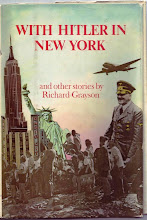
"Richard Grayson's first book carried the title,
With Hitler in New York. Some reviewers liked the book, at least one detested it, and readers ignored it in droves. It sold only about 500 copies, according to the author, who teaches English at Broward Community College in Davie, Fla.
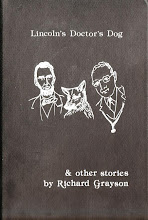
"When it came time to compile a new book…he decided to appeal to a broader constituency. Having heard that books about Abraham Lincoln, doctors and dogs usually sell well, Mr. Grayson is calling his new hardcover book…Lincoln's Doctor's Dog, and Other Stories."
Except for an extra sentence or two and a couple of adjectives, that was the whole thing in a nutshell.
A friend who is into Eastern culture called Grayson and congratulated him. A lady from Queens with a handicapped kid wrote asking for Grayson's autograph if he wasn't too busy.
He wasn't, though he is considering taking up computer programming this summer at the community college.
*
Richard Grayson, who has published 150 short stories in dozens of obscure literary magazines, recently was teaching a Compare and Contrast lesson to his beginning English class at Broward Community College. Something about the American Revolution versus the Russian Revolution. Only one student knew what a Bolshevik was.
Grayson was making the point that a good Compare and Contrast didn't have to be one paragraph about Russia followed by one on America (although that was one way to do it). You could have both revolutions in the same paragraph. It wasn't clear if anyone was getting this concept.
There is no other way to put it: Broward Community College does not feel like the kind of place anyone one would be doing serious writing. It feels like a place where future pharmacists, computer programmers and dental technicians will learn to write sentences without comma splices if they pay close attention. It feels very clean and scrubbed, very healthy and wholesome. Lots of tanned young people wearing very little clothing hurry up and down geometrically pleasing stairwells. You could cast Brave New World here. Almost no one looks fat or excessive or impolitic. It's the kind of place that might make one of Richard Grayson's elderly characters say: "So many sensational young people and nice teeth, too."
Graffiti from radio The graffiti covering desks in Grayson's classroom are not literary. They're mostly from the radio. A sample desk in Grayson's class says: "Styx…Trash…For Sure…Lou Reed…Rock and Roll Forever."
More than once Grayson has thought that were Melville or Hardy around today he might go electronic.
"I know most of you, when you get the urge to read, lie down until it passes," he says, though not in a mean way. The tone is of a man being left behind.
Still, Grayson remains faithful to the course curriculum. He talks about comma splices.
"I once had a student who said, 'Don't you put a comma every fourth word?' We're going to have a very animated discussion on commas Monday…We'll have a real good discussion on the dash. The dash is wonderful. When all else fails – use the dash."
* Richard Grayson, whose favorite food is the hamburger, likes life in Davie. He is making the most money ever in his life, $14,000 from the community college, plus a $3,000 grant from the Florida Fine Arts Council. And there are perks: Teaching at the college entitles him to take computer programming at a reduced tuition rate.
This is his ninth college teaching job. To make ends meet he has worked at places like New York City Technical College, where, his resume says, he was a substitute adjunct lecturer.
He does not consider any of this noble.
His fiction has never paid much. Taplinger Co. gave him a $500 advance for the first short story collection,
With Hitler in New York. The book didn't sell enough copies to cover the advance. Nor does he expect to make anything on
Lincoln's Doctor's Dog, scheduled for release in May. There was no advance for that one.
Most literary magazines that publish his stories count circulation in the hundreds, not thousands:
Apalachee Quarterly, City, Writ, Shenandoah, Texas Quarterly. The big ones pay $50. The small pay nothing.
Welter, the University of Baltimore's literary review, just accepted one of his stories. His compensation will be two free copies.
The story is about a painter who becomes a computer programmer.
* Richard Grayson started writing regularly at 18. He had just spent a year in his room, scared to come out. Grayson didn't know it then, but he was suffering from agoraphobia, a fear of mixing with crowds. It was a nervous breakdown of some sort. When he reappeared in the spring of 1969, everything seemed fresh. It was a classic case of being rehatched.
"I wasn't the best in my creative-writing class. I was maybe in the middle of eight. But I kept at it. I'd keep sending my stuff out when it was rejected. I sent out the same story over and over. Others gave up."
* The absurd is on Richard Grayson's mind.
He takes major historical figures and drops them into mundane American settings like his native Brooklyn. There's absolutely nothing funny about Hitler, right? Grayson's Hitler flies into Kennedy on a Laker flight, smokes a joint on the Belt Parkway, eats Szechuan in Brooklyn Heights.
Constipation is sad and private, right? Richard Grayson wrote this about one of his characters:
"When he was very young, he was constipated. Sometimes he did not go to the bathroom for weeks. His grandmother would cry that the boy's appendix might be on fire…In the summer, people would come into his grandmother's bungalow to watch him straining at the stool. The bathroom door would be open wide and sometimes people would bring their guests for a weekend barbecue….
"When there was a bowel movement his grandmother would make a party. It was more for the adults than him."
* His stuff is autobiographical. At times he doesn't bother to disguise it. In the middle of a short story about a lawyer he interrupts the narrative: "The 'I' of this story is really me, Richard Grayson, and not some literary device….Please, you can see I'm a sick person. What would it take, a few pages in your lousy literary magazine, to make me happy?....If I can't have your respect I'll settle for your pity."
"Pitiful," wrote Kirkus Reviews.
"I used to get rejections saying, 'Grow up.' Truly cruel ones. The kind that level with you: 'You have no talent. Give up.' They discourage you for a couple of days."
The Los Angeles Times thought he was funny;
Newsday said he had a wild sense of humor, yet some telephone company official stringing reviews for the
Minneapolis Tribune almost had a nervous breakdown:
"This is the worst book I ever read in my life," he wrote, "a cornucopia of crap."
The telephone review man said he planned to give Grayson's book to someone he despised.
*
In his spare time Grayson cooks up minor media events. It amuses him and brings a little of the recognition you don't get when you're trying to do something enduring in Davie. He started a campaign to run Burt Reynolds for U.S. Senate.
Burt refused.
Grayson ran for Davie Town Council as a lark last month, saying horses should be given the vote and the council should be abolished because it didn't do much. This offended local newspaper editorial writers, who have a genuine concern about the quality of leadership on the Davie Town Council.
Grayson lost.
When his grandmother, Sylvia Ginsberg, was lonely and depressed last year, he sent out press notices saying she was a superstar and that he was starting the Sylvia Ginsberg Magazine and fan club.
She died.
* Grayson expects ts to be famous.
"I have a feeling I'll be discovered in my 70s. I can't really say why. I just feel that's the way it is. It's fate.
"I've done things a lot of people tried to do and couldn't. I've had books published by a commercial publisher. I'm young, too. Maybe I'll go on for 10 years without having a successful book, and all of a sudden I'll have one.
Wilder slept there Two years ago Grayson was a fellow at the MacDowell Colony in Peterborough, N.H. A small group of promising writers, composers, painters and sculptors spends the summer at a wooded retreat. You work in your cabin all day and gather for discussions in the evenings.
"You're treated so well," Grayson remembers. "Like you're important. I wasn't used to being treated well."
He lived in the same cabin where Thornton Wilder once worked. At the desk where Grayson sat, Wilder wrote
Our Town.
Each year, when the summer's over, the fellows write their names on the wall of the cabin where they stayed.
As he added his to the long list, Richard Grayson scanned the other names. A few were familiar.
* "Of course sometimes it hurts me that I have friends who make $70,000 doing what I might call trivial things.
"My best friend Linda I've known since first grade. She's the editor of a magazine. She owns two houses in Washington, D.C., as investments. She's written a book. But I have things she doesn't have. Her book's about roller skating. She's doing a story about travel in Costa Rica. The magazine she runs is for weight watchers. I don't think she has the same feeling toward her material that I do. I have the freedom to write what I want."
A couple of years ago Richard Grayson was depressed about not being known. Then a Mount Holyoke professor sent him an English 234 paper. It was a detailed analysis of "Summoning Alice Keppel." A short story. By Richard Grayson. That kept him going a couple of extra days.
And there is more:
"Linda has a friend who taught high school in Wisconsin. He was going around the class, asking everyone their favorite writer.
"And one kid said, 'You've probably never heard of him, but Richard Grayson.'"