As might be expected from a collection of journal excerpts, there is a good deal of self-indulgence, occasionally smacking of that late '60s, post-hippie sensibility which seeks to startle, but is more often merely tiresome. Still, however, the sheer variety of styles makes for an entertaining tour of some of the frontiers of contemporary prose. The book is given some structure through division into six sections, which correspond loosely to different points of view, or aspects of the writers' experience. The first is aptly titled "The Writer." and Richard Grayson's musing is an eloquent and ironic slice of the difficult and seldom rewarding realities of that life
Sunday, April 29, 1979
Minneapolis Tribune reviews First Person Intense, an anthology with a contribution by Richard Grayson
Today, Sunday, April 29, 1979, the Minneapolis Tribune published on page 12G a review of First Person Intense, edited by Sasha Newborn. The reviewer, Barry Silesky, mentioned Richard Grayson's contribution to the anthology:
Wednesday, April 25, 1979
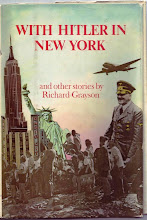
Publishers Weekly reviews Richard Grayson's WITH HITLER IN NEW YORK


The April 23, 1979 issue of Publishers Weekly has a review of Richard Grayson's With Hitler in New York:

WITH HITLER IN NEW YORK AND OTHER STORIES
Richard Grayson. Taplinger, $7.95
ISBN 0-8008-8406-X
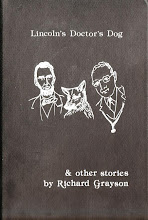
Grayson pokes fun at American life -- politicians, business, television and fads -- in these sharp, witty stories populated by such figures as Farrah Fawcett-Majors, "Chief Justice Burger, Teen Idol," and Sarah Lawrence of Arabia. Abe Lincoln, who isn't the least bit interested in slavery, sprawls on a couch in total apathy as Stephen Douglas makes love to Mary Todd upstairs. The degeneration of love in an alienated society is sketched in "Classified Personal," a collection of ads signed by Sappho, The Impotent Kid, Take Me I'm Yours, and other lonely hearts in search of potential mates. "In the Lehman Collection," a boy jogs 11 miles a day through the Main Gallery, a family takes a tour in their Winnebago, and a man is stabbed, unnoticed. The staccato style, laced with puns and wisecracks, is apt for these amusing if somewhat contrived satires. [June 15]
Friday, April 6, 1979
Taplinger Publishing Company's Spring 1979 Catalog features Richard Grayson's "With Hitler in New York"
Thirty astonishing stories by an exciting new writer –
Hitler and Mike get stoned and go for eggcreams in Brighton Beach. Buddy’s grandfather secretly knows that Farrah Fawcett-Majors has a foreign accent. A famous weight-lifter realizes that he’s got to live inside the body he’s built for himself. A teenage fan magazine tells ‘How to Make Chief Justice Burger Love You.’ A woman dutifully lies under the bed while her son has sex with Sarah Lawrence of Arabia. Cambodian insurgents auction off centaurs, gorgons, satyrs and griffins. A short story on a low-cholesterol diet gets arrested for solicitation. . . Welcome to the world of Richard Grayson, a gifted young writer whose short fiction, published in dozens of literary magazines, has been startling lucky readers for years. With Hitler in New York is a collection of Grayson’s finest, freshest, funniest work – thirty original visions of the way we live now.
160 pp. 5¼x8 $7.95 8406-X May Fiction
- Taplinger Publishing Company Spring 1979 Catalogue, page 14
Saturday, March 24, 1979
New York Post features Richard Grayson's prize-winning "Tales of New York" story


The New York Post today (Saturday, March 24, 1979) features a story by Richard Grayson, winner of its "Tales of New York" story contest, judged by James Brady.

Labels:
11201,
Brooklyn,
James Brady,
New York,
New York Post,
Page Six,
Richard Grayson,
short stories
Thursday, March 15, 1979
Washington Review of the Arts publishes Richard Grayson's "Super-Fab Senators"


The current (March 1979) issue of Washington Review of the Arts features Richard Grayson's "Super-Fab Senators."

Tuesday, February 27, 1979
The Smudge Review reviews Richard Grayson's DISJOINTED FICTIONS

The current (Winter 1978-1979) issue of the Detroit-based magazine The Smudge Review has a review of Richard Grayson's Disjointed Fictions by Hank Malone on pages 11-12:

DISJOINTED FICTIONS
By Richard Grayson
Released as X - A Journal of the Arts #5
Printed by Lawson Press · First Rate Offset
$3.00 · 42 Pages · Write to editor George Myers, Jr.
P.O. Box 2648 · Harrisburg, PA 17105
Disjointed Fictions is a funny, very readable, collection of "short fictions" written by one Richard Grayson, a 26 year old, well-published MFA who teaches English in Brooklyn. Mr. Grayson's premise appears to be that since he cannot write a piece of sustained fiction, like a novel, that he will instead write a book-length manuscript, building it, piece by piece, with clever fictions, ramblings, and fragments, a form popular in South America and probably best known to American readers in the work of Jorge Luis Borges.
These literary morsels and tidbits suggest a very fine talent, capable of much larger work; so the premise of an inability to sustain a longer fiction is, I think, clearly contrived for the purposes of doing this sort of thing: just jogging along in print, writing one's heart out in a wide-ranging variety of styles and fictions, relating nearly everything and everyone (especially celebrities) to himself in some very intriguing ways. It is a wildly narcissistic narrative, on the surface: very bright, wise, very "Jewish," very "New York," and often very funny, if you enjoy "put-on" and a subtle kind of surrealism that bursts occasionally in all kinds of ironically wise ways.
Disjointed Fictions is full of fun for a literate reader (comix readers beware), with lots of puns and potshots at everyone and everything. And yet, it is a strangely haunting work a well. Grayson's sense of logic is both conventional and precise, ad with this book I have discovered another fine American talent whose future work should be more than a light entertainment. Grayson is both a philosopher and a class clown, and in Disjointed Fictions there is a lot of Talmudic wisdom showing up in the wisecrack format of the Marx Brothers.
This is not a book for everyone. Sometimes the cleverness turns to lead, and the fun and absurdity becomes merely frivolous detailing On the other hand, I laughed a lot with it, and I suspect others will as well. This would be a thrilling Good Friday present to a disjointed friend. - H.M.
Tuesday, December 12, 1978
Aspect Magazine features Susan Lloyd McGarry's "Twenty-Seven Statements I Could Make About Richard Grayson"


The latest issue (#72/73, 1978) of Aspect magazine features Susan Lloyd McGarry's "Twenty-Seven Statements I Could Make About Richard Grayson" on pages 88-91.
Friday, October 20, 1978
Long Island Poetry Collective Newsletter reviews Richard Grayson's DISJOINTED FICTIONS

The Long Island Poetry Collective Newsletter reviews Richard Grayson's Disjointed Fictions in its current (October 1978) issue:

Disjointed Fictions. Stories by Richard Grayson ($3.00 from X, A Journal of the Arts. PO Box 2648, Harrisburg, PA 17105)

So what’s a person who mostly reads poetry and non-fiction doing with a book of stories? Fact is that lots of modern fiction is innovative, defiant of form, and often less self-conscious, more daring than most poetry we read. We see an evolving open form, assimilating poetic advances and rapidly transcending category. Read aloud, it even sounds great. In Disjointed Fictions, things fall into place . . . or seem to . . . or maybe not. Richard Grayson is frequently witty, nearly always irreverent; we catch him in the midst of talking to himself, trying to put it all together, commenting on the process of writing, managing to skirt self-indulgence as he steps and out of his stories. He tries for scope and simultaneity with mixed results, though; his connections are often tenuous, the parts sometimes refuse to link. Maybe it’s intended; the book’s title implies as much. Grayson is most effective when he works in direct forms. “Progress” is a bizarre but understated tale reminiscent of “The Twilight Zone” and works very well for me. “The Facts Are Always Friendly” is ingenious, successfully developing characters through news briefs covering all the days of Winter 1972-73. Disjointed Fictions appears as Issue #5 of X, A Journal of the Arts, and is perfectbound with endpapers. Unfortunately the entire thirty-eight pages of text are set in an italic typewriter face, without leading, a poor design choice resulting in margin legibility. The $3.00 price tag seems steep and is sure to discourage many who would enjoy the book.
– George William Fisher
Tuesday, August 22, 1978
SCRIBES features Richard Grayson's story "How We Are Different from Other People"


Richard Grayson has a story, "How We Are Different from Other People," in the summer/fall issue of Scribes, Metropolitan State College of Denver's award-winning literary journal for, by, and about senior citizens.
Monday, August 7, 1978
Kings Courier profiles Brooklyn author Richard Grayson


The Kings Courier this week (August 7, 1978) has a feature story on Brooklyn short story writer Richard Grayson:
Kings Courier
______________________
Monday, August 7, 1978
Page 22
______________________
Brooklyn Trivia Incorporated—
Author Richard Grayson Practices His Craft With Little Fanfare
By CAROLYN BENNETT
Richard Grayson, at age 27, is a very successful writer. Not in the world’s terms, mind you, but in that nether land of shades, shadows, and unsung fictioneers, i.e., the world of small presses and little magazines. Writing since he was 19, Grayson’s first short story appeared in Transatlantic Review which accepted it immediately and unanimously, even after it had been previously turned down by more than 20 less well-known little magazines. A flood of publications followed, including short stories in Shenandoah, Panache, Statements 2: New Fiction, Dark Horse and The Texas Quarterly. To date, Grayson has published in over 80 literary journals, with 40 more stories expected out this year. His first book, Disjointed Fictions, will appear next month from X Press.
Grayson is hard not to like. Handsome, personable and sincere, he exudes high-level energy, and he is a highly imaginative writer. That same power is present in his fiction. One short story, “The Finest Joe Colletti Story Ever Written (so far)” leaves spaces to be filled in by the reader. Adjectives are also left out occasionally so as to entice the reader and make him or her participate in the author’s most current fiction. Here’s an example:
What makes Joe Colletti Joe Colletti? Does anyone know? Come on, you guys, please help me out. Why are you just sitting around reading this? Let’s get some dialogue going between us here: that’s the way Joe Colletti would want it. You’re the reader of this Joe Colletti story. Let’s have some communication already. This is a two-way street, you know. Here’s a blank space for you to fill in with your favorite anecdote about Joe Colletti. Come on, it’s easy once you start. Anyone who knows even the slightest thing about Joe Colletti (and that includes 99.999 percent of the human race) can do it. Just try. Please. For me, and more importantly, for Joe Colletti. A better Joe Colletti story is up to you.
Grayson knows a great deal about Brooklyn. For instance, did you know that Mill Lane, between East 56th and East 57th Street (Grayson lives on East 56th) used to be trafficked by British soldiers during the colonial wars? Furthermore, a house on East 46th Street owned by a friend of Grayson’s used to hold imprisoned British soldiers. The most interesting fact regarding Brooklyn which Grayson confided was that during the last ice age glacier stopped short at Empire Blvd., its thick ice finally melting to cause Flatlands and Flatbush. This material found its way into his short story, “Where the Glacier Stopped,” published in Epoch.
Because he seemed to know so much about Brooklyn, I asked Grayson if the borough figured importantly in his writing.
“Sometimes I change the locations just to make it appear as if my stories are more cosmopolitan,” Grayson answered, “or disguise the story for the sake of a friend. But all of my stories happen in Brooklyn inside my head.
Asked how he felt about living in Brooklyn when many budding literary figures feel that Manhattan, with its book parties and poetry readings, is the place to be, he said: “I have a friend who lived in Flatbush for most of his life. Just recently he moved into Manhattan and now will eat only Boston lettuce. What can I tell you? I guess I’m an iceberg lettuce boy at heart."
Currently an adjunct instructor in the English Department at Long Island University, Grayson began writing seriously while still a college student. His literary interests prompted him to work as assistant editor for the Fiction Collective publishing cooperative. He began working for the Collective in 1975, evaluating manuscripts, corresponding with authors, writing press releases, doing publicity and, finally, serving as a preliminary judge in the Fiction Collective/Braziller First Novel Contest in 1976. Grayson also co-directed a two-day conference in “Literature and Publishing” at Brooklyn College in 1977, which included Kurt Vonnegut, John Ashbery, Cynthia Ozick and Renata Adler.
Grayson’s own literary distinction begins with the 1973 Ottilie Grebanier Drama Award, first prize in playwriting for undergraduates sponsored by Brooklyn College’s English Department, and ends with a scholarship at the Santa Cruz Writing Conference, at the University of California at Santa Cruz this year. In between, Grayson was awarded a National Arts Club Scholarship in 1977, granting him leave to study at the Bread Loaf Writers’ Conference, our nation’s oldest writers’ conference, under the tutelage of such distinguished literary figures as John Gardner and Stanley Elkin.
Grayson’s fiction is highly suggestive of the work of Donald Barthelme, but escapes mere imitation because it embodies qualities that do not appear in Barthelme’s work. Grayson writes very fragmented fiction and his stories are very, very short – some of them no longer than two pages total. One reason for this, given by the writer himself, is that he is of the generation weaned on television. Because of TV, he says, he has a very short attention span and therefore cannot read or write long pieces. He tried his hand at a novel once . . . lousy, in his own estimation. But at the short form he is highly skilled. Grayson manages to cause the reader enough discomfort by his “disjointed fictions” to make him (or her) stop and think. But, unlike Barthelme, Grayson still maintains touch with emotion: his characters still care about the world and each other, which is very different than a Barthelme story. A good example of this is Grayson’s short piece, “With Hitler in New York,” published in Shenandoah. “Hitler’s girlfriend and I are waiting for him in the International Arrivals Building at Kennedy Airport,” the story begins, then proceeds to take you on a journey through Brooklyn with a character whose name evokes terror in the hearts of many and disgust in the minds of many more. Yet, in Grayson’s story there is no strong emotion, just quiet, contemplative feeling. Hitler could be Harry or Hilda or Herman from down the block. Only once does a character in the story dare to call Hitler a Nazi and even then you are not sure if he understands whom he is addressing. If Barthelme had written this story, it would have been devoid of emotion, but because Richard Grayson has written it, quiet emotion becomes the heart of the drama which unfolds.
Wednesday, July 19, 1978
New York Post reports on Richard Grayson's article "The Weird Sex Lives of Jewish-American Novelists"


The New York Post's Page Six today (July 19, 1978) has a report by Claudia Cohen on Richard Grayson's article, "Who Swaps? Who Swings? The Weird Sex Lives of Jewish-American Novelists," on Philip Roth, Saul Bellow, Bernard Malamud, Isaac Bashevis Singer and Cynthia Ozick.
Thursday, June 15, 1978
SCHOLIA SATYRICA features Richard Grayson's story "The Unexamined Life"


Richard Grayson's story "The Unexamined Life" appears in the current (Spring/Summer 1978) issue of Scholia Satyrica, the satire magazine published at the University of South Florida.
Sunday, April 2, 1978
Sunday Afternoon in Gramercy Park: Bread Loaf Scholars Richard Grayson, J. Garrett Glover and Tom Nevins reading at the National Arts Club

Today, Sunday, April 2, 1978, at 3 p.m., the National Arts Club presented a reading by the winners of the 1977 NAC Literary Scholarships to the Bread Loaf Writers Conference at Middlebury College, Vermont: J. Garrett Glover, Richard Grayson and Tom Nevins. The reading was followed by an informal reception.
Labels:
10003,
1977,
1978,
Bread Loaf,
Gramercy Park,
J. Garrett Glover,
National Arts Club,
Richard Grayson,
Tom Nevins
Sunday, November 6, 1977
Richard Grayson reviews Brad Gooch's THE DAILY NEWS in NORTHEAST RISING SUN

Richard Grayson reviews Brad Gooch's The Daily News in Northeast Rising Sun, Volume 2, Number 8/9 (1977).
Tuesday, August 16, 1977
Ottawa Citizen Columnist Mentions Fiction by Richard Grayson Featured in Writ Magazine
Today, Tuesday, August 16, 1977, The Ottawa Citizen's "Magazines" columnist Richard Labonte published a column, "Mundane fiction, infrequent flair and poety," praising Richard Grayson's fiction along with three other contributors, in Writ 8 as standing out as "carefully crafted commpared to the fevered droppings of too many young ficion writers."
Subscribe to:
Posts (Atom)