Showing posts with label Miami. Show all posts
Showing posts with label Miami. Show all posts
Thursday, March 17, 2022


Tuesday, March 16, 2021

Thursday, June 11, 2020

Friday, May 29, 2020

Friday, May 22, 2020

Wednesday, May 20, 2020

Thursday, April 23, 2020

Tuesday, April 14, 2020

Thursday, September 19, 2019

Monday, January 15, 2018

Saturday, December 2, 2017

Saturday, February 11, 2017

Thursday, October 20, 2016

Monday, October 17, 2016

Wednesday, June 18, 2014

Friday, January 28, 2011
Friday Morning in Williamsburg: Conselyea Street After the Latest Snowstorm

This will be our last winter in New York. The last five winters have been hard for someone who spent the previous twenty-six winters in Miami/Fort Lauderdale, Gainesville (go Gators), Phoenix or Silicon Valley -- but last one was really hard and this one has been worse. Here's Conselyea Street after our latest snowstorm. We're posting these pics mainly as a reminder to ourselves that we will not be missing Brooklyn come next January when we're living in a warm, snow-free place -- like our wonderful former neighbors two houses down.


No more shoveling for us after March! (Unless April is really, really weird.)

Saturday, November 18, 1989
Saturday Afternoon in Downtown Miami: The Miami Book Fair International 1989 at Miami-Dade Community College Wolfson Campus

Here we are with the outdoors booth of Broward Community College South Campus English Department at the 1989 Miami Book Fair International at the Miami Dade Community College's Wolfson Campus in downtown Miami.

Saturday, June 6, 1987
Richard Grayson's Funhouse column in the Hollywood Sun-Tattler imagines a new Miami theme park


Richard Grayson's Funhouse column in the Hollywood Sun-Tattler today (Saturday, June 6, 1987) imagines a new Miami theme park.
Tuesday, July 31, 1984
MIAMI SOUTH FLORIDA MAGAZINE Reviews Books by Richard Grayson
MIAMI SOUTH FLORIDA MAGAZINE is featuring an article on Richard Grayson on page 32 of its current (August 1984) issue:

CUTTING EDGE
Richard Grayson is a young writer who experiments with the short story form. His stories don't necessarily have the traditional beginning, middle and end. Some are extremely brief but intense sketches. Some jump radically in time or place. Others are stories in the form of notes, questionnaires and interviews. They are all stories which uncover a person who must deal with the shallowness, anonymity and pain Grayson finds in today's life. Grayson deals with that subject with poignancy and humor.

A four-year resident of South Florida, Grayson lives in North Miami Beach, teaches English at Broward Community College in Davie, and has had more than 125 stories published, most in exceedingly outre magazines. Some of these stories have been compiled in three hardcover books. Others are gathered in two chapbooks, which are thin, softcover collections. His latest publication, I Brake for Delmore Schwartz (Somerville, Mass., Zephyr Press, 1983) contains, paradoxically, much of his earliest work. In many of these stories, he deals with his personal vision of his Jewishness. His characters face loneliness and alienation with little loving absurd gestures. "Reluctance," the opening story, is about the love he felt for, and the pain he caused, his great-grandmother. "She told me," he writes, "she would make cookies when my own son was born, and when I said that would never happen, she just grabbed me up to her mammoth breasts and shook me until I laughed and said okay, I will have a son."
"By now," claims Grayson, "I've forgotten which work is autobiographical. Some of it is."

He also plays with perception, challenging the way we take the appearance of things for reality. "One of my feelings is that we live in a time when the perception or the so-called appearance of things is more important than what is real. Good writers always challenge our society. I hope to get people stirred up and even angry and outraged," he says. "I don't like telling people what they want to hear because they get enough of that on television."
And he does outrage, especially in his "press releases," a black comic part of his fictional work. As part of his experiments iwth perception and the way the media shapes ours, Grayson sends out press releases for his make-believe organizations like Future Fetuses of America and The Devil Broadcasting Company, which has "non-programs" like Satan Place, Route 666, and I Love Lucifer. He and his mother ran as delegates to the Democratic Convention on the platform of the Committee for Immediate Nuclear War. The publicity they received via the press releases garnered the pair more than 10,000 votes.

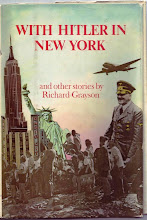
The surrealist Latin American writers Gabriel Garcia Marquez and Jorge Luis Borges are his literary models, so it is not surprising that Grayson produces such stories as With Hitler in New York (New York: Taplinger Publishing Company, 1979). He portrays Hitler as nothing more than an ordinary, likeable person with ominous undertones to his personality, thus asking and telling the reader how Hitler was able to reach his stats in the first place.
What makes Grayson's work outstanding, though, is that he mixes conventional narrative styles and subject matter with experimental games and unconventional material.

True, some of his experiments don't work, such as the tiresome and cliched Eating at Arby's (Brooklyn, NY: Grinning Idiot Press, 1982) but when I read the opening lines to the title story of his latest book, I know I am communicating with a person who is not afraid of looking down toward reality:
"Sometimes when I wake up in my loft bed in the mornings and I see the bars on the windows, I remember I am in prison. I try to feel repentant for the awful crimes I have committed, but then I remember that this memory is a false one and that the bars on my windows are only to protect me from other people . . . . Other times I decide that I really am in prison."
---Ann Reaben Prospero
________________________________________

Richard Grayson at Waldenbooks, Books & Books, 296 Aragon Avenue, Coral Gables, and Bookworks, 6933 Red Road, South Miami.

CUTTING EDGE
Richard Grayson is a young writer who experiments with the short story form. His stories don't necessarily have the traditional beginning, middle and end. Some are extremely brief but intense sketches. Some jump radically in time or place. Others are stories in the form of notes, questionnaires and interviews. They are all stories which uncover a person who must deal with the shallowness, anonymity and pain Grayson finds in today's life. Grayson deals with that subject with poignancy and humor.

A four-year resident of South Florida, Grayson lives in North Miami Beach, teaches English at Broward Community College in Davie, and has had more than 125 stories published, most in exceedingly outre magazines. Some of these stories have been compiled in three hardcover books. Others are gathered in two chapbooks, which are thin, softcover collections. His latest publication, I Brake for Delmore Schwartz (Somerville, Mass., Zephyr Press, 1983) contains, paradoxically, much of his earliest work. In many of these stories, he deals with his personal vision of his Jewishness. His characters face loneliness and alienation with little loving absurd gestures. "Reluctance," the opening story, is about the love he felt for, and the pain he caused, his great-grandmother. "She told me," he writes, "she would make cookies when my own son was born, and when I said that would never happen, she just grabbed me up to her mammoth breasts and shook me until I laughed and said okay, I will have a son."
"By now," claims Grayson, "I've forgotten which work is autobiographical. Some of it is."

He also plays with perception, challenging the way we take the appearance of things for reality. "One of my feelings is that we live in a time when the perception or the so-called appearance of things is more important than what is real. Good writers always challenge our society. I hope to get people stirred up and even angry and outraged," he says. "I don't like telling people what they want to hear because they get enough of that on television."
And he does outrage, especially in his "press releases," a black comic part of his fictional work. As part of his experiments iwth perception and the way the media shapes ours, Grayson sends out press releases for his make-believe organizations like Future Fetuses of America and The Devil Broadcasting Company, which has "non-programs" like Satan Place, Route 666, and I Love Lucifer. He and his mother ran as delegates to the Democratic Convention on the platform of the Committee for Immediate Nuclear War. The publicity they received via the press releases garnered the pair more than 10,000 votes.

The surrealist Latin American writers Gabriel Garcia Marquez and Jorge Luis Borges are his literary models, so it is not surprising that Grayson produces such stories as With Hitler in New York (New York: Taplinger Publishing Company, 1979). He portrays Hitler as nothing more than an ordinary, likeable person with ominous undertones to his personality, thus asking and telling the reader how Hitler was able to reach his stats in the first place.
What makes Grayson's work outstanding, though, is that he mixes conventional narrative styles and subject matter with experimental games and unconventional material.

True, some of his experiments don't work, such as the tiresome and cliched Eating at Arby's (Brooklyn, NY: Grinning Idiot Press, 1982) but when I read the opening lines to the title story of his latest book, I know I am communicating with a person who is not afraid of looking down toward reality:
"Sometimes when I wake up in my loft bed in the mornings and I see the bars on the windows, I remember I am in prison. I try to feel repentant for the awful crimes I have committed, but then I remember that this memory is a false one and that the bars on my windows are only to protect me from other people . . . . Other times I decide that I really am in prison."
---Ann Reaben Prospero
________________________________________

Richard Grayson at Waldenbooks, Books & Books, 296 Aragon Avenue, Coral Gables, and Bookworks, 6933 Red Road, South Miami.
Friday, May 6, 1983
Brooklyn Literary Review reviews Richard Grayson's EATING AT ARBY'S: THE SOUTH FLORIDA STORIES

The Brooklyn Literary Review has published a review of Richard Grayson's Eating at Arby's: The South Florida Stories on page 306 of issue 5 (1983):

Book Review
Eating at Arby's
by Richard Grayson
(Grinning Idiot Press)
by Bob Tramonte
It has always been my feeling that the best writers are linguists within their native tongue. They are able to bend and use every subtlety, nuance and tick of the language they were born to. This is certainly true of Richard Grayson in Eating at Arby's. In this tastefully wicked and funny tale, he combines the metre and sound of a first-rade reader to strip the pretensions of brain-bleaching vacationland mania and moronizing addlepated materialism. Imagine a writer able to do all that while you're laughing your cojones off!
Try to visualize if you will, Mr. Rogers scoring in Needle Park or Big Bird standing on Pacific Street looking for a trick. That's vaguely what Manny and Zelda are like. They remind us of the children and drunks God watches over as they stumble into every horror Miami has to offer, their innocence and ignorance unscathed. I had the unmitigated cheek to hand Eating at Arby's to three perfect strangers and got the following responses:
"IT MAKE ME CALL MY COUSIN SHIRLEY" - Tony Livotti.
"IT MADE ME JUGGLE LENTILS" - Hans Henning.
"COULDN'T PUT IT DOWN, READ IT WHILE SITTING SHIVA" - Irving Baumrind.
Frankly, I couldn't agree more with these three people. After my first reading, I scrambled eggs with my best wing-tipped shoes!
Subscribe to:
Posts (Atom)