In the review, Evans calls Life as We Show It "an anthology of essays, screenplays, and stories about watching movies that has the virtue of not treating life and cinema as obvious antagonists" and goes on to say
One of the pleasures of this collection is that writing about movie viewing produces a cheerful and salutary indifference to conventional judgements of a film’s “importance.” In Richard Grayson’s charming paean to the suburban cinemas of his youth, Victor/Victoria is remembered not for being a great film, but for marking the first time the author held hands with another man. For me the two highlights in this regard are Wayne Koestenbaum’s essay about the body of Elizabeth Taylor (which might, just might tempt you to look again at Cleopatra), and “Phone Home,” Dodie Bellamy’s story of her preoccupation with E.T. when her mother was dying of lung cancer. . . I would buy this book for Bellamy’s piece alone. To watch as cinema’s most famous stranded alien becomes by turns a figure for the narrator’s alienation from her mother’s body through illness and age, the alienation of the able bodied from boys like Matthew De Meritt, the boy with no legs who helped bring E.T. to life by walking on his hands, and finally an opportunity to reflect on what alien technologies like cinema can do to repair these rifts—is to have one’s own ideas about how and why films matter to us completely and productively overturned.
struck me as a 9/11 story, as it's set on 9/14/2001, as well as an interesting little story of comparisons and contrasts. The narrator, an unnamed male from Brooklyn, is visiting his old friend, Cindy, who has moved to Eureka Springs, Arkansas. There is mention of the World Trade Center, and the fact that the narrator determined nobody close to him was lost, maybe just some friends of friends. Life in Eureka Springs certainly seems safer, and the fact that planes are still grounded means he might just be in this safer environment for some time to come. His friend Cindy then gets bitten by a bat. Getting to the hospital involves finding the closest house, which only has a 16 year old male, Duane, when they arrive. He drives them to the closest hospital, which has no rabies vaccination. Grayson drops in interesting tidbits throughout - where Duane is assumed to be a heterosexual male (the narrator assumes when they first meet him that they've interrupted him and his girlfriend), but then he makes an interesting comment at the end of the story with a sly look on his face that allows the reader to question that. There's a mention of Christ of the Ozarks and how they had to make Jesus out of proportion, much stumpier than he should have been to keep from having to put a big red light on his head to make sure no planes crashed into Him - fitting in well with the earlier mention of 9/11. Grayson drops all of these in very matter-of-factly so that it doesn't beat the reader over the head, but seeps in throughout the read. And then for some time afterward - a good thing for a story to do.
The story originally appeared at VerbSap in February 2005. Many thanks to Dan Wickett, the hardest-working man in lit bizniss, for the plug.
* * * * *
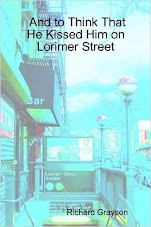
Our link above to the Google Books Search page of the story in And to Think That He Kissed Him on Lorimer Street turned up their interesting keyword feature for the book. Apparently they've assigned three tags for each story:
Contents And to Think That He Kissed 1 Brooklyn Law School , Canarsie , Brooklyn College
In the Sixties 19 Brian Epstein , fascist , Sixties I got
Diary of a Brooklyn Cyclones Hot Dog 25 KeySpan Park , Hot Dog , Ketchup
Heat of the Moment 31 Titania , Lissette , Deborah Harry
As our spring semester winds down, we took a break from grading on this chilly winter night - oh, that's right it's supposedly May - to enjoy a wonderful event at Idlewild Books, the brilliant Flatiron District bookstore where volumes are arranged by continent and country.
The reading/discussion was forGods and Soldiers: The Penguin Anthology of Contemporary African Writing, edited by Rob Spillman, who's also editor of the venerable literary magazine Tin House. After what seemed like a very pleasant cocktail party without the cocktails amid the wonderful geographic shelves of Idlewild Books, the house lights were dimmed and folding chairs brought out to accommodate the large crowd on the second story shop.
Rob Spillman thanked Idlewild Books and began by saying that Africa encompasses 54 nations and over 2,000 languages; although its population is about the same as that of Europe, Africa is much more diverse, in its literature as much as everything else. This variety, and the amount of literary material available, made selecting pieces for the anthology a daunting task, Rob said: "We really could have done 54 different anthologies." He called the book a sampling, "snapshots" of a rich and varied literary culture.
The Publishers Weekly review of Gods and Soldiers said
Spillman, editor and cofounder of lit journal Tin House, brings together a diaspora full of urgency and possibility, featuring recent fiction and nonfiction (mostly fiction) from 30 African authors. First up is Chinua Achebe, author of the groundbreaking Things Fall Apart, looking at North African writers often excluded from the canon, reminding readers that Africa is far from homogeneous (entries come translated from Arabic, Zulu, French and other languages). Each piece finds a human story to illuminate the continent’s history of plight and promise, turning up a range of voices: Helon Habila’s breathtaking tale of a political prisoner forced to write poems for the prison superintendent’s girlfriend; a scene from Ngugi wa Thong’o’s novel Wizard of the Crow depicting an Orwellian celebration for an unnamed ruler; Patrice Nganang’s essay “The Senghor Complex” examining the influence of poet Léopold Senghor, Senegal’s first president (“[for] writers of my generation,” he’s “everyone’s grandfather”). This collection sheds light on a multifarious continent too often thought of in one-size-fits-all terms
. He introduced the two authors who'd be reading excerpts from their contributions to Gods and Soldiers. First up was Binyavanga Wainaina, Kenyan journalist, fiction writer and author of the now-classic wonderful essay "How to Write About Africa," which devastatingly explodes all imaginable cliches. It was originally published in Granta, but as Rob noted, it's been recopied so many times, often with the original source and author's name missing, that Wainaina himself sometimes is emailed a copy by someone saying, "You must read this!" Wainaina's story "Discovering Home" won the 2002 Caine Prize for African Writing and is a pleasure to read.
Currently a Bard Fellow and director of the Chinua Achebe Center for African Literature and Languages at Bard College, Wainaina has been writer-in-residence at Williams College and Union College in recent years, so we've been lucky enough to have him near. It was a treat to listen to him in person, reading about a journalist's return to Nairobi and his sharp descriptions of the absurdities of Kenyan life in a collapsing economy under the waning days of a dessicated strongman whose every moment is covered reverentially in newspapers. In the story, Wainaina also describes his own family's perils under Idi Amin, a bigger monster than Daniel arap Moi.
We really enjoyed the grace of Wainaina's prose and his perceptive eye for telling details, whether about the uses a young bookish boy makes of Woody Woodpecker, the speech of a Stetson-wearing Nairobian, or the Nyerere T-shirt the protagonist spots at the airport after returning from a long stay in South Africa.
The second reader was Patrice Nganang of Cameroon, who currently lives in Brooklyn and teaches at Stony Brook. The Francophone author is, of course, highly fluent in English and also German, since he studied for his Ph.D. at Johann Wolfgang Goethe University in Frankfurt. Like Wainaina, he writes with precision to devastating effect in his "The Senghor Complex," his contribution to the anthology, and before that, to the current conversation about the ambiguous roots and influences of African literature of the past few decades.
Léopold Sédar Senghor, of course, was not only the first, longtime president of Senegal but the seminal African poet we remember from our long-ago undergraduate literature class in "Afro-American literature" at Brooklyn College, where we were told that he, along with Aimé Césaire, invented the literary movement Negritude, which influenced the writers of Harlem Renaissance and other black writers around the world. In "The Senghor Complex," Nganang begins, "I am not a negro and I never was one." From that provocative starting point, the author examines the assumptions and discomforts resulting from the outsized influence of Senghor, specifically from a Cameroonian perspective, and what happens to the sensitive writer's soul when he or she is categorized as a member of even the most admirably-portrayed group. It's a thought-provoking essay we are going to read in its entirety in the book. (Nganang also made us want to re-read Césaire.)
There were some interesting moments during the question and answer period as Rob Spillman deftly managed at least one audience member who seemed to think the reading was a one-on-one conversation. (There's always somebody like that, ain't there?) But most of the Q&A was enlightening, far more so than we can report here from our semi-legible notes.)
Asked why the anthology was titled Gods and Soldiers, Rob said that it was at the suggestion of his editor at Penguin, who was sitting near us in the rear, because many of the selections seemed to be encompassed by those themes. Rob talked a little bit about the post-independence struggle for non-strongman regimes and other concerns in recent decades.
An audience member expressed frustration that white African authors are often given "the Oprah treatment" to the detriment of black writers from the continent. Wainaina wonderfully riffed on that for a while, discussing Kenya's "Cookie Blixen complex" and how the Western penchant for stories about white women finding themselves, and a captivating white lover, in Africa - while the women condescend to, and never quite comprehend, those who live there (Blixen couldn't even spell the name of her African "adopted son"). This concentration on Out of Africa-type literature once outraged Wainaina but now basically amuses him: "it's an influential joke."
The questions also led Nganang into a fascinating and heartfelt discussion of why he became a writer and how much of the "business" side of publishing which is caught up in the superficial doesn't matter to someone who can remember his boyhood dream of one day seeing his own book being sold in the same Yaoundé bookstore where he bought his first books. There was an enlightening discussion and back-and-forth on the part of the editor, the two writers, and audience members on recent African literature, on the "lost decades" of less celebrated continental writers now in their fifties and sixties, of how the immediacy of Web publication created a boom that has led to the proliferation of contemporary African fiction and poetry online, and of the vast differences among Africa's disparate regions, peoples and levels of sophistication regarding literature. The irony is, according to Wainaina and Nganang, is that many of their writer contemporaries like them "hated African literature in school" the way it was taught. We guess it is the same for many American writers the way "American literature" is taught in many high schools. But there's a burden placed on African writers, it seems. It must be annoying to be asked at every PEN conference, "What are you doing for the next generation?" or "What about Darfur?" As Nganang stated eloquently, the words on a page in a book are a place just as much as a geographic location is. We look forward to reading Gods and Soldiers: The Penguin Anthology of Contemporary African Writing, edited by Rob Spillman, which also has contributions by our favorites Chris Abani, Laila Lalami, J.M. Coetzee and many others. We are grateful for tonight's event at Idlewild Books.
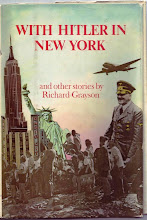
Negotiating what American culture associates with the figure of Hitler, Tours of the Black Clock echoes Richard Grayson's short story "With Hitler in New York," published ten years earlier, in 1979. Grayson's story achieves a very similar effect by way of very different formal means.
Erickson's Hitler is obviously a version of the historical Hitler, although the novel withholds the name. Grayson attaches Hitler's name to a character that seems to have little or nothing in common with the historical figure. "With Hitler in New York" persistently evokes and questions the image of Hitler as the epitome of evil that the reader is familiar with.
The story is set in the 1970s and revolves around Hitler's trip to New York where he visits his Jewish girlfriend Ellen and an unnamed male narrator. The narrator and Ellen pick Hitler up at the airport, and over the following days they go sightseeing, have dinner with Ellen's parents, and sit outside "on the stoop smoking a joint and eating vanilla ice cream" (15).
The sense of the ordinary thus created, however, is persistently undermined by the presence of the name "Hitler." The participation of a figure named Hitler in these everyday activities compels the reader to view otherwise harmless events in a different light.
Hitler's comment about the heat in the airport's arrival hall — "It's like a bathroom" (14) — for example, inconspicuous if uttered by anybody else, takes on a darker meaning, as the phrase echoes the lie Jews were told on their way to the gas takes on a darker meaning, as the phrase echoes the lie Jews were told on their way to the gas chamber, namely, that they were going to take a shower.
In addition, the narrator frequently compares the Hitler he chaperones around New York with the image he previously had of Hitler. Realizing that Hitler "looks handsomer than [he] remembered him as being" or that he "never realized [Hitler] was so witty," he adjusts his view (14, 16). And the reader, of course, constantly compares the version of Hitler the story presents to what he or she knows about the historical figure.
The effect the story thus produces, however, is not, as Alvin H. Rosenfeld has argued, "the neutralization of the historical Hitler and the normalization of a new image of the man" (72). To claim that "With Hitler in New York" presents a "de-Nazified Hitler" means to read the story realistically and to determine that the character it features is indeed an aged version of the historical figure (73). The story of course invites but simultaneously discourages this identification.
However, it is ultimately interested neither in the historical nor in its own "Hitler." Instead, "With Hitler in New York" explores what is commonly associated with Hitler. It denaturalizes connections between Hitler on the one hand, and evil, sadism, or anti-Semitism on the other, urging its readers to acknowledge how stereotypical these connotations have become.
And yet, "With Hitler in New York" does not attempt to reconfigure the meaning of Hitler for U.S. culture. The story neither offers a different set of associations nor does it invite a revisionist interpretation of the historical Hitler. By contrast, Tours of the Black Clock pushes its critique several steps further, since the text, as I have argued above, questions the validity of the category "evil" as such.
I saw Goodbye Columbus & thought it was very good. The theater was pretty crowded. The wedding scenes in the movie were so true to life. I think the message of the film is to decide for yourself what is right and what is not. But what if you're like Brenda Patimkin or me, and aren't sure?
Saturday, July 11, 1970
A hot, humid day. Johnny was up early & went for drum lessons. Marc & I woke later & together we went to the Brook to see Boys in the Band. It depressed him altho he admitted it was great, & I have to confess I didn't come out of the theater feeling very happy, either.
Thursday, August 13, 1970
After lunch, I went to the Marine to see The Games, a surprisingly good movie about Olympic marathon runners - something that looks very exciting. I felt enormously happy this evening, for no apparent reason.
Thursday, August 20, 1970
I drove to Korvette's on Bay Parkway & bought 2 hardcover books. One was The Lord Won't Mind by Gordon Merrick, a straight-forward novel of a lasting homosexual relationship. I think its candor upset me. I went to the Rugby to see Bob & Carol & Ted & Alice, which I thought was a funny story of American morality today. Thursday, June 10, 1971
We went to the Marine & saw a double feature: Little Murders, a wild movie about violence & feelings in the city, based on the Feiffer play, & Making It, about a high school kid's sexual adventures. Shelli was upset by the abortion scene in the last movie - she may take the pill after all.
Friday, June 18, 1971
Shelli came soon after, bringing a card that said "thank you for being you." When I told her about Dr. Wouk telling me to date other girls, she dialed his number & shouted "Pig!" into the phone. She was upset, & as the three of us went to Kings Plaza & looked around, both she & Avis tried to convince me that Dr. Wouk is a nut. I'm very confused at the moment. We went to the movies to see Summer of '42, a pretty good film about a teenage boy's growing up during World War II. Avis took the bus home, & Shelli & I came back to my house.
A warm & sunny Earth Day. Mark called & asked me to come with him to the Union Square rally. Mayor Lindsay closed off 5th Ave. & 14th St. to traffic & the crowds were enormous. But I didn't feel like getting into so big a crowd & went by myself to the smaller Prospect Park rally. I parked the car on 8th Ave. & walked to the meadow. A singing group called the Smubbs, dressed as pigs, sang about pollution. They also sang a song to the tune of "Give My Regards to Broadway" that was "Give my regards to Brooklyn / Remember me to Bartel Pritchard Square." Then Gov. Rockefeller made a speech saying, "If you're not part of the solution, you're part of the pollution." He had a lot of trouble with hecklers... Walking back to the car when the rally ended ended, I was stunned to see Rocky waving to me from a bicycle! Too bad I'd used up all my film. Dad came home and said he was booed by the crowd as he drove through the streets near Union Square and people banged on his Cadillac. The TV reports said the crowds were disappointing. It remains to be seen what will be done about our environment.
--Richard Grayson
More of our diary entries from age 18, long before the age of blogs, are featured in Dumbo Books' Summer in Brooklyn. Other Brooklyn pics from 1970 of NYC politicos like Bella Abzug, Paul O'Dwyer, Arthur Goldberg, Basil Paterson, Howard Samuels, Richard Ottinger, Elinor Guggenheimer, Adam Walinsky, et al. can be found on our 2008 Grayson for Congress blog.
For the second week in a row, the New York Times Book Review for April 19, 2009 is 28 pages rather than just 24 like most of this year's issues.
And for the second week in a row, we're sure that the increased length of the review has to do with the section's most important feature: the advertising.
This week we count 7.6 pages of advertising, including 6 full-page ads. (Actually, one ad - for books by Alexander McCall Smith - spans two facing pages). That's just 4/10 of a page less than last week's Easter paper, and the second week in a row, advertising (not for the New York Times itself or its products) makes up more than a quarter of the section.
We've turned a corner! Kudos to the display advertising department. To show our admiration and gratitude, this week we are sending you a Brooklyn blackout cake from Ladybird Bakery.
From Harlem and hip-hop, we took the A train downtown five stops to Greenwich Village and queercore once we felt reasonably sure our brother was doing okay (although kidney stone surgery sounded horrific - you don't want to hear where they get it out from - and Marc's description of post-operative bladder problems led us to make a pit stop at the Time Warner Center's men's room).
We still made good time and were early for the 7:30 p.m. event at the Barnes & Noble on the corner of Sixth Avenue and Eighth Street - a bookstore we have fond memories of, for when it was B. Dalton back in March 1983, it was the scene of our Zephyr Press publication party and a reading for I Brake for Delmore Schwartz. We were excited about seeing Jon Ginoli, there to perform and read from and talk about his new memoir, Deflowered: My Life in Pansy Division. Coming out (OK, odd choice of words) at the same time is the definitive gay rock band's seventh CD, That's So Gay, which this week's Newsweek has called "a catchy call to arms for the gays and lesbians who say they want a revolution while their iPods tell a different story." Jon was already there, walking around in jeans and a red T-shirt, looking very down-to-earth and unpretentious - probably because he is and always was. He sat down in the front row by Glenn Morrow of The Individuals and a couple of other old friends, telling them his book tour "had been a blast most of the time - a couple of duds, but not for a while now."
We apologize for eavesdropping from the row behind them, but we can assure everyone that Jon's appearance tonight was definitely not a dud. If you can catch him at Bluestockings on Friday evening, his acoustic set at Cake Shop on Saturday night, or Sunday's NYC premiere of the Pansy Division documentary Pansy Division: Life In A Gay Rock Band at Monkeytown in our neck of the Williamsburg woods, we can practically guarantee you'll enjoy going. We have fond memories of discovering Pansy Division while we working as a staff attorney at the Center for Governmental Responsibility at UF in Gainesville in the mid-'90s. One idyllic Friday afternoon we left work early and drove a convertible down I-75 on our way to an Authors Guild dinner at the home of Betty Castor, then president of the University of South Florida. Headed for Tampa on that gorgeous spring day, we listened to tapes (yes, tapes) of Public Enemy's Fear of a Black Planet, Green Day's Dookie, and Pansy Division's Deflowered. It was bliss. During dinner that evening we ineptly tried to explain our enthusiasm for both hip-hop and punk music to our tablemates, including Kathy Castor (now a Florida congresswoman), novelist Gay Courter and filmmaker Phil Courter.
Realizing we probably express ourselves better on paper than by talking, that night in our motel off Fowler Avenue - nasty because there were no non-smoking rooms left - we began a Pansy Division-inspired story about a queercore band, a story that eventualy became "Boys Club," which appeared in the summer 1998 issue of Blithe House Quarterly and then in our 2000 collection, The Silicon Valley Diet, whose back cover description began: "The bassist in a gay punk band reflects on his troubled relationship with the band's guitarist/singer." So we were thrilled to be seeing Jon Ginoli. After Kyle, the Barnes & Noble event coordinator introduced Jon (substituting "blankers" for the B-word when he quoted the lyrics "We're the buttfuckers of rock-and-roll, We want to sock it to your hole!"), Jon said he'd start reading from the prologue, which begins with them driving their rental truck out of Madison Square Garden and heading for the Lincoln Tunnel.
He reproduces his thoughts: "How did we get here?" They'd never planned for this, and if they had, it never would have happened. They got to open for Green Day and changed people's lives by being themselves, and the story of Pansy Division seemed to us not merely a collection of resonant anecdotes about the '90s music scene but a reflection of the metamorphosis in how society viewed gay people. Rock and roll, Jon noted, always had an undercurrent that subverted male heterosexuality even as it normalized it. Think Elvis's moves and makeup, Little Richard's prancing, the Beatles' feminized hair, Mick Jagger's coyness, David Bowie, Prince, Freddy Mercury, Morrissey. But male rock stars were either not gay, wouldn't come out, or once they did, beat a hasty retreat. Jon said that complete gay history of rock is another book's story to tell.
Deflowered is Jon's story and Pansy Division's story, based on the stuff he's been telling his friends - how, coming of age sexually at a time when punk and queer were going mainstream, Jon created something even he almost thought was impossible: a gay rock band. He tried to go out on his own as a performer in San Francisco first, and then found bassist Chris Freeman by putting a classified ad in an alt-weekly. Pansy Division, Jon said, was probably the least likely of the four bands Chris was in to succeed, but Chris had the nerve to play Jon's songs at a time when gay culture was under a right-wing attack. But Jon felt the '90s would be more joyful than the '80s, and he didn't want to write heavy, angry lyrics. Only after a few months did Chris remark, "Hey, this song can have political meaning," to which Jon responded: "Dude, it took you long enough."
Jon decided early on that he didn't want costumes, wigs, makeup or flamboyance. In San Francisco, Pansy Division probably could have gotten more attention that way, but he said he was from Peoria and Chris from Aberdeen, WA (Kurt Cobain's hometown) and they felt like jeans and T-shirts were more them. Punk meant being "down to earth, get to the point, cut to the chase." What he hoped for was to produce the kind of music he got enthusiastic about when he heard it, the "Ya gotta hear this" kind. Their first album and tour went pretty well, but the gay press didn't know what to do with them since their worldview was at odds with the gay mainstream (blogger's Freudian slip: before correcting the typo, the last word read "meanstream"). In Chicago, the gay weekly Windy City Press only grudgingly interviewed them once straight newspapers had written about Pansy Division and then the WCP editor killed the piece because he was offended by Jon's criticism of Judy Garland.
As Jon said, he had no beef with Garland, just the way an older generation of gays had fetishized her; he felt it was clinging to the past, a way of seeing ourselves as victims. (As someone who was 18 forty summers ago when Garland died - and who later started hanging out in the Village that summer of the Stonewall riot - we thought she was OK but were mystified at Garland- and later Streisand-worship among gay men. We also recall going to see Boys in the Band in August 1969 and realizing that a part with one of the gay characters imitating Garland had to be changed to make him imitate Ruby Keeler, which wasn't exactly the same thing. . .) Jon reported other ways the gay establishment dissed Pansy Division, from eye-rolling because the band supposedly wasn't charging enough for their CDs to a well-known book about gay musicians whose author felt Pansy Division weren't important enough to be profiled in the volume - unless, cough cough, they would come up with the money to buy their way in. Needless to say, Pansy Division don't play that game.
In the book are some excerpts from Jon's diary on tour, like a July 11, 1994 entry from their tour opening for Green Day - and throughout, Jon praised Green Day for not just choosing Pansy Division to go on tour with them back then (that's how we learned of the band) but for standing up for them when things got rough. On the tour, the gay band would be heckled. (Sometimes they spotted GOD DIDN'T MAKE ADAM AND STEVE and AIDS KILLS FAGS DEAD T-shirts in the audience - or on the security guards assigned to them.) When audience members shouted, "You suck!" Jon replied cheerfully, "Of course we suck."
Jon wrote about the mosh pit that night in Winnipeg and others on the tour and the high school girls who loved Chris and the sweaty, shirtless boys - all the teens, when they talked to band members, couldn't understand why they didn't watch Saved by the Bell. Generation gap. Jon also reported about a tall, hunky "college kid" who flirted with him outrageously during a Nashville appearance: blowing kisses, vamping, etc. After the show, when they met up, Jon asked him how old he was, the kid brightened and said, "Oh, I just turned 15 two weeks ago!" Jon wrote: "Needless to say, I slept alone that night." The December 2, 1994 opening for Green Day at Nassau Coliseum provided a great show and great diary entry. (We are humiliated to admit that the first concert we ever saw there was John Denver. Hey, it was the Nixon administration!) Backstage, Jon thought he saw Joey Ramone, but it was Howard Stern ("nice" - and Howard referred to the band favorably on his show). Before a sold out crowd of 14,500, Pansy Division was greeted with cheers and applause and it was the best reception they'd had.
Jon also read an excerpt about the Madison Square Garden concert soon after:
The show was a multi-artist extravaganza: faux-alternative station Z-100’s Christmas bash. The lineup from top to bottom: Green Day, Hole, Weezer, Melissa Etheridge, Bon Jovi (gag, choke, splutter, barf), Sheryl Crow, Toad The Wet Sprocket, the Indigo Girls and us. When Green Day found out Bon Jovi was on the bill, they were fit to be tied. This was everything we had ever fought against. This was an alternative station? Z-100 tried to throw us off the bill, but Green Day said they wouldn’t do the show if we didn’t get to play. We’ll always be grateful for the many times they stood up for us that year. We got a 10-minute slot at 7 p.m., and it was amazing. We squeezed in four songs. The crowd was still coming in; the place was two-thirds to three-quarters full (about 12,000 people) for our set and it was tremendous, loud applause and loud cheers. It was as short as a breath, though, and then it was over. But we’d never dreamed of playing such a place, and it was an incredible experience. If we’d had the goal of playing such a place, we’d never have done the kind of music we were doing, so being there gave us a special kind of satisfaction.
Jon told us dishier stuff about Bon Jovi, about watching him warm up for the concert by punching the air, Rocky-style; about the women with them, with fake orange tans and unnatural-looking breasts; and about their many bodyguards and entourage that displaced the other bands. There were other good stories Jon told - searching for a drummer for the band, their later "lowkey" years, surprising bandmate Luis by beating him in a club's "hot butt" contest - and we'll be interested in reading them all. He also took his guitar and sang a few songs, including "Twinkie Twinkie, Little Star" from the new CD That's So Gay (remember, the one Newsweek said great things about).
Jon exuberantly sang other songs, too - old ones, new ones -- from the sweet but not sentimental "Life Lovers," an implicit critique of normalizing monogamy and marriage as the be-all and end-all, and the classic "Bad Boyfriend" to the manic energy of the voice of the high school football player on the hilarious "Pat Me on the Ass."
We've gone to lots of worthwhile readings, but tonight at Barnes & Noble, Jon Ginoli gave us a good show that would have been well worth paying for. He's a terrific raconteur, a great performer and a real mensch. Check out his book, the CDs, and the documentary DVD. Long live Pansy Division!
It was a nervous day at Dumbo Books HQ since one of our two favorite brothers had been admitted to the Mountain Vista Hospital near our house in Apache Junction the day before and this morning he told us he'd be having surgery as soon as an OR could be found. By late afternoon Marc was back in his room, but groggy and in bad pain.
Since there wasn't much we could do from here, we decided to get out of the house and we're glad we did: We went to two great readings tonight for two different books we are excited about reading. Both relate to music and some of the most important cultural movements of our adult lives: hip-hop culture, punk culture and queer culture. First we took the A train to Harlem, to the wonderful Hue-Man Bookstore for the second time in two weeks. We were there for a 6 p.m. presentation and book signing by Adam Bradley, author of Book of Rhymes: The Poetics of Hip Hop.
We'd gotten an email from Marva Allen that Adam's appearance from yesterday (when we had to teach) had been re-scheduled for this evening. Consequently, the crowd was probably smaller than it should have been: maybe about 20-25 people, mostly African American and white men of a certain age like ourselves and a few women. Robert Guinsler, Adam's literary agent at Sterling Lord Literistic, was sitting behind us, and he got a call that the author and his wife were coming out of the subway and went to fetch them. After Marva welcomed Adam from L.A. and gave a brief introduction to Book of Rhymes: The Poetics of Hip-Hop, he apologized for this misunderstanding he had regarding the date of the reading. After a book tour that had taken him to seven cities, he admitted being tired but said that as the plane touched down at LaGuardia this afternoon, he felt energized again being in New York, where hip-hip was born.
His thesis is that perhaps the most exciting poetry today is being created by young MCs of all colors, classes and types, and that rap lyrics have fused the African-American oral tradition with the traditions of formal Western poetry. Reminding of us of Nas' "hip-hop is dead" statement of a few years back, Adam said that for most people today, poetry is dead, that apart from a couple of poems in each issue of The New Yorker, poetry doesn't reach the average person today. Although it is National Poetry Month, Adam said, much American poetry ignores the American people, just as the people ignore poetry. (Those of us who teach literature to first-year college students have known this for decades.) Most poetry is too removed from people's lives, too recondite - and it uses words like recondite, familiar to enough to us or to a Harvard Ph.D. like Adam but which most of our students can't define.
Adam spoke about the clueless negative reactions from some mainstream like CNN's report Hip-Hop: Art or Poison?. (We go back to the day when hip-hop music was actually banned by federal judges: see our 1990 New York Newsday piece, "A Rap Smuggler Sings the Blues.") Hopefully, this ignorance can be countered with books like Adam's -- and the first academic anthology in the genre, The Yale Anthology of Rap, forthcoming from Yale University Press, co-edited by Andrew Du Bois and Adam Bradley himself. Adam admitted that as a kid growing up in the late 1980s home-schooled by his grandmother in Salt Lake City, where trends from the coasts took five years to finally reach, he might be an unlikely exponent of hip-hop (he admitted still being into Bobby Brown's late-80s Gumby cut as late as 1994). But Adam sought to reconcile the Romantic poetry instilled in him by his grandmother - the work of Shelley, Coleridge, Wordsworth, Keats - with the music he listened to: De La Soul, A Tribe Called Quest, Public Enemy, and "when I was being adventurous," NWA. The author discussed his semi-hapless adolescent attempts to DJ, to be an MC, to tag, to break-dance, none of which were really his forte. Studying at Harvard with such brilliant professors as Henry Louis Gates - whom we first heard expound on rap lyrics in October 1990, when he was an expert witness at a hip-hop obscenity trial we were covering in Fort Lauderdale) and Cornel West showed Adam how he could bridge the gap between the Western poetry tradition as taught by his grandmother (and by the "close reading" of his Harvard professor Helene Vendler) and his love for hip-hop. The great Afrika Bambaataa, after all, finally posited a fifth element to hip-hop: doing the knowledge. And "doing the knowledge" was what was going on this evening and which goes on every day at places like the Hue-Man Bookstore. We figure Adam must be a great teacher - he's a professor of English at Claremont McKenna College - for he gave a brilliant talk. His book has two parts: first, about rhyme, rhythm and wordplay, the elements of both rap and traditional poetry; second, about style, signifying and story-telling.
Rhythm, he said, is perhaps the most basic element of rap. Adam related being on an isolated beach in Brazil, missing hearing the English language after several weeks and walking along the beach summoning the lyrics
I bomb atomically, Socrates' philosophies and hypothesis can't define how I be droppin these mockeries, lyrically perform armed robbery Flee with the lottery, possibly they spotted me Battle-scarred shogun, explosion when my pen hits tremendous, ultra-violet shine blind forensics
A 15yo Brazilian boy behind him called out, "Wu Tang Clan!" Adam tried to talk with him, but the kid had exhausted his knowledge of English and Adam's Portuguese was nearly nonexistent; still, they related the same way to the rhythm of the sounds.
Adam talked about the synergy between voice and beat being at the center of hip-hop when joined with rhyme. MC's don't just rhyme sounds, they rhyme ideas, and we value rap for its ingenuity, as in the classic Chuck D lyrics from 1989's "Fight the Power":
As the rhythm designed to bounce What counts is that the rhymes Designed to fill your mind
Adam noted the over-exposed Asher Roth's lyric
'Till I learn Yiddish, Or find a little kid who likes spinach Can't nobody beat me in Quidditch
is probably the first time anyone rhymed those three words before but that they represent the experience of a suburban white kid born in the mid-'80s. Adam called rhyme "a form of coercion" in which the poet forces audiences to connect disparate words and reconcile them, both in sound and meaning, a process of recognition and differentiation which creates rhyme's pleasures.
In addition to rhythm and rhyme, wordplay is the last basic element of hip-hop and it includes simile, metaphor and other forms of figurative language that allows MCs to take the familiar and make it unfamiliar. Anyone who still thinks hip-hop is just about girls and violence merely has to listen to its lyrics, but even within the stereotyped limited subject matter you can hear elegant wordplay like Jay-Z's
Nigga please, like short sleeves I bare arms
Or in this lyric from Clipse:
I move caine like a criple Balance niggas through the hood Kids call me Mr. Sniffles
Adam also cited Kanye West's poetry in "American Boy":
Dressed smart like a London Bloke. Before he speak his suit bespoke!
which he said must have sent kids to the dictionary. Discussing the asthetic values of hip-hop, Adam noted, may not pay as much as MC'ing but clearly, he loves what he does as much as the MC's who have day jobs. We are anticipating bringing some of what Adam Bradley does in Book of Rhymes: The Poetics of Hip-Hop to our own students and hoping the book gets as wide an audience as he deserves.
Because we got a call from Arizona from our sick brother, we had to leave before the Q & A, but we're sure the discussion was as lively as the best of hip-hop. We'll close with excerpts from Adam Mansbach's review of the book in the Los Angeles Times:
[A] new paradigm of scholarship is emerging, and Adam Bradley's "Book of Rhymes: The Poetics of Hip Hop" is a solid contribution...[that] scrutinizes hip-hop's artistry with rigor and imagination.
Many scholars would characterize the use of these devices as a subversion of the canon. Bradley is more interested in the notion of rap as a Western poetic form and, as such, heir to all that's come before.
His argument is far too nuanced, however, to suggest that rap's legitimacy stems from its use of classical techniques.
Rather, Bradley asserts, hip-hop contains many techniques that "rappers didn't inherit; they created [them] for themselves out of the need for expressive freedom." He zeros in on metaphoric construction, word bending and the narrative innovations of hip-hop storytelling.
Because he knows "flow" is as important as composition, Bradley spends ample time on voice, style and attitude, making his analysis as three-dimensional as the music.
Rap is a competitive art, and fans are notorious for the fervor with which they parse verses and rank artists. Much of what devotees do instinctively, Bradley formalizes in "Book of Rhymes."
His insights are compelling. . . In his discussion of storytelling, Bradley pinpoints rappers' conflation of the narrative voice with the dramatic -- a fusion that allows for "intimacy" and "imaginative freedom" and finds its antecedent in "the tall tales of oral tradition."
Later, he connects rap's ethos of "battling" with similar traditions in ancient Greece, 10th century Japan and modern Namibia, pointing out that while much has been made of hip-hop's "stereotypically masculine" braggadocio, "here [are] young men boasting of . . . poetry, eloquence, artistry." "Book of Rhymes" is well-served by Bradley's discipline. In limiting his focus, Bradley creates space for the kind of analysis often subsumed by polemics and grandiosity.
The result is a book equally enriched by his academic training and his years of studious listening -- not the last word on hip-hop lyricism, but an engaging first verse.


_(1997).jpg)