Pages

Tuesday, June 13, 2006

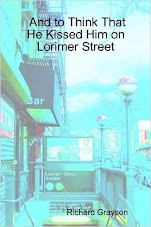
How Dumbo Books Makes Money: Product Placement in AND TO THINK THAT HE KISSED HIM ON LORIMER STREET


This post appeared on Richard Grayson's MySpace blog on June 13, 2006:
Product Placement in AND TO THINK THAT HE KISSED HIM ON LORIMER STREET


Apparently The New York Times ("Product Placement Deals Make Leap From Film to Books" by Motoko Rich)thinks it's newsworthy that authors using their books of fiction for product placement deals.

But I've been doing that for years. Because few people actually buy my books, I have to make money by mentioning products, services, and corporations which pay me to plug them.

For example, in "Schmuck Brothers of East Harlem" -- just one of the thirty stories in And to Think That He Kissed Him on Lorimer Street, I got money for plugging Murray's Sturgeon Shop, Washington Mutual Bank, the Leonard Nimoy Theatre,

the Kashbah Kosher Café, Victoria's Secret, Tasti D-Lite, the Estée Lauder Stress Relief Eye Mask, Starbucks frappuccinos, Hard Candy Vintage Nail Polish's classic Tantrum, Urban Decay's Maui Wowie eyeshadow, the Café des Artistes, the Cellcomet Anti-Stress Cream Mask, Cooper 35 Restaurant, Molson Ale, Blue Cult jeans, Kim's Video, Diary of a Mad Black Woman, The Dreamers, Con Edison, Target, Jewelrymaven.com, Mitchum Deodorant, Demeter's Riding Crop fragrance, Altoids, SparkNotes, Kiehl's Pharmacy, the Union Square Café, The Body Shop, Sephora, Longo's Baci XXX lip gloss and even the St. Marks Bookshop, which doesn't carry the book.

Wednesday, June 7, 2006

Syntax of Things reviews Richard Grayson's AND TO THINK THAT HE KISSED HIM ON LORIMER STREET

Jeff Bryant reviewed Richard Grayson's And to Think That He Kissed Him on Lorimer Street at his blog Syntax of Things on June 5, 2006. Excerpts:

And To Think That He Kissed Him on Lorimer Street
by Richard Grayson
Dumbo Books
Short Stories; 289 pp.


A few months ago I got an email from Richard Grayson asking if I would be interested in reading his new collection. He warned me that it would be a waste of my time and that the book might make for a better doorstop than reading material. Well, if a book has the potential to keep the cool breeze flowing through my room, I can't turn it down, probably would even read it before putting it to use. And I did. Read it. And man did I enjoy it. Grayson is nothing short of a master storyteller, a man willing to take chances, to mix the straightforward narrative with avant-garde twists. Letters to the editor, mysterious front-page ads in the New York Times, a very young Anderson Cooper, and references to YouTube and Myspace, all make for an interesting collage, a blend of nostalgia with the very contemporary. . .

Highlights for me include the numerous recollections of the evolutions of theaters in Brooklyn and Broward County, the hilarious tale of a man forced to go to a lesser college by his zealous father and who ends up rooming with a monkey which he plots to kill after the monkey pees on his stuff, and the first line from the story "G--d Is My Fuckbuddy": "Significant others come and go but fuckbuddies can be forever." One can only speculate as to why a publisher didn't give this collection a shot, but luckily for us, Grayson did all the work himself. He's even made the book available as a free download, but save your eyes and give the man a few bucks. You'll be glad you did.

*****

That Girl Who Writes Stuff on Richard Grayson's HIGHLY IRREGULAR STORIES


This post is from Richard Grayson's MySpace blog for June 6, 2006:

That Girl Who Writes Stuff has blogged about Highly Irregular Stories:

Highly Irregular Stories by Richard Grayson
Aside from finding dirty bits on the internet to flash at you, I spent part of my weekend sunning myself like a walrus and reading Richard Grayson’s Highly Irregular Stories.

The book is a compilation of four out-of-print chapbooks (Disjointed Fictions, Eating at Arby’s: The South Florida Stories [my favorite], The Greatest Short Story That Absolutely Ever Was, and Narcissism and Me).

If you are unfamiliar with the bizarre tales of Mr. Grayson I have much to share with you.

He’s odd.

A very odd man indeed.

And funny, funny, funny.

I could describe his stories’ weirdness to you but that’d be like talking through a bucket of water.

You really need to be submerged in it too to get the full effect.

But if you insist . . .

Here are few of the sections I highlighted and smiley-faced in my copy.

I’m a geek, I know.

Just let it be.

I also realize that only showing you nuggets from his stories is a little like showing you a box with a severed finger in it and running off giggling. . . . you need some context.

That’s fine.

I understand that.

And for some reason still don’t care.

So, enjoy the severed nuggets:

From Disjointed Fictions:

Ordinary Peepholes:

My eye catches an unauthorized advertisement scrawled on the subway map across from my seat:

FOR A GOOD LAY CALL 969-9970

It’s bad enough that this is my sister’s phone number, but what really hurts is that the handwriting is unmistakably my father’s. (p. 7)


Escape from the Planet of Humans:

She is tall, slightly chubby, with frizzy long brown hair and a scar on her nose. She wears a flannel shirt over a turtleneck, faded jeans, work boots, hoop earrings and a red kerchief. She reminds me of something else.

Our eyes meet once. Neither of us really smiles.

I look down at her application to graduate school and mentally note her name and address. I hand another man two dollars and receive some coins back in return. Then I go home and I write this letter:

Dear Rebecca Archer:
You don’t know me but I stood next to you today at the copy center. You are the most beautiful lesbian I have ever seen. Good luck with your grad school applications.
Sincerely yours,
(My name)


Guess what happens next (p.41)


Eating at Arby’s: The South Florida Stories:

I’m not even going to show you a passage. Just know that the funniest two characters you are ever going to meet play here.


From Narcissism and Me:

Some Arbitrary Answers:

I ask my mother what kind of birth control she uses.
“Headaches, she says. . . . .

I ask my brother’s girlfriend’s father’s grandmother’s doctor’s dentist’s mother’s therapist’s rabbi what life is all about.

“Headaches,” the rabbi says. (156-7)

Tuesday, June 6, 2006

That Girl Who Writes Stuff reviews HIGHLY IRREGULAR STORIES by Richard Grayson

That Girl Who Writes Stuff has blogged about Highly Irregular Stories:

Highly Irregular Stories by Richard Grayson

Aside from finding dirty bits on the internet to flash at you, I spent part of my weekend sunning myself like a walrus and reading Richard Grayson’s Highly Irregular Stories.

The book is a compilation of four out-of-print chapbooks (Disjointed Fictions, Eating at Arby’s: The South Florida Stories (my favorite), The Greatest Short Story That Absolutely Ever Was, and Narcissism and Me.

If you are unfamiliar with the bizarre tales of Mr. Grayson I have much to share with you.

He’s odd.

A very odd man indeed.

And funny, funny, funny.

I could describe his stories’ weirdness to you but that’d be like talking through a bucket of water.

You really need to be submerged in it too to get the full effect.

But if you insist . . .

Here are few of the sections I highlighted and smiley-faced in my copy.

I’m a geek, I know.

Just let it be.

I also realize that only showing you nuggets from his stories is a little like showing you a box with a severed finger in it and running off giggling. . . . you need some context.

That’s fine.

I understand that.

And for some reason still don’t care.

So, enjoy the severed nuggets:

From Disjointed Fictions:

Ordinary Peepholes:

My eye catches an unauthorized advertisement scrawled on the subway map across from my seat:

FOR A GOOD LAY CALL 969-9970

It’s bad enough that this is my sister’s phone number, but what really hurts is that the handwriting is unmistakably my father’s. (p. 7)


Escape from the Planet of Humans:

She is tall, slightly chubby, with frizzy long brown hair and a scar on her nose. She wears a flannel shirt over a turtleneck, faded jeans, work boots, hoop earrings and a red kerchief. She reminds me of something else.

Our eyes meet once. Neither of us really smiles.

I look down at her application to graduate school and mentally note her name and address. I hand another man two dollars and receive some coins back in return. Then I go home and I write this letter:

Dear Rebecca Archer:
You don’t know me but I stood next to you today at the copy center. You are the most beautiful lesbian I have ever seen. Good luck with your grad school applications.
Sincerely yours,
(My name)

Guess what happens next (p.41)


Eating at Arby’s: The South Florida Stories:

I’m not even going to show you a passage. Just know that the funniest two characters you are ever going to meet play here.


From Narcissism and Me:

Some Arbitrary Answers:

I ask my mother what kind of birth control she uses.
“Headaches, she says. . . . .

I ask my brother’s girlfriend’s father’s grandmother’s doctor’s dentist’s mother’s therapist’s rabbi what life is all about.

“Headaches,” the rabbi says. (156 -7)

Get your copy here

Friday, June 2, 2006

Pete Lit reviews Richard Grayson's AND TO THINK THAT HE KISSED HIM ON LORIMER STREET

Pete Anderson reviewed Richard Grayson's AND TO THINK THAT HE KISSED HIM ON LORIMER STREET at his blog Pete Lit on May 31, 2006. Excerpts:

And To Think That He Kissed Him on Lorimer Street is a fine collection of stories from the prolific Richard Grayson. Grayson tells these twenty-nine stories exclusively from a first-person perspective, making them come off as at least partially autobiographical. The back cover copy admits as much, calling the book "part fictional memoir, part memorish fiction," and I've read just enough about Grayson's personal life to know that many of the narratives mirror his own life. This is a bit of a bold move in the post-Frey literary world, where questions over what is fact and what is fiction often distract the reader from the writer's main point--the telling of the story itself. Personally, I don't particularly care how much of these narratives came directly from Grayson's life, and how much he invented. The important thing is that the stories are compellingly readable; Grayson is a natural storyteller, tireless and inventive, and the Lorimer Street stories are of course him telling of his own life but, more importantly, of the world around him.

For me, three stories from the collection stand out. "Conselyea Street" tells of a middle-aged contractor who has lived his entire life in one Brooklyn brownstone, with several generations of his family living there during his youth. The brownstone--owned by his family for decades--is located in what has become a very trendy neighborhood, and the narrator faces the dilemma of choosing, for a tenant, between his young niece and his nearly-as-young lover (the latter, he suspects, is only interested in him for the apartment). He soberly faces a critical decision between keeping family tradition and satisfying fleetingly sensual needs.

"Bottom, New York Times, Front Page, Tiny Print" is a quietly heartbreaking story of a young man who has abandoned his family, which desperately tries contacting him via classified ads in the New York Times. As time goes on, their ads run less and less frequently as they slowly abandon hope of finding him again, and adjust to no longer having him in their lives.

Perhaps the strongest story, "The Lost Movie Theaters of Southeastern Brooklyn and Rockaway Beach," is told through Grayson's recurring device of a lengthy list of places and people from his life, with added commentary. In this story, he catalogs an extensive list of defunct movie theaters, each with its own distinct section and headings, mentioning where they were located, what movies he saw there and whom he saw them with, what became of the theater buildings and, indirectly, what each theater meant to his life. In one particularly poignant scene, he tries to convince his grandmother, implausibly, to see Boyz N the Hood with him:
"Richard," she said, "my movie-going days are over." Then she wanted to know why I didn't just go two doors down from the theater and bring back a movie from the video store.

"It's not the same thing," I said. I saw Boys N the Hood alone.

The Surfside closed three years later, a few months after my grandmother died.

Driving by on Rockaway Beach Boulevard last summer, I couldn't tell it had once been a movie theater.

This unexpected generational twist--his grandmother wanting to rent a movie, while he longs for the old-fashioned theater experience--was quite a nice touch. And the book is filled with similarly nice touches like this one. A very satisfying effort overall.

Monday, May 15, 2006

Saturday, April 15, 2006

Kirkus Discoveries reviews Richard Grayson's AND TO THINK THAT HE KISSED HIM ON LORIMER STREET

Kirkus Discoveries has reviewed Richard Grayson's And to Think That He Kissed Him on Lorimer Street:

AND TO THINK THAT HE KISSED HIM ON LORIMER STREET
and Other Stories

Author: Grayson, Richard

Review Date: APRIL 13, 2006
Publisher:Dumbo Books (304 pp.)
Price (paperback): $16.95
Publication Date: 2006
ISBN (paperback): 1-4116-7595-9
Category: AUTHORS
Classification: FICTION


The dynamic Brooklyn cityscape serves as the backdrop in this beguiling collection of short stories.

Grayson’s tenth volume of fiction introduces a multicultural multitude of characters, including a teen lesbian from Uzbekistan who works as a Brooklyn Cyclones hot-dog mascot and a gay black student whose Pakistani roommate’s pet monkey helps him find acceptance on a mildly homophobic campus. Most, though, are slight variations on the quasi-autobiographical persona of a middle-aged white man reminiscing about the friends, families, lovers and locales that have populated his life. Grayson often constructs his loose, episodic narratives with a pop-culture scaffolding, as in “Seven Sitcoms,” in which the narrator meditates on his relationship with his family’s black housekeeper through a commentary on the racial and class stereotypes of early TV sitcoms; and “1001 Ways to Defeat Green Arrow,” a reconstruction of a love affair between a man and his much younger stepbrother, paired with a hilarious exegesis of a comic-book hero in decline. In other stories, like “Branch Libraries of Southeastern Brooklyn” and “The Lost Movie Theaters of Southeastern Brooklyn and Rockaway Beach,” the author maps out memories against the geography of his beloved Brooklyn, with excursions to Los Angeles and South Florida. Grayson’s low-key, conversational prose is injected with flashes of wry wit (“I live in a neighborhood where neighbors notice my lack of body art”), but some of the slighter pieces are no more than droll shaggy-dog stories. The more substantial ones, however, like “Conselyea Street,” about a gay man with a younger Japanese lover reflecting on his Williamsburg neighborhood’s demographic transitions—from Italian to Hispanic to hipster to yuppie—fuse vivid characters with a keen sense of place and cultural specificity.

A funny, odd, somehow familiar and fully convincing fictional world.

Sunday, February 19, 2006

"Bending Gender": Richard Grayson reviews Jonathan Ames’s "Sexual Metamorphosis: An Anthology of Transsexual Memoirs" in American Book Review

Richard Grayson reviews Sexual Metamorphosis: An Anthology of Transsexual Memoirs, edited by Jonathan Ames, in the January/February 2006 issue of American Book Review:

Sexual Metamorphosis: An Anthology of Transsexual Memoirs
Edited and with an introduction by Jonathan Ames
Vintage Books, paper, $13.95, 314 pages

By Richard Grayson


Most Americans are intrigued by transsexuals but don’t know what to make of them. I can recall the dopey reaction of one teenager to the sentimental 1970 film The Christine Jorgensen Story: “She was such a cute guy! Why did she become a girl?”

Sexual Metamorphosis: An Anthology of Transsexual Memoirs, doesn’t answer my adolescent question. Jonathan Ames, the book’s editor, is after something more profound than that. In his introduction, Ames calls the etiology of gender dysphoria “probably unanswerable…a mystery of the human condition.” (xv) The testimony of the fifteen transsexuals compiled here serves as a celebration of that mystery and of the infinity capacity of human beings to reinvent themselves.

At first blush, Ames – a talented novelist, performance artist, and newspaper columnist and perhaps the wittiest writer of his generation – might seem an odd guiding force behind this kind of anthology. But Ames’s comic novels – I Pass Like the Night, The Extra Man, and Wake Up, Sir! – are, at their heart, stories of quirky characters choosing to profoundly transform their lives.

While changing one’s sex may seem like a drastic step, the overarching theme of the entries in Sexual Metamorphosis is restoring the natural order of things. The first excerpt, Case 129 from Richard von Krafft-Ebing’s Psychopathia Sexualis, sets the tone for the volume. A nineteenth-century Hungarian physician describes how, despite marriage and children, he has felt “like a woman in a man’s form” his entire life.

Although the second memoirist, the Danish painter Lili Elbe, born Einar Wegener, died in the 1930s following surgical implantation of ovaries, later medical advances made true sex change possible and fairly safe. At this point, Ames notes, transsexuals’ memoirs take on the same basic narrative structure: First, a child feels terribly uncomfortable in his or her gender role; next, an adolescent or adult, after much torment, undergoes a transformation into his or her “true” sex; finally, after more suffering – now physical as well as psychological – the individual finds peace, if not total happiness, in the aftermath of the sex change.

The excerpts from Jan Morris’s Conundrum – the book that made transsexuals respectable if still a bit outré – exhibit all the stylistic gifts of her best travel writing. Morris’s earliest memory, exquisitely rendered, is of three-year-old James, sitting beneath his mother’s piano as she plays Sibelius, suddenly realizing that he “had been born in the wrong body, and should really be a girl.”

Despite that, Morris relates a happy, nearly idyllic childhood, and seems so well-adjusted that it makes James’s transformation from husband and father into plucky, Mrs. Miniver-like Jan almost anticlimactic.

Some of these selections deal with public reaction to the writer’s metamorphosis. Jorgensen, the former Army private from the Bronx whose Danish sex change operation in 1952 caused a national sensation, is represented here with an account that goes a long way to explain how her unpretentious charm and ladylike demeanor made her something of a beloved figure, the first celebrity transsexual.

In contrast, Christine Cossey, a fashion model and James Bond girl cruelly outed by British tabloids, wanted to keep her gender reassignment a secret, not only to the general public but also to her overbearing mother-in-law. When, to her horror, Cossey’s sex change is revealed, her career and fairy-tale marriage appear to come apart.

Most of these memoirs deal not with public coming out, but with private people struggling with their own feelings and relationships. The excerpt from Deirde McCloskey’s Crossing relates how a distinguished economics professor named Donald, who has long enjoyed dressing as a woman, finally decides to become Deirdre.

McCloskey concentrates on the struggles with Donald’s wife and adult children, who react to his crossing the gender barrier with horror and cruelty. No wonder McCloskey tells her story in the third person.

On the other hand, the excerpt from tennis player and physician Renée Richards’s Second Serve concentrates on the physical aspects of the metamorphosis, recounting in somewhat gruesome detail the bodily pain and suffering she undergoes in her surgical transformation from Richard Raskin, as well as the practical clinical details of maintaining her new sex organs.

A recurring motif is that both rejection and acceptance can come unexpectedly. Donna Rose and Deirdre McCloskey tell of wives who ridicule and demean their husbands’ desires and take extreme measures to avoid them post-surgery and post-divorce. However, the wife of Jennifer Finney Boylan, a novelist and English professor, stays in the relationship after her husband has become a woman.

Generally, transsexuals’ parents and grandparents, even those from the working class, rally around them surprisingly quickly, perhaps because they’ve known something was up since childhood. Children have more trouble getting used to their parents’ transformations, though the younger they are, the more they take the sex change in stride. The funniest moment in the book is when, on his first outing with his newly-female father, Donna Rose’s son Matt, wanting to get her attention in a crowded store, shouts out, “Hey, Dad!” – and immediately covers his mouth as if trying to recapture the words.

As Ames points out, the public is particularly ignorant of female-to-male transsexuals (F-to-M’s). However, the excerpts of the memoirs of Mario Martino, Loren Cameron, and Mark Rees – as well as the account of “Joe” from a book written by Dr. Harry Benjamin, who coined the term transsexual and whose Benjamin Standards are guiding principles that still form the basis for treatment today – show that their struggles are quite similar to their M-to-F counterparts.

One point the anthology makes crystal clear is that sex and gender, sexual orientation and sexual identity, are distinct categories. About the only thing gay and lesbian people have in common with transsexuals, Boylan tells her psychologist, is that the same people beat up both groups.

Uncharacteristically, Jonathan Ames stays in the background too much here. Beyond his thoughtful introduction to the volume, he gives us only a few sentences setting up each entry. A reader unfamiliar with the tragic story of the homophobic murder of Army Sgt. Donald Watkins may be somewhat confused reading the moving excerpts from the memoir of Calpernia Sarah Addams, Watkins’s transsexual beauty-queen girlfriend.

All of the memoirists here are white Americans or western Europeans, leaving readers to wonder how cultural differences might affect transsexuals in other parts of the world. Unfortunately, few Asian transsexuals – the best known are the Beijing Modern Dance Company's artistic director Jin Xing and the Thai boxer-turned-actress Parinya Charoenphol – have written memoirs available in English translation, and as Ames points out, no anthology can be a perfect selection.

However, given their prominence in the transsexual community, the apparent omission of African-Americans is unfortunate. Did Ames deliberately pass on the recent autobiography Hiding My Candy by The Lady Chablis of Midnight in the Garden of Good and Evil fame? Perhaps he felt that her decision to keep her penis – the “candy” of her book’s title – made her different from his other memoirists.

The Lady Chablis may actually be closer in spirit to today’s new trans generation, educated in gender deconstruction and not so interested in becoming a “real” man or women. Forgoing the surgery or even hormone treatments that make the transformation definitive for the writers in Sexual Metamorphosis, young genderqueers can be perfectly comfortable having both breasts and a penis. Loren Cameron, a San Francisco F-to-M photographer, notes in his memoir that younger people have less static gender identification than his generation of transsexuals. Ames, acutely attuned to the cultural scene, is aware of the changes in transsexual culture, but the production of memoirs by the coming generation will have to wait.

Although Ames’s anthology should find a place on the syllabi of college courses in human sexuality, its compelling narratives make Sexual Metamorphosis a work of literature.

Tuesday, December 6, 2005

ROLL CALL covers Richard Grayson's DIARY OF A CONGRESSIONAL CANDIDATE IN FLORIDA'S FOURTH CONGRESSIONAL DISTRICT


Roll Call, the newspaper of Capitol Hill, today (December 6, 2005) has an article about Richard Grayson's WRITE-IN: Diary of a Congressional Candidate in Florida's Fourth Congressional District:


Life on the Campaign Trail

By Elizabeth Brotherton
Roll Call Staff

Tuesday, December 6, 2005


Remember the heated battle over Florida’s 4th Congressional district last summer?

You don’t?

Well, that’s probably because the race didn’t attract too much attention. But there was one.

It pitted incumbent Rep. Ander Crenshaw (R-Fla.) against writer Richard Grayson, a Democratic write-in candidate running on a platform in support of gay marriage, abortion rights, universal health care and immediate withdrawal from Iraq.

Keep in mind, this race took place in one of Florida’s most conservative districts.

So why did Grayson even bother?

“Voters are essentially disenfranchised,” said Grayson, now 54. “It’s frustrating, that yeah, we have a democracy, and yet most of the Florida Representatives were essentially unopposed. From both parties.”

Annoyed, Grayson decided to hit the campaign trail. He documented his journey in a series of diary entries published on McSweeneys.net, which have been put into a book titled “Diary of a Congressional Candidate in Florida’s Fourth Congressional District.”

Grayson was no rookie, either. He ran for president in 1984 and twice as a write-in candidate against Republican House Members, for similar reasons as in his race against Crenshaw.

“It was really a fun thing to do,” Grayson said of his latest campaign. “And I think having McSweeney’s publish the diary as I was writing it, with a couple weeks time lag, got attention.”

Grayson’s journey begins on May 7, 2004, the day the Florida Division of Elections posted his name as an official candidate in the race. But because he couldn’t afford the $9,000 filing fee, Grayson was listed as a write-in candidate. (Grayson notes in the book that in March 2004, Crenshaw had a war chest of $612,691.)

Throughout the diary, Grayson documents life on the campaign trail. Or rather, trying to get to there.

Grayson ran for the 4th district seat, a long, narrow stretch of land across the Northeastern part of the state that encompasses parts of Tallahassee and Jacksonville.

Even though he lived in South Florida.

See, in his home 22nd district, there was already a race under way between Republican incumbent Rep. Clay Shaw and Democrat Jim Stork. Grayson’s goal in running was to make a point, even if he didn’t stand much of a chance at getting elected.

“Every Congressional race in this country I would like to see have at least two candidates,” he said.

Grayson picked the 4th district because he noticed Congressional representation for Jacksonville was safely divided between the two parties, with Rep. Corrine Brown (D) holding the other seat.

“Basically, I had the feeling the two major parties pretty much like it the way it is,” he said. “They like the fact that the city of Jacksonville has one Democratic seat, one Republican seat.”

But since Grayson worked a normal day job from 8:30 a.m. to 5 p.m. Monday through Friday, he found it difficult to get to the Jacksonville area. He didn’t even set foot in the 4th district until Oct. 2 to do a television spot at a Jacksonville CBS affiliate.

So many of Grayson’s campaign efforts consisted of filling out surveys from various interest groups, ranging from the National Taxpayers Union to the Vision Council of America, and hoping somebody somewhere might hear of his candidacy and want to vote for him.

Then, he had to deal with people wanting to sell him everything from software programs to potholders.

“They don’t realize I’m running this campaign out of my studio apartment,” Grayson said. “What it tells me is that campaigns are very big business in this country. It’s sort of this whole class of people who make their money out of the election industry.”

As the months wore on, Grayson started to hit the trail a bit more, and it began to pay off. His proudest moment came in October 2004, when he was endorsed by the National Organization for Women Political Action Committee.

“I was actually touched by that, because it was probably the most serious organization that endorsed me,” Grayson said.

In the end, Grayson received 1,170 votes, which amounts to 0.5 percent of the total count. Crenshaw got the other 99.5 percent with 256,157 votes.

“I was sort of surprised. I got more votes than I expected,” Grayson said.

Grayson has not ruled out running again for office, although he admits his strong liberal views wouldn’t likely get him elected (“I think I’d have to find a new country,” he said).

And he got to do something in 2004 even many Members don’t get to do.

“I never had to pander for any votes, because frankly, I didn’t care if anybody voted for me,” he said. “I imagine some of the Members of Congress must envy that sort of thing.”

The “Diary of a Congressional Candidate” is available to purchase online at http://www.lulu.com/content/172015 or by visiting Grayson’s Web site at www.richardgrayson.com. The book costs $9.38, or $2.37 to download.

Tuesday, November 15, 2005

Richard Grayson's memoir of 1969 Vietnam Antiwar Moratorium at Hackwriters.com


Richard Grayson's memoir, "Moratorium," about the October 1969 Vietnam antiwar action, appears today (November 15, 2005) at Hackwriters.com:

On Saturday, October 5, 1969, I got up early and took the subway from my home in Brooklyn to the Manhattan headquarters of the Vietnam Moratorium Committee at 150 Fifth Avenue.

The Committee’s office was four blocks from the factory and showroom loft where my father, grandfather and cousin ran Art Pants Company, our family business. I was 18 and had started Brooklyn College a few weeks before. Thirty-five years ago I was sure of maybe three things. I wanted to try to be a writer. I loved the New York Mets. And I hated the stupid war in Vietnam.

Richard Nixon had been President since January and had done nothing to bring a conclusion to the conflict that had driven Lyndon Johnson from office. Things actually seemed to be getting worse. The Paris peace talks were going nowhere. Every day soldiers were still being sent to Vietnam. Thousands of them had already been killed or injured. Tens of thousands of Vietnamese had died in the war.

The Moratorium was going to be a national day of protest on Wednesday, October 15 – a kind of general strike by the peace movement, with all sorts of different local activities, from rallies and prayer vigils to marches and reading aloud the names of the war dead. Its leaders were people like D.C.s Sam Brown, active in the Clean for Gene student movement backing peace candidate Eugene McCarthy in 1968, and New York’s Adam Walinsky, who’d been a speechwriter for Senator Robert Kennedy. These were activists who, like me, still believed in the political process. I’d worked for peace candidates since I was 16 and that fall was working in the campaign of New York Mayor John Lindsay, running for re-election on the Liberal Party line.

Planning for M-Day had started on college campuses, but its leaders wanted to involve all kinds of people – in churches and union halls and businesses and small towns.

When I walked into the Moratorium office that Saturday morning, my only intention was to buy some buttons, so I went straight to a table where some high school girls were selling peace-related merchandise. I was pretty shy but I could deal with high school girls. For three dollars, I bought thirty dark blue buttons that said “moratorium” in white lower-case sans-serif type. I also got a big blue-and-white poster with a dove on it that said Vietnam Moratorium: October Till The End Of The War.

I was considering whether to buy some candles or black armbands – sold with free safety pins – or some “Work For Peace” ribbons when suddenly this girl in her mid-twenties grabbed my arm, saying, “I need a strong young man to carry up some boxes from downstairs.” I was anything but strong. Still, I was delighted to put my stuff down on the table and be led around by this girl, who was at least a head taller than me.

Her name was Peggy, she told me as I struggled to keep up with her as we ran down the stairs. She said she’d just walked in one day like I did, and they’d put her to work right away. Suddenly Peggy found herself organizing things and people.

A delivery truck had dropped off about twenty cartons in front of the building. It occurred to me that if my grandfather were still at work just down Fifth Avenue – he came in on Saturday mornings to sell pants wholesale to people in the know – I could go over there and get one of Grandpa Nat’s hand trucks and save us a lot of effort.

But Peggy had already hoisted up one carton and I didn’t want her to think I was a pussy, so I grabbed a carton and went back into the building with her. Some other guys and girls joined us, and it didn’t take as long as I’d thought to carry everything upstairs. Then Peggy told me to open the cartons and put the literature in them in packets. Some needed to be mailed out, and others had to be sorted and sent to the various campuses or other locations for M-Day events. That first day at the Moratorium HQ, Peggy had me answering phones and stapling anti-war signs to sticks and getting people sandwiches and drinks from Squire’s Coffee Shop across the street.

After I’d been there about five hours, she introduced me to Adam Walinsky, calling me “one of our hardest workers.” “Great,” Adam said. “We can always use people like you.” He was about the only guy in the office who wore a white dress shirt and a tie.

At the end of the day Peggy and Adam let me sit at the merchandise table alongside a grizzled Vietnam vet who wore a leather jacket that said 'When I die I’m going to heaven ‘cause I’ve spent my time in hell'. He shocked me by saying he was only 23.

Just before we were about to close around 5 p.m., the vet was telling me a long story about how he got off smack when two society ladies sauntered in, the kind of Park Avenue “beautiful people” I’d only read about it in magazines. One of these woman said she was looking for a black rosette for her Yorkie to wear on M-Day. 'Sorry, we don’t have any rosettes,” I said. I made a mental note to look up the word in the dictionary when I got back home. They bought some buttons and posters, and one lady was about to take a cloth black armband for her husband – I imagined him to be on the board of some big corporation – when the other lady said not to because they were selling silk black armbands at Abercrombie and Fitch. The vet snorted. As we left the office, he told me he didn’t even need a cloth black armband; one made of crepe paper was good enough for him and should be good enough for anyone.

I said I was glad all kinds of people were taking part in the Moratorium.

On the subway heading toward Brooklyn, I felt more exhilarated than tired even though I’d been working all day. An elderly black lady sitting next to me on the 3 train pointed to my rolled-up poster and asked, “Is that a Beatles poster?” “No,” I said, and unrolled it for her to look at.

She just smiled and nodded her head. Mom let me put the poster in our living room window with scotch tape, and on Sunday, doing my French homework on our porch, I kept staring up at it, thinking how cool it looked.

But the next morning, the sanitation men wouldn’t unload our garbage cans until Mom ran out and yelled at them, saying what they were doing was illegal, that they had to empty our garbage cans no matter what they thought of our poster. The sanitation men grumbled, but finally they put our garbage into their truck. I told Mom we should take the poster out of the window, that I’d rather have it in my room anyway.

The next ten days, I alternated between working in the Manhattan headquarters and doing Moratorium-related stuff at Brooklyn College. Somehow I managed to go to all my classes and do my homework and freshman comp essays and take my quizzes, too. And I watched the Mets on their incredible march to the pennant.

Everyone seemed to be talking about the Moratorium all the time, and I became optimistic that the war would end soon. I knew October 15 would not just be another day and that Nixon would have to listen to the thousands of people telling him we wanted to get our troops out of Vietnam.

Sixteen U.S. senators – eight from each party – had endorsed the Moratorium, along with over 50 House members, and other elected officials. Several Roman Catholic cardinals, Protestant groups, and the American Jewish Congress announced their support, asking people to take part in peace-related activities.

At City University of New York, our Board of Higher Education approved a resolution saying faculty and students at all the schools could take part in M-Day, and campuses across the country announced that classes were being suspended on October 15. Mayor Lindsay said city flags would fly at half-mast that day. Adam opened the Manhattan moratorium headquarters early on Sunday morning, October 12. There was still a lot of work to do. Someone brought in a TV and on CBS’s Face the Nation, Sam Brown talked optimistically about how the outpouring of nationwide antiwar sentiment on Wednesday would change everything.

Later, as I worked on getting last-minute mailings out, I heard Adam and Peggy saying how important the New York rallies outside the city were. Adam was going to go to rallies around the state that day, in places like Buffalo and in Syracuse, where New York’s Republican Senator Goodell, who had introduced a bill calling for all troops to be out of Vietnam by the end of 1970, would be the lead speaker.

The Moratorium Committee had rented a little plane for Adam. Peggy’s brother, who was a pilot, was going to fly him from place to place and then back to New York City.

“Wow, I’m glad I don’t have to go with Adam and your brother,” I told Peggy in a rare moment when she wasn’t too busy. “I’m not crazy about flying even in regular jets. Actually, the one time I flew, I was really freaked out.” Peggy assured me that I’d get used to airplanes when I got older and more experienced.

The next day was the Columbus Day holiday, so I came in to the city to work. Things were getting frantic, but by then we actually had more volunteers than could comfortably fit in the office. By early afternoon, when we were working on pulling together packets of literature for the various demonstrations, there weren’t enough seats for everyone. Adam said I could sit at his desk when he went out to lunch with Peggy and her brother, and that’s where I sat when I was interviewed for TV, twice – once for the news on WOR, New York’s channel 9, and once by a crew from the BBC.

When Adam and Peggy came back from lunch – her brother had to go to the Brooklyn Navy Yard, she said – I relinquished Adam’s chair, and as I excitedly told him about being interviewed, he patted my head and said, “And I thought you said you were shy.”
When I came back from fetching coffee and cokes from Squire’s, a Columbia grad student with granny glasses and a goatee showed me a copy of that afternoon’s New York Post.

In his column, Pete Hamill had written about us! I hadn’t realized he’d been in the headquarters on Saturday. “Something oddly magnificent is happened in that queer-shaped yellow-walled office,” Hamill wrote, and then said of the Moratorium, “It’s going to be the biggest, loudest 'NO' anyone’s heard… The way to get out of Vietnam is to just get out.” The grad student from Columbia talked about the momentum being unstoppable. There were going to be all kinds of actions everywhere, from Wall Street to Madison Avenue to Harlem. Kids from elementary school to college were going to be demonstrating on Wednesday.

I told the Columbia guy that he was lucky because Mayor Lindsay was speaking at his school. We weren’t going to have anyone that famous at Brooklyn College. He said it was still important for everyone to go back to their own schools or neighborhoods. I said goodbye to everyone, including Adam and Peggy, before I left Manhattan on Monday night.

The next day, as I arrived on campus at BC, my oldest friend Linda – we’d known each other since second grade – and her boyfriend Howie, a disc jockey on the campus radio station, ran over to congratulate me for my appearance on the channel 9 news the night before. I’d forgotten to watch it myself.

On the quadrangle, we started an hours-long reading of the names of the soldiers who had died.

Some Young Americans for Freedom, right-wing students who supported Nixon and the war, started shouting that we were all commies, but there were a lot more of us than there were of them and eventually they got tired and left.

At 4 p.m., the reading over, I went to my health ed class, which back in those days was just for boys. Mr. Aronin, the teacher, had us talk about the war, which is what we all wanted to do. Not one person, not even the vets, spoke for the President’s policy.

The next morning I woke up early and put on WBAI, Pacifica radio, which promised 19 consecutive hours of coverage. For mid-October, it was a chilly, blustery day. I got to Brooklyn College at 9 a.m. and someone gave me leaflets to hand out at the Junction, the intersection of Nostrand and Flatbush Avenues, right by the subway stop.

Within five minutes of my standing there, someone spit at me and two people told me I should go back to Russia. I wiped off the spit and didn’t say anything. An old white lady must have taken pity on me or something and came over to tell me how her nephew had had his legs shot off in this “horrible, horrible war.” Then she started crying, and then I started crying, which I hadn’t done when the people were harassing me.

Eventually Linda and Howie came by with our friend Jeane, who I went to Midwood High with, and on the campus quadrangle the four of us positioned ourselves up front.

The rally at Brooklyn College didn’t have the biggest names – our speakers included Howard Samuels, an upstate industrialist running for governor; Manhattan Assemblyman Jerry Kretchmer; Mrs. Cora Weiss of Women’s Strike for Peace, who’d just come back from North Vietnam; and the Village Voice writer Joe Flaherty – but we all cheered them loudly as they each called for immediate withdrawal of our troops.

Then the “peace marshals” lined us up behind the pallbearers of a symbolic black coffin made of plywood, containing the lists of the thousands of soldiers who had died in the war, and we started marching up Flatbush Avenue, two by two. In the middle of the long line of demonstrators, Howie and Linda held hands in front of me and Jeane as we chanted “Peace now” and sang “We Shall Overcome.” Some passing drivers stuck their hands out the window of their cars and joined us in making the “V” sign for peace.

Others, driving with their headlights on in support of the war, cursed us. At one corner, two policemen made “W” signs for war. Suddenly the marshals stopped us from marching because a fight had broken out up front. The pallbearers were being attacked by half a dozen creeps who carried a 10-foot sign that said “BOMB HANOI!”

Howie, who worshipped Bob Dylan, said, “Something is happening, but those guys don’t know what it is.” Jeane wanted to go help the pallbearers, but Linda reminded her we were here precisely because violence wasn’t our thing. Linda said the cops would take care of it. Linda turned out to be right: the cops did break it up, but instead of arresting the war hawks, they took away one of our guys. We started jeering. “I wish they’d arrest me,” Jeane said. “It would be a badge of honor.”

Linda said that an arrest would look bad on your record, no matter what it was for. She wanted to be a magazine writer and editor, but preferred writing features about fashion and food to stuff about politics. I tried not to get depressed by all the people who were against us. Why didn’t they get it? We stopped at Church Avenue, by Erasmus Hall High School, then walked across Flatbush Avenue to the old Dutch Reformed Church, and started marching back toward the Junction and Brooklyn College.

I cheered up when I passed The Book Worm, a little store where I used to buy my paperbacks, and saw Irv, the owner, in the doorway holding up a sign saying “War Is Not Healthy for Children and Other Living Things.” He recognized me and we exchanged peace signs. When we got back to school, Linda, Howie, Jeane and I went for hot chocolate at the Sugar Bowl. None of them were as into politics like I was, although Jeane sort of had this aggressive flower-child mentality. Still, like everyone my age that I knew, they were against the war. Howie was graduating in two years and Linda was afraid that even so far in the future, he could get drafted.

“That’s impossible,” I told her. “The war will be over long before 1971.”

My friends decided to call it an M-Day, but I got on the subway and took it to Times Square. I wanted to make the afternoon rally at Bryant Park.

The crowd there was enormous and I could barely hear the speakers, even with the amplification. I wished I had taken my transistor radio so I could listen to what they were saying over WBAI.

I stood on my tiptoes to catch a glimpse of Senator McCarthy or Mayor Lindsay, but I couldn’t really see them too well. The one remark that I did hear that most struck me came from the Yale chaplain, Rev. William Sloan Coffin: “Silence is treason when good men die in a bad war.” For some reason I felt depressed as I took the train downtown.

I decided to stop off at my family’s pants factory to see if I could get a lift home with my father. When Dad and I started out in his Cadillac from Union Square, I noticed that some kids about 15 or 16 were yelling at us. I opened the window and heard them shout, “Fascist!” Puzzled, I realized only while we were going over the Manhattan Bridge that the kids must have mistaken us for hawks because Dad had put his headlights on. But he’d done that only because it had started to get dark.

After watching the nationwide demonstrations on the 7 p.m. CBS Evening News with Walter Cronkite, I wondered how Adam and Peggy had spent M-Day and where the peace movement would go from here. I talked about it with my younger brothers – like them, over ninety percent of the kids in New York City schools had stayed home that day – and then I went to my room and studied for a Science quiz and fell asleep for ten hours.

When I got up on Thursday, things were no different in Vietnam despite what millions of us had done the day before. American involvement in that guerilla war would not end until the last helicopter left Saigon in defeat in 1975. On the other hand, I’d have to wait only a couple of weeks to see the New York Mets win the World Series in 1969.

More than 35 years later, Linda and I are still friends. Now a high-powered literary agent after a successful career as a magazine editor and nonfiction author, Linda is friendly with celebrities like Phyllis Diller and Richard Simmons. Her penthouse is just off Fifth Avenue, across the street from the old Art Pants Company loft and four blocks south of where, for a few months in the fall of 1969, the New York Vietnam Moratorium Committee had its headquarters. Most clothing manufacturers have left the now-fashionable neighborhood, which got a new name: the Flatiron District.

When I visit Linda, we often go to lunch at an expensive restaurant on the same block as 150 Fifth Avenue.

Soon after graduating from Brooklyn, Howie moved upstate to Woodstock and became a deejay for a station in Kingston. He and his wife named their son Dylan. Dylan has kids of his own by now.

Jeane is also a grandmother. Widowed young, she moved to Long Island and never remarried.

Adam Walinsky became the Democratic candidate for New York State Attorney General the year after the Moratorium. After a day of classes at BC, I walked over to the Junction to hear him make a campaign speech from the back of a pickup truck. I went up afterwards to see if he remembered me. Adam said of course he did, but I could see in his eyes that he really didn’t.

After losing to Attorney General Lefkowitz, the Republican-Liberal candidate, Adam became a neo-conservative. In a few years he was best known as the leading opponent of a proposed New York City gay rights ordinance. He spoke and wrote on the evils of homosexuality. In 1977, some friends I knew from the Gay Activist Alliance told me they were planning a “zap” of Adam’s house in the wealthy suburb of Scarsdale. I couldn’t go. I wanted him to be the way he was in October 1969 and remembered how he patted me on the head.

The Scarsdale “zap” was an important event in New York City gay history, “the night they raided Walinsky’s.” They said Adam’s wife was so upset she pressured him into not talking about gay rights again. He eventually became New York Commissioner of Investigation and lobbied for the Police Corps, a proposal that finally passed Congress in the Clinton administration.

Unlike Adam, most of us from the Moratorium days are still pretty liberal. Many of us have been actively opposing the Iraq war. I started to going on antiwar marches and attending peace rallies and candlelight vigils in early 2003 as a member of Peace South Florida. The night before we invaded Iraq, friends from the group Pax Christi and I read interfaith prayers at St. Maurice Catholic Church in Dania Beach.

Sam Brown, the national coordinator of the Moratorium, served as director of the Peace Corps in the Carter administration and later as ambassador to the Organization for Security and Cooperation in Europe. Sam and his wife Alison Teal criss-crossed the country in 2004, raising funds for candidates against the Iraq war.

Peggy, too, is still involved in politics. At an age when most of her friends were busy with grandchildren, she and her husband, an administrator at CUNY, adopted a baby from China, a girl probably abandoned by birth parents who wanted a son instead. Taking care of her little girl and working at her job at the U.S. Mission for the United Nations doesn’t leave Peggy much free time, but she became active in politics again. At the 2004 Republican convention, Peggy participated in an abortion rights march over the Brooklyn Bridge, and for in the fall she gave speeches in support of Democratic candidates.

As for Peggy’s brother, the pilot who flew Adam around the state on the day of the Moratorium – well, only in recent years did I find out that he had actually seen what went on in Vietnam for himself.

I saw Peggy’s brother only once at the Moratorium headquarters, on Columbus Day, and I never actually got to talk to him. But 35 years after the Vietnam Moratorium, hoping to end a different war, I voted for him for President.

Wednesday, February 16, 2005

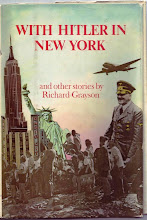
Gavriel D. Rosenfeld's THE WORLD HITLER NEVER MADE analyzes Richard Grayson's story "With Hitler in New York"


Gavriel D. Rosenfeld's The World Hitler Never Made: Alternate History and the Memory of Nazism, published this year (June 2, 2005) by Cambridge University Press, contains an analysis of Richard Grayson's "With Hitler in New York" appears on pages 234-236:
Several years later, [Michel] Choquette’s tale ["Stranger in Paradise"] was itself surpassed by the most normalized of the decade’s narratives – American writer Richard Grayson’s 1979 short story, “With Hitler in New York.” Set in an indeterminate year, Grayson’s work recounts an unnamed narrator’s several days of socializing, partying and walking the streets of New York with Adolf Hitler. The Hitler described by the narrator is a contemporary Everyman, indistinguishable from others of his generation. A tall, dark and handsome individual who wears a leather jacket, Hitler is quick-witted, gregarious and popular. Nothing of much importance happens in the story, which is more a chronicle of banal events than a sustained plot. Its most intriguing aspect, indeed, is its vagueness regarding whether the Hitler in the story is in fact the “real” Hitler or simply another man coincidentally possessing the same name. By the end of the tale it is clear that the man is, indeed, the (allo)historical Hitler. The hostile reactions toward him by other characters in the story show that he continues to suffer from a sullied reputation due to unspecified historical misdeeds. The mother of Hitler’s girlfriend, Ellen, dislikes him and will not speak to him; a patron in a coffee house “recognizes Hitler [but] everything is too mellow for him to make a scene.” Yet Hitler’s negative image is complicated by the fact that his girlfriend is Jewish and he enjoys strolling around Brighton Beach listening to elderly Jews sing old Yiddish folk songs. The historical significance of this allohistorical Hitler remains ambiguous. The narrator’s drunken observation at a party that Hitler deserves to win the Nobel Peace prize is as cryptic as his concluding question to him whether he “ever feels bitter.” Hitler’s cryptic response – that he feels “useless” – suggests some kind of grand past that has given way to a banal present, but nothing more.

Grayson’s portrayal of Hitler’s survival in an alternate New York City, like Choquette’s, was notable for its complete abandonment of a morally grounded framework. Unlike the tales of [Brian] Aldiss, [George] Steiner, and [Pierre] Boulle, which still depicted him as unrepentant for his crimes, Grayson’s story left unspecified which historical misdeeds he may have committed – or whether he committed any at all. Without a clear criminal background to be held accountable for, Grayson’s Führer is no fugitive but merely another human being who blends into the crowd in New York City. And yet it would be a mistake to see Grayson’s humanization of Hitler as an act of rehabilitation. Rather, Grayson’s tale imagines an alternate world that has largely forgiven Hitler for his crimes and forgotten them. Such a world – in which the narrator can ignore his grandfather’s own death to get stoned with Hitler and can muse, “I wonder if I am beginning to fall in love with him” – is a callous, unfeeling one, in which historical consciousness has either atrophied completely or become irrelevant to most human beings. In short, it is a nightmarish world of total amnesia. In all probability, this is the primary point Grayson was looking to make. Evidence for this reading is provided at the very end of the autobiographical introduction to With Hitler in New York (which immediately precedes the story by the same name) where he describes his adolescent withdrawal from his family and concludes “I just lay in my bed trying to sleep. When I slept I had nightmares.” Given this de facto premise to the short story “With Hitler in New York,” Grayson’s account of a world in which Hitler hardly differed from anyone else was meant to be seen as a bad dream.

In offering this conclusion, Grayson’s story can be taken as a complex response to the Hitler Wave. Like Boulle and Choquette, Grayson was strongly influenced by the Hitler Wave’s de-demonization of the Führer and drafted the most humanized portrait of him yet to appear in postwar alternate history. Yet Grayson was also concerned about, and tried to counteract, the Hitler Wave’s progressive normalization of the deceased dictator. As a writer of Jewish background who grew up around Holocaust survivors in Brooklyn, Grayson was concerned by the increasing fascination with Hitler and aimed to show, in reductio ad absurdum fashion, its dangerous endpoint – a Hitler who was regarded as any other human being. The author’s decision not to bring Hitler to justice in “With Hitler in New York,” then was animated by different aims from those that shaped the tales of Aldiss, [Gary] Goss, Steiner, Boulle, and Choquette. For while these narratives were less overly committed to remember the Nazi past for its own sake, Grayson’s story was intended as a plea not to forget the Nazi past for its historically specific horrors. Still, in effect, “With Hitler in New York” did not differ substantially from these tales insofar as it, too, dramatically challenged the limits of representing Hitler and offered a radically altered portrait of him as a “regular guy.”

Taken together, the tales of Aldiss, Fadiman, Goss, Steiner, Boulle, Choquette, and Grayson all reflected the broader phenomenon of normalization. This was most obvious in their de-demonization of Hitler as a character. The fact that, in nearly all of the narratives, Hitler’s enduring capacity for evil was overshadowed by his average human traits represented an increasing willingness, in the wake of the Hitler Wave, to view the Führer in non-judgmental terms. The motives underlying many of these narratives also reflected an increasingly normalized view of the Nazi past. These writers showed Hitler evading justice in order to offer universal conclusions about the human condition – most of them pointing to the continued existence of contemporary political crises. For all of their moral evidence on liberal-left politics, however, the effect of their tales was to divert popular attention from Nazism as a specific historical phenomenon.

Friday, January 7, 2005

Fifty Years Ago in East Flatbush: First Birthday Party at 120 East 43rd Street


On January 7, 1956, our family had a first birthday party for our brother Marc at the apartment of our maternal grandparents, Herb and Ethel Sarrett, in East Flatbush, where we also lived. Above, a pic of us blowing out Marc's candle on the birthday cake, with our grandparents and Michael Sarrett, our grandfather's brother Abe's son, who lived around the corner with his parents and our great-grandmother, Bubbe Ita (Yetta Saretsky, shown below with us and Marc).

Sunday, September 19, 2004

Richard Grayson letter in The New York Times on South Florida as New York's Sixth Borough


Richard Grayson has a letter in the New York Times today (September 19, 2004): "The Sixth Boroughs":

To the Editor:

Jonathan Safran Foer is one of our finest young novelists, and "The Sixth Borough" (Op-Ed, Sept. 17) is a wonderful work of fiction.

Of course, those of us who live in South Florida know that we live in the real sixth borough of New York City.

Richard Grayson
Davie, Fla., Sept. 17, 2004

Tuesday, August 10, 2004

KILL BILLIONAIRES