Pages

Tuesday, June 12, 2007

Tuesday Afternoon in the Theater District: Kitty Carlisle Hart Memorial at the Majestic Theatre


At noon today, we stood on a long line outside the Majestic Theatre to get into the memorial service for Kitty Carlisle Hart, singer, actress, TV personality, (extremely) longtime chairwoman of the New York State Council on the Arts, and an icon of Broadway and NYC life from a different era. In the 1950s and early 1960s, we used to watch her on To Tell the Truth and sometimes What's My Line? and often saw her greatest movie role, as a supporting member of the cast (the young female romantic lead, though) in the Marx Brothers' funniest movie, A Night at the Opera. Broadway-loving kids like us idolized her late husband Moss Hart, playwright, director of My Fair Lady and many other hits (and plenty of flops) and author of perhaps the most fascinating theater memoir ever, Act One, which entralled us when we read it in junior high.

We sat up in the nosebleed section of the highest balcony -- but then again, it's about the same spot we were sitting our first time in the Majestic 43 years ago, watching Sammy Davis Jr. in Golden Boy. We could tell when our family walked into the Saturday matinee, the people around us looked nervous when they spotted three boys ranging in age from 13 to 3. But we were the kind of kids that sat quietly if not silently and didn't fidget. We started taking our youngest brother Jonathan to Broadway shows and museums when he was two -- even to the show at the Hayden Planetarium, where the people in charge expected a 2-year-old would cry in the dark. But Jonathan just sat there and looked up at the Christmas "Bethlehem star" show.

We met Ms. Hart only once, at an AIDS benefit at the 92nd Street Y sponsored by the writers' organization PEN in the fall of 1987. We were introduced by our friend Gregory Kolovakos, the late great translator who worked for Kitty as head of the Literature program at the Arts Council. (Gregory was the one that told us about her relationship with almost-U.S. President Thomas E. Dewey [and he also disabused us of the notion that Elizabeth Taylor was seeing Malcolm Forbes, who preferred younger guys].) The next summer, we got a letter from her saying we'd won a $3,750 Writer-in-Residence Award at the Rockland Center for the Arts in suburban West Nyack; in the fall and winter of 1988-89 we spent several months doing creative writing workshops with schoolkids (from third to twelfth grade) in Rockland County.

Anyway, Kitty's memorial - which we're sure the New York Times will cover so we don't have to, at least not in detail - was a terrific "show" and a great sendoff. The best speakers were her son and daughter, who told great stories about their irrepressible mother, who well into her mid-90s was running circles around people one-third her age. Barbara Walters told some good stories too, and others that spoke included Gerald Schoenfeld of the Shubert Organization and Mario Cuomo. Kristin Chenoweth and Michael Feinstein sang some of Kitty's songs, and they showed clips from her on the TV quiz shows, on a PBS documentary and from the movies.

Our personal favorite Kitty Carlisle song was the one she sang in Woody Allen's Radio Days, about the lack of eligible men in wartime, "They're Either Too Young or Too Old":
They're either too young, or too old,
They're either too gray or too grassy green,
The pickings are poor and the crop is lean.
What's good is in the army,
What's left will never harm me.

They're either too old or too young,
So, darling, you'll never get stung.
Tomorrow I'll go hiking with that Eagle Scout unless,
I get a call from grandpa for a snappy game of chess.


We know the feeling ourselves, but we imagine that in real life, Kitty Carlisle Hart never did.

Monday Night at the Old Stone House: 808 Union Writing Group's Tenth Anniversary Reading


This was posted to Richard Grayson's MySpace blog on Tuesday, June 12, 2007:

I enjoyed last night's reading at the Old Stone House in Park Slope, celebrating the tenth anniversary of the 808 Union Writing Group. It featured:

Kevin McPartland reading a novel about pre-gentrified Park Slope gangs and all by someone who lived it;

Marian Fontana reading from her hilarious new memoir about dating as a 9/11 widow;

Louise Crawford, reading a short story called "Halloween Blonde," about Upper West Side high school girls in the 70s;

Mary Crowley reading a beautiful set of poems;

Wendy Ponte reading from novel about a woman in search of her Portugese identity;

Barbara Ensor, reading from her forthcoming kids' book, Thumbelia, Runaway Tiny Bride;

and playwright Rosemary Moore presenting scenes from a new play with actors.

This writing group all have different voices, work in different genres, but each of their selections was well worth listening to.

Friday, June 8, 2007

Sunday Afternoon in Red Hook: Reading at Lucky Gallery with Harris Bloom, Kevin Freidberg & Richard Grayson


Here's the flyer for an event and reading we'll be part of on Sunday along with our old friend Harris Bloom and new friend Kevin Freidberg at the Lucky Gallery in Red Hook at 1 p.m.:

Two FREE and FANTASTIC events in Red Hook on Sun June 10 at 1pm. How LUCKY is that!

First, head over to the newly-reopened LUCKY GALLERY, where Kris Monroe, our latest NYC emerging talent 'find' (by way of Atlanta) has organized a reading that's sure to get those neurons firing!

Featured writers include:

Kevin Freidberg has worked for the sitcom "King of the Hill," written for The New York Times Magazine and volunteers on a regular basis for 826NYC and the Brooklyn Superhero Supply Co.

Harris Bloom is a New York born and bred writer, stand-up comedian, and regulatory accountant. He eagerly awaits the day his fame will allow him to quit one of the three. Guess which one. He can be reached at harrisbloom@yahoo.com.

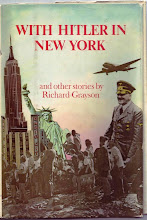
Richard Grayson is the author of several short story collections, including With Hitler in New York, I Brake for Delmore Schwartz, The Silicon Valley Diet, And to Think That He Kissed Him on Lorimer Street and Eating at Arby's: The South Florida Stories. He has received three individual artist fellowships from the Florida Arts Council and a writer-in-residence award from the New York State Council on the Arts. A native of Brooklyn, he currently lives in Williamsburg and Phoenix and teaches at the School of Visual Arts.

After that, head over to the Brooklyn Waterfront Artists Coalition's pier show, and pick up a map for the annual RED HOOK/CARROLL GARDENS OPEN STUDIO TOUR. This year, Ellie Winberg, Matt Tieman, and I have wrangled over 100 participating artists!

See more details here.

B61 bus to Red Hook from Jay St train in Downtown Bklyn is one way...or B77 from Smith/9th...see BWAC.ORG for more detailed directions.

If you're coming from downtown Manhattan, we've even alerted Water Taxi to Red Hook!

Mark your calendars for what's sure to be a GREAT DAY!

Saturday, May 12, 2007

Monday Night in Williamsburg: 3:AM Night at Galapagos Art Space with Richard Grayson, Ellen Kennedy, Tao Lin & Kim Chinquee


This post appeared on Richard Grayson's MySpace blog on Wednesday, April 4, 2007:

May 16 is 3:AM Magazine Night at Galapagos Art Space

5/16 back $tbd
7pm doors
7:30 show
9:30 end

3:AM MAGAZINE NIGHT


3:AM Magazine authors and editors will read stories and poetry about hot sex, insane violence, and coke fiends.

Richard Grayson is a retired teacher and lawyer who was born in Brooklyn in 1951. He is the author of a dozen books, including With Hitler in New York, The Silicon Valley Diet, I Brake for Delmore Schwartz, And to Think That He Kissed Him on Lorimer Street, and WRITE-IN: Diary of a Congressional Candidate in Florida's Fourth Congressional District.

Ellen Kennedy is the author of a collection of prose and poetry, yesterday i was talking to myself and i told myself that i was going to write a book and give it to you so i put paper in my bag and put a pen in my bag and rode my bike to the river bank and then sat on the ground and thought 'i will never write a book' and watched ducks swim away from me , which can be read at bearparade.com. She has been published in Mipoesias, Elimae, 3 am magazine, and Juked. She lives in Manhattan.

Tao Lin is the author of a novel, Eeeee Eee Eeee (Melville House), a story-collection, Bed (Melville House), and a poetry collection, You Are A Little Bit Happier Than I Am (Action Books). He has been published by Nerve, Noon, and Spork and he lives in Brooklyn. His web site is called Reader of Depressing Books. He is 3:AM Magazine's poetry editor.

Kim Chinquee's work has recently appeared in Noon, Denver Quarterly, Conjunctions, Fiction Magazine, New Orleans Review, Notre Dame Review, Fiction International, 3:AM, the Pushcart Prize anthology, and several other places. She teaches creative writing at Central Michigan University.

Sunday, May 6, 2007

Thursday Night in Williamsburg: P.E.E.L. Reading Series at Stain Bar with Bronwen Tate, William Hubbard, Richard Grayson & Jennifer Cooke


This was posted to Richard Grayson's MySpace blog on Thursday, May 3, 2007:

P.E.E.L. Reading Series tonight at Stain Bar


Special PPEE Reading: May 10

Please join us for a special PPEE edition of the PEEL reading series. The short-format reading will feature a seat-wetting double dose of poetry by Bronwen Tate and William Hubbard, Richard Grayson with an essay on the personal and political sides of Roe v. Wade, and Jennifer Cooke, presenting "After the Symphony."

Thursday, May 10
7:30pm FREE
Stain Bar, 766 Grand Street, Brooklyn
MAP

About the authors:
Bronwen Tate, a native of Portland, OR, lives and writes in Brooklyn, NY. Her work has appeared or is forthcoming in Word For/Word, Kulture Vulture, Lungful!, HOW2, Typo Magazine and horse less review, among others. She received her MFA in Poetry from Brown University, and will be a PhD candidate in Comparative Literature at Stanford in the fall. Her chapbook, Souvenirs, will be available for purchase.

William Hubbard is the editor of CapGun, a journal of arts and letters based in Brooklyn, New York. His poetry has appeared or is forthcoming in Fourteen Hills, Mantis, and Red Line Blues, and his chapbook, A Suggestion Regarding Vacations, will be published by Third Class Press in July. He lives in Brooklyn, and is currently working on a screen adaptation of Robert Creeley's only novel, The Island.

Jennifer Cooke lives and writes in New York City. She has been published in a few literary magazines and newspapers. When she's not writing, she's taking care of her two kids and husband.

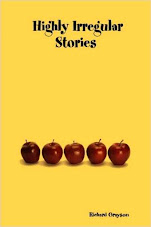
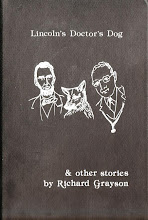
Richard Grayson is the author of the story and essay collections With Hitler in New York, Lincoln's Doctor's Dog, I Brake for Delmore Schwartz, I Survived Caracas Traffic, The Silicon Valley Diet, Highly Irregular Stories, And to Think That He Kissed Him on Lorimer Street and the recently-published WRITE-IN: Diary of a Congressional Candidate in Florida's Fourth Congressional District, based on his 2004 feature on the McSweeney's website. His nonfiction has appeared in The New York Times, The Miami Herald, The Orlando Sentinel, The Arizona Republic, The San Jose Mercury News and People. A retired teacher and lawyer, he lives in Brooklyn.

Monday, April 9, 2007

Askew Reviews reviews Richard Grayson's WRITE-IN: DIARY OF A CONGRESSIONAL CANDIDATE IN FLORIDA'S FOURTH CONGRESSIONAL DISTRICT


Askew Reviews has a review by Dennis Sheehan of Richard Grayson's WRITE-IN: Diary of a Congressional Candidate in Florida's Fourth Congressional District:

Richard Grayson is your average Joe who works for a living, enjoys music, and decides to run a write in campaign for Congress against an uncontested, popular incumbent Republican, Ander Crenshaw. Richard has no campaign dollars and no endorsements, but he has balls large enough to fight for what he believes is right and the guts to do something about it. The diary chronicles Grayson's campaign run from May 7, 2004 to Nov. 3, 2007. Grayson details several interviews he granted, the dealings with obnoxious surveys by nationwide political groups, and the coincidences of several political appointments of Crenshaw's staff. Along the way, Grayson also dives into the 2000 Presidential election, some personal life stuff, and thoughts on various social issues.

Richard Grayson is a Democrat's Democrat and whether you agree or disagree with his views, you have to admire his running for office against a very strong candidate. Political junkies will enjoy the easy flow of the book and the "normal" account of running for elected office. Republicans will throw their arms up in the air with Grayson's thoughts, but also gloat in his loathing over what happened with the national and Florida state elections in 2004. Dems will cheer on Grayson and agree 100 percent with his hatred and annoyance with the opposite party. Personally, I enjoyed the read and found it magnificently interesting, but some of his writing is a bit whiney in a sore loser kind of way. Concerning the results of the 2004 national and Florida state elections, Grayson writes "The people have spoken, the subhuman douche bags." The fairly large text font and paragraph spacing makes for a quick read, but Grayson minces no words and has a lot to offer in the 105 pages.

Friday, March 9, 2007

Thursday Morning at The New School: "The Mandarin at the Minimart: What We Talk about When We Talk about Mass Market Fiction"


This post is a report on a National Book Critics Circle panel at The New School University and was originally posted on the esteemed blog Edward Champion's Return of the Reluctant on March 9, 2007:

The Mandarin at the Minimart: What We Talk about When We Talk about Mass Market Fiction

More and more often professional critics are called upon to review mass-market fiction. Mysteries, thrillers, romances, science fiction, ghetto lit — editors are getting more aggressive about assigning them, and literary writers (Roth, Ishiguro, McCarthy, Chabon, Atwood) more fearless about borrowing from them. Why do critics review genre fiction so condescendingly? Why does genre fiction get so little critical attention? Who are the hacks, and who are the pros, and how do we tell them apart – and do literary critics have the skills to do it? Join moderator and Time book critic Lev Grossman in conversation with novelist Walter Mosley, Publishers Weekly Reviews Director Louisa Ermelino, Little, Brown executive editor Reagan Arthur, and Entertainment Weekly book editor Thom Geier for a discussion about these issues and more.
(The New School University , Wolf Conference Room, 65 Fifth Avenue , Room 229)

~ Free and open to the public.


I got there about 15 minutes early and seemed to be one of the few members of the public there. Nearly everyone else, I guess, were newspaper book section editors, literary critics, people in publishing, etc. As a former taker of minutes at the Brooklyn College student assembly in the early ‘70s and many other academic meetings and weird clubs, I made extensive notes, which are kind of illegible now, but I thought people who couldn’t attend the panel might be interested in reading:

Before the panel, the critics were talking about the decline of book pages in newspapers, like the recent news of the folding of the Los Angeles Times Sunday book section into a larger section of opinion articles. One man (I wish I knew who these people were, sorry) talked about how online reviews may take the place of reviews in the paper. John Freeman of the NBCC said that the Philadelphia Inquirer’s book editor, Frank Wilson, is leading the way with his Books, Inq. blog that has apparently drawn traffic to the newspaper’s book reviews. Someone discussed that some papers put a few book reviews online only, and they don’t pay for these reviews, and someone else worried about the danger that this would only justify publishers who want to take away physical space in the newspaper – unlike print, putting reviews online costs nothing – and they might then decide, hey, if we’re not paying online book reviewers, why bother paying the reviewers in the dead-trees version?

John Freeman then talked about how authors who come to the Twin Cities get reviews and profiles in the Minneapolis Star-Tribune, are interviewed on the local NPR station, give stage talks and go to bookstores; he said publicity should be bundled in a creative format, but the newspaper is integral to this. He wasn’t sure how the NBCC could be involved.

A woman (Helen?) spoke about meeting the new editor of the L.A. Times, a Mr. O’Shea, and she talked about moving book sections from Sundays, when the papers are so huge, to Saturdays; someone else noted that in the metropolitan area, New York Times subscribers already get the NYT Book Review on Saturday so maybe they have more time to read it.

Another man said Mr. O’Shea of the L.A. Times is a friend and that he really cares about books. Whether that translates to more book coverage, he wasn’t sure, but this editor was definitely not an enemy of book coverage. (Someone then said, I think, that he savaged Freakonomics in a review.)

Freeman said they had to wrap up the discussion because the panel was going to start, but he wanted ideas what NBCC could do (lobbying? events?) to help newspaper book sections raise their profiles. He told people with ideas to contact the NBCC board members.

Members talked about how the NBCC blog, Critical Mass, was a great step forward (there were kudos to Rebecca Skloot at this point) as was the fact that members could pay their dues online, which has improved revenue. Freeman closed by reminding NBCC members that March was the time to renew their membership and pay their dues.

Then Lev Grossman of Time and the other panel members took over the table at the front of the room. (I came in late, so I had to sit right up in front of them.) Here’s a kind of transcript. I may have some things messed up. My notes are pretty much a scrawl.

Grossman talked about the genesis of the panel. A few years ago he was in Palm Beach, Florida, to write a profile of James Patterson, and he felt uncomfortable, not just because he was tapering off his antidepressants: He didn’t know what critical language to use regarding Patterson’s work other than “lousy.” He said genre fiction was “hard to grasp for me” although he understands its appeal, but it was like a Higgs-Boson particle for him, not easy to describe critically and fill up three pages of Time. So today’s panel topic was taken to the board members of NBCC, and it had caused a lot of controversy. He read some critical emails, one of which said simply, “Genre fiction is inferior, mediocre.” Another email (or comment post, I’m not sure which) took a sarcastic tone, making fun of the NBCC deigning to discuss something that its members looked down their noses at. (I think it was sarcastic; Freeman said so, but otherwise it was hard to tell).

Tom Geier from EW: Why, for god’s sake, should we assign reviews [of genre books]? I’m not sure what a genre book is. Literary books are genre – consider coming-of-age novels that are so formulaic. Yes, I assign both commercial and literary books because that’s the world of books.

Walter Mosley was addressed by Lev Grossman as “a writer of popular fiction” and asked how he was treated by reviewers. Mosley said he generally got good reviews, except for Entertainment Weekly. He noted the crowd (I’m a bad judge of numbers, maybe 60? 75?) was very white and said all over New York roomfuls of white people like the NBCC members defined what culture is. He said coming-of-age novels are the genre in literary America . It’s impossible to find an genuinely original book that’s literary: they’re all imitative to some degree.

Lev Grossman asked what the dividing line was, if there was one, between literary and genre fiction.

Mosley said that he wrote all kinds of books and it was hard to say what the dividing line is. The tag he’s often given is that he’s the writer who created the first black detective, but of course he didn’t. He mentions Ted —– (I didn’t catch the name) and George Pelecanos and said they don’t get reviewed. Once critics have put you down as a genre author, they want to keep you in there. They give his non-mystery books reviews in the mystery section.

Grossman asked about bookstores because that’s where the hard decisions about who goes where get made.

Mosley said he’s never once gone into the African-American section of a bookstore. Toni Morrison is there, though she’s also with literary fiction.

Louisa Ermelino of PW said they review 100 books a week, including sci fi (they all called it that; no one said SF), mystery, etc. and they put a lot in their “mass market paperback” section. So PW has more latitude than newspapers. It’s a slippery slope. PW has a mystery editor, but sometimes they don’t know if a book is a literary thriller or a genre mystery and it’s a dilemma where to put the review. SF series books are very hard to review in the New York Times Book Review or Entertainment Weekly, but PW can make room for some reviews of them.
Ermelino went on to say it’s a matter of individual taste and that she’s addicted to Pringles potato chips. Books are in fact entertainment; however, the dividing line between genre and literary is there. Her own second novel contained a murder, and she was told by an editor to take out the murder because otherwise the book would be considered detective fiction. She closed by saying genre is in some ways a purely American concept; the demarcation between genre and literary fiction doesn’t really exist in Europe.

Mosley said that the American division is “pure capitalism.” Reagan Arthur of Little, Brown edits some writers seen as “transcending genre.” He asked Reagan Arthur how she sees these books, if she thinks of them as genre fiction.

Reagan Arthur, said yes, with George [Pelecanos?] and Kate [Atkinson?], it’s a different story. Kate’s first book won the Whitbread Prize over Salman Rushdie’s Satanic Verses. Her “genre” book got reviewed seriously because of her literary past, but it also brought her a totally new audience. Arthur mentioned other writers like Ian Rankin; she doesn’t consider them “crime novelists.”

Lev Grossman said (I think; my notes are a bit hazy) that Rankin was considered a crime writer and Atkinson literary. Reagan Arthur said she wants Rankin to be taken seriously and noted he wrote his Ph.D. dissertation on Ruth Rendell. Walter Mosley said Robert Parker wrote his dissertation on Raymond Chandler. In any case, things are different in Britain , where crime novels are regularly reviewed and even highlighted alongside literary fiction.

Mosley said he thought the smartest writers wrote science fiction. At that point Grossman brought up the heretofore unmentioned romance genre and called it “radioactive: reviewers don’t touch it.” An audience member shouted out that was because all the readers were women. Lev Grossman said that one-third of all novels published were, in fact, romance novels.

Louisa Ermelino said that at PW, they review certain romance novels under mass market paperback; I believe she said they review four a month. She added, “Good writing is good writing.” People talked about what a great story The Godfather was but how badly written parts of it were, and someone said the same was true of early Stephen King novels.

Walter Mosley said there was less good writing in the romance genre than, say, in science fiction. He added there was lots of really bad “literary” writing. PW’s Ermelino: “Oh yes.” EW’s Tom Geier: Some people find some genres off-putting; they don’t want to read 300 pages about space aliens. Ermelino: Alien is a great novel. Geier said he just knew the film. Mosely said, “A book is a book.” Yeah, Ermelino said, but PW and other review media are sent galleys labeled “suspense,” “romance,” “science fiction” – so partly it’s the publishers’ doing separating genre fiction from literary or general fiction.

Lev Grossman noted that Cormac McCarthy did a genre novel, that Philip K. Dick has been enshrined in the Library of America (he just got the galleys); Grossman said Dick has brilliant ideas but “the prose is bad.” Then he mentioned Susannah Clarke’s books; some are genre, some aren’t.

Reagan Arthur said how books are seen all depends upon how the books are “published” rather than the actual works themselves. She mentioned a vampire or Dracula book (I didn’t catch what she was referring to) which she viewed as “literary/historical” – clearly not for the same audience who likes Anne Rice’s Vampire Chronicles. A novel of Susannah Clarke’s may have supernatural elements, but it’s “bigger” than just that. It’s not just for the literary reader and not just for the genre reader. It’s all about story anyway. Lev Grossman said, “You’ll get genre readers and it will also catch the literary market.”

Walter Mosley said that book readers were one thing, they were eclectic, but critics are “a whole ‘nother thing.” His mystery characters are somehow always seen by critics as more complex than the characters in his non-mystery books. In the L.A. Times reviews, the reviewer is always telling him to stick to Easy Rawlins novels; by now his publisher has stopped sending that newspaper his non-Easy books because of that. Mosley said he had to leave one publisher because they said they couldn’t publish one of his books, that they didn’t “do” science fiction.

Tom Geier from EW said Kate Atkinson can “go genre,” that Philip Roth can do alternate history in The Plot Against America and literary reviewers who don’t know that genre actually give Roth credit for inventing that kind of book, as if he were the first one to do it –- when there have been many alternate history novels written for years. The literary community can be blind to what they do not know. For example, critics who don’t know comics may have a hard time with Chabon or Lethem. Walter Mosley: “Well, their books are good, but their comics suck.”

Mosley said it’s very hard for writers to shift genres and seconded Geier’s notion of literary critic’s ignorance of genre. He brought up Octavia Butler; literary people ignored this fine writer. She told Mosley she once gave one of her books to a neighbor couple, and then, asking them how she liked it, they said, “Oh, we saw it was science fiction so we gave it to our kids.”

Tom Geier referred to a Helen Vendler interview in which said she doesn’t review younger poets who rely on so many pop culture references because she’s not familiar with them and therefore is not qualified to criticize such poetry. Lev Grossman referred to the schism between high and low culture brought about by modernism. The schism didn’t exist in the 18th century, although it started in the 19th century when popular literature was both stigmatized and feminized. Postmodern is supposed to be a melding of high and low culture, however.

Louisa Ermelino said that a hundred years from now, people are more likely going to be reading Stephen King than Philip Roth. Why would the Library of America be doing Philip K. Dick if he’s a bad writer? The notion of what a writer is, is changing. Dickens is still not considered literary among the Oxford/Cambridge crowd.

An audience member (it could have been Ron Hogan; I am very bad with names and faces) said newspaper book review sections are on their deathbeds and as far as popular culture is concerned, they don’t care if the review sections disappear because they were never covered in them anyway. Maybe newspaper review sections will have to become more relevant?

Tom Geier: There’s a simple way to do it; you do monthly SF roundups like EW does. These joint reviews make a bigger impact for the books. EW groups together books by Patterson, Sophie Kinsella, et. al. – they can group them as a particular genre and review them that way. Louisa Ermelino: There may be limited space, but they always seem to cover Stephen King.

Walter Mosley said it is literary fiction that is at the margins. He talked about the people on Flatbush Avenue in Brooklyn who sell large quantities of books invisible to and unknown by the literary community. (He’s referring to the many “urban” lit books I see sold by street sellers on Flatbush Avenue and on the Fulton Street mall.)

Reagan Arthur: What’s the purpose of a review if books will sell without a single review? She noted that the Denver Post seems to review more non-literary books than any other newspaper. The authors like the ones Walter Mosley was referring to probably sell more books than do much-reviewed novels by Claire Messud and Marsha Pessl, who got tons of reviews. Audiences manage to find these other books without any reviews.

An audience member (Sarah Gold?) noted that romance books have their own websites that contain reviews trusted by people who read romances. And they have their own critics who specialize in romances.

Chauncey Mabe, book editor of the South Florida Sun-Sentinel (the only one there I really knew fairly well) got up and said his paper doesn’t review romances for the same reason that restaurant critics don’t review McDonald’s: “it’s the same experience all the time.” The paper does regularly review mysteries. Good writing and bad writing can be found in both kinds of books. He found Ian McEwan’s Saturday atrocious. Then he said, “Literary fiction is a genre.” Every genre’s adherents have a romanticized history of the genre and everything can be good writing. Mosley: “Everything but romance?” Mabe: “Yes.” A woman said that she, like Chauncey, once hated romance but she managed to find some well-written novels in the genre – but they weren’t easy to locate: “It took work.” Mabe said they did review Nora Roberts and Janet Evanovich, whom he didn’t consider romance. Harlequin novels are romance.

Sybil Steinberg in the audience said that at PW, she used to get hate mail from romance writers. She said she cast a net out for reviewers of romance books, but a lot of people didn’t want to review those novels. And some of the strictly-romance reviewers’ reviews would be filled the same purple prose in the bad romance novels. It’s important, she said, with limited review space, to review good books. Walter Mosley: That kind of thinking can hurt writers, though, because they get no attention at all.

Someone in the audience (Peter, Lev Grossman called him) noted that NBCC has never nominated a genre book for an award. The argument could be made that we celebrate literary fiction (he mentioned Chabon and Lethem); we can easily say why these books deserve notice and an award.

Walter Mosley said it’s because of (elite?) education that they review the books they do. It’s also why there are no black people in the room. (Someone piped up: Yes, there are.) He mentioned a literary award for poetry and wondered why no Asian-American poet had ever won it. The poetry critics he asked this of said they didn’t know any Asian-American poets.

Chauncey Mabe said that Lethem is a science fiction writer, just a really good one. Walter Mosley said, “Readers are catholic; critics are not.” Readers, but not critics, will read both Philip Roth and Samuel R. Delany. (At that point I nodded, because I love them both, and then I noticed that Mosley was looking at me.) He brought up Edward P. Jones. Where were the critics when he was so many years between books, struggling in his job? Anyway, Mosley said, there’s a kind of tyranny today in publishing: authors must sell 50,000 books; if it’s just 20,000, the publishers will stop publishing them.

John Freeman said he learned about Octavia Butler and Samuel R. Delany in college courses. Universities, he and Lev Grossman said, are probably more open to acknowledging teaching genre today than at any time and more open to genre than some critics are. There are lots of Ph.D. dissertations being written today on genre authors. (Someone: That’s because Melville is all used up by now.)

The session ended with a short discussion of poetry reviews or the lack of them. People said that except for a few places, the very literary work of poetry fared no better in getting newspaper and magazines to review them than do the genre books which were the subject of the panel. With that, Lev Grossman thanked the participants, there was applause, people got up, and Walter Mosley gave out some free copies (I snagged one that he kindly autographed) of his new book This Year You Write Your Novel.
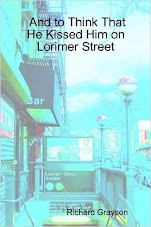
Thursday, February 15, 2007

New York Brain Terrain reviews Richard Grayson's AND TO THINK THAT HE KISSED HIM ON LORIMER STREET

Michelle Lin reviews Richard Grayson's And to Think That He Kissed Him on Lorimer Street at New York Brain Terrain on February 15, 2007:

I was a frequent peruser of the Daily Cal , the school newspaper, and The Heuristic Squelch, the campus humor magazine, during my first two years in college. Squelch was often too raunchy and perverted for my tastes, but I loved their fake news round-ups and the letters from the editor. One particular letter from the editor that stands out in my mind is the one addressed to the freshman in fall 2000: "College," the editor opined, "is like a hypercolor t-shirt. It starts out with a brilliant pink burst of excitement, before slowly fading away to a blur of resentment and apathy." The editor also instructed the freshmen, "If you're one of those students who asks questions in lecture every day, just remember, there's a special circle in hell for you people."

Richard Grayson's recent collection of short stories reminds me of The Heuristic Squelch, both in its smart humor and its ability to induce belly-aching laughs. Composed alternately of semi-autobiographical pieces and humorous shorts, Grayson weaves a picture of Brooklyn (and New York) that is rarely seen in New York literature nowadays.

A native of Canarsie himself, Grayson's characters inhabit the outlying middle-class neighborhoods in Brooklyn and Queens: Flatbush, the Rockaways, Bensonhurst, Brighton Beach, Canarsie, and the like. His characters are wonderfully diverse, much like the city itself, ethnic, immigrants, LGBT--you'll not find a single straight upper-class WASP in the book (not that there's anything wrong with that). The strengths of this book, I felt, lay in its humorous shorts.

A particular one that stands out in my mind is "Diary of a Brooklyn Cyclones Hot Dog," a tale of a lesbian Uzbekistani teen whose job is to dress up as Nathan's Relish Hot Dog. During each game, there is a race between Ketchup, Mustard, and Relish, and, much like the Trix Rabbit who never gets to eat Trix, Relish is never allowed to finish first in the race. However, like the Trix Rabbit, Relish starts out every race absolutely determined not to finish last, but some unfortunate incident befalls her each time.

The semi-autobiographical short stories, while well-written, were a bit too confessional for my tastes; however, they are still interesting reads. Grayson's handling of his characters' sexuality is deft and never overbearing. Highly recommended.

Thursday, February 8, 2007

Saturday Night on the Lower East Side: Words + Music with Gayle Brandeis & Kelley McRae at Bluestockings


This was posted to Richard Grayson's MySpace blog on February 7, 2007:

Great reading and performance at Bluestockings


This evening I went to one of my favorite bookstores, Bluestockings on the Lower East Side. The incredibly cool publicist Lauren Cerand (I've been to eight or nine events she's done, and every one has been terrific -- I wish I could afford her services myself!) had told me about WORDS + MUSIC, featuring Gayle Brandeis, an acquaintance I met on the website Readerville, reading from Self Storage, her new novel.

The book has gotten great reviews, and Gayle read an early section of the novel, dealing with an auction for the contents of abandoned self-storage units. The descriptions were so evocative, I am really looking forward to reading Self Storage.

The music for the evening was provided by Kelley McRae. I liked her "Johnny Cash" song and also a new song, "It's Another Beautiful Day," which seemed to be about the South Williamsburg neighborhood. You should check out Kelley's music, too.

I took the First Avenue bus to 14th Street, and after buying some groceries, went to get the L train home to Brooklyn. I go to the front so I can get out of the Lorimer Street exit on the Lorimer Street stop (most people get off at Union Avenue).

I'm at this station a lot, and I always seem to see, where I like to stand, by where the second car of the train will stop, a certain rodent. Nobody else was around, and as I was getting to my usual waiting place, I found myself saying (aloud -- yes), "Where is my rat friend?"

At that precise moment, the rat came out of the hole in the wall beside me and scurried down the end of the platform into another hole.

Okay, maybe it's a bunch of different rats. But I like to think I've been seeing the same guy for months.

Sunday, January 7, 2007

The Philadelphia Inquirer reviews AND TO THINK THAT HE KISSED HIM ON LORIMER STREET by Richard Grayson


Today, January 7, 2007, Susan Balée reviewed Richard Grayson's AND TO THINK THAT HE KISSED HIM ON LORIMER STREET for the Sunday Philadelphia Inquirer:

Richard Grayson is a funny guy from Canarsie, Brooklyn, and he's been writing short fiction for decades. He's also a lawyer and a teacher, which doubtless does a better job of paying the bills. Which isn't to say he's not a wonderful fiction writer - he is - but his kind of metafiction, mixing his memories (numerous main characters are named Richie Grayson) with his inventions about pansexual borough dwellers dealing with minor and major crises, read like stand-up comedy routines. Only a few of the tales in this book (including the title story) are fully realized short stories in a traditional sense.

At first I wished he'd pen more of the longer, less autobiographical stories, but when I got into the rhythm of his riffs, I changed my mind. Here's his kind of shtick, from "In the Sixties": At the beginning of the Sixties women were girls and girls were chicks. By the end of the Sixties girls were women and chicks were poultry... . In the Sixties... I raised money for a black classmate indicted for murder. I raised money for a Chinese friend to have an abortion. I raised money for Chicano migrant workers I had never met, or expected to meet. Most of the money I raised originally belonged to other people's parents. This is very funny stuff, but it's a comic monologue rather than a story with the traditional elements of plot, characters, setting, and so forth.

Grayson has hit upon a good formula, though, to generate a piece of writing: the annotated list. Hence, he has "Seven Sitcoms," "Branch Libraries of Southeastern Brooklyn," "The Lost Movie Theaters of Southeastern Brooklyn and Rockaway Beach," and so on. But like Grandma's beef brisket, a little of this goes a long way. In these tales of places that mostly aren't there anymore, the main feeling induced in the reader is nostalgia. Unfortunately, if you're not from Brooklyn, much of it is nostalgia for something you never knew in the first place.

Still, in his memories of places he knew as a kid (Mill Basin library, for example, "where I first looked up 'homosexuality' in all the encyclopedias and dictionaries and where I watched the clock so I could go back home in time for Mom to think I'd actually been at Hebrew school, the place I was supposed to be"), we do learn a great deal about Richard Grayson, and he's an interesting guy. A bisexual kid who spent most of his teen years housebound by panic attacks, Grayson read and wrote (and watched TV - hence, "Seven Sitcoms") to survive. Finally, antidepressants helped him regain his sanity and get out of the house.

The fluid sexuality of the characters in these tales adds to their appeal, though mostly the gay main characters suggest Grayson at different ages, from uncertain virgin to gay role model for his young neighbors, Ryan and Sam: I don't get looked at much in any way anymore, definitely not by guys their age. Tempus fugited so fast it seemed like one day I went to bed looking like Chip and woke up the next morning looking like Uncle Charley.

Grayson's expertise on himself, his era, and his homeplace (Brooklyn) convince me that he should shape some of this material into a memoir and forget the metafiction for a while. Memoir is the genre in which Grayson, already an amply credentialed writer, could probably land a decent contract with a publisher people have actually heard of...

Richard Grayson has a fresh, funny voice...
______________________________
Susan Balée's comparative essay on playwrights David Hare and Tom Stoppard is forthcoming in the Michigan Quarterly Review.

Thursday, December 14, 2006

Book.of.the.Moment reviews Richard Grayson's AND TO THINK THAT HE KISSED HIM ON LORIMER STREET

On December 13, 2006, Book.of.the.Moment on MySpace reviewed Richard Grayson's And to Think That He Kissed Him on Lorimer Street:

About Richard Grayson's collection: His sense of humor is unlike any I've encountered before, and he expresses his wit through his creation of a diverse group of characters. "And to Think That he Kissed Him on Lorimer Street" introduces characters such as a teenage lesbian from Uzbekistan, and a black gay college student who debates poisoning his Pakistani roommate's therapy monkey. Grayson skillfully expands on his memories of the past with a pop culture study of sorts..weaving his past memories into his observations and experiences in the here and now. All this is done with a wit that caused me to laugh out loud.

Monday, December 11, 2006

Matt Bell reviews Richard Grayson's WRITE-IN: DIARY OF A CONGRESSIONAL CANDIDATE IN FLORIDA'S FOURTH CONGRESSIONAL DISTRICT

Matt Bell reviewed Richard Grayson's WRITE-IN: Diary of a Congressional Candidate in Florida's Fourth Congressional District on his blog on December 4, 2006:

In 2004, Richard Grayson (author of With Hitler in New York and And To Think He Kissed Him on Lorimer Street) ran as a write-in Democratic candidate for the U.S. House of Representatives against a firmly entrenched Republican incumbent. His opponent, Republican Representative Ander Crenshaw, is almost abstract in his role as antagonist, having enough funding, support, and staff that defending his seat barely requires he even take notice of Grayson, who has no staff, no funding, and, at least, initially, no support. It's to Grayson's great credit that although he always knows what the outcome will be in his race for the House, he still puts an admirable amount of effort and time into reaching each potential supporter he comes across.

Grayson originally chronicled his race online for McSweeney's Internet Tendency (where you can still read the entire manuscript), and has republished his diary in book form. Here's an excerpt from the first entry from Grayson's book:
I'm the only registered Democrat in the race. But, unable to afford the nine-thousand-dollar filing fee to get the official party designation, I'm a write-in candidate. Under Florida's bizarre election laws, write-in votes count only if they're for "qualified" candidates like me.

If I weren't a candidate, Congressman Crenshaw's name wouldn't be on the November ballot. There just wouldn't be an election. Four of Florida's twenty-five House members were elected this afternoon when they did not get a primary or write-in opponent.

Over 90 percent of Americans live in congressional districts that are essentially one-party monopolies. Of Florida's twenty-five House seats, seven are safe for Democrats, and sixteen are safe for Republicans.

The Fourth is the most Republican district in the state. But I'm hoping to give anyone opposed to Crenshaw's positions a chance to vote for someone else.

In the last Congress, Crenshaw voted for more Bush tax cuts and the war in Iraq. He supported oil development in the Arctic National Wildlife Refuge, limiting the Patients' Bill of Rights, and banning "partial-birth" abortion. Crenshaw voted against campaign-finance reform.

As of March, his campaign committee had $612,691 in cash.

Mine had bupkis.

Grayson writes with a self-deprecating wit and a keen eye for the realities of both our overall political situation and that of Florida's Fourth District, where his campaign takes place. Times move fast, and after the semi-uplifting Democratic victory this past November, it may be hard to remember exactly how bleak things felt for progressive or Democratic voters in late 2004, but Grayson's diary, written in the heat of the moment, manages to chronicle not only the desperate backdrop of that election but also the awakening sense of progressive community that was nearly destroyed by the spirit-crushing reelection of George W. Bush and his Congress. Grayson writes much like he ran for the House, in that he isn't so much trying to convert us as voters as much as he is trying to show us that we do still have options when he vote, despite what our political situation seems to allow.

When asked what he'll do to support traditional marriage, Grayson says he'll kill Liza Minelli. His favorite part of living in Florida's beautiful Fourth District? "The hurricanes." He tells the same reporter that he's "too lazy to be in Congress," because "it's a lot of work." Openly transgressive when answering reporters and filling out lobbyist group questionnaire, Grayson couches every answer in a wit that's as cynically sarcastic as it is big-hearted, leading to the confusion of his interviewers and friendly recognition on the part of this reader, whose contradictory feelings of cynicism and optimism from 2004 were both crushed and vindicated by the final results of that election.

Clocking in at just over one hundred pages, Grayson's Diary of a Congressional Candidate in Florida's Fourth Congressional District is a deceptively quick read. Still, it's bigger than it looks. I finished the book in a single evening, but have found myself returning to it to enjoy not only the absurdity of the political situations but also the fine humor of Grayson's prose and the sense of comradery that permeates every page. He so openly shares the details of his ironic, winking candidacy that it's impossible not to cheer him on. Towards the end, a voter writes Grayson a letter thanking him for trying that the voter signs "your constituent," a sentiment that I too felt by the time I turned the final page. Although Grayson lost the race, his book tells it like a victory march, celebrating every small triumph won against impossible odds.

I couldn't agree more.

Thursday, November 30, 2006

Monday Night at Mo Pitkin's: AVERY reading with Dominic Preziosi and Richard Grayson


At Mo Pitkin's House of Satisfaction on Monday, November 27, 2006, at 7 p.m. there was a reading for the inaugural issue of Avery: An Anthology of New Fiction with contributors Dominic Preziosi and Richard Grayson. It was part of Mo Pitkin's Reader's Room series.

Here's the post by editor Andrew Palmer from the Avery blog on November 29:

Andrew: Avery takes on New York

Avery pulled off a big coup earlier this month when Francis Ford Coppola's Zoetrope: All-Story cancelled a reading in Manhattan and Avery was invited to take their place. The reading went down with a healthy dose of fanfare this Monday night on the second floor at Mo Pitkin's House of Satisfaction in East Village--a small, wood-panelled, night-clubby, noirish room with three long tables stretching from a curtained stage to the back of the room. It seemed to me to be about half-full--a more than respectable turnout for a new literary anthology that hasn't even been published yet. Leigh Newman, one of our writers (and our informant for this reading series) hosted, I nervously said a few words about Avery, and then I gave up the floor to our two readers for the night--Avery contributors Dominic Preziosi and Richard Grayson, both of whom I was meeting for the first time.

Dominic held us in thrall with his Avery story about a man and a woman in a hauntingly familiar semi-post-apocalyptic Manhattan. The first sentence is "In the aftermath of everything we meet up with the one-eyed priest." Now we're listening!

Richard read, in an appropriately neurotic, hyper-self-conscious voice, his Avery story about, about . . . . it seems to be about trailing off, about starting things and never being able to finish them--whether it's a PhD thesis or sexual intercourse or a hamburger. In any case it's hilarious, and everyone laughed a lot. My favorite part is where the narrator--oh I'll just quote it:
When I was young, Rilke admonished me nearly all the time. That “You must change your life” written so earnestly.
But mostly I was tired and preferred to close my eyes.
You must, Rilke would say.
But I just can’t now, not right now, I thought.
You must change, he said.
Tomorrow. Tomorrow I’ll do it.
Change your life, he kept saying.
Yes, yes. But not at this minute.
Your life, Rilke said.
So I reached for my pills, the little red triangular ones, the ones that helped me sleep. I swallowed two of them without water, and Rilke became silent.

Brilliant, Richard. Thanks again, really many many thanks, to Richard and Dominic for providing the meat of the entertainment on Monday--and of course to Leigh for hosting. (If you're in New York you need to check out the weekly Reading Room series at Mo Pitkin's.) We got the word out to a few more people, made a couple more connections, and had a wonderful time.

Monday, November 20, 2006

Flatbush Life and Kings Courier cover Richard Grayson's AND TO THINK THAT HE KISSED HIM ON LORIMER STREET


Flatbush Life and Kings Courier report on Richard Grayson's And to Think That He Kissed Him on Lorimer Street was the subject of an article today (November 20, 2006):

'Lorimer Street' Writer Turns the Pages on Brooklyn

by Helen Klein


Here [is]autobiography seen through the lens of fiction, fiction created through the maze of past life re-imagined – not Proust, considerably less dense, for one thing, but certainly not the unProust.

This is not to say that the stories in Lorimer Street are inaccessible to anyone who did not share Grayson’s college days or his clearly not-forgotten youth. To the contrary, in some ways they are an evocation of the quintessential school days, the bittersweet portrait of the artist as a young man. Not coincidentally, the son of the narrator of the story after which the book is named, asks his father, “Hey, Dad, how’d you like a chance to relive your past?”

Not only do the stories fictionalize a past life, they evoke a Brooklyn of times gone by, a Brooklyn fading in memory as the old-timers move to Florida or die, leaving behind the vanished movie theaters and other borough landmarks recreated in Grayson’s book, written by him while he lived thousands of miles away.

Joyce may have been the first writer who dramatized the need to articulate his memories of his home from a vast distance; he is certainly not the last.

“It’s very much so that you have to leave a place to write about it,” agreed Grayson, who cited emotional distance as well as chronological distance as important elements in shaping memories for the translation into fiction. But, he pointed out, leaving does not mean abandoning. Throughout his adult life he has left the borough and returned, living in different neighborhoods for a month or a season at a time.

Which may be one reason why, unlike Joyce, Grayson doesn’t confine himself to the past. One of the stories in his most recent collection centers on a man taking his son to a concert at the Williamsburg hot spot, Northsix. Another is entitled, “Diary of a Brooklyn Cyclones Hot Dog.”

“There are a lot of writers who’ve written about Brooklyn,” mused Grayson during a phone interview that felt, many times, more like a conversation. “It’s different for every person because the borough is such a treasure trove of different experiences.”

Grayson’s Brooklyn was one not only defined by the movie theaters and branch libraries, but by the buses, which he rode, criss-crossing the borough. “I always liked to explore Brooklyn,” he recalled. “I used to collect bus transfers so I would ride every bus line from one end to the other, so I actually did see a lot of Brooklyn.”

Grayson has already written about the tension between the Brooklyn of 30 or 40 years ago and the Brooklyn of today, in the book’s title story, which, he said, “Is really about two Brooklyn’s. The narrator is probably around my age and he lives with his wife and his teenage son from his first marriage.”

While the story is set in Williamsburg, circa 2005, it features recurrent flashbacks to Canarsie in the 1960s, a time when Brooklyn was a borough defined by the middle-class families who had moved from cramped apartments in older buildings into newly built homes somewhat distant from subway lines, such as the one lived in by the Grayson family in Flatlands.

Now, he stressed, the borough is different. There has been a new wave of middle class immigrants, Grayson noted, as well as a massive dose of gentrification. “It’s shedding its destitute art student image,” he remarked, in a reference to a Post article. “It’s not the Brooklyn I grew up in.”


Wednesday, November 8, 2006

The Outsiders' Book Review from Underground Literary Alliance Reviews HIGHLY IRREGULAR STORIES & AND TO THINK THAT HE KISSED HIM ON LORIMER STREET


The prolific author Jack Saunders reviews Richard Grayson's two Dumbo Books short story collections for the Underground Literary Alliance's Outsider Writers' Book Review:

Richard Grayson: Highly Irregular Stories; And To Think that He Kissed Him on Lorimer Street and Other Stories
Reviewed by: Jack Saunders


Jack Saunders has met Richard Grayson, and Richard has met Jack.


Highly Irregular Stories (2006) and And to Think That He Kissed Him on Lorimer Street and Other Stories (2006), by Richard Grayson. Dumbo Books of Brooklyn, 72 Conselyea St., Brooklyn, NY 11211-2211. dumbobooks@yahoo.com

And to Think That He Kissed Him on Lorimer Street and Other Stories is Richard Grayson’s 10th volume of fiction. Or metafiction. Or autobiography. Or stand-up comedy. Or short form narrative. He’s published two other books. What are they? Nonfiction? Reportage? I always think of Jonathan Winters saying he is in gar-bahj, when I hear re-por-tahj.

I believe you could call the writing avant-garde. It’s out ahead of the pack. The avant-garde is a tradition, like any other. Like commercial fiction, or literary fiction. It’s anti-commercial. Anti-literary. The literary is a set of conventions an iconoclast wants to bust up.

An iconoclast is aware of his place in the scheme of things. He knows the history of what he’s doing. He is aware, or self-aware, and self-awareness leads to irony.

Irony lends itself to short pieces. You don’t want to be long-winded. That’s for novels, a more expansive form, where you can stretch out. In one sense, you could say the avant-garde leads the way. In another, profounder sense, you could say it doesn’t go anywhere, it just is. It is what it is. Take it or leave it. As it is. This makes reviewing a collection of short pieces either very easy or very hard.

What is the author trying to do, and is he succeeding, on his own terms? Larry wrote the other day that he found himself at looking at books in a rummage sale, and found he was reading them to see what bias they had; not to see what the book was about or to read for enjoyment or to get taken up by it.

What happens when we approach books like that? How do we not approach books like that?

Do collections of stories become something in the aggregate they were not, separately, as lone stories, in magazines that pay in copies and go belly up, or self-published chapbooks, issued in editions of hundreds of copies? Are they clever, amusing, cute? Do they hold up? Do we see a design to the works, over time? A pattern? Is a collection of them more impressive, more authentic, does it have a gravitas scattered fragments cannot demonstrate? Are we impressed? Are we surprised? Did we disremember? Do we see things we didn’t see the first time through?

You can buy the books from lulu.com for $12.95 or $16.95. Highly Irregular Stories is a collection of four chapbooks, which are out of print, and rare. A copy of Eating at Arby’s was recently listed online at $350. It’s good to see the stuff back in print. The stories in And to Think That He Kissed Him on Lorimer Street haven’t been collected before. It’s nice to see them in one spot.

What is One Life in the Short Form Narrative Business like? We get a good feel for it, in these two collections, which span three decades.

What is America like? It’s like Richard Grayson says it is, it’s how Richard Grayson sees it. He’s a Jew from Brooklyn, I’m a cracker from Delray Beach. We have different accents, different life-experiences, different expectations, about life. I’m older than he is, and was in the Air Force for eight years. I boxed. I went ten rounds with Bukowski. I fought the Creature from the Black Lagoon underwater, at Wakulla Springs.

Now I just sit around and watch my boot turn blue, from mildew.

But his America rings true, to me, a deep and eclectic literary sensibility in a pop-culture milieu of glitz and flash, the shallow and the hyped, pinball-machine moths, attracted to the light, the noise, the buzz. Love-bugs, smashed on the windscreen. In the throes of their mating ritual. Up around Gainesville on a two-lane blacktop. Harry Crews afraid to leave his writing studio because he might miss something. And Harry Crews ain’t afraid of death or taxes.

A reader said he kept my books on the back of the crapper, and he started every day with a good old country shit and a belly laugh.

That’s a good thing to do with Richard Grayson’s books. Keep them on the back of the crapper and read them every day. They will make you laugh. The stories are short enough you can read one at a sitting.

My theory is that we are attracted to a writer’s voice, and every time we find a writer we like, we buy everything by him or about him we can find, regardless of genre. If he’s any good, he has invented his own genre, conflated one or more genres into a form of his own, which we recognize, because of his distinctive voice.

Bud Powell had small hands. Mary Lou Williams had hands that looked like $10 worth of spareribs in 1937. They’re not going to sound the same. Why should they? If the short pieces have a unity of form, a consistency of vision, a continuity of effort, a tone, an outlook, when do they begin to be less self-contained short pieces and constituent parts of a longer work composed of short pieces, if they do? If they do, was it an accident?

Public taste is fickle. A writing career is a tradeoff and a crapshoot. You can make a fortune writing but not a living. Not even the living you’d make at more mundane tasks. You have to have a sense of humor about it.

A sense of black humor, like the old comics Lenny Bruce, Mort Sahl, and Shelley Berman. The writers Woody Allen, Richard Brautigan, and Terry Southern. Would you choose writing for a career? You don’t choose it, it chooses you. What if you choose it and it doesn’t choose you?

Can you be funny about that? For 30 years? It’s not as easy as Richard Grayson makes it look.

The stories in the second book are newer and darker than the stories in the first book. Branch libraries are closed, movie houses shut down, neighborhoods gentrified, people moved away, friends died, what was not there, then was new, and ugly, is now shabby, with people hanging on, because they have no choice. There are constants. The stock market rises and falls, real estate goes up, people have careers, careers have an arc, not all careers have the same arc.

Richard Grayson once observed to me that writers advise you to do what they did. If they teach writing, they advise you to teach writing. If they are some other kind of professional, they advise you to be some other kind of professional. He was a lawyer. Journalists advise people to write for newspapers or magazines. Or television. I was a paraprofessional. A technical writer. Not an engineer or a programmer. On a par with a draftsman or a logistician (supply specialist). A white collar job, but not a full-fledged profession.

What is true is you need a job that pays enough so you can live comfortably, and are not so tired by your work that you are too tired to write, after work. And that can mean too tired emotionally. Then you just do your job and write before and after work. Or during work.

Maybe you’ll have a year off now and then, when you win a grant, inherit some money, or, in my case, once, are able to draw 49 weeks of separation pay, unemployment, and extended unemployment benefits, plus social security, or, another time, cash in the retirement you rolled over into an annuity when your last corporate employer laid you off and live on that for a year. Or mortgage the house you inherited when your grandfather died and run up the balance on a line-of-credit home-equity loan.

I’m always curious about how a writer supported himself when he wrote the books, and think that should go in the books. I think a reader has a right to know that.

Did he kiss a Stalinist’s ass in Macy’s window?

I enjoyed reading these books and I think you will too. I think they’re worth going to some trouble to find out about and buy. And tell your friends about.

And tell the author about them, if you liked them.