Pages

Sunday, September 17, 2006

Blogcritics.org Reviews HIGHLY IRREGULAR STORIES by Richard Grayson

On September 16, 2006, Nancy Gail reviewed Highly Irregular Stories for Blogcritics.org:

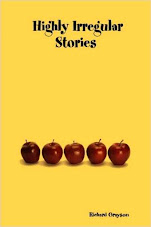
Highly Irregular Stories is an anthology of four Richard Grayson chapbooks. Although not for every taste, selections are intriguing enough to keep the reader turning pages until the end.

"Inside Barbara Walters" examines what might have happened if a young girl had not had a flash of inspiration when it came time for show-and-tell in second grade. Having left her stamp collection at home, young Barbara reached into her backpack and grabbed her Curious George book. After that, all she had to do was mention her interest in reading and the day was saved.

"Progress" takes the relationship between a young man and a stranger and brings it full circle. Ricky is prevented from buying the wrong shirt in Bloomingdale's and ends up going home with Eric Cornell. While Eric fixes dinner for the two of them, he suddenly remembers a neighborhood association meeting he must attend. For some reason, he has gotten himself named in charge of the tree parent committee. Ricky is left at Eric's place to fend for himself. When Ricky calls a pharmacy for a sleep aid, a young teenager named Rico delivers it.

"17 Fragments in Search of a Story" is exactly what the title implies. An author talks about himself and the book he is trying to write in 17 parts. While there is a natural flow to the sections, the ending is not one readers are going to forget.

"Eating at Arby's" was the longest selection and the one I liked least. A retired couple moves to Florida (where else?) and discovers life is not quite what they imagined. In a bizarre move, Grayson takes their day-to-day banter and turns it into an irritating form of repetition. It makes the two main characters sound like idiots. However, I found the reference of wanting to take a trip to Columbia amusing.

"The Governor of the State of Depression" looks into the life of a politician and shows the glamour of a life in public office is not always what people think.

Grayson is hardly a typical author. He takes real life issues in society and uses them freely in every story he writes. With the varied selection, readers will find at minimum one thing they like even if they consider the rest to be junk.

Sunday, September 10, 2006

Judd Lear Silverman Reviews Richard Grayson's AND TO THINK THAT HE KISSED HIM ON LORIMER STREET

On his eponymous blog, Judd Lear Silverman reviewed Richard Grayson's And to Think That He Kissed Him on Lorimer Street on September 9, 2006:

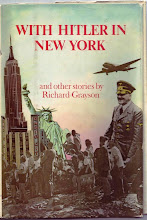
If you're not familiar with the writer, Richard Grayson, you should be, especially those who love the short story form. Besides spending time on bogus runs for political office and publicity stunts that have graced People and Page Six in the Post, Grayson's been writing prolifically for years, and his first anthology, With Hitler in New York, was recently reissued. Other humorous writings have included the collections I Break for Delmore Schwartz, Eating at Arby's: The South Florida Stories, and Narcissism and Me, as well as a novella, The Silicon Valley Diet. [Some of these stories have also been reprinted in Highly Irregular Stories (Dumbo Books).] But his recent collection, entitled And to Think That He Kissed Him on Lorimer Street, is perhaps the best collection to start with, reflecting not only his gifts as a satirist but his ability to keep the mind so busy it doesn't know that the heart has been touched. Like a reality TV junkie, Grayson mixes seeming fact with fiction, borrowing names, places and people from his own life and shaping them into odd and effecting commentaries on the passage of time, family relationships, sexuality, race relations, and America's pathological preoccupation with celebrity. Some stories are quick brushstroke sketches of people and a particular time. Others are journeys told in vignettes stretching spans of 20-30 years. Friendships are explored in sideways glances, showing how the most unlikely of alliances can turn into lifelong relationships. Numerous stories (perhaps one too many for the same collection) are subdivided by real estate locations: old movie palaces, libraries, and shopping centers, where seemingly innocuous events are recalled that by the end of the story add up to a whole lifetime of experience. Grayson shape shifts from gay to straight, white to black, male to female, kid to aging wit. Grandparents and childhood buddies play recurrent and important roles, but discerning fact from fiction in Grayson's work is tricky until one considers these stories in the aggregate. In the biography of the great Italian filmmaker, Federico Fellini, the maestro is quoted as saying that the truth of his life is not in the facts reported by birth certificates, death notices and journalistic reportage, but in his art, his dreams, his films--it is in the revelation of the imagination that the real artist is known. Likewise, the truth of Grayson is in these tales, invented and reinvented versions of his life and experience. The facts may not be verifiable, but the affection and care he displays in his description of life's travels and the people in his life are real, resulting in stories that are affecting and sharply observed. Recommended.

Monday, August 7, 2006

Bookgasm Reviews HIGHLY IRREGULAR STORIES by Richard Grayson


Ken Davis has reviewed Highly Irregular Stories at Bookgasm:

With HIGHLY IRREGULAR STORIES, I can’t think of adjectives that more accurately describe this collection of Richard Grayson’s writings than the first two of his title, although unorthodox, quirky, peculiar and highly entertaining also come to mind.

This book is purportedly an accumulation of stories originally published in the 1970s and ’80s in four separate chapbooks (DISJOINTED FICTIONS, EATING AT ARBY’S, THE GREATEST SHORT STORY THAT ABSOLUTELY EVER WAS and NARCISSISM AND ME), all long been out of print. I wouldn’t exactly describe the contents as stories, at least in the traditional sense anyway. Many of them might be better described as vignettes or sometimes as just snippets of a fictional conversation. Heck, “Some Sad News” is a mere 180 words. By comparison, this review is roughly 450. I didn’t find any exquisite plots or character development, but I was too busy enjoying myself to care.

Grayson is a literary performance artist. His words are avant-garde and so uniquely different than anything else I’ve ever read., as the book is chock full of the offbeat. Take the narrator in the 147-word “Ordinary Peepholes,” who spies the scrawled message on a subway “FOR A GOOD LAY CALL 969-9970.” He recognizes the phone number as his sister’s and the handwriting as his father’s. Or how about the very subtle but delicious irony in “I Saw Mommy Kissing Citicorp,” in which the Chairman of the Federal Reserve Board who oversees the ebb and flow of cash in this nation has trouble with an ATM and can’t withdraw $200.

The entries from EATING AT ARBY’S were by far the most entertaining, written in the style of the old Dick and Jane readers, but updated to feature the liberal thinkers Manny and Zelda. These two don’t discuss how fast Spot can run, opting instead for more adult subject matter. For example, in “Strange Experience,” Zelda comes home and announces, “Look what I have got, Manny. I have some cocaine.” Manny replies, “So that white powder is cocaine. I have heard a lot about it from many people.”

Manny and Zelda are taken to a gun range by their friend José in “Fun with a Gun.” Zelda warms to the idea of firearms and says, “Manny, I want to shoot that gun. That gun will become our friend, just like José is our friend.” The topics of murder, homosexuality and outrageous electric bills also are tackled by the pair. Sasson Jeans and the Arby’s salad bar at Arby’s also make hilarious repeat appearances.

I highly recommend this book and reading in general. So do Manny and Zelda. In “Shopping in the Mall,” Zelda says, “I read a book once. It made me think.” Manny replies “Thinking is fun. I like to think.” – Ken Davis

Saturday, July 15, 2006

Kirkus Discoveries Reviews HIGHLY IRREGULAR STORIES by Richard Grayson

Kirkus Discoveries reviewed Highly Irregular Stories by Richard Grayson on July 14:


HIGHLY IRREGULAR STORIES
Author: Grayson, Richard


Review Date: JULY 14, 2006
Publisher:Dumbo Books (178 pp.)
Price (paperback): $12.95
Publication Date: 2006
ISBN (paperback): 1-4116-5796-9
Category: AUTHORS
Classification: FICTION

An audacious and wickedly smart comedic writer brings his full weight to bear in a collection of his early work.

Grayson, no stranger to experimentation, here assembles four of his most engaging chapbooks, which merge nicely as an eclectic anthology of intriguing short stories. The author, who breaks nearly every literary rule in an obsessive effort to be unique, is both maddeningly and hilariously self-aware. “Narcissism and Me” leaps dizzyingly between the author’s presence and the actual story like a snake eating its tail, while “Sixteen Attempts to Justify My Existence” reads like a blog from another planet, and “I Saw Mommy Kissing Citicorp” waxes poetic on the rise and fall of 1980s greed. No business is safe, either, as Grayson mocks traditional publishing’s buzzed-based marketing with caustic sarcasm in “The Greatest Short Story That Absolutely Ever Was.” In “The Facts Are Always Friendly,” the action is narrated through a series of terse, date-stamped factual statements. Grayson opens up in the meatier “Eating at Arby’s,” a clever spoof written in childlike prose. It details the absurd dichotomies of South Florida as a pair of retirees fall prey to consumerism, political exiles and even gunplay on their way to the mall. With a keen eye for highlighting the high anxieties of the modern world, and many of the sensibilities of a sensitive urban writer, Grayson is occasionally compared to Woody Allen. But Grayson’s stories here recall no one so much as Richard Brautigan, who walked a similar line between wit and warmth in his more eccentric novels. Though certainly unconventional, Highly Irregular Stories are refreshing because of their aloofness, which allows the author to indulge his peculiar point of view.

An iconoclast sways to his own beat, making beautiful music along the way.

Monday, July 3, 2006

QueerType on Richard Grayson's WITH HITLER IN NEW YORK


Jameson Currier writes about "With Hitler in New York" at his blog QueerType on July 2, 2006:

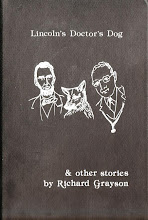
Three Discoveries: During the spring, works by three writers came to my attention that I can highly recommend, one is Richard Grayson's surreal and thought-provoking short story, "With Hitler in New York," which was also the title of a collection of his short stories that were published in the late 1970s and which has been recently reissued. In the story, Hitler becomes a stand-in for the alienation and discrimination many Germans felt in the decades after the war. The story is readable on-line via a link on Grayson's Web Site. (http://www.richardgrayson.com/) Grayson also has an impressive political background (in the 1980s he was a Presidential candidate), but it is his short fiction that intrigues me most. His other collections worth exploring are Let Slip the Dogs of War, Lincoln's Doctor's Dog and Other Stories, and his most recent collection, And to Think He Kissed Him on Lorimer Street.

Saturday, July 1, 2006

Literary Kicks reviews Richard Grayson's AND TO THINK THAT HE KISSED HIM ON LORIMER STREET

Levi Asher reviewed Richard Grayson's And To Think That He Kissed Him On Lorimer Street at his blog Literary Kicks (LitKicks) on June 29, 2006:

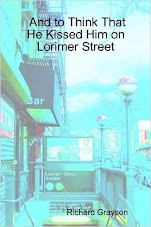
Richard Grayson's And To Think That He Kissed Him On Lorimer Street allows the touching moments to sneak up on the reader. This is a surprising collection of assorted writings by a veteran Brooklyn author who once published a diary of a New York City congressional campaign and has produced numerous other books with intriguing titles like The Boy Who Fell To Brooklyn and I Brake For Delmore Schwartz (a long list of the author's books can be found here). I really like the first story in this collection, in which a good-humored narrator chaperones his teenage son to a loud punk concert at the Northsix club in Brooklyn. His son is openly gay, and the title of the book is explained when the trio amass at the L Train subway entrance on Lorimer Street and the father averts his eyes, wondering at his own amazing tolerance, while the two boys kiss goodnight. Elsewhere, Grayson's book gives us a tour of Brooklyn neighborhoods, a list of bad sitcoms nobody else remembers, and many other scattered ideas. The book has more sprawl than focus, but then so does the borough it proudly represents.

Monday, June 26, 2006

Kaye Trout Book Reviews reviews HIGHLY IRREGULAR STORIES by Richard Grayson

Kaye Trout's Book Reviews has reviewed Highly Irregular Stories by Richard Grayson:

Wednesday, June 21, 2006
HIGHLY IRREGULAR STORIES by Richard Grayson


Dumbo Books of Brooklyn
72 Conselyea Street, Brooklyn, NY 11211
http://dumbobooksofbrooklyn.blogspot.com
www.richardgrayson.com
Genre: Fiction/Humor
Rating: Unusual
ISBN: 1411657969, $12.95, 177 pp, 2006

Highly Irregular Stories is, indeed, a most appropriate title for this compilation of prior writings: Disjointed Fictions, Eating at Arby’s, The Greatest Short Story That Absolutely Ever Was and Narcissism and Me.

Richard Grayson opens with: "The anarchist’s bomb that killed Czar Alexander II in St. Petersburg in 1881 led to the Russian pogroms and the anti-Semite May Laws of 1882. To these events we Americans owe countless things: the comedy of Woody Allen and Lenny Bruce; the popularity of psychoanalysis . . ."

It’s interesting that Woody Allen and psychoanalysis are first among his list and that’s just what I was feeling as I read this book. Grayson has taken that Woody Allen-type New York humor about a self-deprecating, neurotic, talented man one step further into the twilight zone.

As I’m not a New Yorker and never could fully appreciate Woody Allen’s humor, I’ll let the book stand on its own. My experience of reading Eating at Arby’s about Manny and Zelda in downtown Miami brought back memories of learning to read with Dick and Jane. It almost has the same rhythm and meaningful depth. We were just missing "See Spot run."

But to be fair, I would like to quote from "Myself Redux" which I particularly enjoyed: one, for the historical perspective and two, for the Kurt Vonnegut-flavor of humor:

""On Wednesday, the thirteenth day of October in the year many people call 49 B.C., Caius Julius Caesar, a Roman general, crossed the ancient watery boundary between Cisaplin Gaul and Italy known as the River Rubicon, thus making immortal the phrase "to cross the Rubicon," meaning "to take a decisive and irrevocable step."

Precisely two millennia later, on Wednesday, the thirteenth of October in the Christian year 1951, my Jewish parents took a decisive and irrevocable step in a room of the Quality Courts Motel outside Corning, New York. Within a week, the embryo that was to become the person writing these words was as large as one of Caius Julius Caesar’s fingernails. A tube formed within the embryo. This enlarged at a certain point, and then it began to pulsate. Eventually this pulsating tube developed into a four-chambered organ which circulated the fluid known as blood throughout my body.

On Sunday, October 17, 1971, 185 years and one day after the establishment of the United States Bureau of the Mint, I decided that my four-chambered pulsating organ had been broken because I had found the 18-year-old female whom I described as my "girlfriend" in bed with my 16-year-old brother, their four-chambered organs pulsating rapidly.

One week later, on the twenty-sixth anniversary of the establishment of the United Nations, I attempted to stop the pulsating of my four-chambered organ by making a three centimeter incision with a razor blade across my left wrist.

The following Monday, October 25, 1971, known that year as "Veterans Day" due to federal legislation enacted to give citizens a three-day holiday weekend, I found myself in the offices of the clinical psychologist Marilyn Wertheim, crying into a tissue.""


The story goes on to tell us: his girlfriend becomes pregnant, his brother is killed when hit by a bus, he marries his girlfriend, she has the baby, he doesn’t know whether he’s a father or an uncle, the baby dies, and they annul the marriage. There’s more but that will give you an idea of the beginning.

So, if you’re a Woody Allen fan and using the same stuff as Richard, you just might enjoy this book and a trip into the twilight zone.

Richard Grayson is a prolific writer and to appreciate who he is, what he has accomplished and what he has written, I refer you to his website: www.richardgrayson.com.

Reviewed by Kaye Trout - June 21, 2006 - Copyright

Sunday, June 25, 2006

Wet Asphalt reviews Richard Grayson's AND TO THINK THAT HE KISSED HIM ON LORIMER STREET

Eric Rosenfeld reviewed Richard Grayson's And to Think That He Kissed Him on Lorimer Street at his blog Wet Asphalt on June 21, 2006:

Richard Grayson's new book And to Think That He Kissed Him on Lorimer Street is a collection of confessional fiction that I think illustrates both the best and the worst of how the style can be used. Much of Lorimer Street is clearly autobiographical—Grayson even uses his own name—and reads more like memoir than fiction, though at least once he plays around with this by making himself married to a woman and with children, while in the other stories he's an unmarried, aging homosexual. Grayson generally organizes these stories around themes and objects—e.g. libraries he used to go to or the dead silent film star who once lived in his house. In the story "Conselyea Street" he employs this trick to devastating effect as he tears off pieces of life in New York until the only thing left is real estate. By way of contrast there is "The Cool Guy," in which Grayson rambles on interminably about some guy he used to know, and how this guy dated this girl and then this other girl and then he (Grayson) dated this girl and now she's married and has kids and... wait, why am I reading this again? "The Cool Guy" feels like something Grayson copied right out of his diary.

There are other stories that (though still confessional) are more clearly fictional, and those are the high-points of the collection. Richard Grayson has been around for a long time and his practiced simplicity is easy to read; his prose manages to be lean without being terse. Among these more fictional stories is a tale about a foreign girl who is one of the hot dog mascots for the Coney Island Cyclones baseball team. Another is about a kid in college whose Muslim roommate has a therapy monkey. A third is about a guy whose pushy female friend gets off on watching the protagonist kiss her boyfriend. These are all fun to read and a story collection made up entirely of stories like these would deserve glowing praise. As it stands parts of this book make clear that Richard Grayson is very good at writing fiction, while other parts make you wish he would actually write some.

The question then isn't "can Richard Grayson write," it's why is he typing out these boring autobiographical numbers?...

Grayson...refers to "...the small press that published... my book of idiotic stories." Which might be funny if he didn't sound serious, and this wasn't a book of "idiotic" stories published by a small press. Grayson's work paints a portrait of a talented writer whose ambition has washed away in a sea of middling reviews and self-pity. This is a man who has given up, and I'm not talking about going to law school, I can understand resigning yourself to not making a living as a writer when so few do. It's like he's given up on being read, he's given up on literature, and he's given up on mattering. And frankly if he thinks so poorly of his own work then why is he inflicting it on other people at all? Why bother?

What happened to you, Richard?

Whatever happened, I think it's the real reason for the uneven quality of the stories in this collection. This is the work of a good writer who doesn't think what he does matters anymore. And that's kind of sad and unfortunate. Richard, come back.

Tuesday, June 13, 2006

How Dumbo Books Makes Money: Product Placement in AND TO THINK THAT HE KISSED HIM ON LORIMER STREET


This post appeared on Richard Grayson's MySpace blog on June 13, 2006:
Product Placement in AND TO THINK THAT HE KISSED HIM ON LORIMER STREET


Apparently The New York Times ("Product Placement Deals Make Leap From Film to Books" by Motoko Rich)thinks it's newsworthy that authors using their books of fiction for product placement deals.

But I've been doing that for years. Because few people actually buy my books, I have to make money by mentioning products, services, and corporations which pay me to plug them.

For example, in "Schmuck Brothers of East Harlem" -- just one of the thirty stories in And to Think That He Kissed Him on Lorimer Street, I got money for plugging Murray's Sturgeon Shop, Washington Mutual Bank, the Leonard Nimoy Theatre,

the Kashbah Kosher Café, Victoria's Secret, Tasti D-Lite, the Estée Lauder Stress Relief Eye Mask, Starbucks frappuccinos, Hard Candy Vintage Nail Polish's classic Tantrum, Urban Decay's Maui Wowie eyeshadow, the Café des Artistes, the Cellcomet Anti-Stress Cream Mask, Cooper 35 Restaurant, Molson Ale, Blue Cult jeans, Kim's Video, Diary of a Mad Black Woman, The Dreamers, Con Edison, Target, Jewelrymaven.com, Mitchum Deodorant, Demeter's Riding Crop fragrance, Altoids, SparkNotes, Kiehl's Pharmacy, the Union Square Café, The Body Shop, Sephora, Longo's Baci XXX lip gloss and even the St. Marks Bookshop, which doesn't carry the book.

Wednesday, June 7, 2006

Syntax of Things reviews Richard Grayson's AND TO THINK THAT HE KISSED HIM ON LORIMER STREET

Jeff Bryant reviewed Richard Grayson's And to Think That He Kissed Him on Lorimer Street at his blog Syntax of Things on June 5, 2006. Excerpts:

And To Think That He Kissed Him on Lorimer Street
by Richard Grayson
Dumbo Books
Short Stories; 289 pp.


A few months ago I got an email from Richard Grayson asking if I would be interested in reading his new collection. He warned me that it would be a waste of my time and that the book might make for a better doorstop than reading material. Well, if a book has the potential to keep the cool breeze flowing through my room, I can't turn it down, probably would even read it before putting it to use. And I did. Read it. And man did I enjoy it. Grayson is nothing short of a master storyteller, a man willing to take chances, to mix the straightforward narrative with avant-garde twists. Letters to the editor, mysterious front-page ads in the New York Times, a very young Anderson Cooper, and references to YouTube and Myspace, all make for an interesting collage, a blend of nostalgia with the very contemporary. . .

Highlights for me include the numerous recollections of the evolutions of theaters in Brooklyn and Broward County, the hilarious tale of a man forced to go to a lesser college by his zealous father and who ends up rooming with a monkey which he plots to kill after the monkey pees on his stuff, and the first line from the story "G--d Is My Fuckbuddy": "Significant others come and go but fuckbuddies can be forever." One can only speculate as to why a publisher didn't give this collection a shot, but luckily for us, Grayson did all the work himself. He's even made the book available as a free download, but save your eyes and give the man a few bucks. You'll be glad you did.

*****

That Girl Who Writes Stuff on Richard Grayson's HIGHLY IRREGULAR STORIES


This post is from Richard Grayson's MySpace blog for June 6, 2006:

That Girl Who Writes Stuff has blogged about Highly Irregular Stories:

Highly Irregular Stories by Richard Grayson
Aside from finding dirty bits on the internet to flash at you, I spent part of my weekend sunning myself like a walrus and reading Richard Grayson’s Highly Irregular Stories.

The book is a compilation of four out-of-print chapbooks (Disjointed Fictions, Eating at Arby’s: The South Florida Stories [my favorite], The Greatest Short Story That Absolutely Ever Was, and Narcissism and Me).

If you are unfamiliar with the bizarre tales of Mr. Grayson I have much to share with you.

He’s odd.

A very odd man indeed.

And funny, funny, funny.

I could describe his stories’ weirdness to you but that’d be like talking through a bucket of water.

You really need to be submerged in it too to get the full effect.

But if you insist . . .

Here are few of the sections I highlighted and smiley-faced in my copy.

I’m a geek, I know.

Just let it be.

I also realize that only showing you nuggets from his stories is a little like showing you a box with a severed finger in it and running off giggling. . . . you need some context.

That’s fine.

I understand that.

And for some reason still don’t care.

So, enjoy the severed nuggets:

From Disjointed Fictions:

Ordinary Peepholes:

My eye catches an unauthorized advertisement scrawled on the subway map across from my seat:

FOR A GOOD LAY CALL 969-9970

It’s bad enough that this is my sister’s phone number, but what really hurts is that the handwriting is unmistakably my father’s. (p. 7)


Escape from the Planet of Humans:

She is tall, slightly chubby, with frizzy long brown hair and a scar on her nose. She wears a flannel shirt over a turtleneck, faded jeans, work boots, hoop earrings and a red kerchief. She reminds me of something else.

Our eyes meet once. Neither of us really smiles.

I look down at her application to graduate school and mentally note her name and address. I hand another man two dollars and receive some coins back in return. Then I go home and I write this letter:

Dear Rebecca Archer:
You don’t know me but I stood next to you today at the copy center. You are the most beautiful lesbian I have ever seen. Good luck with your grad school applications.
Sincerely yours,
(My name)


Guess what happens next (p.41)


Eating at Arby’s: The South Florida Stories:

I’m not even going to show you a passage. Just know that the funniest two characters you are ever going to meet play here.


From Narcissism and Me:

Some Arbitrary Answers:

I ask my mother what kind of birth control she uses.
“Headaches, she says. . . . .

I ask my brother’s girlfriend’s father’s grandmother’s doctor’s dentist’s mother’s therapist’s rabbi what life is all about.

“Headaches,” the rabbi says. (156-7)

Tuesday, June 6, 2006

That Girl Who Writes Stuff reviews HIGHLY IRREGULAR STORIES by Richard Grayson

That Girl Who Writes Stuff has blogged about Highly Irregular Stories:

Highly Irregular Stories by Richard Grayson

Aside from finding dirty bits on the internet to flash at you, I spent part of my weekend sunning myself like a walrus and reading Richard Grayson’s Highly Irregular Stories.

The book is a compilation of four out-of-print chapbooks (Disjointed Fictions, Eating at Arby’s: The South Florida Stories (my favorite), The Greatest Short Story That Absolutely Ever Was, and Narcissism and Me.

If you are unfamiliar with the bizarre tales of Mr. Grayson I have much to share with you.

He’s odd.

A very odd man indeed.

And funny, funny, funny.

I could describe his stories’ weirdness to you but that’d be like talking through a bucket of water.

You really need to be submerged in it too to get the full effect.

But if you insist . . .

Here are few of the sections I highlighted and smiley-faced in my copy.

I’m a geek, I know.

Just let it be.

I also realize that only showing you nuggets from his stories is a little like showing you a box with a severed finger in it and running off giggling. . . . you need some context.

That’s fine.

I understand that.

And for some reason still don’t care.

So, enjoy the severed nuggets:

From Disjointed Fictions:

Ordinary Peepholes:

My eye catches an unauthorized advertisement scrawled on the subway map across from my seat:

FOR A GOOD LAY CALL 969-9970

It’s bad enough that this is my sister’s phone number, but what really hurts is that the handwriting is unmistakably my father’s. (p. 7)


Escape from the Planet of Humans:

She is tall, slightly chubby, with frizzy long brown hair and a scar on her nose. She wears a flannel shirt over a turtleneck, faded jeans, work boots, hoop earrings and a red kerchief. She reminds me of something else.

Our eyes meet once. Neither of us really smiles.

I look down at her application to graduate school and mentally note her name and address. I hand another man two dollars and receive some coins back in return. Then I go home and I write this letter:

Dear Rebecca Archer:
You don’t know me but I stood next to you today at the copy center. You are the most beautiful lesbian I have ever seen. Good luck with your grad school applications.
Sincerely yours,
(My name)

Guess what happens next (p.41)


Eating at Arby’s: The South Florida Stories:

I’m not even going to show you a passage. Just know that the funniest two characters you are ever going to meet play here.


From Narcissism and Me:

Some Arbitrary Answers:

I ask my mother what kind of birth control she uses.
“Headaches, she says. . . . .

I ask my brother’s girlfriend’s father’s grandmother’s doctor’s dentist’s mother’s therapist’s rabbi what life is all about.

“Headaches,” the rabbi says. (156 -7)

Get your copy here

Friday, June 2, 2006

Pete Lit reviews Richard Grayson's AND TO THINK THAT HE KISSED HIM ON LORIMER STREET

Pete Anderson reviewed Richard Grayson's AND TO THINK THAT HE KISSED HIM ON LORIMER STREET at his blog Pete Lit on May 31, 2006. Excerpts:

And To Think That He Kissed Him on Lorimer Street is a fine collection of stories from the prolific Richard Grayson. Grayson tells these twenty-nine stories exclusively from a first-person perspective, making them come off as at least partially autobiographical. The back cover copy admits as much, calling the book "part fictional memoir, part memorish fiction," and I've read just enough about Grayson's personal life to know that many of the narratives mirror his own life. This is a bit of a bold move in the post-Frey literary world, where questions over what is fact and what is fiction often distract the reader from the writer's main point--the telling of the story itself. Personally, I don't particularly care how much of these narratives came directly from Grayson's life, and how much he invented. The important thing is that the stories are compellingly readable; Grayson is a natural storyteller, tireless and inventive, and the Lorimer Street stories are of course him telling of his own life but, more importantly, of the world around him.

For me, three stories from the collection stand out. "Conselyea Street" tells of a middle-aged contractor who has lived his entire life in one Brooklyn brownstone, with several generations of his family living there during his youth. The brownstone--owned by his family for decades--is located in what has become a very trendy neighborhood, and the narrator faces the dilemma of choosing, for a tenant, between his young niece and his nearly-as-young lover (the latter, he suspects, is only interested in him for the apartment). He soberly faces a critical decision between keeping family tradition and satisfying fleetingly sensual needs.

"Bottom, New York Times, Front Page, Tiny Print" is a quietly heartbreaking story of a young man who has abandoned his family, which desperately tries contacting him via classified ads in the New York Times. As time goes on, their ads run less and less frequently as they slowly abandon hope of finding him again, and adjust to no longer having him in their lives.

Perhaps the strongest story, "The Lost Movie Theaters of Southeastern Brooklyn and Rockaway Beach," is told through Grayson's recurring device of a lengthy list of places and people from his life, with added commentary. In this story, he catalogs an extensive list of defunct movie theaters, each with its own distinct section and headings, mentioning where they were located, what movies he saw there and whom he saw them with, what became of the theater buildings and, indirectly, what each theater meant to his life. In one particularly poignant scene, he tries to convince his grandmother, implausibly, to see Boyz N the Hood with him:
"Richard," she said, "my movie-going days are over." Then she wanted to know why I didn't just go two doors down from the theater and bring back a movie from the video store.

"It's not the same thing," I said. I saw Boys N the Hood alone.

The Surfside closed three years later, a few months after my grandmother died.

Driving by on Rockaway Beach Boulevard last summer, I couldn't tell it had once been a movie theater.

This unexpected generational twist--his grandmother wanting to rent a movie, while he longs for the old-fashioned theater experience--was quite a nice touch. And the book is filled with similarly nice touches like this one. A very satisfying effort overall.

Monday, May 15, 2006

Saturday, April 15, 2006

Kirkus Discoveries reviews Richard Grayson's AND TO THINK THAT HE KISSED HIM ON LORIMER STREET

Kirkus Discoveries has reviewed Richard Grayson's And to Think That He Kissed Him on Lorimer Street:

AND TO THINK THAT HE KISSED HIM ON LORIMER STREET
and Other Stories

Author: Grayson, Richard

Review Date: APRIL 13, 2006
Publisher:Dumbo Books (304 pp.)
Price (paperback): $16.95
Publication Date: 2006
ISBN (paperback): 1-4116-7595-9
Category: AUTHORS
Classification: FICTION


The dynamic Brooklyn cityscape serves as the backdrop in this beguiling collection of short stories.

Grayson’s tenth volume of fiction introduces a multicultural multitude of characters, including a teen lesbian from Uzbekistan who works as a Brooklyn Cyclones hot-dog mascot and a gay black student whose Pakistani roommate’s pet monkey helps him find acceptance on a mildly homophobic campus. Most, though, are slight variations on the quasi-autobiographical persona of a middle-aged white man reminiscing about the friends, families, lovers and locales that have populated his life. Grayson often constructs his loose, episodic narratives with a pop-culture scaffolding, as in “Seven Sitcoms,” in which the narrator meditates on his relationship with his family’s black housekeeper through a commentary on the racial and class stereotypes of early TV sitcoms; and “1001 Ways to Defeat Green Arrow,” a reconstruction of a love affair between a man and his much younger stepbrother, paired with a hilarious exegesis of a comic-book hero in decline. In other stories, like “Branch Libraries of Southeastern Brooklyn” and “The Lost Movie Theaters of Southeastern Brooklyn and Rockaway Beach,” the author maps out memories against the geography of his beloved Brooklyn, with excursions to Los Angeles and South Florida. Grayson’s low-key, conversational prose is injected with flashes of wry wit (“I live in a neighborhood where neighbors notice my lack of body art”), but some of the slighter pieces are no more than droll shaggy-dog stories. The more substantial ones, however, like “Conselyea Street,” about a gay man with a younger Japanese lover reflecting on his Williamsburg neighborhood’s demographic transitions—from Italian to Hispanic to hipster to yuppie—fuse vivid characters with a keen sense of place and cultural specificity.

A funny, odd, somehow familiar and fully convincing fictional world.