Pages

Monday, March 17, 2008

Sunday Night at KGB: Nina Siegal & Warren Adler


This was posted to Richard Grayson's MySpace blog on Monday, March 17, 2008:

Sunday Night at KGB: Nina Siegal & Warren Adler


Teaching everything from business writing to creative writing five evenings a week at four campuses – The School of Visual Arts, Fashion Institute of Technology, Borough of Manhattan Community College and Brooklyn College – I don’t get to go much to readings this semester. But last evening I went to a terrific one at KGB with classy debut novelist Nina Siegal and the legendary Warren Adler, screenwriter and author of dozens of novels and story collections, including the justly-celebrated best-seller The War of the Roses.

Siegal, an MFA graduate of the Iowa Writers Workshop, worked as a top New York journalist for a number of years and she’s put her newspaper experience to good use in what sounds like a delightful romp of a murder mystery, A Little Trouble with the Facts, published two weeks ago by HarperCollins.

It’s a very New York novel, and from the first chapter and other excerpts that Siegal read fluidly last night, it’s a breezy and very funny noir-ish take on the upper reaches of the Manhattan media and art worlds. Valerie Vane (all the names sound as if they belong to characters in 1930s films featuring fast-talking swells and gum-snapping dames) is a reporter who covered the glamorous and famous for a Times-like "newspaper of record," now demoted to the obituary desk.

When a mysterious caller, "Cabeza," feeds her information that the supposed suicide of a once-famous graffiti artist wasn’t really a suicide, Valerie turns gumshoe (after listening to Siegal’s snappy prose, I find it hard to avoid writing words like "gumshoe") to investigate. The novel seems as if it’s full of social satire from someone who knows the scenes she’s covering like she knows the back of her hand.

After a short intermission following Siegal’s reading, Warren Adler came up to read a story from his new collection, New York Echoes. Although he lived elsewhere for forty years, the Brooklyn native recently returned to the city (I know the feeling) and if the piece last night is any indication, his eye for details and Manhattan milieus is as sharp as ever).

"The Mean Mrs. Dickstein," which Adler said he was not going to read half as well as Cynthia Nixon did for Audible.com (you can listen here) is an old-fashioned story about a 75-year-old lifelong New Yorker, a genuinely sweet old widow who’s nevertheless no fool. Like many older Manhattan residents, she’s a prisoner of her routine, and when she sets out to re-read Stendhal’s The Red and the Black on "her" bench at Central Park on a spring weekday, the confrontation-averse Mrs. Dickstein is faced with a nightmare: a stylish, vulgar yuppie woman who will not stop yakking loudly and pretentiously on her cell phone. I could see the ending coming a mile away, but that didn’t make the resolution of the story any less perfect or less satisfying.

I’ve long admired Adler’s fiction, particularly his stories. Living in a condo at Sunrise Golf Village in 1982, when I was decades younger than any of my neighbors, I stumbled upon Adler’s story collection The Sunset Gang, set in a South Florida condo similar to the milieu I found myself in. I was entranced. Just two years ago, I taught his story "Yiddish" to students at a Jewish community high school in English and the teenagers in my class loved the story of forbidden love among people their grandparents’ ago.

Last night Adler also mentioned his just-published novel, Funny Boys, about young comedians in Catskills resort hotels in the 1930s, is "historical fiction" and he wondered if people today even knew what the Borscht Belt was. (Being of a certain age, with parents who owned the DeVille Country Club in South Fallsburg – "where the elite meet," the slogan went – I certainly did.) It looks like a charming book too.

Warren Adler is really an amazing journeyman writer who deserves more recognition. I’ve enjoyed his books and his email newsletters. Adler has more advanced ideas about the publishing industry and using online technology than writers and editors one-third his age. His avatar lectures on Second Life and he runs web-based short story contests. Check him out.

As it did with Siegal, the KGB audience gave Adler a lot of applause when he finished his stint at the podium. Although the old pro Adler admitted that he didn’t go to many readings because he found them boring, this night at KGB was anything but boring. I enjoyed both authors a lot and look forward to reading more of their work.

--- Nina Siegal will be giving her final New York reading this Wednesday at Three of Cups in the East Village.

Also at KGB, in the Kraine Theatre, you’ll find currently running the new rock musical based on the gripping memoir, Attorney for the Damned, by Denis Woychuk, my friend for 34 years from the Brooklyn College MFA program, who adapted his book for the stage.

It’s got a limited run, so catch the show while you can. (Denis is also the owner of KGB!)

Saturday, February 9, 2008

Interview with Richard Grayson, Author of WRITE-IN, at Florida Book Revi

Tom DeMarchi has reviewed Richard Grayson's Write-In: Diary of a Congressional Candidate in Florida’s Fourth Congressional District and interviewed Richard at The Florida Book Review:

In 2004, fiction writer Richard Grayson campaigned as the Democratic write-in candidate against incumbent Republican Ander Crenshaw for Florida’s 4th Congressional District, a move roughly akin to Harvey Fierstein crank calling Evander Holyfield for the Heavyweight Boxing Title. (In the end, Crenshaw received 255,448 votes; Grayson received 1,167.) Grayson’s hilarious, informative account of his 2004 campaign first appeared as a blog on McSweeneys.net.

In 2007, Grayson compiled his blog entries and published them as Write-In: Diary of a Congressional Candidate in Florida’s Fourth Congressional District, through his own press, Dumbo Books. He plans on publishing books by other authors later this year. Write-In might be a collected blog, but it unfolds like much of Grayson’s fiction. On display we find suspense, humor, self-mockery, absurdity, telling details, deep knowledge of the subject matter, and a narrative voice informed by humility, fierce intelligence, and compassion. It makes you wonder what Grayson could accomplish if he took his campaign more seriously. Grayson has campaigned for Congressional office multiple times. A lifelong political activist, he’s currently running as the Democrat against incumbent Republican Jeff Flake for Arizona’s 6th Congressional District.

Florida Book Review: Are you a fiction writer who campaigns or a candidate who writes fiction?

Richard Grayson: Yes.

FBR: Throughout Write-In you admit that your chances of winning are slim and none. Your chances against Flake are equally bad. Why invest so much time, money and energy toward running in unwinnable races?

RG: For the same reason I write books of short stories that are unwinnable in the marketplace, I guess. Because I enjoy doing it.

But I really believe that contested elections are important in a democracy. One of the reasons we tend to have a partisan war with hysterics on both sides in Congress is that the vast majority of districts are safe seats. I testified at the state commission that did the redistricting in 1991, following the 1990 census, when they met in Gainesville. Karen Thurman, the current Democratic party state chair, was on that commission, and surprise, one of the districts created was one that centered around her state senate district and she got elected to Congress (a seat she lost after the 2000 redistricting).

The Ocala Star-Banner, Orlando Sentinel and Gainesville Sun ran stories on my testimony. I showed some drawings I'd made of my proposed districts. For the Orlando area, I'd created a Congressional district in the shape of Mickey Mouse ears. For Brevard County and the Space Coast, my district was shaped like a rocket ship. I had a gator-shaped district centered around Gainesville and a palm-tree-shaped district in Palm Beach County.

I was in my first semester of law school, and one of the members of the redistricting commission, former House speaker Jon Mills, director of UF Law's Center for Governmental Responsibility, asked for my drawings so that they could have them for the official record. Three years later, Jon became my boss when I went to work as a staff attorney at CGR, but he made sure he kept me out of any work we did on the electoral process!

John Anderson, whom I voted for in the November 1980 election for President—the only time since 1972 I didn't vote for a Democrat—and whom I mention in my book, is now a Nova Southeastern law professor whom I got to know during my four years as an administrator at the law school John has studied the issue with colleagues, and they've done some brilliant scholarly writing on the problem of the gerrymandering that has turned the vast majority of U.S. House seats "unwinnable," as you say, for one party or the other. He's also proposed several innovative solutions that work in other nations, such as multi-member districts (which we used to have in the Florida legislature when I moved to the state in 1980) and preference voting.

It annoyed me that so many Florida incumbents in Congress were "elected" on that day in May when they filed for reelection and no one bothered to oppose them. In 2002, living in Davie, I got a ballot I had gotten several times in the past: there's not even a spot for the U.S. House race. You'd think at least you could vote for the incumbent or not vote for him or her. But Florida doesn't do that, and I find it sad.

As a hopeless candidate, I don't have to worry about fundraising, currying favor with anyone or avoiding saying what I think for fear of losing votes. It's an ideal situation in many ways.

FBR: You open Write-In with a frightening statistic: "Over 90 percent of Americans live in congressional districts that are essentially one-party monopolies." These monopolies are maintained though a variety of tactics and conditions: redistricting, voter apathy, and patronage, among others. How do parties establish these monopolies in the first place?

RG: Through the redistricting process, which is first and foremost incumbent protection and sometimes ridiculously partisan. I recall being in Fort Worth in 2003 while Tom DeLay was getting the Texas legislature to redistrict the Congressional seats in a naked Republican power grab. The Democratic legislators fled to Oklahoma and New Mexico to avoid the vote, but they couldn't do it forever and the GOP could gerrymander state to create several more Republican safe seats Of course Tom DeLay's own seat wasn't safe after he was indicted on corruption charges.

FBR: One of Write-In's real triumphs is your humorous handling of the surveys you received from all those special interest groups and organizations. When the first one landed in your mailbox—from Gun Owners of America—-you wrote, "Surveys from interest groups are fun to fill out and can help the campaign." Within two months "questionnaires [were] coming in at a rate of about one a day," many of them exhaustive and tedious. Right-leaning Eagle Forum, a group that opposes same-sex marriage (their website's mission statement proclaims "We support constitutional amendments and federal and state legislation to protect the institution of marriage and the equally important roles of father and mother," and “Eagle Forum successfully led the ten-year battle to defeat the misnamed Equal Rights Amendment with its hidden agenda of tax-funded abortions and same-sex marriages") bludgeoned you with 69 questions; when their final question asked you to describe how you'd "support traditional marriage," you answered, "Kill Liza Minelli." Why is same-sex marriage such a polarizing issue?

RG: I think it's fading a bit. In 2006, Arizona became the first state to vote against an anti-same-sex-marriage amendment to the state constitution after that issue seemed to work everywhere else.

I was shocked last month when Jeff Flake, the very conservative Arizona Republican I'm now running against-—someone with a very poor record on gay rights (organizations like the survey-happy ones you mention but on the left, like Human Rights Campaign, had consistently rated him a zero based on his votes)-—ended up as one of the 35 GOP House members to vote for ENDA, the Employment Non-Discrimination Act. Flake, a religious Mormon, said it was the hateful rhetoric against gay people that made him inclined to vote for the bill.

Now, I happen to be one of those happily single people who, like Ralph Nader, believe that same-sex marriage is a crafty plot to force us all of into matrimony and couplehood. I was 18 and hanging out in Greenwich Village the summer of 1969 during the Stonewall riots, and to some of us back then, the only advantage of being gay was that you couldn't get married.

But I support choice, and there are really good policy reasons that we need same-sex marriage. Teaching in a religious high school a couple of years ago in Phoenix, I discovered that just about all the kids, including the kind of straight jocks you'd think would be very homophobic, just couldn't understand why there isn't same-sex marriage yet.

This issue will eventually fade as an electoral hot-button; right now people are more interested in demonizing immigrants.

FBR: Which presidential candidate do you support for '08, and why? Who do you think has the best chance of winning?

RG: I have no preferences among the Democrats. Due to a staff mix-up, I am actually listed as a candidate for President in the February 5 Arizona presidential preference primary:

I'm where I was back in 1988, when I headed a political committee called Florida Democrats for Undecided. In the Florida primary that year, "uncommitted" was listed along with Michael Dukakis, Paul Tsongas, Jesse Jackson and the other candidates, and I was one of those championing the unsure and the uncaring. I got publicity in the Florida Times-Union and other state papers and got on several radio shows, like Debbie Elliott's show on WNWS in Miami. I think 2008 will be a Democratic year no matter who the presidential nominee is.

FBR: You've been politically active since you were a teenager in the 1960s. What first sparked your interest in politics?

RG: My parents and grandparents talked about it a lot, I guess. My grandfather Herb Sarrett had been a big supporter of Eugene V. Debs, the five-time Socialist candidate for President. I just found politics interesting. When I was in kindergarten, I wore a Stevenson/Kefauver button with pictures of the Democratic candidates. Elections seemed like a lot of fun. Despite its ostensible serious concerns, politics is basically a comic enterprise.

FBR: I was born in 1969, so my sense of an author's cultural influence might be highly romantic, but it seems that during the sixties an author's political perspective mattered on a broader level than it does today, particularly to college students. I don't think it's a coincidence that Kurt Vonnegut was one of the best-selling authors on college campuses during the late sixties and early seventies. It's doubtful that Slaughterhouse-Five influenced Melvin Laird's policies, but Vonnegut's anti-war message spoke directly to a large segment of the population. Mainstream journalists went to people like Vonnegut, Mailer and Heller for statements about the Vietnam War. Many outspoken authors were, I think, household names, literary celebrities, even to casual readers, the way David Sedaris and J.K. Rowling are today. Rowling has a huge cultural influence—the cape industry is booming, kids are chowing down booger-flavored jellybeans, fundamentalist campers roast marshmallows over burning copies of Order of the Phoenix, etc—but I can't imagine Time asking her or Sedaris to offer a perspective on Iraq. And if Time did ask, I wonder whether readers would notice or care. Did the era of best-selling-author-as-motivating-activist ever actually exist? If so, what factors have led to its demise?

RG: Probably the same cultural factors that have made serious literature a marginal enterprise. We do have celebrities testifying before Congress, leading antiwar rallies, taking up causes—but they are all performers, since nobody but other writers know who leading authors are.

The closest thing now is Obama backer Oprah Winfrey, who is important in literary circles because her Book Club can move a lot of units—the term younger writers in New York now use for what we used to call books.

The writer-as-candidate was less unusual in the 1960s: James A. Michener and Gore Vidal ran for Congress; Mailer and William F. Buckley ran for mayor in New York.

I loved Vonnegut from the afternoon when I was 16 and picked up a copy of Cat's Cradle at the Walt Whitman Shopping Center in Huntington, Long Island, but it had nothing to do with politics. I don't recall him being political. To be honest, I went to probably a hundred antiwar rallies and can't really remember any writers speaking. I didn't go to the Pentagon in 1967, but Mailer's The Armies of the Night is one of my favorite books, one I've enjoyed teaching.

Today nobody cares what fiction writers or poets or playwrights think about politics...or anything else. Arthur Miller is dead.

FBR: Has your activism informed your fiction writing?

RG: I wouldn't think so. But it has taken time from my production of short stories, so it's been a boon to lovers of good literature all over the United States. I can perform a civic service and please discerning readers of fiction at the same time.

FBR: Between a crushing teaching load (seven classes!), campaigning, and blogging regularly, where do you find time to write fiction?

RG: Well, the seven classes was a one-time thing, and I'll hardly be teaching much in 2008. But I write fiction only when I enjoy it. I wrote a lot of stories in the fall of 2004, when I was running the campaign in Write-In, had a job as associate director of student services at Nova Southeastern University's Shepard Broad Law Center and taught two undergrad classes at night.

Right now I've stopped writing fiction with no plans to go back to it. My last couple of books got some nice notices, but they didn't sell many copies—to put it mildly!—and, as at other times in my fiction writing "career," usually after a book comes out, I get discouraged and decide that nobody's interested.

I did not write any fiction for years at a stretch—for example, between 1991 and 1994, when I was studying at UF law school and beginning my faculty job there, and most recently between 2001 and 2003, my first years on the job as director of academic resources at NSU Law before I took a lesser position that freed up my time.

There's no point in writing fiction unless it gives me pleasure. For now, I don't have anything to say in the genre. With almost 300 published stories and a bunch of books, I've probably written enough bad fiction for this lifetime—as some perceptive critics have suggested.

That said, I probably will one day decide to write another story.

FBR: What unique political challenges did Florida face in 2004 that it still faces in 2008?

RG: Probably there are more challenges now. In 2004 the economy was good and growth was still vibrant. At the Center for Governmental Responsibility back when I worked there, Jon Mills and other and the state's other policy institutes were working on how to manage the phenomenal growth.

But in the year ending July 1, 2006, Florida slipped to the 19th-fastest growing state, a huge drop from the 9th-fastest growing the previous year. Retirees now are more likely to head for the Southwest, Georgia or the Carolinas. The insurance cost crisis didn't exist in 2004. With the mortgage crisis and housing industry in a recession, Florida's can't rely on growth anymore.

There are other problems. Florida's educational system never really caught up; I remember Gov. Bob Graham's goal from the early 1980s of getting us into the top quartile of states in education spending, but Florida never made it.

My own feeling is that the constitutional bar to a state income tax has been a real detriment to Florida. I once headed a state political action committee called Floridians for a Personal Income Tax that went nowhere.

But the weather's great and Florida is breathtakingly beautiful. That's why I plan to buy a condo in a Sunrise senior citizen community now that I'm age-eligible.

If you want to follow Richard Grayson’s current Congressional campaign, visit his blog. For more information on Grayson’s 2004 Congressional campaign, fiction writing, astrological sign, favorite musicians and movies, and to see how much he has in common with Spiderman, visit: http://www.myspace.com/Richard_Grayson or http://www.richardgrayson.com/

Tom DeMarchi, Director of the Sanibel Island Writers Conference, lives and votes in Fort Myers, Florida

* * *

For those interested, here are the results of the 2008 Arizona presidential preference primary, according to Wikipedia:
Arizona Democratic presidential primary, 2008[2]
Candidate * Votes * Percentage * National delegates[3]
Hillary Clinton 229,501 * 50.37% * 31
Barack Obama 193,126 * 42.39% * 25
John Edwards 23,621 * 5.18% * 0
Bill Richardson 2,842 * 0.62% * 0
Dennis Kucinich 1,973 * 0.43% * 0
Sandy Whitehouse 632 * 0.14% * 0
Christopher Dodd 484 * 0.11% * 0
Edward Dobson 398 * 0.09% * 0
Mike Gravel 340 * 0.07% * 0
Richard Grayson 322 * 0.07% * 0

Tuesday, January 29, 2008

Arizona Republic feature article on Richard Grayson's candidacy in the Arizona Democratic presidential preference primary


There is a feature story in the Arizona Republic today (Tuesday, January 29, 2008) about Richard Grayson and other candidates running in Arizona's Super Tuesday Democratic presidential preference primary:

Arizona makes it easy to run for president; just ask Doctress Neutopia

Richard Ruelas
The Arizona Republic


Arizona voters will face a daunting ballot on Super Tuesday. The challenge with the state's presidential preference election won't be choosing a candidate, but finding a candidate.

The Democratic and Republican ballots are stacked with 24 names each. Barack Obama, John McCain, Hillary Clinton, Mitt Romney and other recognizable names are there. But so is Sean "CF" Murphy, who gives his address as "one stone's throw from the Rillito River," and Libby Hubbard, whose first name will be listed on the ballot as "Doctress Neutopia."

It doesn't take much to get on the Arizona ballot. Print your name and address on a nomination form, sign it in front of a notary, mail the form in and you're on. You don't have to live in Arizona. You don't even have to be registered to vote.

The lax rules result in a few ambitious candidates getting themselves listed. Some are serious. Others just want to see their names alongside well-known candidates.

This year, the Tucson Weekly, an alternative newspaper, added to the confusion with "Project White House." It solicited readers to run for president and blog about the experience. It also offered to notarize the candidate forms for free. (Then again, the Secretary of State's Office will perform that same function for anyone who asks.)

That's why Jan Brewer, the holder of that office and the woman charged with running the state's elections, would like to see the Legislature adopt new rules to qualify for the ballot.

"This is something we should all take very seriously," she said. "By enabling people to get their names on the ballot just for the glory of it, it sort of circumvents the seriousness of the serious candidates that have campaigned and have issues and policies."

Brewer said it's not her job to figure out who is serious and who is joking.

The two candidates from metropolitan Phoenix illustrate the dilemma. One, Michael P. Shaw, a Republican from Glendale, has a stack of policy ideas, has made campaign trips (including to Iowa) and fervently believes in his chances of winning. Another, Richard Grayson, a Democrat from Apache Junction, is running as a joke, concurrent with his nearly non-existent campaign for Congress.


Michael P. Shaw

There is no use discussing the long odds or nearly improbable scenarios it would take for Shaw to become the next president of the United States. He knows the fight he's facing, and he isn't backing down.

"Defeat is not acceptable," Shaw said. The 36-year-old son of a minister is leaving his fate in the hands of God. "He has something he will pull out of his sleeve. You can doubt me, but don't doubt the God of Israel."

Shaw, a truck driver and former security guard, actually showed up for the drawing that determined the candidate's ballot order. Dressed in a "Geek Squad" shirt from the Best Buy electronics stores, he drew No. 6, then made a "W" with his fingers, and declared he was representing the west side.

Shaw said he believes his street credentials will help him in international affairs and in the upcoming debates, if he's invited.

"I'm from the gutter. I'm from the 'hood," he said. "Those men up there on the stage don't scare me."

Shaw said that after he got himself on the ballot, he started taking his chances of getting elected seriously.

He took a Greyhound bus to Iowa to try to drum up support in the caucus. The trip took longer than he thought it would, costing him time. He blames the bus company for his defeat there.

With no time to get his name in front of the masses necessary for victory, Shaw volunteered to help out Sen. Barack Obama, D-Ill., courting votes in the 'hoods of Iowa.

"Those few votes pushed (Obama) over," Shaw said. "I take full responsibility for the victory in Iowa for Obama."

Shaw said he has always been interested in politics, but became truly awakened after hearing the Rush Limbaugh radio program.

"I'm bringing Reaganomics back from the dead," he said, referring to the economic program of President Reagan. Shaw also wants to bring the man himself back, claiming the technology exists to create a virtual clone of the former president.

Shaw claims support from both the immigrant community and gangs from his former home cities in California and Illinois. Shaw said that if he can get enough people motivated to support him, he could start leveraging that support with Obama, possibly creating a Shaw/Obama ticket.

In the meantime, Shaw said he campaigns every day along 59th Avenue in Glendale. He also solicits donations online. "Let the people know the man needs donations," he said.

Shaw hopes to raise enough to travel the country in an 18-wheeler, which he hopes someone will donate.

"Obama wouldn't be nothing without money," Shaw said. "McCain wouldn't be nothing without money. I need the same thing they need."

Richard Grayson

Richard Grayson said he filed to run for president of the United States by mistake and worried that the mix-up will distract voters from his nearly non-existent run for Congress.

"I'm a terrible candidate," he said.

Grayson said he's running as a Democrat against Republican Rep. Jeff Flake in an attempt to get somebody better to run.

"There's been no (Democrat) running in this district since 2002, and frankly, I'm getting annoyed that I can't vote for a Democrat," he said.

Grayson said the state Democratic Party essentially has written off the Sixth District because it has such a high Republican registration rate. "It's an impossible district for a Democrat," Grayson said. "Unless (the Republican) like murdered his wife the week before, but even then, the early voting would probably get him in."

Grayson, an author and college professor who splits his time among Brooklyn, Apache Junction and Florida, has run for office several times.

His political career began in 1979 when he ran for vice president even though, constitutionally, he was too young to hold the office.

He ran for town council of Davie, Fla., in 1980, advocating that horses should get the right to vote. In 1993, he ran for Congress in Florida. In 2000, he ran for U.S. senator. He didn't win any of those elections. Not even close.

But Grayson, an author of short-story collections that have garnered favorable reviews, sees running for office as a way to make political points. His presidential run was designed to show that it's easier to get on that ballot than it is to become a candidate for Congress.

"It's kind of ridiculous that it's so easy," he said.

Now that his point is made - and he has garnered a bit of publicity - Grayson said seeing his name on the Democratic side of the ballot does not fill him with pride.

"Frankly, I feel kind of stupid," he said. "It's kind of embarrassing. I don't tell many people."

Thursday, January 24, 2008

Thursday Night at Pete’s Candy Store: Jami Attenberg & Jim Shepard

This was posted to Richard Grayson's MySpace blog on Thursday, January 24, 2008:

Thursday Night at Pete’s Candy Store: Jami Attenberg & Jim Shepard


Still pining somewhat for Arizona's milder weather -- three Thursdays ago, Mesa was the warmest spot in the USA and I was tooling around town doing errands in an Arizona Central College T-shirt and shorts -- I nevertheless braved Brooklyn's winter weather tonight to walk up four blocks on Lorimer Street to Pete's Candy Store for the first of their spring (ha!) series of biweekly readings in their back room.

Jami Attenberg was the first reader. Having just come back from a grueling book tour of the West Coast, she was evicted from her Williamsburg building along with lots of other residents in no way responsible for the illegal matzoh factory in the basement, and I marveled at her ability to run last night's reading at the Boxcar Lounge and then perform with such aplomb again tonight.

This was a more intimate, comfy scene and I managed to get a seat near the front. Jami read, not from her new novel The Kept Man or her great short story collection, Instant Love, but a story that's going to appear in a new anthology edited by Stephen Elliott titled Sex for America: Politically Inspired Erotica.

The story, "Victory Gardens," takes place in 2033, when cars have been made illegal, by a guy whose high school girlfriend left him for a soldier about to go off to fight one of the four wars America has recently started, at a time when young people have to have sex in some of the few bushes left in a crazy wasteland. The story was funny, tender, and wry.

Jim Shepard read what I think is one of this master fictioneer's best stories, "Pleasure Boating in Lituya Bay," which you can enjoy for yourself here.

From Jim's collection Like You'd Understand Anyway, in his inimitable voice, "Pleasure Boating" moves from his usual attention-must-be-paid opening sentence as it juxtaposes the natural disaster of an Alaskan tidal wave with the subtler diaster of a marriage in desperate straits. Jim reads in a deadpan that highlights both the humor and poignancy of his characters' situations.

It was a real pleasure to hear both Jami and Jim tonight. And well worth a lot more than a four-block walk in the cold.

Wednesday Night at the Boxcar Lounge: Michael Dahlie, Lynn Lurie, Ceridwen Dovey & Mark Sarvas

This was posted to Richard Grayson's MySpace blog on Thursday, January 24, 2008:

Wednesday Night at the Boxcar Lounge: Michael Dahlie, Lynn Lurie, Ceridwen Dovey & Mark Sarvas


Back in New York from Arizona (I'm shuttling between Apache Junction and Brooklyn this year), I went to a great and very crowded reading last night at the Boxcar Lounge in the East Village.

Part of the "Class of 2008" series of debut novelists curated by Jami Attenberg (The Kept Man), last night's reading featured four very different authors, all of whom read passages that made me want to read their forthcoming books.

Michael Dahlie read from the first chapter of A Gentleman's Guide to Graceful Living, a very funny scene from the childhood of his hapless protagonist Arthur.

Lynn Lurie read a deft passage from Corner of the Dead, winner of the University of Massachusetts Press's Juniper Prize. The novel takes place in Peru during the violence perpetrated by the Shinning Path guerillas, a Maoist based organization and the subsequent government counter-insurgency.

Ceridwen Dovey's Blood Kin sounded really fascinating from the excerpt she read; J.M. Coetzee called her novel "a fable of the arrogance of power, beneath whose dreamlike surface swirl currents of complex sensuality."

And last but far from least, Mark Sarvas read a hilarious riff from Harry, Revised in which his hero ponders whether which version of The Count of Monte Cristo -- Penguin Unabridged or Puffin Abridged -- to select.

Many of Mark's fellow litbloggers -- Maud Newton, Ed Champion, Sarah Weinman, Levi Asher, Jason Boog, Marydell and others -- were in the wall-to-wall crowd. It was just as jammed on the L train back to Williamsburg at 10 p.m. but nowhere near as fascinating. Check out these authors' forthcoming novels.

Saturday, January 19, 2008

Kirkus Discoveries reviews Richard Grayson's WRITE-IN: DIARY OF A CONGRESSIONAL CANDIDATE IN FLORIDA'S FOURTH CONGRESSIONAL DISTRICT

Kirkus Discoveries has reviewed Richard Grayson's WRITE-IN: Diary of a Congressional Candidate in Florida's Fourth Congressional District:

WRITE-IN
Diary of a Congressional Candidate in Florida's Fourth Congressional District


Author: Grayson, Richard


Review Date: JANUARY 18, 2008
Publisher:Dumbo Books
Pages: 128
Price (paperback): $9.95
Publication Date: February 22, 2007
ISBN (paperback): 978-0-6151-4111-4
Category: AUTHORS
Classification: NONFICTION

A witty campaign diary by a wannabe Congressman far too clever to ever be elected.

In the spring of 2004, Grayson announced (mainly to himself) his bid to unseat the firmly entrenched Republican incumbent in Florida’s fourth Congressional district. Grayson’s long-shot run was made even longer by a number of factors: First, a South Floridian, Grayson had neither the time nor the money to travel to the Florida fourth, located on the Georgia border. Second, unable to afford the $9,000 filing fee, he could only run as a write-in candidate. Third, he was a gay, pro-choice, anti-war, anti-death-penalty liberal running for office in the state’s most conservative district. These insurmountable challenges—and the biting humor with which Grayson faced them—led one sympathetic journalist to call him “every seasoned politician’s worst fear: a verbose, unknown, unrestrained, write-in mock-challenger.” Grayson chronicled his efforts as a “mock-challenger” in a series of postings on McSweeney’s Internet Tendency website, and here he collects these postings in a slim, delectable volume. The author’s wry deadpan punctuates almost every entry, and his commentary is equal parts funny, sad and true. He benefits as much from his own droll intelligence as from the fact that American politics seem to have devolved into a theatre of the absurd; some of the best laughs come from Grayson’s merely transcribing passages from election questionnaires, publicity packets and political journalism that he encounters during his “campaign.” Nonetheless, the critique of election politics that his run represents is as hilarious as it is completely legitimate; gerrymandering and the incredible advantages of incumbency have resulted in a system where challengers for U.S. House seats—both “mock” and real—are defeated the vast majority of the time. And after reading this, one is left with the sinking feeling that even a thousand Graysons might never change this broken system.

Funny and devastatingly incisive.

Sunday, December 23, 2007

Wednesday Evening in Ditmas Park: Vox Pop Publish Yourself & Community Publishing Party


This post is from Richard Grayson's MySpace blog for Sunday, December 23, 2007:

Wednesday Evening at Vox Pop: Publish Yourself & Community Publishing Party

On Wednesday evening, I went to Vox Pop, the amazing coffee bar/bookstore/performance space/community center and now instant-publishing center on Cortelyou Road by Stratford Road in America's most diverse neighborhood, Brooklyn's Ditmas Park.

In 1966, when I was 15 I started hanging out around there because of my weekly sessions just up the block with my friendly neighborhood psychiatrist, Dr. Abbott A. Lippman, who got his medical degree from NYU during World War I and who grew orchids and taught me how to swallow pills without water.

I've always loved the neighborhood, even before Sander Hicks brought Vox Pop there and lots of other exciting places lined Cortelyou Road.

Apparently lots of other people like the neighborhood too. To celebrate Publish Yourself, Vox Pop's new community book printing and publishing center around the corner from the coffee bar, they've published What I Love About This Neighborhood, a 48-page paperback featuring "a collection of memories" by residents of Ditmas Park/Flatbush and other Brooklynites.

Leading off the collection is contributor Marty Markowitz, whom I first met at Brooklyn College back in the 1970s when he was head of the Graduate Students Organization which had its office where I hung out with other undergrad student government/newspaper/radical types, and who went on to become a community organizer, state senator and Brooklyn Borough President for the past six years.

Marty was on hand for the party, though a bit late because former President Bill Clinton had asked Marty to introduce him at a fundraiser that evening. His reminiscence of Flatbush and Ditmas Park resonated with me, although I'm kind of shocked that Marty actually managed to eat the dish called "the Kitchen Sink" at the old Jahn's ice cream parlor on Church off Flatbush back in our day.

The other contributors to What I Love About This Neighborhood share memories of the neighborhood, which now features groceries and eateries from the far ends of planet earth. Oldtimers who can recall stores I used to go in during the 1960s and 1970s and newcomers from rural America and even Manhattan all have distinctive voices, and all share their love of Ditmas Park/Flatbush and similar-but-distinct Brooklyn neighborhoods. I wonder if the Glenn Feingold who describes eating his way through Windsor Terrace ("If you want to eat tofu, go to L.A. and meditate") is my old friend whom I last recall driving home to his parents' apartment in Bergen Beach in, oh, about 1974. . .

Sander, founder of Soft Skull Press, showed me around the Publish Yourself store. It's a print-on-demand micropublisher, and the bookmaster Gabriel Stuart let me watch the magic as he produced a professional-looking paperback with his InstaPrinter machine within a few minutes.

Around the store are many paperbacks published there, and all look as good as the much more expensive small press paperbacks I used to see at our New York Small Press Book Fairs thirty years ago. If you're interested in publishing a book, Sander told me his prices are better than those of some of the more established POD firms. Check out the website for more info.

Thanks to Sander, Gabriel, and the other great people associated with Vox Pop and Publish Yourself for a fine evening and a nice little book about Brooklyn.

Now I'm leaving Brooklyn, heading out West for some holiday tofu and meditation.

Tuesday, November 20, 2007

Tuesday Night in Williamsburg: Jonathan Baumbach and Others for The Brooklyn Rail at Pierogi


This was posted to Richard Grayson's MySpace blog on Tuesday, November 20, 2007:

Tuesday Night at Pierogi: Jonathan Baumbach and Others for The Brooklyn Rail

On Tuesday evening at 7 p.m. I walked the few blocks from home to the Williamsburg art gallery Pierogi for a reading sponsored by The Brooklyn Rail, the borough's great arts, politics and cultural monthly.

I was ill with bronchitis and had worked from 8 a.m. until 5:30 p.m. but I wanted to hear and see Jonathan Baumbach reading from his new novel You: Or the Invention of Memory.

I wasn't disappointed. Baumbach read chapter 12 from his galleys. It was a record of four "couples therapy" sessions for an estranged couple, Jay and Lois, with the marriage counselor Leo.

Baumbach's forte is literature about the day-to-day frustrations and pleasures and dramas of domestic life, and the excerpt had the author's right-as-reigned-in-fury dialogues between the couple, who at one point get beyond their contempt for each other to gang up on Leo.

I very much enjoyed chapter 12 of You and look forward to reading the novel when it's published any day now. Baumbach has written a dozen novels since the late 1960s, as well as four short story collections, including 2006's superb On the Way to My Father's Funeral.

I was grateful that Baumbach went first, because a paroxysm of coughing (and the attendant embarrassment) following his reading caused me to miss most of the other writers featured by The Brooklyn Rail: short story writer Diane Williams (It Was Like My Trying to Have a Tender-Hearted Nature), novelist Cees Nooteboom (Lost Paradise) and poet Jerome Rothenberg (Triptych). I hope I can catch them another time.

Full disclosure: I first met Jonathan Baumbach when I took him for a short story writing class at Brooklyn College in the fall of 1971, when he introduced me to such writers as Donald Barthelme, Grace Paley, Walter Abish and John Hawkes.

From 1974 to 1976, I was a student in Brooklyn's nascent MFA program in creative writing, and Baumbach was the director of the fiction program whom I had as my teacher in both workshops and tutorials. I also worked for him and another MFA professor, the novelist Peter Spielberg, for several years at the then-new Fiction Collective, of which they were the founding co-directors.

But until Tuesday's reading, I had not seen or spoken to Jonathan Baumbach in thirty years. However, I've continued to enjoy his writing. Long careers in fiction writing in America are rare and confined mostly to household names like Mailer, Updike and Roth. Baumbach's longevity is due to many of his strengths as a writer, and I am pretty sure that I would admire him even if I had never met him.

Monday, November 19, 2007

Sunday at the Lefferts Homestead: "Disappearing Dutch Brooklyn"


This post appeared on Richard Grayson's MySpace blog on Monday, November 19, 2007:

I have a blog post reporting on yesterday's presentation at the Lefferts Historic House running today at Only the Blog Knows Brooklyn:

Sunday was the last day of "5 Dutch Days, 5 Boroughs" – the annual celebration of Dutch culture in New York City. The day's events included a morning service at the Old First Reformed Church on Carroll Street and Seventh Avenue as done in its congregation 300 years ago, using the Netherlands Liturgy of 1619, and an afternoon family exhibit at the Vander Ende-Onderdonk House in Ridgewood to show kids what life was like for young people in the early years of the city.

Four centuries ago, of course, Brooklyn was part of the great Dutch commercial world empire, but traces of Dutch Brooklyn have all but vanished in my lifetime along with the dirt roads like Mill Lane I used to walk and the wooden planks that preceded sidewalks in my little corner of what had been Nieuw Amersfoort.

When I was born, about 70 Dutch-American farmhouses stood in Brooklyn. Today only 14 are left.

On Sunday afternoon, I was at the Lefferts Homestead for "Disappearing Dutch Brooklyn – Where Have All the Houses Gone?" -- a presentation by anthropologist and archaeologist Christopher Ricciardi, who showed slides from his dig at an old house I know well, the Hendrick I. Lott House on East 36th Street, down the block from my friend Ken Falk's house in Marine Park not far from where I grew up.

Living in this Dutch Colonial farmhouse from 1720 until 1989, members of the prominent Lott family participated in the Revolutionary War, supported abolition – freeing their slaves as early as 1801 and then hiring them as paid servants – and may have later used the house as a stop on the Underground Railroad.

In 2001 Ricciardi and his colleagues from the Brooklyn College Archaeological Research Center discovered the slave quarters, a windowless, cramped garret room roughly ten feet square. A tiny space – a closet within a closet, its door hidden behind coat hooks that would have held a curtain of garments – may have been a way station for escaping slaves.

Ricciardi acknowledged that just as many 18th century houses claim that George Washington slept there, most pre-Civil War houses in the North claim to be a stop on the Underground Railroad.

But two different descendants of the Lott family, who didn't know each other, both remembered the same story when given tours of the old homestead. "They said this was where they kept their runaway slaves," Ricciardi said.

Although southern Brooklyn Dutch farmers were quite wealthy, Ricciardi noted, apparently they were not materialists like their equally rich counterparts in Manhattan and what is today brownstone Brooklyn, who had more opulent homes.

The dig proved that the Lotts lived frugally, with plain dishes, glasses and pipes and no fancy materials in the construction of their house.

The Lott House is one of four Brooklyn sites owned by the Historic House Trust of New York City, along with the Lefferts Historic House Museum (c. 1783), the Old Stone House (1699), and the oldest structure in New York City, one I can recall my first girlfriend's mother, an East Flatbush community planning board member, fighting to save in the late 1960s: the original portion of the Pieter Classen Wyckoff House on Clarendon Road and East 58th Street, which dates from 1652.
The Wyckoff Farmhouse Museum now looks a lot better than the old dump with a caved-in roof sporting a crooked TV antenna I remember from that day in August 1970, when Mayor Lindsay presided over a ceremony marking the start of its restoration.

In a fascinating Q&A session following his presentation, Chris Ricciardi said that it's hard to get New Yorkers interested in southern Brooklyn's old Dutch farmhouses because they're a bit out of the way. But, he concluded, it's important to respect our borough's past and preserve our common heritage.

Wednesday, November 14, 2007

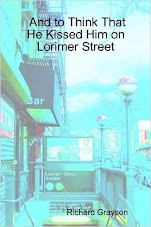
The PODler Reviews Richard Grayson's AND TO THINK THAT HE KISSED HIM ON LORIMER STREET

The PODler reviews Richard Grayson's And to Think That He Kissed Him on Lorimer Street today:


Richard Grayson is a prolific writer of over 200 stories, articles, and books. In the 80s, he staged a satiric run for the White House against Ronald Reagan. He has obtained a J.D. degree from University of Florida with honors and is, in addition, a master satirist and a keen observer of the American scene from his own and unique viewpoint. Grayson writes in a deceptively simple style that is, nevertheless, hard to imitate. Using this kind of autobiographical method, bordering on a confessional, Grayson looks through shifting viewpoints (gay and straight; white and black; American and immigrant; young and old) at the people, times, and palaces of a fictional Brooklyn.

In these fictions, Grayson meditates on various topics, mostly race, sexual identity, age, and change by using the device of popular culture, mixing in liberally the icons of pop culture with persons and places from memory to construct a solid literary edifice.

The collection is filled with resonant stories about the lives of ordinary people, and this focus is what makes them interesting and memorable. Somehow, though Grayson's master touch, the ordinary becomes fascinating and highly readable literature. Many of these stories, however, reflect a deep sadness that exists in the heart of the common man and his experience. Nothing seems to happen for the protagonists in these stories, their lives stupefying their subjects. Grayson reminds us with his fiction that our lives are, in the end, rather banal, revolving around the mundane, the ordinary, and the common. At the same time, there seems to be a kind of weird current of apathy that flows beneath the surface of the stories. In the title story, we wonder, for example, whether the narrator is incredibly open-minded about his son's sexuality and the kiss between the boys, or whether he's just too apathetic to care, and we wonder because the title seems to be a kind of subconscious expression of protest by the protagonist. Apathy, or more precisely, a kind of stupefaction, perhaps synergized by the bathos of pop culture, rears its head in "Shirtless Tea-bag Eating White Boys," in which two characters, one stupefied by Haldol, the other just tranquilized by American culture, watch internet videos, which somehow are appropriate for the mentally dysfunctional character and the young elementary school teacher; the first prefers to watch a purple hippo, and the latter prefers to view shirtless tea-bag eating white boy clips.

Some of these stories are biographical, and those are the stories that I like the best. Especially likable are "Branch Libraries of Southeastern Brooklyn," in which Grayson's character reminisces about the libraries that he had known and how they had evolved over the years-this one is probably my favorite story, as I do love libraries, and it seems that Grayson is a true lover of the library as well - and "The Lost Movie Theatres of Southeastern Brooklyn and Rockaway Beach," another story of nostalgia and memory, where we are treated to reminiscences about the various theatres that the author remembers. "1001 Ways to Defeat Green Arrow" deals with change in gay relationships and the longing and emptiness that result. "My Life in The New York Post" is a collection of strange but somehow funny clips from, apparently, the Post regarding a fictional Grayson's plots and schemes.

Other stories that I liked were "In the Sixties," a kaleidoscope-like summary of the Sixties; "Diary of a Brooklyn Cyclones Hot Dog," which deals with the life of a lesbian Uzbek immigrant who is promoted to being the Relish in a Hot Dog Race; and "Mohammad's Therapy Monkey," in which the protagonist, a college student with some issues is assigned a roommate with a pet monkey, which helps him find acceptance and a relationship of his own in a place that he detests.

Grayson chronicles the real through his funny, sometimes sad, but always genuine, if slightly offbeat, fictional world.

Thursday, November 1, 2007

Exploring Brooklyn by Bus: The B35 from Brownsville to Sunset Park


This post appeared on Richard Grayson's MySpace blog on Thursday, November 1, 2007:

"Exploring Brooklyn by Bus: The B35 from Brownsville to Sunset Park" at OTBKB


At Only the Blog Knows Brooklyn today, I have another in my "Exploring Brooklyn By Bus" series -- today it's on the B35, the Church Avenue/39th Street route from Brownsville to Sunset Park:

Several bus routes go east-west through nearly all of Brooklyn; closest to the center of the borough is the B35, Church Avenue/39 Street, which stretches from Brownsville to Sunset Park.

Many Brooklyn bus routes are based on the old trolley routes. The Church Avenue trolley is the only one I can recall riding; it was one of the last routes to go, lasting until I was five. On trips from her house to ours, Bubbe Ita, my great-grandmother, would let me stand on the wicker seat and pull the cord to request the stop.

The B35 begins at Mother Gaston Avenue, but I walk a few blocks up to where I began – at Brookdale Hospital, Beth-El Hospital in 1951, where I was delivered by the same Park Slope GP who'd delivered my mother twenty years before. I pass streets reflecting the earlier neighborhood ethnicity, Herzl Street and Strauss Street – but at Rockaway Parkway, Church Avenue's alternative name is Bob Marley Boulevard.

I once told someone in South Florida who asked me where I was from in Brooklyn, "Around Church and Utica," and the guy, a Jamaican, said, "That's not Brooklyn; that's the West Indies." The familiar colors of the Jamaican flag are on local storefronts and posters.

West Indians started to move into East Flatbush in the late 1950s, about the time we left our apartment on East 54 Street just south of Church for our new house in Old Mill Basin. All our relatives left the neighborhood as "blockbusters" came in and scared the white people into moving. Both sets of my grandparents left in 1967 for Rockaway.

The last time I went to our old block was in 1980, when black friends brought me along to a party given by Carol, whose Jamaican father, it turned out, owned the apartment building on the corner. When I told Carol that I'd lived on this very block until 1958, she said, "Oh, I envy you. It must have been beautiful here before the Haitians came and ruined it."

Around here, as in other places, Brooklyn's varied street numbering patterns collide: on one side of Ralph Avenue, it's the East 90s; on the other side the East 50s.

We pass the East Flatbush branch library, hair braiding places, Jerk City and the Brooklyn Jerk Center, and an inspirational mural of a (Caribbean?) beach with manna from heaving falling upon it. I spot, behind a car wash by Kings Highway, the third-story window of the bedroom where I misplaced my virginity in the spring of 1971.

Storefront houses of worship, like the Reviving Revelation Revivalist Pentacostal Church, its sign decorated with a crown, a cross, and a star of David, line Church Avenue. On lampposts are many signs of the times, all with some version of AVOID FORECLOSURE! By now the bus is jammed.

Most of the stores from my childhood are gone, of course, but SilverRod Pharmacy at the corner of Utica and Church, the crossroads of our neighborhood, still stands. As we stop, the driver calls over the PA system: "Does anyone know where Kingsbrook Hospital is?"

I hesitate, then yell out, "Get out here and take the Utica bus four or five blocks north and then go left a few blocks."

"Are you sure?"

"Pretty sure," I yell. I decide not to add how I know: "My grandmother had rectal surgery there."

I'm the only non-black person on the bus.

In the East 40s we pass restaurants like Linda's Guyanese, West Indian and American Cuisine. Every three or four blocks, the numbered streets are broken up by streets named after cities: Utica, Schenectady, Troy, Albany, New York, Brooklyn (Saratoga, Kingston and Buffalo don't go down this far).

We see more churches – Eglise Baptiste and Iglesia Pentecostal – as well as day care centers, a fast-food vegetarian restaurant and a storefront P.S. 245. At Nostrand Avenue lots of people leave for the subway. The corner Granada Theatre is long gone, in its place the Guyana Gold jewelry store. Banners decorated with a palm tree on a beach proclaim "East Flatbush, the Caribbean Heart and Soul of Brooklyn."

Soon East Flatbush becomes Flatbush, and we're at Flatbush Avenue, across from the old Dutch Reformed Church that I assume gave the avenue its name. This area was the Broadway of Brooklyn, with seven or eight theaters that no longer exist. The Kenmore, right by the bus stop, is a Modell's Sporting Goods store.

On the other side of Ocean Ave, near the B/Q train station, is West Indian Farm, a great place to buy Caribbean produce. At the subway stop, an Indian woman in a sari gets on, along with Hispanic people and old Jewish man who sits beside me, replacing the woman who was reading the Bible in Creole.

On the south side of Church, brick stanchions with the PPS crest signal Prospect Park South, and both the fronts and sides of Victorian homes line the street. For a few blocks, English street names displace the East Teens: Rugby, Westminister, Marlborough, Stratford, Buckingham, Argyle.

Past Coney Island Avenue and where Ocean Parkway becomes the Prospect Expressway, the signs proclaim Kensington's ethnic mélange: Transfer D'Argent Haiti, a taqueria, a giant yeshiva, Mazowsze Polish Deli, Plaza 5 de Mayo, Productos Mexicanos, Pinosha Albanian Village, Kadima Cell Phones, food from Russia, Israel, Ukraine, Poland, Turkey. Just past Yummy Taco by McDonald Avenue's F train stop, a woman in a burqa pushes a shopping cart past Bangladesh Hair Design.

The East numbered streets are gone now as Kensington bleeds into Boro Park, and Church Avenue ends, diagonally interrupting the plain-numbered streets and avenues that dominate western Brooklyn.

The bus goes up 36 Street past auto body shops, a matzoh factory, the Heimishe Bakery a few stores down from a Mexican supermarket. Past Fort Hamilton Parkway, we pass Camp Warehouse, your spot to buy everything for summer campers.

The bus rides on 39 Street now, and I see some signs in Arabic, but also a kosher market with yarmulke-wearing customers, and a Mexican eagle in front of a barbershop.

It's kind of industrial here: auto repair shops, furniture stores and factories. Passing Fourteenth Avenue, there's The Largest Sukkah Manufacturer in the World, the Eretfsz Hachaim gas station and the Heimeshe Coffee Shop. But all the men with yarmulkes get off the bus and the only new passengers look Mexican or Central American.

Suddenly, the street is residential, mostly two-story brick houses, but there's a brand-new five-story building too. At Fort Hamilton Parkway, there's the mammoth white brick Lamp Warehouse, its sign featuring two portraits of Thomas Edison and the store's founder and these quotations: "Let there be light." – The inventor. "Let there be discounts." – The Maven

At Eleventh Ave only Chinese people get on, and by Tenth Avenue and the New Utrecht Avenue el, we pass mostly Chinese venues like Long Sing Bakery and Q Q Poultry Market, though I spot Korean signs as well. Eighth Avenue is dominated by stores featuring furniture, plumbing and heating supplies and what appear to be factories for some kind of electric, glass and stone products.

We start to go downhill as we pass Sixth and Fifth Avenues, and there's a weird Days Inn hotel tucked into a street otherwise filled with older houses with aluminum siding.

At Fifth Avenue in Sunset Park, we stop a long time for a switch of bus drivers as a crowd gets on: a woman wearing a hijab, Hispanic teens, an elderly Chinese couple, a black woman chatting on a cell phone, more Arabs, and white couple speaking a language I can't make out.

Past the Gowanus Parkway exit, at Second Avenue, the cobblestone streets have old trolley tracks coming up in all directions. This area is industrial, with huge Mack tractor-trailer trucks, the Closeout Connection and the Eat It Corporation warehouses. A two-story Costco has a parking lot huge even by suburban standards. Very prominent on the street is Peyton's Play Pen, a Gentlemen's Club that's All Nude All the Time – not that I've ever been inside.

Getting off the bus, I walk to the barbed wire at the end of 39 Street. I smell the brackish harbor and look out at the water. The Bayonne Bridge seems surprisingly close. My journey across the heart of Brooklyn has taken over an hour and my unlimited MetroCard is ready to head back east.

Saturday, October 20, 2007

Friday Night at Bluestockings: Brian Berger & "New York Calling: From Blackout to Bloomberg"


This post appeared on Richard Grayson's MySpace blog on Saturday, October 20, 2007:

Friday Night at Bluestockings: Brian Berger & "New York Calling: From Blackout to Bloomberg"


Last night at 7 p.m. I arrived at one of my favorite bookstores, Bluestockings, just in time for a reading and presentation for New York Calling: From Blackout to Bloomberg, a fascinating collection of 28 essays and about 200 photos, all focused on the last thirty years of New York history.

I was disappointed that the book's co-editor, Marshall Berman, couldn't make it. The last time I saw him was over twenty years ago and he came to the Upper West Side apartment where I was spending the summer to hand me a check for a lot of money (it was for my best friend Nina, who was renting her Berkshires house to Marshall and his wife Meredith Tax, whom I knew from activities at PEN – they are both excellent writers whose work you should explore).

But Brian Berger, the poet, journalist and photographer who co-edited the book with Marshall, was there – appropriately dressed for the warm October night in shorts. Also there were three contributors to the anthology: the photographer Margaret Morton, longtime NYC political reporter Tom Robbins and food and culture critic Robert Sietsema. I overheard the latter two were discussing the arrest of their big boss, Village Voice Media's Michael Lacey, in my other hometown of Phoenix (those of us who live in the Valley of the Sun know it's dangerous to anger Sheriff Joe Arpaio). I also heard Robbins tell Sietsema that Ward, whoever that is, was editing something he was working on, which effectively meant that nobody was editing him at all.

(When a student in Brooklyn College's MFA program, I myself worked for the Village Voice in 1975 and 1976 in the exalted capacity of messenger for the display advertising department at the then-minimum wage of $2 an hour and all the subway tokens I could save by walking or using the discount "midtown shoppers" bus pass. There were 4 of us messengers, and the turnover was so brisk that within 3 weeks of starting the job, I was the senior messenger.)

Anyway, New York Calling is a wonderful anthology that probably should be read by a lot of people who call themselves (or are well-known as) New York writers, most of whom weren't around for the 70s and 80s and maybe not even the 90s.

Last night's group were the real thing: Brian Berger's grandparents lived a stone's throw away from mine, overlooking Playland in Rockaway, and he's probably traveled thousands of miles inside the five boroughs; he knows New York like the back of his hand. The same is true for the others who spoke last night, none of whom I can imagining living anywhere else but the city none of them would ever dare call the Big Apple.

Here's the take on New York Calling from The Financial Times:

"In 1977, the murder rate in New York City was nearly three times what it is today. Vagrants settled in shantytowns under bridges and in tunnels, and heroin addiction rose dramatically. But it was the growing frequency of arson attacks which unnerved the city's residents the most: from the 1960s onwards, fires - almost certainly lit by landlords to collect insurance money - had been gutting buildings and sometimes entire blocks in the city's poorer neighbourhoods. On the night of July 13 1977, a power cut brought mayhem to New York, and riots and looting ensued across the five boroughs.

But subtler forces than fire and crime had already been shaping the city's direction. In the mid-1960s, the Port Authority of New York and New Jersey closed most of the docks and shipping terminals around New York, prompting coastal trade to move to New Jersey. Separately, the Defense Department shut the Brooklyn Navy Yard, a facility that had, at one time, employed as many as 100,000 people. The result was that jobs and infrastructure moved south, and the city's character, both economic and cultural, became increasingly less focused on blue-collar, waterfront industry.

This is the backdrop for New York Calling . . . Through the lens of New York politics, music, art and counterculture, we hear several, often fascinating takes on essentially the same story: how the squalor, struggles, crime, drugs, and free expression of the 1970s and 1980s gave way to a cleaner and safer city in the subsequent two decades, but one in which commercial development has often trumped, protecting existing residents and preserving a rich past.

If not explicitly intended, the collection places a special emphasis on the Bronx, and the artistic movements spawned by the chaos of the 1970s. Particular attention is paid to graffiti art and the rise of hip-hop, which was ushered in by Grandmaster Flash's 1982 hit 'The Message'. Perhaps less revelatory - as writers often cover the subject today - are the numerous sections which pay homage to the bad-old East Village, where 'bodega' grocery stores sold dime bags of marijuana, and where - as one contributor remembers – 'no restaurants... stayed open past 6:00pm' . . . the essays, whether read discretely or as a complete work, offer a near-unforgettable impression of an era."


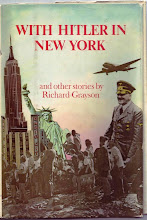
(My own take on NYC in 1977, roughly the year this collection starts with, is in my story "With Hitler in New York" and the other fictions in the 1979 book with that name.)

In his introductory talk, Brian stressed that despite the mythic narrative of the completely dysfunctional city in the 1970s, in fact New York never wholly lost its allure and back then there were still enormous opportunities for immigrants, artists and others willing to put up with the crime, the bad subways (in 1980, it seemed I encountered a track fire that delayed every rush hour trip), the arson, and the decline of city services, particularly to less affluent neighborhoods.

Brian mentioned three iconic movies of that era, all of which I love: The Taking of Pelham One Two Three (best line: "What do they expect for their lousy thirty-five cents? To live forever?); Woody Allen's instant classic (and we all knew it at the time) Annie Hall; and Dog Day Afternoon (in real life I was only blocks away from the bank robbery when it happened). (I'd probably add The Warriors, Saturday Night Fever and maybe even Death Wish.)

Going on to describe various parts of the city that I sort of miss (the pre-Disneyfied Times Square, seedy and louche and somehow wonderful to me; the Fulton Fish Market; gritty, not chic, downtown neighborhoods), Brian contrasted this with the current hypercapitalist frenzy in all the five boroughs, from the suburban sprawl of Staten Island to the waterfront towers of Williamsburg – a lot of it soulless and all of it seemingly geared to the very rich. (Though some of us think this long party is about to end, kids.)

Margaret Morton presented her amazing photographs of homeless encampments of the era: the little huts by the Manhattan Bridge near the Canal Street off-ramp and plywood shanties on the bridge's other side – all of these places where people made their homes and lived their lives were eventually razed by the city – and the places by the Hudson River piers and most notably, the famous tunnel under Riverside Park where a community of squatters took shape and stayed for years (I met a few of these people when I lived in the neighborhood, and they were all extremely decent people).

Anyway, where are the homeless now? Thirty-two thousand are in shelters every night, including 13,000 children.

After Margaret's presentation, Tom Robbins began by speaking of the New York City of today, invoking the scene at Mayor Bloomberg's landslide re-election victory party, at which Magic Johnson MC'ed and a gospel group sang "Ain't No Stopping Us Now" – the classic McFadden/Whithead song that 1970s City Hall protestors used to sing when they began to realize that poor and disaffected New Yorkers were, in fact, the new majority.

Back in the late 1970s, the years of "white flight," it was assumed by all of us left that soon there'd be a city government controlled by blacks and Hispanics, that the power was shifting away from white elites. Yet our current mayor is a white Jewish billionaire from the suburbs of Boston. Wha' happened?

Tom, who has been a Lower East Side community organizer and who's covered politics as long as I can remember, took as the subject of his essay Herman Badillo, the Puerto Rican-born Bronx Borough President and Congressman who once seemed the hope of a lot of us. I worked for Badillo in the second of his runs for the mayoralty, in 1973, and I'd gotten to know him and his wife Irma the year before at the Democratic National Convention in Miami Beach. He was a voice for the disempowered in the city, but Badillo morphed into a conservative power broker as – in Tom's narrative of minority power thwarted repeatedly – Badillo's campaigns for the Democratic nomination for mayor (in 1969, when he was overshadowed by Norman Mailer; in 1973, when he lost the runoff to clubhouse guy Abe Beame; in 1977, lost in a brilliant field that included Percy Sutton, Bella Abzug, Mario Cuomo and Ed Koch, who shouted "death penalty" in a crime-ridden city long and loud enough to win); and most shamefully, in 1985, when the Democratic establishment, black and white, shut him out completely.

Badillo went on to work for Rudy Giuliani and his last run for Mayor was a pathetic attempt to get the Republican nomination. As a trustee of the City University of New York, he now works to raise tuition on its mostly poor student body – one of which Badillo once was – ironic, considering he was the foremost advocate in the 1970s for keeping the free tuition policy that he and I and countless others benefited from.

(After reading about a slur he'd made against Mexican-Americans, I had a letter in the New York Times Magazine a few years ago saying that the Herman Badillo that I knew would be ashamed of the man he's become.)

After Tom's excellent piece, Robert Sietsema discussed the new ethnic cuisines of the city; before the 1965 immigration law was passed, there were only 17 different types of ethnic restaurants in New York and now he counts 78 different ones (and he seems to amalgamate different kinds of Chinese and Indian cuisines).

He showed us three odd edibles from Chinatown, which has long since burst its historic confines to take over a lot of lower Manhattan as immigrants, mostly from Fujian province, have come – legally and illegally – for many years. (One of my students, a lifelong Chinatown resident, said her neighborhood is not the same anymore; she misses the familiar Mandarin and Cantonese she used to hear spoken in the streets and dislikes what she calls the rough Fujianese dialect that she can't understand and the "smell of the stinky fish they like." The city's changes always seem to rankle oldtimers, if only just a little.)

I got to eat a dragon's eye, admired the colorful and weirdly shaped dragonfruit, and puzzled over a shiny black double-horned thing that Robert said was a "devil nut" – which he'd gobbled up one day the first time he encountered them in Chinatown, only to go home and uncover by research that devil nuts need to be boiled for at least an hour to rid them of a dangerous parasite.

Robert praised the many exciting new ethnic foods and went on a very New Yorkerish rant against Whole Foods (which will not deal with our city's wonderful ethnic bakers and instead sell long-lasting but bad-tasting "hippie" bread in plastic).

All of this, and a lot more, is in New York Calling. The co-editor and contributors answered a few questions from the crowd at Bluestockings and signed copies of the book. If you're interested in New York and how it got the way it is, New York Calling is a worthwhile investment.

Thursday, October 18, 2007

Tuesday Night at the Park Slope Barnes & Noble: Anthont LaSala & Seth Kushner’s "The Brooklynites"


This was posted to Richard Grayson's MySpace blog on Thursday, October 18, 2007:

Tuesday Night at the Park Slope Barnes & Noble: LaSala & Kushner’s "The Brooklynites" at OTBKB


At Only the Blog Knows Brooklyn, I have a report on Tuesday evening's presentation by Anthony LaSala and Seth Kushner on their book, The Brooklynites:

ON TUESDAY EVENING I attended a presentation at the Park Slope Barnes & Noble by Anthony LaSala and Seth Kushner about their excellent coffee-table book of photos and interviews, The Brooklynites. Casually dressed, they sat on either side of a screen on which they showed Seth's photos of Brooklyn residents from the book and discussed how they went about developing and executing their project and gave interesting tidbits about their subjects.

The first photo that the pair of Brooklyn natives (Seth has never left the borough for more than two weeks at a time; Anthony went away only for college) showed was of themselves back in high school in Bay Ridge in 1991.

When the two friends started their project to photograph the people of Brooklyn, they had a hard time. The neighborhood young women at the annual feast on 18th Avenue, thinking the guys were "perverts" trying to pick them up, were suspicious – as were many others.

Even Seymour, their local hardware store owner, was so dubious about what seemed to him a "not very successful" idea that he refused to be photographed – and would not agree to be until after a year had elapsed and the duo had already shot celebrities like Spike Lee (their first big "get," Spike led to others), Rosie Perez (who drove Anthony's car "with a very heavy foot" to the marqueta in Williamsburg where she posed), Jonathan Lethem (who also rounded up Brooklyn's other literary Jonathans, Safran Foer and Ames) and Marty Markowitz (photographed at his table at Junior's, where he posed with a slab of cheesecake that he would not eat – at least in front of them – but did take home).

Seth and Anthony said they gained of weight from all their travels around the borough: they got steaks at Peter Luger (whose chef is seen on the Williamsburg Bridge), pizza at Totonno's and DiFara's (Dominick DeMarco has his floured hands, as usual, taking his pie out of the oven), and cases of Fox's U-Bet syrup at the Brownsville factory where the crucial ingredient in eggcreams is still manufactured and which is permeated by the smell of chocolate.

They also got to go behind the scenes at Brooklyn's cultural and historic attractions. The pair got into the Brooklyn Museum on a Monday or Tuesday, when all of us natives know it's never open, to take a photo of director Arnold Lehman in the famed Egyptian room. They also went to Green-Wood Cemetery on a bright snowy day when it too was closed, to shoot director Ken Taylor – who told them it was often hard to convince pizzerias that, yes, the delivery should come to his home in a graveyard.

And that shot of Otis the sea lion and his keeper at the New York Aquarium also allowed Seth and Anthony access to places usually off-limits to the public. They even managed to get past the gate in Sea Gate, which Anthony said was unlike any other place in the city, when they shot gymnast Olga Karminski doing contortions on a ledge in front of the Sea Gate lighthouse.

Other photos we saw featured the Coney Island freak show's The Great Fredini, swallowing a sword on a street corner in Greenpoint; writer David Lefkowitz and his young son, who actually live on a Gowanus Canal houseboat; one of the young players for the Cyclones in Keyspan Park, with the Parachute Jump in the background; and singer Sufjan Stevens, photographed on the Brooklyn Bridge in one of the most artistic shots in the book (thanks to the wonderful geometric patterns of the bridge's cables).

They were most pleased to shoot Steve Buscemi on the block in East New York where he grew up; they were invited to his old apartment, which he hadn't been in since childhood and where he did his first acting for his mom and dad. But of course many of the portraits in the book are not of famous Brooklynites but of the regular people we pass on the street every day. In the book, all of them get to talk about what makes Brooklyn special to them. (When asked by Southerners to say something in Brooklynese, one wise guy photographed in the book said he told them, "Hand over your wallet.")

After the presentation, a lot of us lined up to get our copies of The Brooklynites signed by Seth and Anthony. I'm sending mine to my father who may have lived in other states for the past 30 years but who's still a Brooklynite at heart.

Wednesday, October 3, 2007

Geoffrey Philp: A Conversation with Richard Grayson

At his blog today, the great Miami-based Jamaican-American author Geoffrey Philp interviews Richard Grayson.

Tuesday Evening at the Upper West Side Barnes & Noble: Joseph Berger & "The World in a City"

This was posted to Richard Grayson's MySpace blog on Wednesday, October 3, 2007:
Tuesday Evening at the Upper West Side Barnes & Noble: Joseph Berger & "The World in a City"

Last evening I went back to the neighborhood where I lived part-time from 1984 to 1990, specifically to Broadway and West 82nd Street to the Barnes and Noble that opened after I left the area. When I lived there, part of the bookstore was a Chase Manhattan branch I wrote about in my story, "I Saw Mommy Kissing Citicorp," which originally appeared in the Lower East Side litmag Between C and D.

I always liked that Barnes and Noble store when I'd visit in the 1990s because it was one of the few bookstores in New York that carried my books. (So I didn't mind that they caused Shakespeare and Company a block down to leave; not only wouldn't they carry my books, they were pretty snobby about it.)

By 7 p.m. a big crowd was there to see New York Times reporter Joseph Berger discuss his new book, The World in a City: Traveling the Globe Through the Neighborhoods of the New New York.

Berger began by noting the changes in New York's ethnic makeup since the relaxation of the immigration laws 40 years ago. Old neighborhoods are no longer the bastions of one nationality; for example, Astoria is still somewhat Greek but now more Arab and Brazilian; Bensonhurst is still Italian, but the Chinese -- who love Bensonhurst's brick homes -- are beginning to dominate parts of the area depicted in 1977's Saturday Night Fever.

This is because as Italians, Greeks, Jews, Irish, Germans and ethnic groups established in this country for over a century become more affluent, current generations see no allure to the old neighborhood and light out for the suburbs, the Sun Belt, and posher places in New York City.

The Grand Concourse, where Berger grew up in the '40s and '50s as the son of Yiddish-speaking immigrants, now has many West African residents -- and stores that sell homes in Ghana to its immigrants who want to show their relatives and friends that they have truly "made it" in America.

While New York's newer immigrants often lead hard lives -- Berger tells the story of a Palestinian woman who has the incredible daily commute from Bedford Park in the Bronx to Jamaica, Queens, all for a $7-an-hour job as a home health care attendant -- they are usually better off than they'd be back in their native lands, and that's why they keep coming.

To anyone who explores the various neighborhoods of New York by bus and on foot as I do, none of this should come as big news. Flushing has been Chinese and Korean for a long time now; I have Guyanese friends who've dominated Richmond Hill (along with other West Indians, South Asians and Indo-Caribbean people) for years.

A lot of what Berger talked about also echoed what I'd heard at Saturday's lecture on Brooklyn by historian Mike Wallace, who, like Berger, mentioned the incredibly diverse Ditmas Park -- a neighborhood familiar to me all my life and now home to great restaurants like The Farm at Adderly and the righteous coffeehouse Vox Pop.

Berger discussed material in the book that came out of stories he did for the Times, such as the Little Neck controversy over the Korean-language signs over the stores once dominated by the neighborhood's Italians and Jews; why you can find so many ballroom dancing places in Russian Midwood and Brighton Beach; how Bukharian men in Rego Park have responded to their adjustment problems and being financially dependent upon their more adaptable wives by resorting to domestic violence; and how an Ecuadorean couple in Jackson Heights go to a videoconferencing store to be a presence in the lives of the teenage children they were forced to leave behind (they can't go back to visit for fear of never being able to return to the U.S.)

Berger discussed the last story in light of how the nature of immigration has changed. While Italians, Irish, Jews, Germans and others who came over decades earlier essentially lost nearly all contact with the old country -- Berger's mother could communicate with her only relative in post-Holocaust Poland through occasional aerogrammes back when international phone calls and airfares were prohibitively expensive -- technology and cheaper prices have made it possible for immigrants to have much more contact with their homelands.

Any New York immigrant can watch satellite channels found in her native land, Berger said. I still have the fan I got at the Dominican Day parade for Television Dominicana -- advertising the ability to get ¡Toda la emoción de tu tierra está aquí!

Younger people adapt more easily. Berger said he used to exhort his parents, "This is America! Speak English!" and today's young immigrants often chafe under their parents' old-country ways and rules, such as the Queens Afghan girls who rebel by wearing makeup and who dread arranged marriages. (I heard recently from an Indian teenage girl who bemoaned this "tradition" she knows will be forced upon her.)

There are also conflicts between more established immigrants and the newcomers from their homelands, Berger said. Just a few days ago, a friend who's lived her whole life in Chinatown complained about the Fujianese who have recently come to the neighborhood, speaking not Mandarin or Cantonese but a dialect she can't understand, as well the "smelly fish" from this province that she gets a whiff of every time she goes home.

Berger took many questions and his talk was fascinating. He emphasized that while New York is unique, the world is coming to cities and suburbs and even rural areas all over the country. Asked what New York's new rising immigrant might be, Berger guessed the Mexicans, who have largely taken over the stores in East Harlem, once the barrio of Puerto Ricans, who've moved on to the suburbs as they became more affluent and educated.

After I left Barnes and Noble, I walked along Broadway in the neighborhood I called home two decades ago and wondered what happened to the Korean greengrocer, the Lebanese hardware store owners, the Chinese-Cuban and Sichuan restaurants that were once the local specialty of the Upper West Side. As they used to say in Liverpool, Ob-la-di, ob-la-da.

Back in 1980, when I was living in a Rockaway neighborhood once known as Irishtown (and not so Irish anymore), my friends Marie Cincotta and Stuie Hershkowitz from Brooklyn College took me along to a party at the apartment of their friend Carol.

It turned out to be in the building on East 54th Street between Snyder and Church Avenues where I lived till I was eight. Most of the people at the party were West Indians from the neighborhood. When I told Carol that I used to live just a few houses down as a little kid -- of course I didn't say that the block was all Jewish in those days -- her reaction was one I'll always remember because it illustrates how we all idealize the past: "It must have been beautiful back then before the Haitians came and ruined it."

Arthur Avenue is more Albanian than Italian now, and the Albanians own many of the city's "Italian" pizzerias. No doubt some little Albanian boy fifty years from now will go back to the neighborhood of his childhood and say that some other nationality has ruined it.

Meanwhile, as Berger said, New York's population has gained a million residents since the nadir of the 1970s, and we'll have nine million people here in 2020.

Joseph Berger, who currently writes the education column for the Times, is an engaging speaker as well as an excellent stylist. I look forward to enjoying his book as much as I have his reporting.