The
Kings Courier this week (August 7, 1978) has a feature story on Brooklyn short story writer Richard Grayson:
Kings Courier
______________________
Monday, August 7, 1978
Page 22
______________________
Brooklyn Trivia Incorporated—
Author Richard Grayson Practices His Craft With Little Fanfare
By CAROLYN BENNETTRichard Grayson, at age 27, is a very successful writer. Not in the world’s terms, mind you, but in that nether land of shades, shadows, and unsung fictioneers, i.e., the world of small presses and little magazines. Writing since he was 19, Grayson’s first short story appeared in
Transatlantic Review which accepted it immediately and unanimously, even after it had been previously turned down by more than 20 less well-known little magazines. A flood of publications followed, including short stories in
Shenandoah, Panache, Statements 2: New Fiction, Dark Horse and
The Texas Quarterly. To date, Grayson has published in over 80 literary journals, with 40 more stories expected out this year. His first book,
Disjointed Fictions, will appear next month from X Press.
Grayson is hard not to like. Handsome, personable and sincere, he exudes high-level energy, and he is a highly imaginative writer. That same power is present in his fiction. One short story, “The Finest Joe Colletti Story Ever Written (so far)” leaves spaces to be filled in by the reader. Adjectives are also left out occasionally so as to entice the reader and make him or her participate in the author’s most current fiction. Here’s an example:
What makes Joe Colletti Joe Colletti? Does anyone know? Come on, you guys, please help me out. Why are you just sitting around reading this? Let’s get some dialogue going between us here: that’s the way Joe Colletti would want it. You’re the reader of this Joe Colletti story. Let’s have some communication already. This is a two-way street, you know. Here’s a blank space for you to fill in with your favorite anecdote about Joe Colletti. Come on, it’s easy once you start. Anyone who knows even the slightest thing about Joe Colletti (and that includes 99.999 percent of the human race) can do it. Just try. Please. For me, and more importantly, for Joe Colletti. A better Joe Colletti story is up to you.Grayson knows a great deal about Brooklyn. For instance, did you know that Mill Lane, between East 56th and East 57th Street (Grayson lives on East 56th) used to be trafficked by British soldiers during the colonial wars? Furthermore, a house on East 46th Street owned by a friend of Grayson’s used to hold imprisoned British soldiers. The most interesting fact regarding Brooklyn which Grayson confided was that during the last ice age glacier stopped short at Empire Blvd., its thick ice finally melting to cause
Flatlands and
Flatbush. This material found its way into his short story, “Where the Glacier Stopped,” published in
Epoch.
Because he seemed to know so much about Brooklyn, I asked Grayson if the borough figured importantly in his writing.
“Sometimes I change the locations just to make it appear as if my stories are more cosmopolitan,” Grayson answered, “or disguise the story for the sake of a friend. But all of my stories happen in Brooklyn inside my head.
Asked how he felt about living in Brooklyn when many budding literary figures feel that Manhattan, with its book parties and poetry readings, is the place to be, he said: “I have a friend who lived in Flatbush for most of his life. Just recently he moved into Manhattan and now will eat only Boston lettuce. What can I tell you? I guess I’m an
iceberg lettuce boy at heart."
Currently an adjunct instructor in the English Department at Long Island University, Grayson began writing seriously while still a college student. His literary interests prompted him to work as assistant editor for the Fiction Collective publishing cooperative. He began working for the Collective in 1975, evaluating manuscripts, corresponding with authors, writing press releases, doing publicity and, finally, serving as a preliminary judge in the Fiction Collective/Braziller First Novel Contest in 1976. Grayson also co-directed a two-day conference in “Literature and Publishing” at Brooklyn College in 1977, which included Kurt Vonnegut, John Ashbery, Cynthia Ozick and Renata Adler.
Grayson’s own literary distinction begins with the 1973 Ottilie Grebanier Drama Award, first prize in playwriting for undergraduates sponsored by Brooklyn College’s English Department, and ends with a scholarship at the Santa Cruz Writing Conference, at the University of California at Santa Cruz this year. In between, Grayson was awarded a National Arts Club Scholarship in 1977, granting him leave to study at the Bread Loaf Writers’ Conference, our nation’s oldest writers’ conference, under the tutelage of such distinguished literary figures as John Gardner and Stanley Elkin.
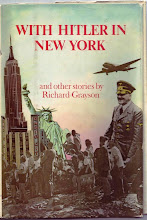
Grayson’s fiction is highly suggestive of the work of Donald Barthelme, but escapes mere imitation because it embodies qualities that do not appear in Barthelme’s work. Grayson writes very fragmented fiction and his stories are very, very short – some of them no longer than two pages total. One reason for this, given by the writer himself, is that he is of the generation weaned on television. Because of TV, he says, he has a very short attention span and therefore cannot read or write long pieces. He tried his hand at a novel once . . . lousy, in his own estimation. But at the short form he is highly skilled. Grayson manages to cause the reader enough discomfort by his “disjointed fictions” to make him (or her) stop and think. But, unlike Barthelme, Grayson still maintains touch with emotion: his characters still care about the world and each other, which is very different than a Barthelme story. A good example of this is Grayson’s short piece, “With Hitler in New York,” published in
Shenandoah. “Hitler’s girlfriend and I are waiting for him in the International Arrivals Building at Kennedy Airport,” the story begins, then proceeds to take you on a journey through Brooklyn with a character whose name evokes terror in the hearts of many and disgust in the minds of many more. Yet, in Grayson’s story there is no strong emotion, just quiet, contemplative feeling. Hitler could be Harry or Hilda or Herman from down the block. Only once does a character in the story dare to call Hitler a Nazi and even then you are not sure if he understands whom he is addressing. If Barthelme had written this story, it would have been devoid of emotion, but because Richard Grayson has written it, quiet emotion becomes the heart of the drama which unfolds.