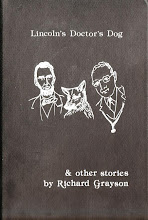
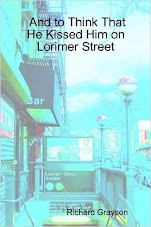
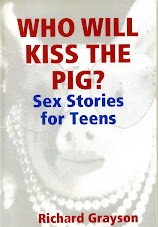
The New York Post today (October 25, 1979) covers Richard Grayson and his involvement with WNYC's "The John Hour."


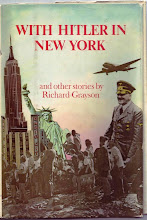
 The Penn State Daily Collegian reviews Richard Grayson’s With Hitler in New York on page 15 in its September 19, 1979 issue:
 Rapid-fire style
‘Hitler in New York’: Notes from the front
By MARK VANDINE
Daily Collegian Staff Writer
“With Hitler in New York” and other stories by Richard Grayson, Taplinger, $7.95, 190 pages.
Rapid-fire style
‘Hitler in New York’: Notes from the front
By MARK VANDINE
Daily Collegian Staff Writer
“With Hitler in New York” and other stories by Richard Grayson, Taplinger, $7.95, 190 pages.
 Richard Grayson teaches at a college I’ve never heard of. The slipcover for this book boasts that his stories have appeared in more than 125 literary publications, none of which I’ve ever heard of, either. And, unfortunately, he writes stories that, for the most part, I won’t ever remember.
Grayson uses a rather set reserve of subjects to write about: old people (mostly grandparents), death, sex and being a very unspecial person.
Nothing wrong with that list of subjects, except they’ve all been given the literary work-over several times. Nothing wrong with that either, but you’d think that if a writer was going to try a used subject he’d try a new angle. That is what’s wrong here.
Grayson has an interesting rapid-fire style, but he doesn’t say much worth reading. He’s mastered the basic points of prose only to discover that he hasn’t got anything to say.
This problem is further frustrated by what seems to be a conflict of motives.
Grayson will have his moments as a successful comic (for example, in a piece called, “Chief Justice Burger, Teen Idol”) or as an analytical observer of people and events, but sometimes he doesn’t seem to know what he wants the story to do. Should it be funny? Should it have a message? He seems confused or, what may be worse, he may be trying to do both, a job for writers of higher caliber.
Grayson’s efforts are further hampered by his tendency to present as stories what seem to be more like plot outlines for what will eventually be stories.
He will introduce a situation, sprinkle in a few quickly introduced characters and proceed to have them interact. There is no meat here. Whey do they do what they do? Why do they say what they say?
Certainly some degree of this can be implied, but Grayson brings the reader in too close too fast. If he wants us to note the quirks in a character’s behavior his attitudes, we simply need to know more. Without the background, the reader is left with a blank check for the story’s message.
These flaws (or perceived flaws, if you want to be fair) are characteristic of fully two-thirds of the stories contained in this book. The remaining third does work, and they work well. They may not completely justify the cost of the book, but they do go some of the way toward indicating a promising new American writer.
Richard Grayson teaches at a college I’ve never heard of. The slipcover for this book boasts that his stories have appeared in more than 125 literary publications, none of which I’ve ever heard of, either. And, unfortunately, he writes stories that, for the most part, I won’t ever remember.
Grayson uses a rather set reserve of subjects to write about: old people (mostly grandparents), death, sex and being a very unspecial person.
Nothing wrong with that list of subjects, except they’ve all been given the literary work-over several times. Nothing wrong with that either, but you’d think that if a writer was going to try a used subject he’d try a new angle. That is what’s wrong here.
Grayson has an interesting rapid-fire style, but he doesn’t say much worth reading. He’s mastered the basic points of prose only to discover that he hasn’t got anything to say.
This problem is further frustrated by what seems to be a conflict of motives.
Grayson will have his moments as a successful comic (for example, in a piece called, “Chief Justice Burger, Teen Idol”) or as an analytical observer of people and events, but sometimes he doesn’t seem to know what he wants the story to do. Should it be funny? Should it have a message? He seems confused or, what may be worse, he may be trying to do both, a job for writers of higher caliber.
Grayson’s efforts are further hampered by his tendency to present as stories what seem to be more like plot outlines for what will eventually be stories.
He will introduce a situation, sprinkle in a few quickly introduced characters and proceed to have them interact. There is no meat here. Whey do they do what they do? Why do they say what they say?
Certainly some degree of this can be implied, but Grayson brings the reader in too close too fast. If he wants us to note the quirks in a character’s behavior his attitudes, we simply need to know more. Without the background, the reader is left with a blank check for the story’s message.
These flaws (or perceived flaws, if you want to be fair) are characteristic of fully two-thirds of the stories contained in this book. The remaining third does work, and they work well. They may not completely justify the cost of the book, but they do go some of the way toward indicating a promising new American writer.


NOTICE SENT TO PW'S STRAIGHT-FACED EDITOR:
The Taplinger Publishing Company has announced that it will pursue an innovative policy in regard to review copies of "With Hitler in New York," the book of short stories by Richard Grayson ("Grayson pokes fun at American life . . ." PW, April 23). Review copies will bypass critics and be sent directly to the Strand Book Store in New York City.
"This efficient system," observed the author, who originated the plan, "will save postage and bothersome packaging for literary critics."
Reviewers may now contact Taplinger and request that copies of "With Hitler in New York" be sent directly to the Strand rather than to their homes or offices. The book will be credited to each reviewer's account by the bookstore.