Pages

Thursday, November 17, 2011

Thursday Afternoon in Union Square: Occupy Wall Street November 17th Day of Action Student Rally


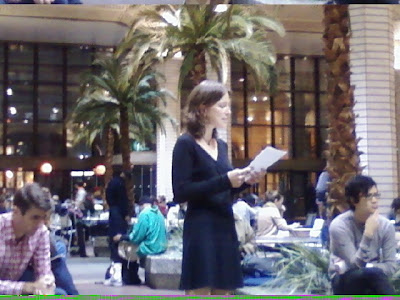
At 3 p.m. today we were out in the cold at Union Square, at the Occupy Wall Street's Day of Action student protest rally, which included many non-student supporters as well. (Above is a view we took from the Barnes & Noble fourth floor window when we went into the store to use the restroom.)


Thursday Morning on the Upper East Side: Student Strike at Hunter College


Arriving on the Hunter College campus for our 11:10 a.m. class in American literature after our crosstown bus ride from Fordham University's Lincoln Center campus, where we'd taught composition starting at 8:30 a.m., we saw a group of Hunter students outside on strike.

Today's CUNY-wide student student activities were protesting budget cuts and tuition hikes and part of the Occupy Wall Street's November 17th Day of Action.

Our faculty union, the Professional Staff Congress, will be at Foley Square at 5 p.m. and asked members to "march with us to demand full funding of CUNY, a renewal of the NYS millionaires’ tax and an end to policies that that have enriched the 1% and impoverished the 99%."

Thursday, November 10, 2011

Thursday Afternoon in the Financial District: "I Would Prefer Not to: A Marathon Reading of 'Bartleby, the Scrivener'" at The Atrium at 60 Wall Street


This afternoon we had the privilege of attending "I Would Prefer Not To," a marathon reading of Herman Melville's Bartleby, the Scrivener at the Atrium at 60 Wall Street.

Organized by Justin Taylor, whose The Gospel of Anarchy was one of the best new novels we've read this year,

along with the Housing Works Bookstore Cafe and McNally Jackson Books, and supported by People’s Library at Occupy Wall Street and to Melville House, publisher of the Art of the Novella edition of Bartleby, the Scrivener, this terrific event featured about two dozen acclaimed writers and editors taking turns reading the entirety of what Melville called "A Story of Wall Street."

We've read the story more than a dozen times, taught it half a dozen times (and will be teaching it again in our American Literature to 1865 class at Hunter College in a few weeks), seen several dramatic versions, and heard a fascinating lecture on "Bartleby" by novelist Stanley Elkin at the 1977 Bread Loaf Writers' Conference, but listening to it read in one sitting, in the neighborhood of its setting, was a powerfully moving experience.

Among the readers were: Nitsuh Abebe, New York magazine; Jami Attenberg, The Melting Season; Polly Bresnick, Pony & Midge;

Amanda Bullock, Housing Works blogger; Ryan Chapman, Farrar Straus Giroux; Joshua Cohen, A Heaven of Others;

Robert Colorafi; Allison Devers, Writers’ Houses; Stephen Elliott, The Adderall Diaries;

Rachel Fershleiser, Bookish; Molly Fischer, journalist; David Goodwillie, American Subversive; Michele Hardesty, People’s Library at Occupy Wall Street;

Michelle Legro, editor, Lapham’s Quarterly; Sam MacLaughlin, McNally Jackson Books; Maureen Miller, editor, Rap Genius; Maud Newton, When the Flock Changed;

Tom Roberge, New Directions; Sarah Sarai;

Erich Strom; Brendan Sullivan, Text, Drugs, & Rock ‘N’ Roll; Adam Wilson, Flatscreen;

James Yeh, editor, Gigantic; and Daniel Zilio.


Starting off with David Goodwillie, who's a terrific reader (we saw him at powerHouse Arena a couple of years ago) and Maud Newton, the readers could all be heard clearly even without a mic, through the story of Bartleby as told by the narrator, Melville's brilliant creation of a middle-aged, cautious, "unambitious lawyer" and bureaucrat, whom Stanley Elkin told us "probably never split a Republican ticket in his life."

Someone called this "the nerdiest protest ever."

Adam Wilson's segment of the story contained the first time Bartleby says "I prefer not to," but James Yeh, much later, got the comedy gold part in which all the members of the narrator's law office unconsciously start using versions of the word "prefer," much to their own amazement.

When Bartleby says, "I am occupied," people naturally laughed, and every mention of the O word got noticed, especially when the narrator says, "I endeavored also immediately to occupy myself. . ."

The best coverage of this protest comes from Molly McArdle, a wonderful writer, in Library Journal. She wrote, in part:

Less a production of or from Zuccotti Park, the gathering was an expression of solidarity with the protesters by a community of young, savvy, lit-oriented folks. (The event has been tumbled & tweeted vociferously and iPhones were a-flash as the reading commenced.)

It occupied a small corner of the large, faux-tropical atrium at 60 Wall Street—a room out of a Keaton-era Batman movie. For all of the space’s scale, it was terribly echo-y, and the readers’ voices were often overwhelmed by late lunch-hourers, chess players, backgammoners, groups of Occupiers in their own meetings. Where was the People’s Mike?

Still, many people had their own varied editions of Melville in hand and we tried to follow along. A police officer stood to the side, disinterested, and observed the proceedings. Snippets of dialog from a smaller Facilitation group directly behind us floated up and above the story. (I heard an impassioned “he screwed the pooch!” and a dark “then the GA turned on him…”)

On the other side of the reading, two ratty young men in unwashed-stiff black jeans and black hoodies pulled out a banjo and harmonica and played old-time folk music. As the story stretched on and the audience thinned, Occupiers themselves filtered through us, harvesting chairs for their groups.

The audience cheered on Bartleby’s first “I would prefer not to” and we all murmured when Stephen Elliot-as-narrator asserted, “Nothing so aggravates an earnest person as a passive resistance.”

Savarese calls Bartleby the “ultimate disillusioned egalitarian” and Taylor claims he “starts out as a functioning part of the system he comes to oppose. His is not an outsider’s but an insider’s critique.” But for all of Bartleby as ur-Occupier, what has always struck me about the story is the character’s profound aloneness.
One could, and I’m sure many have, read the absence of Bartleby’s relatives or friends as the scrivener’s rejection of the hegemonic, rigidly classist structure of a family and connections—the stuff of which so many 19th century novels were made—Bartleby’s solitude as protest of all things nuclear and patriarchal. But it’s strange to do so in light of yesterday’s reading and this year’s Occupy movement, which is all about solidarity and community, the creation of new societal structures. I suspect, should Bartleby be set down in present-day Zuccotti Park, he would still “prefer to be left alone.”

Bartleby does not tell his own story; Melville’s narrator is a man who today would be in the one percent—a Wall Street lawyer. His reactions to Bartleby’s preferences veer dramatically, even comically, from resentment to pity, anger, powerlessness. Most effecting, I think, is his fear that his employee’s actions are somehow tainting him, that Bartleby’s very language is infecting the minds of all who surround him . . .

Bartleby’s protest (if we are to see it as such) is communicable, contagious. This ultimately is where Occupy Wall Street and the scrivener’s efforts best mesh. While the Occupy movement has avoided naming specific goals, and Bartleby speaks more about what he would rather not do than do, both have changed the conversation and indeed the very language we use to participate in it . . .


If you can read all of Molly McArdle's commentary here.

"Ah, Bartleby! Ah, humanity!"

As a rather elderly lawyer ourselves, we're grateful we got to attend "I Would Prefer Not To."

Thanks to Justin Taylor, McNally Jackson, Housing Works Bookstore Cafe, and everyone else who worked so hard to make this a meaningful event.

Tuesday, November 8, 2011

Tuesday Evening in Chelsea: Denise Duhamel and Amy Lemmon reading at Barnes and Noble at Fashion Institute of Technology


Early this evening we went over to the fabulous Fashion Institute of Technology's Barnes and Noble college bookstore to see two of our favorite poets, Denise Duhamel and Amy Lemmon, read from their collaborative books, ABBA: The Poems and the just-published Enjoy Hot or Iced: Poems in Conversation and a Conversation.

Denise Duhamel is an old friend, and we were glad to see her photo in the New York Times on Saturday although the story of her reading at Horace Mann with another old friend from Miami, Maureen Seaton, was a little discomfiting. It was great to see her in person again as well as hear her read. We've enjoyed Denise's poetry since the 1980s although we didn't meet her until November 1993, when we did a reading together, along with others, for the anthology Mondo Barbie (coincidentally, it got a nice writeup by Dave Housley at The Lit Pub just this past weekend) at the Miami Book Fair International. And it was great to see her with Amy Lemmon, whom we've had the pleasure of knowing since she hired us to teach business writing at FIT in the fall of 2006.

Their joint reading from their collaborative books was a terrific hour of poetry, probably the best reading we've gone to this year. It had an intimate feel, and the poets -- as they do in their texts -- play off one another expertly. Denise has done a great deal of collaborative work, and both the playful ABBA poems and the somewhat more elegant Enjoy Hot or Iced (beautifully designed by the publisher) gave us, and the others in the audience, a great deal of excitement and fun.

Take this collaboration, "Ex Post Facto":

"Remember me?" the subject line. My college beau
was now HUGGYBEAR3@yahoo.com and a VIP at Sysco.
He'd worn tie-dye and Birks on our first tryst. "Oh
you're in a sorority?" he'd said. I'd just made a pledge, though

I couldn't afford the dues. "Um, I joined Chi-O,"
I lied. "It's not Greek at all. We sit around and discuss Tao
and the benefits of soy." "Cool," he said. "Let's go
figure out our charts." I was a Gemini. He was a Leo.

Back at his place, he put on Elvis Costello,
lit vanilla candles, and unwrapped his Tarot
deck and ceramic bong. "In a past life, I was a Pharoah,"
I said, showing him my spread: a sword, a wand, and a fellow

with cups, dead ringer for Benny from ABBA. "Bingo!"
he teased until I became defensive. "Hey, I belong to the AFL-CIO
and NOW." "Not bad for a girl from Ohio,"
he whispered. He was from Miami, land of flamingo-

colored hotels and retirees in low-slung Speedos.
His kisses were sweet, a mixture of grass and Gallo.
In the mornings, we would eat marshmallow
clovers and hearts, Lucky Charms inciting our libidos

and sending us back to the lumpy futon. "Presto!"
I'd say, waving the sheets, beginning my strip show
to Pink Floyd's "Dark Side of the Moon." Crypto-
karaoke was at the core of our love-manifesto,

"You Spin Me Round" by Dead or Alive. Ergo,
I traded in my shit-kickers for lime green stilettos
and my Tom Robbins novels for Brecht librettos.
Would he recognize me now? My clothes hamper so

clogged with black, my closet full of faux
Fendi and knock-off Manolo Blahniks? Apropos
or no, humming Schubert's allegro ma non troppo,
I typed "Refresh my memory!" and sipped Bordeaux.


Here's Amy's title poem from Enjoy Hot or Iced:
You’ve brewed this stuff, now drink it—
these dreggy-dregs, this filter-silt,
the tiny bits that cling to tongue.
You always liked it strong and now
you’ve got it at its darkest, split
us at the core to brew a full bold flavor,
so each must shoulder/bear the double-weight
of everything except the other’s body.
I hope you have your fun and drink it, too,
iced now as much as it was hot. I don’t. I didn’t
order it this way. I wanted café au lait,
and when the waiter brought it and I asked for water,
he said flat “No” and mugged—a joke, I thought,
but sure enough, he never brought a glass, left me
to fend with froth and squeeze a dollar tip. He thought
he was funny. You think you’re kind, you think
you’re sensible, you think you’re something
I can’t quite imagine. What of the Monet’s
lily-pads of mold on Earl Grey cooling in the jar?
The brown scrub-nulling scum that clings
to the worn Picasso mug? The ghosts of shattered crockery,
the cartoon souls of slain French press carafes?
Yours, yours, mine, ours. It’s a tossup,
so you clay-pigeon it again and pull! Shoot! A hit!
My heart, I mean, that flat and battered thing
you had and lately thought so little of.


And Denise's "Boxed Set Sestina":
I hid my hopes in a cigar box on Christmas, but you gave them away on Boxing Day (in Canada). I clipped box tops for coupons while you gobbled an expensive Bento box lunch. You were a noshow as I waited in line at the box office in the satin pillbox hat I bought at the thrift shop. I collected hatboxes while you flew your box kite wearing only your boxers. Our lovemaking once wore out the box springs, but now you said you felt boxed in. I slumped in the last row while you glowed with someone else in our box seats. You slept in first class while I shivered in the boxcar. I never got your love letter because you forgot to put it in the mailbox. I felt so neglected I ate fistfuls of croutons right from the box in my boxy, unflattering housedress. My shadow box was filled with ceramic figurines of you. Your toolbox was as empty as our icebox. I stayed home, blaring my boom box, while you drank at the bar, wasting quarters on a dusty jukebox. You told me to get off my soapbox. Were our problems bigger than a breadbox? Yes! Especially when I caught you peeing in the sandbox or dipping into the cashbox while you thought I wasn’t looking. It’s true I was a chatterbox, but you can’t deny you put your affection in a lockbox while you played with your vintage Matchbox cars. It was up to me to open the fuse box and fix the problem—up to me to take kickboxing to defend myself. I thought outside the box when I played your favorite song, Daddy Cool’s “Baby, Let Me Bang Your Box,” on my squeezebox. I was hoping to win you back after our most vicious boxing match—thirtynine rounds of screaming that made the German boxer nextdoor growl. It had all started when your word “boxwallah” wasn’t in the Scrabble dictionary; then I won with “carboxyl.” You snatched up your ebony snuffbox while I tore the boxberries from our flowerbox. I stuffed a shoebox with regret. You packed up your Hot Wheels lunchbox and left.


After the reading, the poets signed our books. We're really grateful for the work of Amy Lemmon and Denise Duhamel, and even more grateful to have them as friends.

Thursday, November 3, 2011

Thursday Morning on the Upper West Side: Peter Woytuk's "Falling Apples" at Dante Park


It's a busy fall semester for us, teaching seven classes six days a week at four colleges. Today, for example, we teach a composition class at Fordham University's Lincoln Center campus from 8:30 to 9:45 a.m. and then have to get to Hunter College to teach American literature from 11:10 a.m. to 12:25 p.m. (and we later today substituted for a Baruch College professor, teaching some of our favorite Yeats poems from 5:50 to 7:05 p.m.) -- but we stopped in mid-morning on our way to the M66 bus on its crosstown crawl from Broadway through Central Park to the East Side to admire Peter Woytuk's bronze "Falling Apples" at the north apex of the Dante Park triangle.

This is one of many of Peter Woytuk's terrific sculptures being presented by the Broadway Mall Association between Columbus Circle and Harlem.