Pages

Thursday, February 7, 1980

The Ventura County News reviews Richard Grayson's WITH HITLER IN NEW YORK


The latest Ventura County News (February 4, 1980) features a review of Richard Grayson's With Hitler in New York:

The Ventura County News

Book Beat
____________

A Superb Mixture

by Lynne Gagnon


With Hitler in New York, by Richard Grayson (Toplinger [sic] Publishing Company, $7.95)


Richard Grayson offers us a comc relief collection of timely, well-designed stories.

Grayson cite the anarchist's bomb that killed Czar Alexander II in St. Petersburg, 1881, leading to many influences in America, namely "the comedy of Woody Allen and Lenny Bruce; the popularity of psychoanalysis;. . . the fact that it is no longer considered good form to use the word 'Jew' as a verb meaning 'to bargain'. . . and to my being here in these United States, to my becoming a fiction writer, to my writing this book, and ultimately to your reading it."

The 27 stories in With Hitler in New York are a generous blend of Kurt , Vonnegut, Woody Allen, Erma Bombeck and Fran Lebowitz, combined with shell steak, Brussels sprouts, a case of shingles, therapy sessions, an uncle who speaks like Donald Duck because of radiation treatments, an ex-lover turned gay (probably because of you) and a Truffaut double feature at the Carnegie Hall Cinema.

Favorite stories include "Classified Personal," "The Art of Living," "Driving Slow," "Wednesday Night at Our House" and "Chief Justice Burger, Teen Idol."

From "The Art of Living":
"You go to visit your grandmother in the hospital. . . In the next room you can hear people talking about you. 'He's a real prick,' somebody says. You can hear another person nodding."

From "Classified Personal":
"To Tired of Being Hurt: I'm a W/F 18 who loves, absolutely adores. . . The Eagles. Springsteen is great too! You appeal to me as a warm human being who wants to share that warmth. Come and be a part of a friendship that can stand up against the cruel stabs of the world. Reply to You'll Never Cry. . ."

"HELP!! I'm a guy trapped in a girl's body! I intend to change surgically. I need friends with the same problems. . . LOOKING FOR AN ECHO!"

From "Wednesday Night at Our House":
"What does David want his mother not to do?
David tells her not to drive his father's 1971 Buick Century, or at least to drive it to the Skyland Shopping Mall once a day and no more.
Why does he say this?
Because David's mother has had arthritis for many years and has not driven a car since 1971; because she is going deaf and getting senile; because David fears that she will kill herself or other residents of North Miami Beach."

From "Slowly, Slowly in the Wind":
"We watch Farrah Fawcett-Majors trying to sell us a car. 'Don't you think she's got a foreign accent?' Grandpa asks. Nobody answers him. We are all eating our junk food. . . Another teaser for the news: 'Coming up next. A building crane falls and kills a little girl.' 'Oh, look,' Great-Grandma Chaikah says, 'that's the one they didn't show last night at eleven.'"

Richard Grayson gets the prize for making us laugh at the ridiculous insanity surrounding our lives. But the award is two-fold, as he also forces us to examine people and what they do to us. And more importantly, what we do to them.

With Hitler in New York is a superb mixture of comedy, drama, satire and philosophy. This book will not remain on your bookshelf long. If it is not read several times, it will be passed on to others and others and others. It might be a good idea to keep two on hand.

(Lynne Gagnon is a local free lance writer.)

Saturday, February 2, 1980

San Francisco Chronicle reports on Richard Grayson's plan to neutralize Iran's Ayatollah Khomeini


Today, Saturday, February 2, 1980, the San Francisco Chronicle features an article, "A Drive to Put Khomeini in Congress":

Washington - A New York City author believes he has found a way to neutralize the Ayatollah Ruhollah Khomeini: elect him to Congress.

"Then he would be as ineffective as any other congressman," said Richard Grayson, treasurer of the "Ayatollah for Congress Committee."

Grayson has duly registered the committee with the Federal Election Commission here, declaring the Iranian religious leader a candidate for the 11th Congressional District in Brooklyn. Grayson also complied with the FEC's campaign financing rules, reporting, "we have taken in no money and spent even less."

The ayatollah was listed as a Democrat.

- Associated Press

Anchorage Daily News reports on Richard Grayson's Plan to Run Ayatollah Khomeini for Congress


Today, Saturday, February 2, 1980, the Anchorage Daily News features an article, "Ayatollah Runs for Congress," about Richard Grayson's plan to neutralize the supreme religious leader of Iran:

Associated Press

Washington - A New York City author believes he has found a way to neutralize the Ayatollah Ruhollah Khomeini: elect him to Congress.

"Then he would be as ineffective as any other congressman," said Richard Grayson, treasurer of the "Ayatollah for Congress Committee."

Grayson has duly registered the committee with the Federal Election Commission here, declaring the Iranian religious leader a candidate for the 11th Congressional District in Brooklyn. Grayson also complied with the FEC's campaign financing rules, reporting, "we have taken in no money and spent even less."

The ayatollah was listed as a Democrat.

Wednesday, January 16, 1980

The Hollywood (Fla.) Sun-Tattler reviews Richard Grayson's WITH HITLER IN NEW YORK and publishes feature article "He Wants to Be a Celebrity"


The Hollywood (Fla.) Sun-Tattler reviews Richard Grayson's With Hitler in New York in today's issue:


Hollywood (Florida) Sun-Tattler

Wednesday, January 16, 1980


Book Review


Story Collection Uneven


"With Hitler in New York," by Richard Grayson.

Taplinger Publishing Company, New York , $7.95.


Reviewed by KATHLEEN KROG


Richard Grayson is a bright young man, a new resident of Broward County and a not-so serious candidate for the vice presidency. (He's not old enough to qualify.)

He is a writer. "With Hitler in New York" is a collection of off-beat short stories. Some of them are a little too short – on entertainment value, ability to hold interest and good writing style. Grayson is intrigued by The Big Name, as in Adolph Hitler, Abe Lincoln and more currently known celebrities like Alan King, Betty Friedan and Beverly Sills.

His literary treatment of today's famous is much more enjoyable than what he writes about past figures of both ill and good repute.

The title story, in the first person, is an exceptionally strange little treatise on what Adolph Hitler would do if he was a tourist in New York City today. If it's supposed to be funny, it fails. If it's supposed to be one of those "what-would-Hitler-do-if-he-were-alive-today" pieces, it isn't. It's just a dumb, quite pointless story.

So, in a slightly less offensive way, is "Lincoln on the Couch," which depicts dear old Abe as an unloved, cuckolded bigot. This isn't even revisionist history at its worst conjecture, but at least the story deals in more reality than Hitler on a search for a good Chinese restaurant in the Big Apple.

Grayson should forget about rewriting history and stick at looking at the present with a surprisingly loving and sensitive eye-view. His introduction is a neat little tribute to his uncle, with whom he shared good talk and good marijuana, and his first girlfriend. It's funny, a little poignant and easy to understand and relate to. You remember what Grayson ruefully says about himself long after what he imagined about Hitler and Lincoln.

In another too brief look at what he knows, "Peninsular People," Grayson paints a pretty little stretch of sand inhabited by residents everyone would like as neighbors. It's the kind of thing we'd all like to write about our favorite place of being.

This is a very uneven collection of stories by a talented writer who hasn't quite figured out what he's best at yet.

Thursday, January 10, 1980

Fort Lauderdale Sun-Sentinel reports on Richard Grayson's Candidacy for Vice President


The Fort Lauderdale Sun-Sentinel reports today (Thursday, January 10, 1980) on Richard Grayson's candidacy for Vice President.

Sunday, January 6, 1980

Miami Herald reports on Richard Grayson's Candidacy for Vice President

The Miami Herald today (Sunday, January 6, 1980) reports on Richard Grayson's candidacy for Vice President in an article in the Political Scene column by Michael Silver and Pat Fisher titled, "Him, Vice President? Is This Some Kind of Joke?" on page 14BR":

The campaign is in full swing now. It's easy to tell because Richard Grayson has at last become adept at throwing out this timeworn phrase whenever he can't answer a question that needs an answer: "I'll have no comment on that." Six words dear to the heart of every politician ever caught in a bind, whether it be intellectual, moral or criminal. That's where the similarity between Grayson - writer of satire, teacher of English at Brooklyn College in New York City and your everyday politician ends. 

GRAYSON, IN case you haven't heard, is a candidate for vice president.Of the United States. He's not running for president because being the country's top leader takes too much out of a person. "Look how Carter's aged," he said. Grayson was in Broward last week campaigning. He'll be here this week too. And maybe the week after. But don't hold your breath waiting for his pitch. He's hardly on a whirlwind popularity-seeking mission. 

AFTER A week in Broward he'd made only one public foray. He went from his parent's home in Davie to the Broward Mall, where people laughed at him, he said.

This is a man who'd be too young to be vice president even if, by some twist of fate, he were elected. Grayson is 28, seven years too young to live in the house that the Navy built. Grayson has these plans, should he somehow land in the lap of power in Washington D.C.: Fred Silverman, president of NBC television, would be president political scene michael silver pat fisher of the United States. Silverman may not comply. "He seems unwilling to take a salary cut to become President," said Grayson.

Gloria Vanderbilt, whose signature adorns the blue-jeaned derrieres of women everywhere, would be Secretary of the Treasury. "The dollar bill may go In if her signature was on it." Little funnyman Gary Coleman would be United Nations ambassador because "he says cute things." Honorary titles would abound: Things like Baron of Broward, Duke of Davie, Marquee of Miami Beach .... • Governors of states would compete for gasoline allocations on a TV show called "Bowling for Gallons," hosted by James Schlesinger, former U.S. energy czar. An evening with Tom Snyder would replace the death penalty as the most severe punishment meted out to the county's Godless criminals.

THE HUMOROUS platform is nothing new. Every big election year joke candidates air their unbalanced philosophies and expend energy on haphazard missions to win highest re offices of the land. Maybe they're frustrated or angry or just crazy. For his part, Grayson is sick of the system. The system, he says, stinks.

The campaigns are too long, "Politics is now show business, completely,' and politicians care more about "popularity polls than programs." 

"WE DON'T elect the best person, we elect the best candidate," he griped. Something ought to be changed, but Grayson doesn't know what. So he's poking a little fun. Would he like politics if he won? "I'll have no comment on that," he said.

Saturday, January 5, 1980

Sunday, December 30, 1979

The San Francisco Voice reviews Richard Grayson's WITH HITLER IN NEW YORK


The current (December 29, 1979) issue of the San Francisco Voice has a review by Daniel Curzon of Richard Grayson's With Hitler in New York:


WITH HITLER IN NEW YORK and OTHER STORIES, by Richard Grayson.
Taplinger Publishing Co., 200 Park Ave. South, NY, NY 10003


Buy this book! It's wonderful. It costs only $7.95. Where else can you get as much pleasure -- both emotional and intellectual -- for so little?

At first I thought With Hitler in New York wasn’t very gay in its content, but the stories get gayer later in the book. Richard Grayson is a real writer, whether he’s writing on gay themes or not. He’s witty and deep, playful and honest. I don’t know whether he is gay or not. I hope he is, because we need all the first-rate writing we can get. If encouraged, Grayson might more explicitly gay-themed stories. (indeed, if all the gay writers wrote about gay life and left straight life to the straight writers, there’d be precious little straight stuff written)

If you’ve been reading the bulk of the books coming out of the big New York presses and finding yourself slowly starving to death for genuine artistic nourishment, buy this book. For the truth, dear friends, is that if readers who like soul-satisfying fiction don’t buy these books when they appear – less and less often, please note – then very soon they won’t be able to buy them at all. They simply won’t be published, and we can all die of literary malnutrition.

The situation in publishing is much worse than I suspected. I’ve always discounted the so-called American preoccupation with making money. But I’ve come to realize at last that vulgar is really all that publishers care about. The corporations are destroying literature. They must be stopped. They are robber barons, neither pure nor simple, who care only about profits, profits, and more profits, just like the oil companies. If you think this doesn’t matter, just remember that these corporations control what you read. They have a monopoly on the market. They must be required to publish quality fiction in the same way that the FCC requires TV and radio stations to broadcast some quality programming. No corporation should be allowed to keep true literature out of your hands just because they have the power to do so.

Don’t read With Hitler in New York all at once. The blunt, declarative sentences are best appreciated when spread out. I also think the author shouldn’t have included three stories about how hard it is to write a story. Two would have been enough.

But there is much here that is truly beautifully done, like the story about an uncle the narrator hates, and “The Princess from the Land of Porcelain,” which may be the finest story about a lesbian ever written.

Richard Grayson probably had to ill to get a collection of stories published by anybody in these disgusting days. The least the literate reader can do is avoid the chaff from Avon, Dell, and the like, and get this book, the real stuff.

-- Daniel Curzon / IGNA

Tuesday, December 25, 1979

Washington Review of the Arts reviews Richard Grayson's WITH HITLER IN NEW YORK


The December 1979-January 1980 issue of the Washington Review of the Arts reviews Richard Grayson's With Hitler in New York on page 34:

WITH HITLER IN NEW YORK by Richard Grayson,

Taplinger Publishing Company, 200 Park Avenue South,

New York, New York, 10003, $7.95


The title story of this collection of stories by Richard Grayson begins:

"Hitler's girlfriend and I are waiting for him in the International Arrivals Building at Kennedy Airport. Ellen and I stand in front of the West Customs Area. My brother is standing in front of the East Customs Area. He is waiting for my parents. My parents and Hitler have each landed at the same time, at seven o'clock. My parents are flying KLM from Saint Maarten. Hitler is flying Laker from London and Manchester . . ."

Hitler arrives in a leather jacket. He suffers from jet lag. He has breakfast at McDonald's – he likes fast food. Hitler and friends have dinner at Shakespeare's in the Village and Hitler hopes for another New York blackout. Later Hitler dunks his girlfriend in the swimming pool:

"'You're a sadist, you know that?' Ellen says to Hitler after they get out of the pool. Hitler shrugs. 'He did the same thing to me in Greece last year,' she says."


This is the closest Grayson comes to characterizing the familiar Hitler. Otherwise Hitler drinks Becki's beer and makes jokes and tried to cheer the narrator up when his grandfather dies. The story ends, "Hitler put his hand on my shoulder and tells me to sleep well."

This story, "With Hitler in New York," is wry and funny and wonderfully imaginative. And Grayson avoids what might be expected – either intrusive fantasy or broad comedy. The tone instead is cool and neutral. Watching Grayson pull off this story is like watching a flying Wallenda. It is dazzling and dangerous.

"'What do you think of Hitler?' Ellen asks me as I take her to her parents' house. We are driving along the Belt Parkway at midnight with our car windows wide open, but there is not a hint of a breeze.

'I kind of like him,' I say. 'I never realized he was so witty.'

Ellen kisses me on the cheek at her parents' house. I watch to see that she gets in safely."


In its bland, neutral control, the story is chilling not only because of the subject but the irony of the setting. The setting is nice, everyday family. The friends seem genuinely friends. The narrator is touchingly grieved at his grandfather's death and sympathetic in his concern and observation of Hitler. The tone and realistic style of the story creates a jolting closeness. "With Hitler in New York" implies that the fantasy of the supermarket tabloid is close to true, closer than the news that's fit to print.

Richard Grayson is thirtyish, but he has published over a hundred and thirty stories, two of them "Understanding Human Sexual Inadequacy" and "Super Fab Senators," in the Washington Review. The dissimilarity of these two stories is not atypical. Grayson uses more diverse forms than any story writer I know. At the same time he maintains a distinctive quality that blends. Unlike many collections of short stories, which to read at once is like eating a quart of ice cream in one sitting, these stories are varied and spicy enough to urge you on. In fact, the numbers and versatility of Grayson's stories give the impression that stories must light on him like flies. If God is in the details, as someone said, it is also true that stories are in details, and Grayson seems not only good at detail but sees than even at varying levels when accumulated, they can make a story. Take "Peninsular People":

"The Weitzes, who live on the peninsula, are a five-surfboard family. They are aspiring or failed actors; they are psychology majors turned dancers; they are mountain climbers and real estate saleswomen and managers of Burger Kings. The Weitzes live above their means. All of them smoke marijuana, and are liberated, and are Unitarians, and are bored . . .

"There is Mrs. Vincente, who didn't listen to people and refused to put her mother in a home, and her son Louis, who keeps taking the law boards in hopes of scoring better and who is marking time in the meantime. They like living on the peninsula."


Grayson often uses "names" of our time, underlining, like Warhol, our perpetual consciousness of "names" and employing them, as Warhol did, as an emotional reflection of our culture. Presented here are stories on Justice Burger and Pol Pot. Appearing are Farrah Fawcett-Majors, Fulton J. Sheen, John Ashbery, and others. Grayson uses them best in a casual off-handed way as he does in "In the Lehman Collection." Or "Real People," a story based on the national game of "guess-who-I-saw-today":

"Betty Friedan is walking across City Hall Park. She is not wearing a bra . . ."

When the names themselves dominate the story as in "Chief Justice Burger, Teen Idol," the device is too obvious. The same is true, I think, in "Lincoln on the Couch," an historical flashback. The author seems forced to balance the obviousness of the device with an equal degree of outrageousness and irreverence. But even so, Grayson uses the incongruity of the language to create fresh and funny scenes:

"Yuck, thinks Mary Todd, looking across the breakfast table at her husband's face . . ."

In a different form of story, "Go Not to Lethe," a TV soap opera is celebrating its twenty-seventh anniversary with its twenty-seven year star Grayson Richards and his co-starring Jewish family. "Au Milieu Interieur," which first appeared in the anthology Statements 2 published by the Fiction Collective, is composed as a series of questions. It begins, "What is a dream?" The development of the story is the characterization of the narrator, which is both complex and fascinating. "Au Milieu Interieur" is an example of how fine an experimental or innovative form can be when handled by a writer who understands the organic development of a story.

Throughout all these stories Grayson's style is supermarket informational with intrusive irrelevancies. Though Grayson refuses to limit himself, especially in the Jewish family stories he will resort to a traditional setting and atmosphere. But commonly the irrelevant details is presented with as much weight as the supposedly "important" facts, making a scene as non-selective as experience itself (which is of course ironic since Grayson as the artist is ultimately controlling and selective). Some of the most successful stories are the scenes of the Jewish family. "Slowly, Slowly in the Wind" begins:

"Here we go again. Grandpa and Grandma have taken the newspaper coupons and the shopping cart and gone out to Pantry Pride. I am in the apartment watching Great-Grandma Chaikah. She is watching Dinah Shore.

'You know she's Jewish?' Great-Grandma Chaikah says. 'Southern but Jewish.'

I nod. The bell rings. It is Mrs. Brody, our neighbor."


There is also more to enjoy in this book than stories. The introduction by the author is so nice you want to run to the phone and urge Richard Grayson to begin his autobiography immediately. Even "A Note on the Type" is a lark:

"Few people have noticed the similarities between the fiction of James M. Cain and the poetry of Wallace Stevens. Of course, the common denominator is that both are set in Electra . . ." And "Exquisite pornography," it tells us, "is often set in Granjon."

I must admit that there are one or two stories in With Hitler in New York that I could have done without. "Ordinary Man," a sort of science fiction story, is one. And I wish Grayson would rewrite "The First Annual James V. Forrestal Memorial Lecture" because it begins marvelously and then disintegrates, which the story itself admits. I say that, knowing that probably fourteen new stories are buzzing around Grayson this instant. But I say it because Angela Cozzarelli, who is practicing to be the great intellectual figure of the 1990s and the nice Jewish boy who went to the Newman Club picnic to watch his heartthrob Eddie Dugan play softball without a shirt, deserve better. They are individual and real and wonderfully conceived. The fact is that even in a story one might quarrel with, Grayson is still so good there is always a lot to like and admire.

This is a terrific book. Read it. Give it to your friends.

– PATRICIA GRIFFITH

Sunday, December 23, 1979

Minneapolis Tribune reviews Richard Grayson's WITH HITLER IN NEW YORK
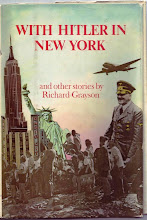

The December 23, 1979 issue of the Minneapolis Tribune features a review of Richard Grayson's With Hitler in New York:

HOW BAD ARE THESE STORIES?

With Hitler in New York and Other Stories, by Richard Grayson (Taplinger, 190 pages, $7.95)

Reviewed by D.G. Wnek


For weeks and weeks I have tried to think of an ingenious way to say “With Hitler in New York” has no literary merit whatsoever. Inferior quality, unfortunately, does not inspire ingenuity. To put it bluntly: this is the worst book I have read in my life.

Richard Grayson’s anthology of short stories is unbelievably bad, bad, bad.

How bad is it?

Well, after a writer reviews his chosen book, he gets to keep it…I am not keeping this one. I want to give it to someone I really despise.

If that sounds harsh then consider this: the author himself refuses to accept responsibility for writing these stories. Grayson blames their existence on “the anarchist’s bomb that killed Czar Alexander II in Petersburg in 1881 (which) led to Russian pogroms and to the anti-Semitic May laws of 1881.” These events, he says, eventually led to his presence in this country as a writer. He also advises readers to address negative criticism to the anarchist who planted the bomb—not him. How fortunate for him and his mailman.

Grayson’s stories have no real plot, no meaningful action, no memorable characters; they do little more than exist. In “Infant Sorrow” a celebrated weightlifter feels unloved and remembers when he was constipated. In “Notes toward a Story for Uncle Irving,” the author begins a tribute to his uncle, then ends with, “And it’s a shame on you, Uncle Irving, you ignorant, boastful, cowardly, neurotic, foolish old man.” In “Princess from the Land of Porcelain” a married woman finally finds contentment in her dreams—as a lesbian. In “The Mother in My Bedroom” a mother who once hid under her son’s bed as he entertained various lovers, must spend the rest of her life in her son’s bedroom. And in “With Hitler in New York” Hitler returns to America to smoke joints, watch television and eat at McDonald’s.

The remaining 22 stories—sometimes confusing, usually boring, and always absurd—impart nothing of any significance to the reader.

Grayson writes about meaningless lives, meaningless actions, trying to uncover something meaningful. He never does. He only shows that those who embrace the monotony of existence become monotonous figures.

Even his better stories, “Chief Justice Burger, Teen Idol” and “Classified Personal” are not, in fact, short stories. They are nonsensical fragments, inchoate exercises from his coffee-stained notebook, perhaps funny little things Grayson, instructor of creative writing, might show his classes at Long Island University and Kingsborough Community College. Grayson knows this. He also knows that his other works, those which most resemble short stories, are decidedly fifth-rate.

In “A Thousand Other Worlds,” Grayson the protagonist writes a short story of the same name that literally comes to life. The story, a touchy thing on a low-cholesterol diet, sees a Truffaut double bill at the Carnegie Hall Cinema with its author, then demands to be sent to The New Yorker. Grayson obliges. The story is rejected.

The following week he takes it to the Bread Loaf Writer’s Conference where John Gardner criticizes it: “To me, it’s just nonsense. And it’s not only nonsense, it’s immoral. Immoral.”

So the story bites him in the leg.

So Grayson realizes his anthology is a cornucopia of crap but would rather laugh about it. He would rather write another silly little story that parodies his own work than accept the responsibility of working harder to express meaningful ideas written in traditional literary form. Gardner was right: this nonsense exemplifies stream-of-consciousness with no conscience.

Call it avant-garde departure from traditional literary structure. Call it playful exercise with traditional literary form. But do not call such nonsense literature, for such literature makes “Betty & Veronica” a selection in The Classics Club.

And now, I must find someone I really despise.

D.G. Wnek, a journalism graduate, is currently working for Northwestern Bell.

Tuesday, December 11, 1979

New York Post reports on Richard Grayson's Right to Be the Life of the Party Party & Gloria Vanderbilt's Candidacy for U.S. Senate


In the New York Post today (Tuesday, December 11, 1979), Jack Martin's Headliners column features a story about Richard Grayson's new New York state political party, The Right to Be the Life of the Party, and his plan to draft socialite Gloria Vanderbilt to run for the U.S. Senate in 1980.

Friday, November 30, 1979

Two Richard Grayson Stories in STAR-WEB PAPER #7


Richard Grayson has two stories, "Notes on the Type" and "Mark the Public Notices," in the current (1979) issue of the literary magazine STAR-WEB PAPER, edited by Thomas Michael Fisher in La Mesilla, New Mexico.


Other contributors to issue #7 include Ron Koertge, Rosmarie Waldrop, Gerald Locklin, Lyn Lifshin, Tom Ahern, Duane Locke and Peter Payack.

Tuesday, November 13, 1979

US Magazine covers Richard Grayson's candidacy for Vice President


US Magazine in its current (November 13, 1979) issue features an article on political candidates in the 1980 election that includes a section on Richard Grayson's campaign for Vice President.


Monday, November 5, 1979

The Kings Courier reports on Richard Grayson's Candidacy for Vice President


The Kings Courier this week (11/5/79) reports on Richard Grayson, Brooklyn's candidate for Vice President.

Saturday, November 3, 1979

CHOICE: Reviews for College Libraries reviews Richard Grayson's WITH HITLER IN NEW YORK


The November 1979 issue of Choice: Reviews for College Libraries has a review of Richard Grayson's With Hitler in New York:


Choice: Reviews for College Libraries

November 1979


With Hitler in New York and other stories, by Richard Grayson. Taplinger, 1979. 78-20695. 7.95 ISBN 0-8008-8406-X


Fiction as joke, word play, vehicle for whimsy: these are the hallmarks of Grayson's stories. Most of these 27 stories – written over the past seven years – have appeared in little magazines. While occasionally eliciting laughter (e.g., "What really happened in Cambodia"), several stories seem to be merely cute, ingenious, alike in texture and tone. An Art Buchwald piece cannot be extended beyond a page or two without breaking down, and that is what Grayson's efforts ignore – with predictably uneven results. The celebrating of a fictional soap opera ("'Go not to Lethe' celebrates its 27th anniversary"), a conversation with a dejected (and rejected) "sick" story ("But in a thousand other worlds"), a hyperbolic rendering of conversation ("Wednesday night at our house") – together these illustrate the matter and manner of Grayson's fiction. One is left with the impression of a writer whose forte is the one-liner, a Bob Hope who would be a Saroyan.