Pages

Saturday, February 14, 1987

Richard Grayson's Funhouse column in the Hollywood Sun-Tattler satirizes the English-only campaign


Richard Grayson's Funhouse column in the Hollywood Sun-Tattler today (February 14, 1987) satirizes the English-only campaign and suggests changing Boca Raton's name to Rat Mouth.

Saturday, January 17, 1987

Richard Grayson column in Hollywood Sun-Tattler: "Teachers Fill in the Very Blank"


Richard Grayson's column in the Hollywood Sun-Tattler today (Saturday, January 17, 1987) is titled "Teachers Fill in the Very Blank."

Saturday, January 3, 1987

Richard Grayson's Funhouse column in the Hollywood Sun-Tattler on Global Warming


Richard Grayson's Funhouse column in the Hollywood Sun-Tattler today (Saturday, January 3, 1987) discusses climate change and global warming, suggesting South Florida will be improved by being underwater.

Saturday, December 20, 1986

Richard Grayson's Funhouse column in the Hollywood Sun-Tattler imagines soap operas set in South Florida


Richard Grayson's Funhouse column in the Hollywood Sun-Tattler today (December 20, 1986) creates soap operas set in South Florida.

Saturday, November 22, 1986

Richard Grayson's Funhouse column in the Hollywood Sun-Tattler is a non-column column


Richard Grayson's Funhouse column in the Hollywood Sun-Tattler today (Saturday, November 22, 1986) is a non-column column.

Sunday, June 15, 1986

Richard Grayson Op-Ed Column in Fort Lauderdale News: "The 'Problem' with South Florida's Senior Citizens"


Richard Grayson has an op-ed column in the Sunday Fort Lauderdale News/Sun-Sentinel today (June 15, 1986) on "The 'Problem' with South Florida's Senior Citizens."

Wednesday, April 9, 1986

Richard Grayson and Fred Bernstein Report on Nation's Critical Celebrity Shortage in PEOPLE Magazine


Richard Grayson and Fred Bernstein have an article in PEOPLE magazine this week (April 7, 1986) reporting on the nation's critical celebrity shortage.


UNLESS WE BAG A FEW NEW STARS, THE U.S. WILL FACE A TRAGIC CELEBRITY SHORTAGE

By Richard Grayson and Fred Bernstein


In New York, paparazzi, driven insane by a growing shortage of celebrities, began to photograph each other. In Los Angeles, tables at Spago are suddenly easier to get than splinters on a boardwalk. All over the country gossip columnists are beginning to reveal their own indiscretions.

Then just as it seems as if things couldn't be worse, officials at Walt Disney begin making plans to thaw out their founder. Syndicated TV's Robin Leach offers to interview "The Rich but Practically Unknown." In Washington, the President personally appeals to Elizabeth Taylor to marry somebody the public hasn't heard of yet. And all three Gabor sisters appear on a single episode of Merv.

These scenes could soon become reality if the United States doesn't take action to stop the rapidly dwindling supply of celebrities within its borders. The problem, according to dozens of star watchers on both coasts and maybe one or two in the middle of the country, is that the American public has been consuming celebrities at an ever-increasing rate while failing to take steps to replenish the supply. Analysts estimate that to keep up with demand, the United States needs to produce at least two new celebrities every day. But in 1985 that didn't happen, and the demand for celebrities outstripped supply for the first time in our history.

For centuries there were plenty of celebrities to go around. (Did you ever wonder why the U.S. government bothered with a $50 bill? There were too many former Presidents for just the useful denominations.) As recently as 22 years ago, talk show host Ed Sullivan had so many guests waiting to get on his program that the Beatles, in their first U.S. television appearance, got only 13 1/2 minutes. And when the powers that be in Hollywood tried to memorialize the early movie stars on a sidewalk, they had to settle for footprints; total body prints, which were originally planned, would have required too many sidewalks. Today we have sidewalks to spare.

With the explosion of celebrity journalism in the '60s and '70s, the demand for stars continued to increase, while the number of household names leveled off. For a while the problem was kept under wraps. Although the U.S. had formerly been the leading celebrity-producing nation in the world, it imported just enough foreign stars, such as Boy George (British), Olivia Newton-John (Australia) and Michael Jackson (Uranus), to alleviate the immediate shrinking of the available pool of famous people. At the same time Americans resisted what they perceived as a flood of low-quality celebrities from foreign parts. Meanwhile other countries have been importing U.S. stars in record numbers (France can have Jerry Lewis, but only Lewis).

Some star searchers scoff at the notion of a shortage. They believe it's all a plot on the part of a cartel of greedy agents to drive up the price of celebrities. But, according to a source close to Pia Zadora (who may soon be the most talented person in America), the fame drain in a real, not a manufactured, development. Reports of celebrity-filled cruise ships floating outside New York harbor, waiting for prices to go up, are almost certainly false. (It's easy to understand how such a rumor might have started: Someone watched Love Boat and thought it was a documentary.) Nor is it any accident that an article about Madonna and Sean Penn appears in every edition of your hometowm newspaper. There simply aren't enough celebrities to go around.

Why is this a problem? Imagine if Barbara Walters had to interview trees ("If you were a star, what kind of star would you be?"). Imagine the chaos in Manhattan if thousands of writers, directors and limousine drivers were suddenly without work. Imagine if there were no one to join the President for White House photo-opportunity sessions.

In the optimistic '60s, Andy Warhol predicted that in the future everyone would be famous for 15 minutes. But Warhol could not have foreseen that nearly 20 years later, few young Americans would want to serve their society as superstars. Recent surveys of high school and college students indicate that the percentage who plan to be celebrities has fallen to its lowest point in 50 years. Embarrassed by attention, wary of the lack of a clear career ladder in the world of celebrityhood, young Americans are avoiding the spotlight in record numbers. Only three percent of college freshmen agreed with the statement that "becoming a celebrity is a worthwhile goal."

Sadly, the few who do intend to become famous tend to have lower SAT scores and less photogenic faces than their media-shy classmates. The youth of the '80s seem set on low-profile, high-security careers in accounting, computer programming and corporate law. These students have spent their lives watching and reading about celebrities, and they have seen that making it as a star requires more hard work, stamina and plastic surgery than they can stand.

It takes so long to become a successful celebrity," said one Fort Lauderdale marketing major. "Look at Don Johnson. Sure, he's made it now, but it took him a long time. If I waited that long before celebrityhood paid off, how could I pay back my student loans?"

Long hours, "flashbulb blindness," writer's cramp from signing autographs -- these are the reasons the new generation has decided to drop out of the celebrity sweepstakes. The heavy price the famous pay in the form of drug and alcohol abuse, divorce and bad haircuts has not gone unnoticed by the youth of today. "These kids are conformists," one professor complains. "They just don't like to stand out in a crowd and have people crawl all over then. What, I ask, has happened to the values that produced such role models as Ed McMahon and Dr. Ruth?"

Are there any solutions to the shortfall of stars?

Celebritologists say that drastic measures are necessary. Certainly future celebrity creation is vital, but that will not solve the short-run problems. The American public must learn to conserve celebrities, to make do with just one supermarket tabloid,one juicy tidbit about Larry "Bud" Melman each week. President Reagan, a celebrity for most of his 75 years, is cognizant of the crisis, political analysts say. But faced with problems like the federal budget deficit, the Gipper believes that individual initiatives, not government programs, are the answer. Others have proposed a variety of solutions:

(1) A federal regulatory agency should monitor celebrity levels around the country. This agency, using convoys of stretch limos, would allocate celebrity resources where they are needed most and issue strict guidelines on such matters as how many times a person's photo could appear in USA Today.

(2) Displaced workers, debt-burdened farmers and unemployed inner-city teenagers should be retrained. Small-scale efforts, like the proposed George Hamilton Institute in Youngstown, Ohio, are already getting under way.

(3) Youngsters should be encouraged to volunteer their services. Chapters of Future Celebrities of America could be set up in every grammar school, and programs in celebrity literacy (i.e., how to talk back to Joan Rivers) instituted in the primary grades.

(4) Academics should recognize celebritology as a distinct discipline and should create departments and majors in the field. Scholoarships would be offered to students who composed the best answer to the question, "Why do you want to sit next to Madonna at the Grammys?"

(5) Penalties for celebrity abuse must be made more stringent. Otherwise our most talented celebrities will decide that being on Donahue just isn't worth the effort. Too many authors are already spending the majority of their time writing rather than hitting the talk show circuit.

Though the future seems bleak, dramatic breakthroughs are possible as technology progresses. Some scientists, for example, believe it is entirely likely that celebrities exist on planets outside our solar system. There may be enough talk show guests and magazine cover subjects in the Milky Way galaxy to satisfy all of America's celebrity needs for the next 200 years.

After all, Americans are relatively lucky compared with others with whom we share Soundstage Earth. In Communist Eastern Europe, men and women live and die without ever seeing a single celebrity. Cruising Moscow's back streets and sinister black marketeers who whisper to passersby and then fling open their raincoats to reveal tantalizing photos of Princess Stephanie and Rambo.

But the real answer lies not in our own stars but in ourselves. We must look for our future celebrities in unexpected places: In our own communities, on the job and even among members of our family. The best and the brightest of us should prepare to meet
the challenge. If Mike the Dog can make the sacrifice, can we expect any less of ourselves?

Friday, March 7, 1986

Fort Lauderdale News and Miami Herald report on Richard Grayson's Legal Challenge to Senior Discounts


The Fort Lauderdale News today (Friday, March 7, 1986) reports on Richard Grayson's legal challenge to senior discounts and his complaint filed with the Broward County Human Relations Division alleging age discrimination by AmeriFirst Federal Savings and Loan Association.

Text of other reports:

The Miami Herald
March 6, 1986
Section: BRWD N
Edition: BRWRD
Page: 1BR

MAN CHALLENGES S&L'S AGE-BASED DISCOUNT

JUSTIN GILLIS Herald Staff Writer


A droll writer of short stories launched the first attack Wednesday on thousands of discounts offered to Broward's senior citizens.

Richard Grayson, a Davie man who once ran for president on a platform of moving the U.S. capital to Davenport, Iowa, filed a complaint with Broward's human relations division against a thrift that he said discriminates against the young.

Grayson, 34, accused AmeriFirst Federal Savings & Loan Association of refusing to sign him up for free checking and a chance to win a free trip on Delta Air Lines because he is younger than 55.

Broward officials said they would soon notify AmeriFirst of the complaint and ask it to respond, the first step toward a formal ruling on whether senior-citizen discounts are legal.

"We are doing nothing that other banking institutions don't do," said AmeriFirst Vice President Bernard Lipskin. "It is common practice among financial institutions to target programs at specific segments of the market."

Grayson's complaint and a similar complaint filed in Dade County last week call into question the widespread practice of giving breaks on banking, bug exterminating and many other services to the elderly.

The complaints were filed after Dade County officials ruled that a Miami Beach apartment discount for young people was illegal.

Officials in Broward and Dade who enforce human-rights ordinances have said they think the senior-citizen breaks -- never previously questioned -- also amount to illegal age discrimination.

After reading remarks by Broward officials to that effect in the newspaper Wednesday, Grayson marched to the Governmental Center to complain that AmeriFirst had turned him down the day before.

"I called the bank at Broward Mall," he said. "The first thing they asked was, 'Are you 55 or over?' I said, 'No, I'm 34.' They said, 'Sorry.' "

Grayson is no stranger to issues that attract the media.

His campaign for president two years ago included not just the pledge to move the capital to Iowa -- a blatant attempt, he admitted, to influence the caucuses there -- but a call for immediate nuclear war.

"If we don't have a nuclear war now," Grayson said at the time, "we might as well never have one."

Grayson does have a serious side. His books of short stories, some of them favorably reviewed, include Eating at Arby's -- The South Florida Stories.

He apparently is serious this time, pledging to pursue his case against AmeriFirst until age discrimination in South Florida is crushed.

"It would be offensive if they had special banking services for white people only," Grayson said Wednesday. "Under the law, age discrimination is as illegal as racial discrimination. I don't want these benefits when I'm 65. I think it will lead to younger people resenting me."

Herald Writer Tim Brightbill contributed to this report.


_________________________________

The Miami Herald
April 2, 1986
Section: BRWD N
Edition: BRWRD
Page: 1BR

WRITER REJECTS SENIOR BENEFITS

PAUL SHANNON Herald Staff Writer


Richard Grayson, the Davie writer challenging discounts offered to senior citizens because they discriminate against the young, said he rejected an unusual settlement offer Tuesday that would have made him an "honorary senior citizen."

Grayson, 34, filed a complaint in early March with the Broward County human relations division against AmeriFirst Federal Savings & Loan Association, alleging AmeriFirst refused to give him free checking and a chance to win a free trip because he isn't 55 years old.

At a meeting at the division Tuesday, called to try and reach a compromise before a formal hearing, Grayson said that AmeriFirst representatives offered to enroll him in the plan that offers the free services and contests to customers 55 or older.

The offer was contingent on him keeping quiet about his special status, he said. "If I had taken the offer, I would have negated the point that I was trying to make in the first place," he said.

AmeriFirst Vice President Bernard Lipskin declined to comment on the meeting.

Lipskin has said the savings and loan association offers discounts to senior citizens to attract them as customers, a common practice among South Florida financial institutions.

Grayson's complaint and a similar one filed in Dade County are the first to question thousands of discounts offered senior citizens in South Florida.

Both complaints came after Dade housing officials said a discount offered young renters, known as the Yuppie discount, amounted to illegal age discrimination.

Grayson, known for his run for the U.S. presidency two years ago on a platform promising to move the capitol out of Washington, D.C., to Davenport, Iowa, said he wants a ruling that would brand senior discounts discriminatory.

After compromise attempts fail, discrimination complaints typically are heard by Broward's Human Rights Board, which would decide whether the discounts are discriminatory.

Illustration:photo: Richard Grayson

_________________
The Miami Herald
April 30, 1986
Section: BRWD N
Edition: BRWRD
Page: 3BR

BOARD WON'T HELP TEACHER GET DISCOUNT

PAUL SALTZMAN Herald Staff Writer


A 34-year-old college teacher from Davie who wants to put a stop to discounts based on age isn't going to get the Broward County Human Relations Division to do that for him.

Richard Grayson had filed a complaint with the county agency in March, accusing AmeriFirst Federal Savings & Loan Association of discrimination. The savings and loan had refused to give Grayson free checking and a chance to win a free trip -- a deal it offered to anyone older than 55 as a way to attract business.

After his complaint, the savings institution offered a settlement: Grayson could have the over-55 deal. He refused.

In a letter Tuesday, county human relations director Gloria Battle told Grayson that he could take that deal or leave it, but the county agency could do no more for him.

"There isn't anything else we can offer him," said Kay Zwick, the assistant human relations director.

Grayson said he wanted a blanket ruling barring such deals. But the human relations office can't do that.

"I think I made my point," Grayson said. "I wanted to bring up the wider issue of the inequity between the generations."

Grayson said news reports of his complaint brought him "a lot of positive response and also a few threats, you know, 'You want to get rid of senior discounts, we'll get rid of you, Grayson.' "

They also brought the county agency a similar complaint, from William L. Main, 35, of Fort Lauderdale. He says he ought to get the $2.99 "senior citizens' special" dinner at Denny's restaurants.

Illustration:photo: Richard Grayson

Sunday, January 12, 1986

Daytona Beach Sunday News-Journal Says Florida Teachers Union Will Not Endorse Richard Grayson for State Education Commissioner

Today, Sunday, January 12, 1986, the Daytona Beach Sunday News-Journal published a "Politics as Unusual"column by Ray Ruester, "Teachers' Union Will Endorse," stating that the Florida Education Association will endorse a candidate for state education commissioner, but that Richard Grayson and two other Democratic candidates will not be considered by the union's executive committee.


Thursday, December 5, 1985

In the Race for Florida Education Commissioner, Richard Grayson Running Last in Poll

Today, Friday, December 5, 1985, The Lakeland Ledger published an article, "Poll shows Hawkins narrowing gap" by Bill Rufty on pages 1A and 16A, which mentions a Florida Opinon Poll conducted by The New York Times in the 1986 Democratic primary race for Florida Education Commissioner showing that Richard Grayson was running fifth with 0.4% of the vote among five candidates.

Sunday, September 15, 1985

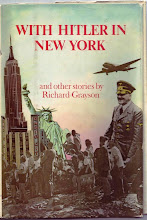
Alvin H. Rosenfeld's IMAGINING HITLER analyzes Richard Grayson's story "With Hitler in New York"


Alvin Rosenfeld's Imagining Hitler, published this year (1985) by Indiana University Press, is, according to the New York Times review of the book "a brief but forceful survey of . . . works of fiction, ranging from books by established authors - George Steiner, Beryl Bainbridge - to pulp thrillers and curiosities such as Richard Grayson's 'With Hitler in New York.'"

Rosenfeld's analysis of "With Hitler in New York" appears on pages 71-73:


. . . Compared to the Wandering Jew, who in most versions of the archetype is pictured as solitary and companionless in his misery, the Wandering Gentile doesn’t have it so bad.

In Richard Grayson’s astonishing story, “With Hitler in New York,” he has it, in fact, pretty good. Grayson gives us a Hitler in blue jeans, who backpacks his way to New York on Laker Airlines to spend some time with his Jewish girlfriend. As the story opens, the narrator is waiting at the airport with Ellen, Hitler’s girl, for the flight to come in. Hitler arrives from Germany wearing a work shirt and leather jacket, and they go off to the city. It’s summertime, and New York is in the grip of a heat wave. They watch T.V., eat ice cream, smoke a joint together. The narrator notes that “Hitler had a nice air about him” and admires the way he moves (“He is so comfortable with his body”). Hitler is jet-lagged and dozes off on the couch. “What do you think of Hitler?” Ellen asks. “I kind of like him,” the narrator says. “I never realized he was so witty.”

As the story progresses, these early good feelings about Hitler increase. “I think I would like to be like him,” the narrator muses. And later, “I wonder if I am beginning to fall in love with him.”

Hitler is uncomfortable in the oppressive heat of New York and is catching a cold, but he doesn’t want to put a damper on things and rallies his spirits. They go off to have breakfast at McDonald’s, watch a movie together on Channel 9, have dinner in the Village. It’s a little like the threesome in Jules and Jim. They gather a fourth, Libby, and go to Washington Square and sit around the fountain. The next day they swim, have dinner at Ellen’s parents’ house (the narrator’s mother “seems to like Hitler,” even if Ellen’s mother doesn’t), walk the boards of Brighton Beach, and eat eggcreams. Nearby some Russian Jews are enjoying themselves singing Yiddish folksongs. Hitler listens intently, understands the slightly bawdy lyrics, then walks off before he can be recognized by the old Jews.

The friendship between Hitler and the narrator deepens as the days pass. As an expression of his affection, Hitler gives the narrator a present, a book of Rilke’s poems.

The remainder of their days together in New York are spent in pretty much the same way. The three friends have dinner together at a Szechuan restaurant in Brooklyn Heights, sample the carrot cake at a healthfood place on Atlantic Avenue, look at the brownstones, joke around.

In the midst of it all, the narrator’s grandfather dies in Florida, but the narrator does not want to skip out on a going-away party for Hitler, who will be flying back to Germany in two days, and does not tell anyone about the death. He feels bad about it, but it’s Saturday night, their time together now is very short, and he joins the other guests at the party.

Hitler is a big hit, holds his beer well, and is as friendly and as witty as can be. The narrator’s admiration has by now turned to love, and it is clear they have become the best of friends. They get drunk and joke about winning the Nobel Prize together, Hitler for Peace, the narrator for Literature. “We would have to wear ties,” Hitler says. “No, tuxedos,” the narrator replies. “And top hats and canes.” They joke some more about doing vaudeville together.

At the story’s end, the narrator confides in his new friend that his grandfather has just died, and begins to cry. Hitler consoles him by telling him funny stories. It helps some, and the narrator drives Hitler home feeling a little better. And there the narrative ends.

Substitute almost anyone else for Hitler, and the story would fail. With Hitler in it, though, it is a fictional tour de force, the furthest extension to date of the neutralization of the historical Hitler and the normalization of a new image of the man. The evil monster is gone, as is the murderous anti-Semite. One neither fears nor loathes this Hitler, for in developing him Grayson has eliminated from his narrative virtually every trace of the Nazi Führer and put in his place a regular guy – likable, affectionate, funny, fun to be with. In costume, manner, taste, and overall affability, he fits in; in fact, he is something of a swinger and the epitome of the late-60s casual style. If one identifies at all with the narrator (and the story is designed to bring about an alignment of the reader’s feelings with the narrator’s), by story’s end one hates to see Hitler go.

It is not difficult to see what Grayson has done in writing his Hitler story, but at the same time it is not easy to know why he has done it or how he wants his readers to understand it. Unlike other fictions that manipulate the survival myth, Grayson has put “With Hitler in New York” under no obligation whatever to explain how Hitler has survived the siege of Berlin and his own suicide and is still around today. The story, in fact, is free of all references to the war years, the Nazi regime, the persecution and murder of the Jews, bunkers and bombs. In all of these respects, the story is unanchored in the history of the Third Reich and without the taint of any of its crimes. If there is any suspicion that this Hitler is sadistic, it is only because he throws his girlfriend around the swimming pool. Otherwise, there is nothing at all brutal or mean-spirited about the man. Were his name not Hitler, indeed, one would not even pause to inquire about the possibilities of a mean streak, for this fellow is a softy, not a sadist.

He is also not an anti-Semite, as his affectionate ways with his Jewish girlfriend show clearly enough. There are indications that the narrator is also a Jew, and yet Hitler and he become the best of buddies. It is true that Ellen’s mother does not take to him, but he gets along well enough with her father and is invited to share a meal at the family table. Hitler’s ways with the Jews are, in sum, by and large natural and easy and bear no resemblance to the mad anti-Semitic passions of the Führer of the Third Reich.

Grayson, one comes to understand, has de-Nazified Hitler, pacified him, and projected him as normative. At some very deep level of the imagination he has removed him from history, recast him in anti-apocalyptic terms, and made him safe to behold. His name and nationality aside, Hitler might as well be someone else, someone one need not fear to touch or tangle with romantically. There are no ironies here, weak or strong, only erasures so complete as to disarm the historical sense altogether and eliminate it as a factor in reading. In its representation of Hitler as a pure fiction, “With Hitler in New York” carries us beyond the transcendental leaps of the religious imagination, beyond the counterfeit claims of the revisionists, beyond the “alternative” possibilities and fictitious endings of popular formula fiction, and into a realm of imagination that all but dissolves historical memory. Whatever its author’s intentions might have been, his story succeeds in showing us just how much is lost when the name Hitler gives up its force and no longer evokes anything of consequence from the past.

“Forgetfulness,” Nietzche wrote, “is a property of all action. . . . One who would feel everything historically would be like a man forcing himself to refrain from sleep, or like a beast who had to live by chewing a continual cud.” The fictions reviewed in this chapter are a diverse lot, but all have in common a will to forgetfulness, a desire or ambition to spit out the historical cud.
Sunday, May 5, 1985

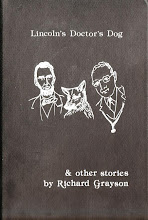
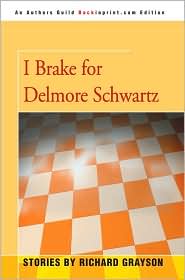
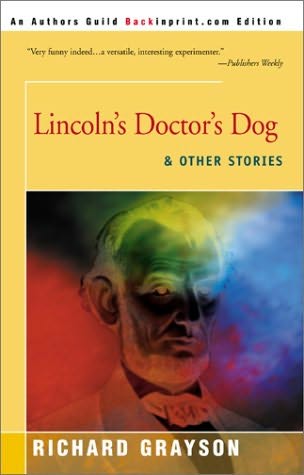
MENU MAGAZINE reviews Richard Grayson’s LINCOLN’S DOCTOR’S DOG & I BRAKE FOR DELMORE SCHWARTZ


Menu Magazine’s first issue (1985) reviews Richard Grayson’s Lincoln’s Doctor’s Dog and I Brake for Delmore Schwartz:

Reading Richard Grayson is like banging your elbow hard on something: the pain is there, but the initial tingling feeling brings an involuntary gasp of laughter. In nearly all of the stories in Lincoln’s Doctor’s Dog and I Brake for Delmore Schwartz, Grayson presents painful situations of verying [sic] degrees but equal intensity. Shame, embarrassment, incompetency, greed and grief are the dominant emotions of his works. But that initial tingling feeling—the urge to laugh against what you know is bound to come—is created by Grayson’s uncanny, ironic perception of human nature in the most desparate [sic] of situations.

One is quite tempted to lump Grayson in the contemporary category of “confessional” writer. Most often, the central character in each story seems an extension of Grayson himself. Common themes deal with bisexuality, Judaism and writing. And if the reader lacks knowledge of Grayson’s personal background, the plotlines can seem downright nonsensical. That by the end of each book the reader feels a certain intimacy with the author is no mere coincidence, so completely does Grayson embody each character, theme and incident with shades of his own voice.

Or does he? That is the enigma, the final enigma, of each Grayson story. Each story smacks of “the voice” that so broadly comes forth in “Diarrhea of a Writer,” in which Grayson treats writing as if it were the ultimate indulgence. When the reader encounters a familiar story form in which the characters are active rather than passive, he is apt to read it warily, just waiting for “the voice” to address him directly. In one hilarious piece, “For the Time Being,” “the voice” interrupts a pathetic reminiscence by a pathetic adolescent who measures his worth through a collection of autographed magazine covers. “The voice” stops the action and confirms what the reader already suspects: “The ‘I’ of this story is really me, Richard Grayson, and not some literary device. You can call this fiction if you want to, but it is true.” What follows is an emotional tirade on the repeated rejections the writer must face.

The hook is established. One constantly searches for symbolism, and thanks to Grayson, is easily satisfied. But, thankfully, Grayson is not the Sylvia Plath of contemporary fiction; nor do his stories evoke the whining self-pity confessional writers thrive on. When Grayson recants [sic?] tales of his childhood (“Appearance House”), sexual awakening (“18/X/1969”), the shame of the Holocaust (“Reluctance”), the anguish of writing (“Nice Weather, Aren’t We”), he tempers the barest of human emotions with gentle twists of irony and sharply seasoned satire. Those are his structures, in the confines of which lie much deeper questions the reader must ask himself. In short, the passive technique Grayson so expertly employs invites action on the highest level by the reader. And that, though “the voice” would be hard-pressed to admit it, is what good fiction is about.

That Grayson so openly laughs at himself is what makes the tragedy of his stories so bearable. Through “the voice,” Grayson makes it quite clear that things are not always what they seem. Life is a prism to Grayson, and he sees through its spectrum by satire, siphoning the light colors from the dark, even though the dark may be the most brilliant. By repeatedly returning to adolescence (“Robin, Remontant,” “Only Time Will Tell”), Grayson goes back to a time when what we expect to be and what we are becoming are two different things. The pain that comes in recognizing and accepting that fact are the cornerstone emotions of those pieces. And Grayson’s penchant for history (“The Story of William Henry Harrison’s Cold,” “Summoning Alice Keppel,” “Lincoln’s Doctor’s Dog”) supremely shows the irony of fate against the sharpest calculations.

Considering Grayson’s skill at presenting the dark side of life so enjoyably, it is somewhat surprising that the story that captured this writer most was “The Smile in the Closet.” Here, Grayson writes of a man so totally alienated from “the voice,” the story seems strangely out of context: “Secretly, you see, he was happy. . . Perhaps, he kept thinking, one day he would go back to normal. But somehow he never did. And: “. . . there was no demarcation line, no DMZ between optimism and pessimism, no date that he could pinpoint the time when he finally decided that the good in life far outweighed the bad.”

Funny, touching and supremely talented, Richard Grayson is an author who draws equally well from the human heart’s strengths . . . and its weaknesses.

—Reviewed by Susan Kurnas

Saturday, December 1, 1984

American Book Review (Nov./Dec. 1984) Reviews Three Books of Short Stories by Richard Grayson


The American Book Review reviews I BRAKE FOR DELMORE SCHWARTZ, DISJOINTED FICTIONS,EATING AT ARBY'S on pages 21-22 of its November/December 1984 issue:

From Our House to Bathos

* * *

I BRAKE FOR DELMORE SCHWARTZ
Richard Grayson
Zephyr Press
13 Robinson Street
Somerville, MA 02145
1983, 95 pages
Cloth, $9.95; Paper, $4.95

EATING AT ARBY'S: The South Florida Stories
Richard Grayson
Grinning Idiot Press
P.O. Box 1577
Brooklyn, NY 11202
1982, 24 pages
Paper, $3.00

DISJOINTED FICTIONS
Richard Grayson
Cumberland Journal
P.O. Box 2648
Harrisburg, PA 17105
1981, 64 pages
Paper, $3.00

Reviewed by Jaimy Gordon

_________________________

Eating at Arby's and Disjointed Fictions clamor for laughs before one even opens the covers. True, I Brake for Delmore Schwartz is a dignified volume, except for the title and the enclosed red bumper sticker that spells it out in large letters. But the flamingo-pink cover of Eating at Arby's announces that Richard Grayson ran for Town Council lately in Davie, Florida, with a campaign promise to give horses the vote; and the back of Disjointed Fictions reports that he was once a candidate for the Democratic Vice-Presidential nomination. Both books offer columns of testimonials on Grayson's work, some from trade organs like Publishers Weekly, others from Florida community rags like the Delray Beach News Journal and the Fort Lauderdale Sun-Sentinel. These critics are, on the whole, somewhat puzzled by Grayson—a woman from the New York Post hopes that "his literary career may be blessedly brief"—but most know a joke when they see it. They invoke Steve Martin, Saturday Night Live and the muse of stand-up comedy to explain Grayson, though a certain uneasiness lingers between the blurbs: If this is Saturday Night Live, can it be literature?

And now a second clipping from the Miami Herald slips out of Eating at Arby's, hinting at yet another South Florida story. In October, 1982, an alert reporter sniffed out a small scandal behind the chapbook: Richard Grayson employed a $3000 grant from the Florida Arts Council to chronicle the banal adventures of Manny and Zelda among mall shoppers, Marielitos, and drug murderers, in flat, repetitive, Dick and Jane-style prose. The reporter finds Grayson in his English Department cubicle at Broward Community College, and he does not allow her to go away disappointed. He elaborates on his municipal campaign platform: besides enfranchising horses, he was in favor of giving tactical nuclear weapons to the Davie police force. He threatens to sell the book on the street and says of the Florida Arts Council: "I'm sure they'll be delighted to see such a great piece of literature came from their money." But he adds a typical disclaimer: he is grading well over a hundred "illiterate papers" a week. "As you can see from the book," he tells her, "it doesn't do much for your writing style."


The willingness to be a public clown—or, more accurately, to present the appearance of a wistful nobody scribbling away in private who occasionally bursts out as a farcical publicist, exposing himself before the world—continues unabated inside Grayson's prolific but never prolix fictions. The several strains of his humor occur in more or less varied combinations according to the story, and I much prefer those loosely segmented chains of association in the first person (happily, two thirds of the stories in both Disjointed Fictions and I Brake for Delmore Schwartz fall into this category), where all his mannerisms exist side by side, to his more symmetrical and abstract pieces; for, in the absence of the first person, Grayson's prose loses much of its charm and is shown to be a rather blunt and inelastic tool. Grayson is not a graceful stylist, and as soon as the expression of a personality (or the illusion of this) disappears, his inventions and satires move on leaden feet. This is particularly true of Eating at Arby's, whose conceptual plan may sound comic, but which, as a literary experience—that is, as something to read—is all but insufferable. Manny and Zelda speak the same stiff, uncontracted idiom with which Dick and Jane stupefied us in second grade; the tiny vocabulary of their dialogues expands primer-style from a base of I like/nice/fun/friends/important/good/glad/ happy/man, to include "gay," "I-95" and "accidents"; "Century Village" and "Arby's"; "trip to Colombia"; "sore back" and "chiropractor"; "hurricane," "cocaine," "gun," and "murder." Besides offering a draught of gall to the Arts Council, the little book has two virtues, of a sort; it does not take a subtle intellect to feel the point of its satire, so that Grayson's contempt, which almost any dolt can share, is ultimately reassuring; and it is all over in twenty-four pages.

The variegated texture of the first-person narratives that most engage his admirers and baffle his critics is challenging to describe, since it is through juxtaposition that these deliberately unshapely tales achieve their effects. There is a strain of soap-opera exhibitionism in Grayson; sown through I Brake for Delmore Schwartz are revelations of an embarrassingly personal nature, often maudlin, often clearly untrue: "At this time I was suffering from schizophrenia," he says in passing, in "Is This Useful? Is This Boring?." "No matter how hard I tried, I never could take the whole bottle of sleeping pills," he says in "Oh Khrushchev, My Khrushchev." "But maybe for Khrushchev I could do it." A commonplace East Coast Jewish extended family, divided between New York and Miami and subject to cancer and bar mitzvahs, is put to use in many of Grayson's stories, variously as the basis of anecdotes that would not go over badly on the borscht circuit ("little antidotes," the grandfather in "Nice Weather, Aren't We?" calls them) or for highly suspect pathos. In one story in I Brake for Delmore Schwartz, the narrator's sister has drowned; in another, leukemia has snatched her away; in Disjointed Fictions ("Escape from the Planet of the Humanoids"), a sister is still tirelessly dying; the reader is instructed to "Feel this:"
The pain of frustration that a man feels when he is trying to write a sentence about how a character feels at his sister's funeral and can only come up with this fragment: Better her than me.

But in another tale the sister's phone number ("FOR A GOOD LAY CALL 969-9970") appears on a subway map in the IRT; and in yet another, she's alive and prospering as Roslyn, "now a Long Island dermatologist and mother of twins," who says, "Yes, I remember Saulie's bar mitzvah. . ."

The thread of the pathetic family saga intertwines with another characteristic one that I will call the lament of the schlemiel in the creative writing workshop. He is no longer in it, of course, but it has left its mark. The narrator worries about the quality of his fictions, checking them against mumble-mouthed platitudes of the craft; and these are travestied evenhandedly whether they arise from the post-modernist school or the Famous Writers' School. Grayson has an MFA from Brooklyn College, so he knows the rhetoric. In "Is This Useful? Is It Boring?," the narrator boasts, "For two years I studied Fiction Writing in one of the best universities in the country. . . .We were supposed to write new kinds of fiction. One writer called himself a 'post-contemporary' writer. That says it all." But from this self-congratulatory beginning, the voice disintegrates into a muddle of pomposity and self-pity: as a writer who misrepresents people as characters and otherwise can "get away with murder," the narrator is "a pretty powerful person"; well, no, he says, actually he writes out of a neurotic need for attention; in fact, he writes to get revenge on some Italian kids who once called him "Irving"; then the narrator changes his mind — "I can't even find the right words" — maybe he didn't learn anything in college after all. So much for the tenets of the experimentalists.

But then there are the traditionalists to contend with. Halfway through "Nice Weather, Aren't We?," the narrator's girlfriend Rosalie sneaks in "while I was out getting a Fresca" and writes "NO FOCUS" on the middle of the page. "Criticism like that I don't feel useful," he says huffily. But he admits it's all a strain. In "The Four Faces of Freud":
Listen, there is no point in finishing this story... I can't understand why some editor would print this, except as a cry for help. I am mentally ill.

This is the Grayson manner in endless variations: alternate strains of impudent posturing that breaks down in self-parody, equally disingenuous confessions of the writer's ineptitude; and, withal, punchlines and puns that he will labor for many paragraphs to set up, like, "I never promised you a prose artist," and, "Fiction's no stranger than Ruth." All these parts are suffused with the appealing professional anxiety of a small-time writer scrabbling against odds and without much concern for his dignity to get a little renown for himself. Grayson once said in an interview (Gargoyle 17/18) that he keeps his fiction short because "fragmented, self-conscious novels might very well be boring. Some people say that fragmented, self-conscious stories are also boring, but at least they're short."

It seems worth noting that Grayson perceives his readership, so far, more clearly than his readership perceives him. There is a sound precedent for that loose-jointedness of his fictions that so confounds his critics, a venerable one that reaches back far beyond the mimetic and novelistic bias that is in fact a middle-class parvenu in the world of letters. It is the satiric tradition of Erasmus and Rabelais, of Diderot, of Swift and Sterne and Peacock, and one may find this tradition, as in Grayson, the shape of a miscellany founded on a loose association of ideas, frequently with humble apologies from the author; idiosyncratic asides, digressions, and non sequiturs; catalogues and inventories; structures of information borrowed from extra-literary domains of the language; dialogues, patterns of query and response, and other instances of the unexpected, the undignified, the fitful, the intellectually pretentious breaking down into parody. But the brevity of Grayson's fictions is his own design, based on a just though severe estimate of the attention span of a literary peer group he understands all too well. In the same interview, Grayson told his questioner, "Actually, if you look at my work, it's probably more influenced by TV than by literature." Grayson writes for (because he is one of) a literati that watches TV, that is hounded by the neologisms "writers' workshop," "Citibank," and "co-op apartment." The narrator of "I Brake for Delmore Schwartz" walks the streets of New York, Citicard in hand—the same streets trod by Isaac Bashevis Singer and by the shade of the departed Schwartz—asking himself if it wouldn't be smarter to take a course in computers for a guaranteed fourteen grand a year, than to persist in this thankless manner of living.

Perhaps the most confusion about whether to place Grayson in the contemporary literary scheme is owing to the imperfect self-knowledge of that public of which Richard Grayson is the jester. We — and I mean you and I — live in a strange literary economy where most writers between the ages of twenty-five and forty accept the lot of the sort-of-published, the semi-solvent, the great unread, against the backdrop of an age of media super-celebrities; so that we are unable to escape the evidence of our under-appreciation though fully aware of the ludicrousness of the contrary. Richard Grayson constructs a literary persona out of just this predicament. He is a satirist and parodist so timely that his brothers and sisters may not yet discern themselves in his mirror. Certainly our hapless group that writes and studies writing and cogitates about writing but cannot know its audience deserves its own comedian, if it can learn — as Richard Grayson has — to laugh at itself.
_________________________________________________

Jaimy Gordon is the author of Shamp of the City-Solo (Treacle Press) and Circumspections from an Equestrian Statue (Burning Deck), among other works. She presently teaches at Western Michigan University.

Saturday, November 3, 1984

Interview with Richard Grayson in HOME PLANET NEWS


The Fall 1984 issue of Home Planet News, edited by Enid Dame and Donald Lev, features interviews with Richard Grayson and Mary Hemingway, as well as work by Amos Oz, Yehuda Amichai, Richard Kostelanetz, Hugh Fox, Gerald Haslam, Louie Crew and others.


Richard Grayson is interviewed by fiction editor Carufel de Lamiere. Grayson stories that have previously appeared in Home Planet News include "Partners" and "Blame It on Brecht."