Pages

Saturday, June 29, 1996

Richard Grayson letter in The New York Times: "Why Concede Florida Seats to Republicans?"


Richard Grayson has a letter in the New York Times today (June 29, 1996): "Why Concede Florida Seats to Republicans?"

Tuesday, June 4, 1996

Richard Grayson analyzes Romer v. Evans for the Human Rights Council of North Central Florida GUARDIAN


Richard Grayson analyzes Romer v. Evans, 116 S.Ct. 1620 (1996)(holding Colorado's anti-gay Amendment 2 unconstitutional as a violation of the Equal Protection Clause of the 14th Amendment) for the Human Rights Council of North Central Florida GUARDIAN's June 1996 issue (Volume 2, Number 2).

Thursday, May 23, 1996

American Book Review reviews Richard Grayson's I SURVIVED CARACAS TRAFFIC


The American Book Review has a joint review of Richard Grayson's I Survived Caracas Traffic and Jonis Agee's A .38 Special and a Broken Heart in its April/May 1996 issue:

_________________________________
Irony and/or Authenticity
_________________________________


A .38 Special and a Broken Heart
Jonis Agee
Coffee House Press, 27 N. 4th St., Minneapolis, MN 55401; 130 pages; paper, $10.95
__________________________________
I Survived Caracas Traffic: Stories from the Me Decade
Richard Grayson
Avisson Press, 3007 Taliaferro Rd., Greensboro, NC 27408; 144 pages; cloth, $21.00
__________________________________

Tyrus Miller


FOR today’s storyteller, irony is less a chosen mode, a figure of speech, than an atmosphere which one breathes of necessity, whether or not the surrounding air smells sweet. Starting from this recognition of irony as a kind of fated climate, the best Anglo-American short fiction writers of this century, from Joyce, West, and Barnes to Carter, Creeley, Davenport, and Abish, have explored ways to understand and inhabit an ironic literary cosmos, without either denying its existence or being consumed by it. It is fitting, then, that in reading new works of short fiction one measures them against the standards set by the masters of the genre in coming to grips with the problem of irony.

. . . .

Richard Grayson's collection I Survived Caracas Traffic is nearly the antipode of Agee's collection: cynical, comic-satiric, resolutely urban "East Coast." Grayson's book assembles twelve previously published pieces of magazine fiction. The topical references in the stories suggest, in fact, that the collection includes work from some time along, along with more polished recent work. For example, one story mentions "People's [sic] Express," the now-defunct Newark-based cut-rate open-seating airline: I pick up a strong aroma of 1984 or 1985 in this story. The risk of such immediate incorporation of topical detail is, of course, that it may lose its charge or even its meaning as time goes by. I can remember a lot of joking about People's [sic] Express about ten years ago, but now one would be lucky to find an audience who even remembers what it was.

Grayson's talents show themselves most fully with his swiftly drawn characters, rendering them in sharp paradoxical sentences. These character appear like walking non sequiturs. In fact, one of the most successful pieces in the book, "Mini-People," is a concatenation of these character sketches:
Dr. Bender has two daughters by his first wife. They call him up during his sessions with his patients and ask for help with their homework. When Dr. Bender cannot help them, he sometimes asks the patient who is with him to do so. Gail helped Dr. Bender's daughter do a report on off-track betting.

Dr. Bender is very much a male chauvinist. He says he is a phallic imperialist. He thinks this is very funny. ("Mini-People")

Grayson's limitations reveal themselves just as quickly, however, whenever he has to narrate anything. Exposition, the communication of background information in order to set up the story, seems to give him particular trouble. In other cases, he lets significant details fall from the narrator's mouth like a bolus of partly-chewed meat: "Some things I couldn't bring myself to talk about with Sean. Like his father ("I Survived Caracas Traffic"). The reader sits in suspense wondering just what the author is about to reveal about Sean's father! Obligingly, the author fills us in with his next paragraph: "At first I figured his parents were divorced, but when he talked about getting social security, I realized Sean's father had died, and from other things he said -- though he never mentioned his father -- I realized it was a hurt so deep I didn't dare explore it." That pretty much covers all we need to know about Sean's father, so we can move on to other things.

One story, entitled "A Clumsy Story," lays bare the mechanisms of short story writing. The "clumsy story" which is the internal object of the framing author's "Preface" and "Apology" bears an uncanny resemblance of style and character of other stories in the book. In a preemptive gesture of meta-fictional irony, thus, Grayson takes up criticisms of his work (such as the one I made above) and incorporates them as the premise of a new story. The question arises within the reader's head: Is Grayson a more proficient writer than I had thought? Maybe all those awkward passages were a sign of true sophistication! Yet it is not just the framed story that is clumsy; it is also the meta-fictional handling. There is none of the comic inventiveness of Barth or Sorrentino; nor is there the poetic play with narrative time that one finds in Calvino or Cortazar.

Yet still one last lingering doubt remains: perhaps this clumsy meta-fictionalizing is an even more subtl ironic criticism of the pretense of meta-fiction to refresh the text, to save it from its fall into conventionality. Perhaps Grayson is telling us that meta-fiction itself has become convention, that this war-horse of "post-modern fiction" is as flyblown as the conventions of Victorian realism. Perhaps. But may I be forgiven if I express my doubt that this is the case. The problem with irony, of course, as Schlegel had already noted nearly two hundred years ago, is that there is no sure way of telling where it begins and ends Irony tends to spread over everything it touches, whether by design or by unwanted extension. But as another man wisely said, just because I can't prove that an abyss won't gape before me when I open my door, doesn't mean I need to act as if it will. Accordingly, then, I draw this review to its meeted close with a timid profession of faith: sometimes "a clumsy story" is just that, and meta-fictional irony -- or is it meta-meta-fictional irony? -- can do nothing to persuade me that it is more

Tyrus Miller teaches Comparative Literature, English and Film Studies at Yale University, where he is working on a critical study of late modernist fiction. His most recent publications include articles on Beckett, Mina Loy, William Carlos Williams, C. Day Lewis, John Cage, and Massimo Cacciari.

Friday, March 29, 1996

Gainesville Sun reports on University of Florida Law School Forum on Affirmative Action with Richard Grayson


The Gainesville Sun today (Friday, March 29, 1996) has a report on yesterday's University of Florida law school panel, "Affirmative Action: Necessary or Outdated?" sponsored by the Center for Governmental Responsibility (CGR) and the Florida Bar Foundation and presented by the Florida Bar Public Interest Law Fellows. The panel included Richard Grayson, staff attorney in social policy at CGR and UF law professors Joseph W. Little, Kenneth B. Nunn, James C. Quarles and Sharon Rush and was moderated Assistant State Attorney Phyllis D. Kotey.

An excerpt:

Attorney Richard Grayson of UF's Center for Governmental Responsibility said that the issue is timely, coming on the heels of the 5th Circuit Court of Appeals striking down the University of Texas' affirmative action admission policy, ruling that preferential treatment cannot be granted to minorities.

Grayson said affirmative action also may be an important issue in this year's presidential race.

"Just last Sunday . . . Sen. Dole endorsed the California civil rights initiative, which is going to be on the ballot this November," Grayson said.

The initiative is against preferential treatment.

Friday, March 15, 1996

New York Times Book Review reviews Richard Grayson's I SURVIVED CARACAS TRAFFIC


This Sunday's New York Times Book Review contains a review of Richard Grayson's I Survived Caracas Traffic:

The New York Times Book Review

Sunday, March 17, 1996

Page 20


Books in Brief

FICTION & POETRY

_____________________

I SURVIVED CARACAS TRAFFIC

Stories From the Me Decades.

By Richard Grayson.

Avisson Press, 3007 Taliaferro Roa,

Greensboro,N.C. 27408, $21.


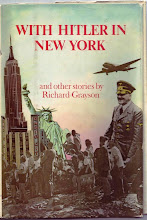
The scrambled nature of things and events isn't what gets your attention in Richard Grayson's new book of short stories. No, it's the incessant familiarity of the writer's secret self that makes his world entertaining and bizarre. The latest in a line of oddball collections with names like "With Hitler in New York" and "I Brake for Delmore Schwartz," "I Survived Caracas Traffic" features stories that are thickly populated with accident-prone people. One piece portrays a man whose great-great-grandfather made a liverwurst sandwich for the surgeon and medical researcher Walter Reed. (Reed died, but not from the sandwich.) Another has its protagonist slouching around a Brooklyn apartment with the Pope, who suggests they go out for a beer: " 'Oh, I don't know, Your Holiness, I feel awfully guilty about not writing anything lately. . . .' 'Don't be like that,' he admonishes me. 'You know what a useless emotion guilt is.' " The dialogue is consistently, even ingeniously funny. However, it's unsettling to find that you've polished off this entire batch of stories but can't remember exactly what they're about. Mr. Grayson excels at diverting the flow of action so nothing expected ever happens. But his results are inconclusive. This book is a perplexing piece of gadgetry: hard to come to grips with, not sturdy enough to make a good can opener for the conscience, far too bright and keenly made to flick casually away.

Sally Eckhoff

Friday, March 1, 1996

HAPPY features Richard Grayson's story "Suspicious Caucasians"


Richard Grayson's story "Suspicious Caucasians" appears in the current issue (#4, Winter 1996) of Bayard's New York-based literary journal Happy.

Saturday, February 17, 1996

Richard Grayson column in Orlando Sentinel: "It's '101 Dalmatians' vs. Woody Allen's Neurotics"


Richard Grayson has a column in the Orlando Sentinel today (Saturday, February 17, 1996), ""It's '101 Dalmatians' vs. Woody Allen's Neurotics."

Thursday, January 11, 1996

Kirkus Reviews reviews Richard Grayson's I SURVIVED CARACAS TRAFFIC


In its January 15, 1996 issue, Kirkus Reviews reviews Richard Grayson's I Survived Caracas Traffic:

AND IN BRIEFER

With this issue, we're pleased to introduce a new fiction column, entitled, as you can see, "And in Briefer." It will be written by Bruce Allen, who will also select the works to be reviewed. The column will appear from time to time, enabling us to provide coverage of titles that, due to considerations of space, might otherwise be neglected. — Anne Larsen

Grayson, Richard
I SURVIVED CARACAS TRAFFIC:
Stories from the Me Decades
Avisson (3007 Taliaferro Rd., Greensboro, NC 27408)


I Survived Caracas Traffic ($21.00; February 15, 1996; 144 pp.; 1-888105-04-6):
An eighth collection from an underground post-modernist who writes Barthelme-derived comic fiction crammed with details adopted from pop culture and the daily news. Troubled Barbie dolls, desiccated yuppies, and dysfunctional singles populate Grayson’s slick lampoons—though the long title story, a resonant meditation on the themes of relationships, AIDS, and mortality, proves him capable of less self-conscious, more serious (though not less comic) work.

Sunday, December 31, 1995

Publishers Weekly reviews Richard Grayson's I SURVIVED CARACAS TRAFFIC


In its January 3, 1996 issue, Publishers Weekly reviews Richard Grayson's I Survived Caracas Traffic:


I SURVIVED CARACAS TRAFFIC:
Stories from the Me Decades
Richard Grayson. Avisson Press
(3007 Taliaferro Rd., Greensboro, N.C.
27408: 910-288-6989), $21 (144p)
ISBN 1-888105-04-6


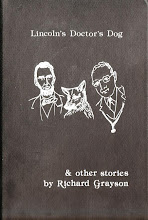
Social tropes and individual types from the “Me Decades” (here, really just the late 1970s and early ‘80s) run through Grayson’s eighth story collection. The stories are riddled with self-absorbed baby boomers, T-shirt slogans, Henry Kissinger, silicone implants, Saturday Night Live, the AIDS crisis, quarreling roommates and psychotherapists. Most are written in a flat first-person, but in others Grayson (Lincoln’s Doctor’s Dog) shows a sense of humor and an appreciation of the weird. The costs of survival in the AIDS retrospective title story, and the isolating entropy of depression in “Where the Glacier Stops,” manage to imbue their drained narrators with some emotional weight. On the whimsical side, “Twelve Step Barbie” sees the doll in a midlife crisis, and “A Clumsy Story” artfully diagrams and parodies MFA-quality fiction. But whatever Grayson’s approach – whether the troubled roommate is a Wisconsin Lutheran (“My Plan to Kill Henry Kissinger”) or the Pontiff (“With the Pope in Park Slope”) – most of his characters carry only a faded familiarity, not an invigorating shock of recognition. (Feb.)

Sunday, December 3, 1995

New Jersey Online Features Richard Grayson's Latest "Off the Shelf: J & J Insider" Column


Every week Richard Grayson's "Off the Shelf: J & J Insider" column on New Jersey Online Business digs up unusual snippets of trivia and news about Johnson & Johnson products. This week (December 3, 1995) read how people are babying baseball gloves, powdering their show dogs and wearing team colors on their casts.

Friday, December 1, 1995

Florida Department of Education Publishes "Legal Issues for the Design and Development of a Technology-Supported System of Education: 1994-1995"


The Florida Department of Education has published Legal Issues for the Design and Development of a Technology-Supported System of Education: 1994-1995 Legal Memoranda, edited and written by Richard Grayson, staff attorney at the Center for Governmental Responsibility of the University of Florida for the Florida Schoolyear 2000 Initiative, a collaborative effort among school districts, the Florida Department of Education and the Center for Educational Technology at Florida State University.


This publication explores the legal issues that surround a public education system enriched by electronic systems and new technologies.

Wednesday, October 11, 1995

Richard Grayson letter in The New York Times: "'My Husband Pays for his White House'"


Richard Grayson has a letter in the New York Times today (October 11, 1995): "'My Husband Pays for his White House.'"

Thursday, September 14, 1995

Phoenix Gazette reports on Richard Grayson's Giraffe Hunters of America organization


The Phoenix Gazette today (Thursday, September 14, 1995) reports on Richard Grayson's Giraffe Hunters of America organization.

San Francisco Chronicle Article on Richard Grayson and the Giraffe Hunters of America

Today, Thursday, September 14, 1995, the San Francisco Chronicle published on page E10 a story in Leah Garchik's "Personals" column, "Men Who Like To Hunt Giraffes," about Richard Grayson and the Giraffe Hunters of America PAC.

Saturday, August 26, 1995

Gainesville Sun interviews Richard Grayson on Legal Challenges to Marijuana Laws


The Gainesville Sun today (Saturday, August 26, 1995) interviewed attorney Richard Grayson on legal challenges to marijuana laws after a Gainesville man,Dennis Watkins, the "doobie tosser," was arrested at the Hempfest celebration for tossing joints into the crowd.

An excerpt:
But court records regarding marijuana cases suggest there won't be any changes in the law because of December's hearing, said Richard Grayson, visiting assistant in law at the University of Florida's Center for Governmental Responsibility

"There have been a lot of constitutional challenges under the federal and state constitutions. Most of the challenges have been unavailing," Grayson said.

Past challenges have been based on a variety of arguments, including selective arrests, the right to privacy, religious beliefs, cruel and unusual punishment because of harsh drug laws, the lack of legislation regarding “drugs” such as alcohol and tobacco and the distinction between the use of marijuana and cocaine or heroin, Grayson said.

Grayson also noted that some drug cases have been overturned because there is a legal distinction between what occurs in the home and in public.

“Your home is your castle. You can do things there, like walk around without clothing. You can’t do that on the street.”

Watkins was charged by Gainesville Police last November for distribution and possession of marijuana after officers said he tossed marijuana cigarettes to the Hempfest crowd outside the courthouse.

“It doesn’t sound like you have much of a chance,” said Grayson about the defense’s position.

“We are hopeful we can get some favorable ruling,” said Watkins’ attorney, Gary Wainwright, about the upcoming trial.

The trial also gives marijuana supporters a chance to express their opinions to the public, Grayson said.

There is always a chance that something surprising will happen, Grayson said.

In 1978, a Florida circuit court found the state statute for private possession and use of marijuana unconstitutional following medical testimony showing the social effects of prohibition outweighed the social effects of decriminalization.

“There are all kinds of constitutional things if you have a creative attorney,” Grayson said.

Grayson also appeared as a guest on the WUFT-TV/5 program North Florida Journal in a show devoted to the issue marijuana legalization.