Pages

Sunday, November 9, 2008

Sunday Afternoon in Rockaway: The Flight 587 Memorial


This afternoon we made our way out to Rockaway from Dumbo Books HQ, getting the B48 bus on Lorimer Street and Metropolitan Avenue and taking it down through Williamsburg's Latino and Hasidic neighborhoods, then down Franklin Avenue in Prospect Heights to Eastern Parkway, where we got the 2 train to the Junction.

There, on Nostrand Avenue by Flatbush Avenue, we got on the first stop of the familiar Q35 bus - now an MTA bus, no longer part of the Green Bus Lines - and traveled down past our old neighborhood, then over the Gil Hodges Memorial Bridge to the last stop at Beach 116th Street, across from where we spent many late weekend nights at the torn-down Ram's Horn Diner.

We walked down 116th past many new stores and some stores we've known practically all our lives, like Brown's Hardware and Rogoff's variety store and the newsstand and Carvel and the Rockaway Surf Shop. (We sometimes hung out at Beach 90th to watch our friends who owned surfboards; we just had - still have - a Rockaway Surf Shop T-shirt.)

With both sets of grandparents and many of our Brooklyn College friends living nearby in Rockaway Park and Belle Harbor, and being summer residents of the Rockaways throughout our childhood, we spent many hours on this block in stores, restaurants and even a movie theater (The Park) that no longer exist.

(See the estimable Kevin Walsh's take on "Sweet 116" on his not-to-be-missed Forgotten New York website; we are grateful for some of the pics here, but he has much more and better ones at FNY.)

Our first apartment, a fifth-floor studio facing Jamaica Bay, was two blocks away on Beach 118th Street and the boardwalk. It was October 1979 when we moved in. Our elderly neighbors, we later discovered, knowing our parents were moving to Florida, were shocked that a family would leave "a 15-year-old boy" alone. (We were 28 and our first book had been published that spring.)

The rent was $240 a month in 1979, and over a dinner of our favorites, salmon croquettes and baked apples, at her apartment on Shore Front Parkway at Beach 105th Street, Grandma Ethel asked us what we had in mind, paying so much money. From the large window where we put our twin bed, we would watch the planes - including the supersonic Concorde - land and take off from Kennedy Airport.

Just before the boardwalk and beach at the end of 116th is the Flight 587 Memorial, a place we have come to several times since it was dedicated a couple of years ago. It's a good place to think and to remember, even on a blustery, chilly (but bright) November afternoon.

On November 13, 2001, the lead story in The New York Times by N.R. Kleinfeld began:
An American Airlines jetliner bound from New York to Santo Domingo with 260 people aboard plunged into a neighborhood in Queens minutes after takeoff yesterday morning, jarring a city still numb from the agony it has already endured.

No one on the plane survived, officials said, and six to nine people were reported missing on the ground in Belle Harbor, a serene neighborhood on the Rockaway Peninsula still mourning dozens of residents killed in the World Trade Center attack. Federal officials said that the crash was being investigated as an accident, but they had not ruled out terrorism, sabotage or other criminal acts. Eyewitnesses reported seeing a burning engine separate from the plane and plummet to earth.

White House officials said there were no unusual communications between the pilot and the control tower, nor had intelligence reports picked up any credible threats against airplanes. Nevertheless, across the country, airports shut down, bridges and tunnels were closed and security was increased at government offices and nuclear plants.

Officials with the National Transportation Safety Board, the lead investigative agency, said at a briefing last night that they had recovered and listened to the plane's cockpit voice recorder. In the less than two minutes between the takeoff and the crash, they said, only the pilot and copilot could be heard. "Every indication points to this being an accident," said Marion Blakey, the board's chairwoman. "All evidence we have points to no evidence of criminal activity."

The aircraft -- American Airlines Flight 587, an Airbus A-300 fully loaded with fuel and carrying 251 passengers and 9 crew members -- took off from runway 31L at Kennedy International Airport at 9:14 a.m. for the Dominican Republic. Many of the passengers were Dominican immigrants who lived in the Washington Heights section of Manhattan. Day after day, American Airlines flights shuttle Dominicans to and from their homeland, often for festive family reunions or business dealings. There is even a famous merengue song about the three-and-a-half-hour trip called "Flight 587."

As the plane ascended into a brilliant, blue sky, something caused it to wobble, flip abruptly on its nose and veer straight down, shedding pieces. With an explosive roar and plumes of black smoke, the plane ripped through the roofs of two- and three-story frame houses in Belle Harbor., The crash ignited fires in about a dozen homes, and sent screaming residents scurrying outside. Four houses were destroyed, leaving a huge crater strewn with muddy debris and smoldering luggage. Other homes were badly damaged by fire.

Chunks of metal as big as car doors showered at least a five-block radius of Belle Harbor, bouncing off homes and streets. Part of one of the plane's engines landed in a boat parked in the driveway of a house; much of the other engine fell in the lot of a Texaco station. A vertical tail fin tumbled into Jamaica Bay.

Many people had the day off from work because of Veterans Day, and schools were closed. A high school and elementary school, both empty, narrowly missed being struck by the plunging plane. One of the schools became a triage center, but was abandoned by evening for lack of survivors. The gym of one school became a temporary morgue. By last night, 265 bodies had been found, Deputy Police Commissioner Joseph P. Dunne said.


Two years ago, Mayor Bloomberg and families of victims dedicated this memorial, a wall designed by Dominican artist Freddy Rodríguez and Situ Studio, with open windows and a doorway looking towards the nearby Atlantic Ocean and angled towards the Dominican Republic. It is inscribed with the names of the 265 who died in the second deadliest aviation disaster in the U.S.

We always read at least some of the names and see the quotation from Dominican poet Pedro Mir at the top of the memorial:
Después no quiero no más que paz.
(Afterwards I want nothing more than peace.)


Today we stood there for what seemed a long time, thinking and looking through the little windows at the sea, before we walked on the boardwalk over the two blocks to where we lived when we were nearly 30 years younger, and then, feeling chilled, made the long trip back to our current home.

The Flight 587 Memorial, in our opinion, is one of the most beautiful in New York City.

Friday, November 7, 2008

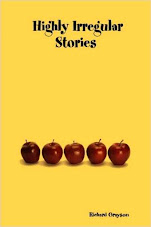
Pete Lit reviews Richard Grayson's HIGHLY IRREGULAR STORIES


Thanks to Pete Anderson for reviewing Richard Grayson's Highly Irregular Stories on his blog, Pete Lit. An excerpt:
Highly Irregular Stories. . .is a collection of four chapbooks from early in [Grayson's] career which show a young writer who was fearless in experimenting with form while never forgetting about storytelling. Much of the book is metafictional, with many stories cleverly being about the stories themselves. (And one story, "Narcissism and Me", even has the story's reader be its narrator – I can’t really explain it, so you’ll just have to read it.) His stories are funny, minimalist, and sometimes fantastical in nature. . .

The "Eating at Arby's" chapbook hilariously relates the primitive, childlike conversations (described by one reviewer as “equidistant between Hemingway's short stories and Dick and Jane”) of Zelda and Manny, an old Jewish married couple who relentlessly praise their South Florida home, their sunny dispositions desperately but never quite disguising many dark undercurrents - suffocating heat, racial tension, drug trafficking, murder - to life in the Sunshine State. "I Saw Mommy Kissing Citicorp" is a rollicking, episodic satire on corporate and government life, set in an absurd Manhattan where the chairman of the Federal Reserve faces down a balky ATM, his mother frets over him at their Trump Tower apartment while repeatedly watching an old videotape of her deceased husband, and the Comptroller of the Currency on a flight from LaGuardia struggles to figure out how he'll explain to his wife how the bag of bagels he brought home to D.C. for her is now half-empty, without bringing up the touchy subject of the cute teenage girl in the next seat who spent their flight obliviously enjoying both his attention and his bagel-generosity.

The strongest story of all is "My Twelfth Twelfth Story Story", in which the narrator tells of writing the twelfth and final story of his collection, all of which involve characters who live on various twelfth stories. The writer is a widower who is raising a young daughter, and struggles to write and earn a living while also being a good father as the girl lives in a fantasy world to avoid the reality and pain of the loss of her mother. [Grayson] he perfectly captures the joys and fears of every parent as well as the inner life of a young girl, showing a remarkable bit of empathy in doing so.

Highly Irregular Stories
is another fine collection of stories from one very prolific and inventive author.


The book was also reviewed in August 2007 by Marie Mundaca at the Hipster Book Club. Excerpts:
Richard Grayson is a meta-fictionalist of the old school, where structure is often as important as narrative, where the story is sometimes hidden in structural tricks like diary entries, lists, and jokes. Grayson revels in finding stories in ephemera—descriptions of what happened to groups of people on dates throughout a year, a list of traits, stories about writing stories.

The stories in Highly Irregular Stories were originally published in the 1970s and 1980s, but Grayson has such a fresh approach to writing that these stories don't seem dated. In some ways, Grayson may remind readers of a younger Woody Allen—an intellectual who ponders the nature of existence yet is remarkably funny while discussing life, death, and capitalism.

Like much of the meta-fiction oeuvre, Grayson often writes stories about writing stories—he'll describe a story he wrote, or wants to write, or is in the process of writing. The trick with this genre is to make sure the reader can find the story. There is a narrative somewhere; It's not all jokes and lists. Grayson succeeds here—the lists and diary entries reveal his passion for finding new ways to tell a story. "The Facts Are Always Friendly" is a series of calendar entries that explore the complicated relationships among a group of friends who are at once affable and duplicitous. "My Twelfth Twelfth Story Story," a tale about a seemingly upright citizen writing a book of stories about living on the 12 floor, reveals that the protagonist has a preoccupation with gruesome murders. "Progress" is a tale of a young man who goes home with a very friendly clothing salesman and ends up alone, trapped in the salesman's circular apartment, afraid to leave.

The funny stuff in Highly Irregular Stories is not just mildly amusing but actually laugh-out-loud funny. Take these lines, from "A Disjointed Fiction":

My eye catches an unauthorized advertisement scrawled on the subway map across from my seat:
FOR A GOOD LAY CALL 969-9970
It's bad enough that this is my sister's phone number, but what really hurts is that the handwriting is unmistakably my father's.


"Eating at Arby's" humorously explores the lives of two Southern Florida residents, Manny and Zelda, through a series of Dick and Jane-style stories. For Manny and Zelda, a trip to a mall becomes an analysis of the wastefulness of the middle classes, a visit to the chiropractor, and an examination of race relations. What sometimes seem like stand-up routines on the outset reveal stories about the deep struggles of creativity and identity in the late twentieth century.

In the story "Innovations," Grayson takes revenge on a more successful writer by making him a character in a story and leaving him trapped in Miami Beach during the 1950s, specifically because the successful writer called Miami Beach America's armpit. However, "Innovations" is not about the successful writer, identified as D.L., being trapped in Miami. Rather, it is about some of the things he does that seem to annoy Grayson's character and how these annoyances lead to Grayson's character trapping him in Miami. "Innovations" is very typical of the tales in Highly Irregular Stories—there are stories within stories within stories that spiral inward or spiral outward towards their conclusions.

There is nothing lazy or superfluous in Grayson's prose. Every word is called into service. What seem like digressions are insights into the story or the characters. For example, Grayson starts "The Governor of the State of Depression" by writing, "The Governor likes to be treated like a baby… He has taken to eating baby food. His especial favorite is Gerber's Strained Vanilla Custard Pudding." The pudding is not only pudding, it's custard, and it's strained. It's practically pre-digested. Later, when the Governor is reading an editorial condemning his policies, he's eating the pudding in an obvious attempt to comfort himself.

Sometimes Grayson's self-effacing humor seems almost Vonnegut-esque, as in "Escape from the Planet of the Humans," where he writes,

If I were to write wonderful books and grow old gracefully and become a member of the Literature Panel of the National Endowment for the Arts, the headline on page 11 of The New York Post might read WRITER HONORED AT FORUM, but I doubt it.

For all the similarities to more mainstream writers, Grayson is firmly seated in the experimental realm and is much closer to writers like Donald Barthelme, Raymond Federman and Steve Katz. Readers in search of realistic plots and characters will not find what they're looking for here, but for the more adventurous reader who enjoys satirical and experimental fiction, Highly Irregular Stories is highly recommended.


The book also was reviewed by Kirkus Discoveries in July 2006:
An audacious and wickedly smart comedic writer brings his full weight to bear in a collection of his early work.

Grayson, no stranger to experimentation, here assembles four of his most engaging chapbooks, which merge nicely as an eclectic anthology of intriguing short stories. The author, who breaks nearly every literary rule in an obsessive effort to be unique, is both maddeningly and hilariously self-aware. "Narcissism and Me" leaps dizzyingly between the author's presence and the actual story like a snake eating its tail, while "Sixteen Attempts to Justify My Existence" reads like a blog from another planet, and "I Saw Mommy Kissing Citicorp" waxes poetic on the rise and fall of 1980s greed. No business is safe, either, as Grayson mocks traditional publishing's buzzed-based marketing with caustic sarcasm in "The Greatest Short Story
That Absolutely Ever Was." In "The Facts Are Always Friendly," the action is narrated through a series of terse, date-stamped factual statements. Grayson opens up in the meatier "Eating at Arby's," a clever spoof written in childlike prose. It details the absurd dichotomies of South Florida as a pair of retirees fall prey to consumerism, political exiles and even gunplay on their way to the mall. With a keen eye for highlighting the high anxieties of the modern world, and many of the sensibilities of a sensitive urban writer, Grayson is occasionally compared to Woody Allen. But Grayson's stories here recall no one so much as Richard Brautigan, who walked a similar line between wit and warmth in his more eccentric novels. Though certainly unconventional, Highly Irregular Stories are refreshing because of their aloofness, which allows the author to indulge his peculiar point of view.

An iconoclast sways to his own beat, making beautiful music along the way.


The book was also reviewed by Ken Davis at Bookgasm in August 2006. An excerpt:
With HIGHLY IRREGULAR STORIES, I can’t think of adjectives that more accurately describe this collection of Richard Grayson’s writings than the first two of his title, although unorthodox, quirky, peculiar and highly entertaining also come to mind.

This book is purportedly an accumulation of stories originally published in the 1970s and ’80s in four separate chapbooks (DISJOINTED FICTIONS, EATING AT ARBY’S, THE GREATEST SHORT STORY THAT ABSOLUTELY EVER WAS and NARCISSISM AND ME), all long been out of print. I wouldn’t exactly describe the contents as stories, at least in the traditional sense anyway. Many of them might be better described as vignettes or sometimes as just snippets of a fictional conversation. Heck, “Some Sad News” is a mere 180 words. By comparison, this review is roughly 450. I didn’t find any exquisite plots or character development, but I was too busy enjoying myself to care.

Grayson is a literary performance artist. His words are avant-garde and so uniquely different than anything else I’ve ever read., as the book is chock full of the offbeat. Take the narrator in the 147-word “Ordinary Peepholes,” who spies the scrawled message on a subway “FOR A GOOD LAY CALL 969-9970.” He recognizes the phone number as his sister’s and the handwriting as his father’s. Or how about the very subtle but delicious irony in “I Saw Mommy Kissing Citicorp,” in which the Chairman of the Federal Reserve Board who oversees the ebb and flow of cash in this nation has trouble with an ATM and can’t withdraw $200.

The entries from EATING AT ARBY’S were by far the most entertaining, written in the style of the old Dick and Jane readers, but updated to feature the liberal thinkers Manny and Zelda. These two don’t discuss how fast Spot can run, opting instead for more adult subject matter. For example, in “Strange Experience,” Zelda comes home and announces, “Look what I have got, Manny. I have some cocaine.” Manny replies, “So that white powder is cocaine. I have heard a lot about it from many people.”

Manny and Zelda are taken to a gun range by their friend José in “Fun with a Gun.” Zelda warms to the idea of firearms and says, “Manny, I want to shoot that gun. That gun will become our friend, just like José is our friend.” The topics of murder, homosexuality and outrageous electric bills also are tackled by the pair. Sasson Jeans and the Arby’s salad bar at Arby’s also make hilarious repeat appearances.

I highly recommend this book and reading in general. So do Manny and Zelda. In “Shopping in the Mall,” Zelda says, “I read a book once. It made me think.” Manny replies “Thinking is fun. I like to think.”


If you like to think, too, you can get a copy of Highly Irregular Stories from Dumbo Books.

Thursday, November 6, 2008

Thursday Night at the Park Slope Barnes & Noble: Vicenza Scarpaci & "The Journey of the Italians in America"


After being sidelined for ten days with illness, election work and work work, tonight we managed to make time to mosey over to the Park Slope Barnes & Noble, where Vincenza Scarpaci gave a fascinating talk about her sumptuous new book of photos and history, The Journey of the Italians in America.

There was a small crowd of 20-25 people there and we were unaccustomedly one of the younger people in the audience (for the first time in our lives, come January - happily - even the President of the United States will be younger than us), though there was at least one child there (who later asked the author how long it took her to write the book).

Dr. Scarpaci, a 68yo native of Bensonhurst, was back in Brooklyn from her home in Eugene, Oregon. As Barnes & Noble's Peaches, who always gives good introductions, noted, the author received her Ph.D. in U.S. history from Rutgers University with a specialty in immigration history.

A recipient of the prestigious Ameritan Award from the Maryland Order of the Sons of Italy for her philanthropic efforts, Dr. Scarpaci has been teaching courses on American and immigration history at the University of Oregon, Seton Hall University, Towson State University and other schools.

She's also published many articles and essays in various Italian and American magazines, scholarly journals, and encyclopedias. Dr. Scarpaci was accompanied on her book tour by her husband Peter, who gave us in the audience handouts with photos and text from the book. (Note: except for the wedding photo from the book's cover, none of the pics here are from the book.)

Dr. Scarpaci began by saying that her book is the story of multiple journeys - her literal journey as a scholar of the Italian-American experience, which has taken her around the U.S. in search of immigrant history as seen in the lives of families; the journeys of Italians in corners of this nation where we wouldn't necessarily think of them as numerous; and her life's journey making Italian-Americans her field of scholarly study.

Families hold the key to immigrant history, she said, and she was aided by amateur family historians in collecting the material for this book. The captions to the historic photographs are more detailed than ones you'd see in most collections of immigrant photographs, since she could include fascinating information on the lives of individuals in the pictures that she'd gotten from their relatives.

"What is it that makes us Italian-Americans?" Dr. Scarpaci asked. After all, many of us are now four, five or even six generations removed from our immigrant ancestors, and many are now - as members of the audience revealed during the Q&A - only partly descended in one branch of our family from those who came over from Italy. It cannot just be a love of Italian cooking and cuisine or the once-a-year feast observances. Italian heritage is far more complex than that.

Many of the original immigrants came from Italy under great duress and financial hardship as they were unable to provide for their families in Europe, but Italians, Dr. Scarpaci said, kept their love of the land. Unlike the Irish immigrants, whose largest immigration occurred due to the potato famine and who felt that there the land had betrayed them, even those Italians unable to make a living off the land back in Italy retained their firm interest in farming, even if it had to be confined to growing vegetables and fruits in urban backyards and city plots.

More importantly, Italian-American farmers - some as close as upstate New York and Hammonton and Vineland, New Jersey - turned their cultivation of vegetables and fruits into a more general vertical dominance of the food industry in various parts of the country as they became distributors, door-to-door and street peddlers, grocery store owners and restaurant owners in California, Florida and other states.

Italian farmers introduced such vegetables as zucchini, broccoli and asparagus, of course; they also influenced those of non-Italian backgrounds, like the Italian food peddlers in Portland, Oregon, who taught the mother of James Beard how to make polenta and other Italian foods.

Dr. Scarpaci's grandfather had a backyard plot in Bensonhurst and she talked about his fig trees and how Italian-Americans have fig trees in backyards all over the nation. (In our backyard in Williamsburg, we have a munificent fig tree which supplies the owner's family - and us - with a bounty of incredibly delicious figs in late summer. We've also got some pretty good grapevines.)

Italian-Americans, the author said, are family-oriented. Their large families of second generation kids - like our beloved landlord and his friends - made World War II soldiers of Italian descent more numerous than any other single ethnic group.

Italian stonemasons built the Croton Reservoir that still supplies New York City with much of its drinking water from what is the world's second-largest structure of hand-hewn stones (the pyramids of Egypt are first).

Italians' love of art, decorative as well as fine art, influenced much of the ornamental sculpture, such as the gargoyles, on 19th century buildings, and Italian architecture and design is represented on both the exterior and interior of monumental public works such as the Library of Congress.

Dr. Scarpaci then said there is a "shadow side" of all immigration, including Italian-American immigration. Many never prospered in America, not all found a better life here, some never learned the language and could not adapt, and some returned to Italy embittered rather than prosperous from the New World.

She showed a 1916 photograph from Bridgeport, Connecticut of a little girl, Francesca Cirillo, in a rocking chair The child died soon after, on Christmas Eve, from tubercular meningitis, and another sister and brother died in 1918 in the Spanish flu epidemic and were buried in a mass grave with other victims. As Dr. Scarpaci writes,
this left their mother, Cesaria, from Melito di Napoli, with one surviving child, Angelina. Cesaria had lost her own mother at an early age and was raised by an aunt before going into a convent for four years.

Cesaria married Antonio Cirillo, from Succivo, Caserta, an experienced chef (many of the marriages in this generation were arranged) who opened a restaurant, Vittorio, in Bridgeport. Even though the family lived above it, Antonio never let his wife go into the restaurant. He was a gambler, an alcoholic and a womanizer who lost most of his money due to his vices, and when he died at 50, Cesaria was left penniless. She spent the remaining years of her life eking out a meager living making artificial flowers by hand and selling them on the street.

Tragic stories like that, Dr. Scarpaci said, are a part of the immigrant experience, too, and we should not turn our faces from its shadow side. We liked that Dr. Scarpaci, while celebrating her heritage, is no sentimentalizer. Her book, publishing by Pelican, is well-designed with a treasure trove of photographs with fascinating stories behind each one.

During the Q&A period, we asked Dr. Scarpaci about the decline of distinctively Italian neighborhoods - her native Bensonhurst, for example - and she said that many Little Italy neighborhoods in cities were destroyed by urban renewal projects or the aspirations of later generations to find more comfortable lives in suburbs. (Block Magazine, by the way, recently had a great article on the shifting boundaries of our Italian Williamsburg.)

The foremost historian on the subject of Baltimore's Little Italy, Dr. Scarpaci noted that the Italian-Americans moved out in "spokes" and that some Italian-American communities, if not quite neighborhoods, reformed in various suburban clusters. (We've noted this phenomenon in places in Long Island and New Jersey.)

There were lots of other fascinating tidbits, both in Dr. Scarpaci's talk, and elicited from her in the Q & A period. A recent immigrant from Italy, for example, asked how post-World War II and contemporary immigrants compare to the vast wave of Italian immigrants in the nineteenth and early twentieth century; most newcomers, Dr. Scarpaci said, are professionals like physicians and executives who have less interest in interacting with others from their native land and find it more comfortable being around those of similar educational and professional backgrounds.

The wedding photo of the cover of Dr. Scarpaci's is that of her grandparents Antonina Gerardi and Francesco Scarpaci on April 15, 1928, at Our Lady of Loreto Church at 124 Sackman Street at Pacific Street. (The church's website has some wonderful photos of old Brooklyn, and not just the church environs.)

The couple met on a blind date and their courtship was allowed to continue only with family supervision. Dr. Scarpaci noted that sitting in the audience was her mother's first cousin, Georgette Girardi, who was one of the little flower girls at the wedding and sitting just behind us was the brother of another flower girl, a cousin from another side of the family. (After the talk, the two unrelated cousins of Dr. Scarpaci introduced themselves to each other.)

Anyway, we had a wonderful time both at Dr. Scarpaci's talk and in looking at her book afterwards. We recommend The Journey of Italians in America if you or an older relative or friend is, like us, fascinated by this immigrant history. As Bobby Tanzilo wrote a couple of weeks ago in On Milwaukee:
the book's 300 pages -- cut from something like 800! -- aim to create something more compelling and engaging than a "family album" of Italian-Americans. Sure, there's the de rigeur photo of Lee Iacocca and a shot of the Italian Carabinieri Band playing in front of the Statue of Liberty. But, Scarpaci isn't afraid to air our "dirty laundry" and admit that the road to America wasn't always paved with gold and with dreamy thoughts of paradise on earth. . .

[The book] not only includes photos from the Little Italys of San Francisco, New York, Boston and Philadelphia, but also have photos of Madison's Greenbush and Milwaukee's Bay View neighborhoods, as well as from small cities and tiny towns across America. . .Because Scarpaci knows that despite the stereotypes of the Italian city kid, immigrants went anywhere there was work. That's why you'll find great bakeries, sausage shops, mutual aid societies, restaurants and more - all bearing Italian names in small-town Western Pennsylvania, in the UP of Michigan and in Northern Wisconsin, in the iron ranges of Minnesota and Ohio, in the mining towns of Colorado and in dust bowl Texas and Oklahoma, too.

Vincenza put her heart and soul and her sweat into. . . her book. But, it's mine, too, and as Americans - of Italian heritage or not - it's also yours, since it cuts to the heart of how nearly all of us got here: through determination, hard work and by surviving the downs and celebrating the ups.

Grazie mille to the Park Slope Barnes & Noble for this event.

Monday, October 27, 2008

Monday Evening in Williamsburg: Teatro El Puente's "LIVE: A Labor of Love," Peformances, Information & HIV Testing for Latino AIDS Awareness Day


We've just returned from a wonderful evening of great performances, informative and moving talks, and free HIV testing at El Puente, Williamsburg's venerable human rights institution and community center, as part of the observance of Latino AIDS Awareness Day.

Presented by Teatro El Puente, "LIVE: A Labor of Love," was aimed at the community's teens, and except for one cranky guy who was afraid he'd be mistaken for someone's abuelo and few other older people, nearly all of the about ninety or so audience members in the El Puente auditorium looked between 14 and 19.

Of course, anyone involved in AIDS education among adolescents knows that Teatro El Puente was a pioneer in employing the arts and peer education since its 1987 founding as the first educational AIDS theater company for adolescents in New York City. (At Teachers College in the summer of 1990, we learned about them when we took a class in AIDS Education and Human Sexuality - one that certified public school teachers for the Board of Ed's curriculum in family living and sex education.)

The main room of El Puente downstairs has a slightly raised stage - a huge red AIDS ribbon was raised over it tonight - and the audience sat in comfortable chairs in two rows. We were lucky enough to get a good aisle seat . There was a DJ in one corner throughout the show, which was incredibly professional, given that the people running it were, to our ancient eyes, very young.

The MCs of the evening, Teatro El Puente's Nikki and Jordan Figueroa, showed real aplomb not just in moving the show along but in their interactions with the audience and the "freshest, dopest" performers who were energetic, feisty and soulful.

Jordan performed a moving monologue about being a five-year-old watching his HIV-positive mom and others shoot up in their apartment and about losing her just three years ago when he was 15. So it's imperative that because the disease affects numerous others besides those who are ill that we all make sure not to engage in risky behavior:
You make the wrong decision,
AIDS targets you with such precision
that it's too late


None of what we heard about AIDS/HIV during the course of the evening seemed saccharine or condescending, and it was clear that the kids in the audience got it. Periodically some of the health workers would walk up and down the aisle during the show holding papers with numbers - 013, 022, 018 - and those kids who were given those numbers got up and went back to be tested in a private room.

After some great moves by Raje Entertainment's N-FINI-T hip-hop dancers, the first solo performer onstage was Robin DeJesus, whose talent we first spotted four years ago at the Gateway Theater in Fort Lauderdale when we saw his amazing performance in the bouncy movie musical Camp in which he played the drag-queen kid rejected by his family.

Robin first performed a charismatic rendition of "I'll Cover You," the love song he first did years ago when he understudied the part of Angel in Rent. This year he got a Tony nomination for his featured performance as Sonny in In the Heights.

Joking about putting on his "drama face," Robin then sang "Corner of the Sky," which he did every bit as skillfully as we can recall John Rubinstein singing it on Broadway in Pippin back in the early 1970s when we were not much older than the kids at El Puente were tonight.

Next, George, a speaker from Love Heals, the Alison Gertz Foundation for AIDS Education. We remember Ali Gertz well: about 20 years ago, she was a prominent AIDS educator who went public after discovering had gotten HIV from her first sexual experience at 16. George talked about how AIDS was first discovered in 1981 and how AIDS was first considered only a gay disease.

We recall first hearing about GRID - "Gay-Related Immune Disorder" - and HIV was "HTLV-III," as it is in our story "I Survived Caracas Traffic," originally published in Florida Review in 1987, later the title story of our 1996 collection. (Self-serving plug: Kirkus Reviews called the story "a resonant meditation on the themes of relationships, AIDS, and mortality.")

Having been gay and living in both South Florida and Manhattan back in the 1980s, we sometimes felt the epidemic would never end. George spoke about being an 18yo Cuban-American from Miami who came up to New York in 1986 to work in a Manhattan hair salon, where he met his friend Steven, also Cuban, the first person he knew who had AIDS.

Like too many of our own friends, Steven was down to 97 pounds in six months and barely hanging on in a hospital where the nurses were afraid to enter his room, where Steven's mom would sit night and day. George described sitting with her at his friend's side and how Steven's skin turned gray, something George could only think of as part of a process of the rotting of his body.

Then, one day while George was there, Steven - who hadn't lifted his head in days - suddenly shot up in bed and said "Michael!" - the name of his dead boyfriend - and just as suddenly laid back dead. "I can't describe to you what the air feels like when you're in a room where someone's life leaves his body," George told the crowd.

Cognizant of the dangers by the many friends who died - George took out a sheet of paper and read the first names of those whose memorial services he attended in just one year in the mid-1980s: men, women, gay, straight, white, black, Latino, Asian, maybe twenty in all - George made sure to be safe. That is, until years later, when unlike in the 1980s you weren't seeing sick people everywhere, when George got drunk one night at a bar and met a cute guy.

That one unsafe encounter led to his testing positive for HIV, and although George looks great and healthy - he just had the eleventh anniversary of surviving with the virus - he discussed how angry his friends became because of their own worry for his health and how the "miracle" drugs that keep him OK once caused an allergic reaction in which his liver swelled, he ran a high fever and almost died in the nine days he was in intensive care.

He told the kids he still has permanent nerve damage and then he took out a card that he carries which states that he takes medication that can cause this kind of allergic reaction at any time, without warning. The audience was very quiet as George said that no one should have sex without a condom or latex barrier and that if you can't talk about condoms with your partner, then you're probably not ready to have sex with them.

The thing is, condoms do work, and George gave as an example his HIV-negative boyfriend who's lived with him for three years. He told everyone to read the instructions for condoms when you've still got your clothes on. The audience laughed, but they got it.

The MC's thanked George and Love Heals and the kids applauded. With some more talk about HIV, the evening then switched to pure entertainment for a while with Quad Divino, a vibrant and sensuous quartet of dancers, two guys and two women.

Next up was the versatile Khalid Rivera, who's been number one several times on MTV Logo's Click List.

If you've never seen Khalid's vid of "Every Nite," you can catch it here, but we've got to say he's even hotter performing it live.

The single of "Every Nite" is, we think, number one on the Canadian charts. Khalid also sang a great version of "How Do U Mend a Broken Heart" and ended his set with a terrific song he performed with Nikki and Shanelle.

After the crowd gave it up for Khalid, Anny Mariano of Teatro El Puente portrayed, in one of the troupe's new plays, a feisty young woman who accompanies her friend to get tested for venereal disease and to her surprise - the character has only been with one guy, the father of her son, who's currently in jail - she tests positive for HIV.

Anny Mariano gave a terrific performance as someone going through all the stages known to those of us with friends and family who've received this diagnosis: denial, anger, and finally understanding and acceptance. The scene she did with Jordan Figueroa, playing her boyfriend who finally admits he's had sex with a guy while incarcerated, was riveting.

Anny's monologue ended back in the health clinic as she comes back to talk to the woman who'd given her the HIV test news weeks or months before (and who she'd cursed out with energetic rage). She (and Jordan) received a lot of well-deserved applause.

The bouncy star of the new PBS Electric Company - premiering in a couple of months - rapper P-Star bounded onstage next with five backup dancers, three other women and two younger boys, all wearing different colored P-Star T-shirts.

A star since she was about 6 - like a whole seven years ago - P-Star is a dynamic one-girl entertainment industry as a rapper, actress, dancer, choreographer, host of TV's Teen Diaries - and she's even got her own exercise DVD!

She gave us an energetic show with audience participation. "Where you at?!" P-Star shouted.

"Brooklyn!" we all shouted back.

It wasn't loud enough for P-Star, so we kept shouting "Brooklyn!" until the decibels were deafening and P-Star said, "Brooklyn, make some news!" Um, okay. We admit, like her song says, she's cool, cool, cooler than us.

The next performer up was Fascious, the writer/performer who's a member of The Intangibles Spoken Word Collective, Nuyorican Poets Café Grand Slam Finalist (2007) and two-time Northeast Regional Poetry Slam Champion (2007, 2008).

Fascious talked about people's lingering false perceptions of AIDS as a disease of Africa or of white gay men before doing a moving poem about being with his dying grandfather when he was a kid who learned chess from the old man. Fascious is a hypnotic performer, as you can see on this video of "Chess":

The next featured speaker, Frances Lucerna, was introduced as "the mother of El Puente" - more formally, she's its executive director - and she took the stage to much applause from her kids and members of the community. She said she was truly honored to be their "mother" at the evening's "celebration of life."
Like us, Frances Lucerna said she was taken aback by the tremendous talent onstage and how skillfully everyone had worked on the show. George's story had touched her, she said, and she remembered how in the 1980s, with AIDS devastating New York, it sometimes seemed like the end of the world. We remember. . .

El Puente lost a lot of members, and Frances said she, like George and many of us of a certain age and a certain community, attended more memorial services than anyone should in just the space of a few years. She mentioned Angel and Andy, who worked hard at El Puente, and how we have to honor people like them by taking up our responsibilities and getting word out about HIV in the community - the way Teatro El Puente has been doing since 1987, when it was established as the AIDS Drama Project.

Back then people were skeptical of doing HIV education for teens and young adults through drama performances, but today "the El Puente way" is the model for such programs not only in the U.S. but around the world. Teatro El Puente has taken their message to thousands of people over the past couple of decades, and Frances exhorted the audience to "tell the story, make a difference, make a commitment, make the right choices."

To warm applause, Frances Lucerna thanked everyone for coming together as a community to "celebrate our lives and our talents." And she ended with the hope that we can look forward to the day when we won't need to do AIDS Awareness Days, when the disease will be just a memory.
The evening ended on a high note with an energetic performance by Anthony Rodriguez and La Santa Luz Dance Company, of which he's artistic director.

Anthony was also a featured dancer on the 2001 Madonna Drowned World Tour, and has worked for Prince, Cyndi Lauper, Marc Anthony and Tito Puente. You can check out Anthony's moves here and you'll understand why the crowd at El Puente went wild.

Okay, not really wild. Not for teenagers anyway. Actually, the thing that most impressed us about tonight's event wasn't even the great performers or speakers but the kids in the audience at El Puente and those in Teatro El Puente who worked so hard on creating a great show. We saw several dozen kids get up during the show to go back to get HIV tests and, we know, some counseling.

Hey, even we took some of the condoms on the front table as we went out into the Williamsburg night. Thanks to everyone at El Puente and Teatro El Puente, particularly to Theresa Doherty for letting us know about this great event.