The New York Times and New York Post cover Richard Grayson's candidacy for Vice President today (Friday, August 3, 1979).


A Brooklyn College English professor, who says he's protesting the country's "circus-like" political campaigns, has decided to take a leave from the ivory tower and run for Vice President.
Richard Grayson, 28, is even officially recognized by the Federal Election Commission.
The federal agency has been flooding him with campaign finance forms since the day he wrote them--and they've never questioned his eligibility.
"I just wanted to see if the FEC would take anybody seriously and apparently they do," he said.
Grayson's biggest concern now is raising the bus fare to New Hampshire to campaign for the nation's first primary.
He's already begun a furious campaign.
He held a $10-a-plate bagel dinner, which brought in $10. His brother was the sole guest and contributor.
A rock singer friend, Wesley Strick, will hold a benefit concert for him tonight at Eric's at 8 p.m.
And, he's drafted his entire family for a Principle [sic] Campaign Committee.
The U.S. Constitution puts the age for holding the office at 35. While Grayson is too young for the job, his political spirit has not been dampened.
Not particular about his political party, Grayson is waiting for an offer from any ticket.
"Jimmy, Jerry, Teddy, they're all the same to me."
A health-conscious candidate, Grayson has no objection to the country's second best seat - especially when he found out there are already 64 contenders for the presidency.
"The President tends to get old a lot quicker," he said. "And Mr. Mondale looks thinner lately."
The serious side of Grayson's candidates involves his belief that the country's leaders are in a "perpetual state of campaigning on non-issues."


Daily News (New York)
Tuesday, June 26, 1979
Page 5
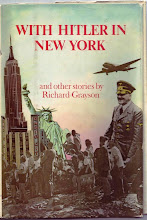
BABY RAVE: While Steve Martin's "Cruel Shoes" is going through the roof in book sales, let me point out another really funny book of short stories published at the same time, titled "With Hitler in New York," These tales by Richard Grayson are populated by Farrah Fawcett-Major, Sarah Lawrence of Arabia, Abe Lincoln and Hitler, to name a few.
I read Richard's book after the 27-year-old author wrote me a letter. "I live with my parents in Brooklyn. We are very poor, but we are honest and good and gossip-minded people." How could I resist?

X: a Journal of the Arts, which has published issues on "geography" as well as "music," last year devoted an issue to the fiction of a single author, Richard Grayson. This month a New York publishing house has published a book of Grayson's collected fiction.

 Today, Tuesday, June 5, 1979, The Ottawa Citizen's "Magazines" columnist Richard Labonte published a column, "Small presses often produce excellent material," praising Richard Grayson's "deft short story" in Bellingham Review.


Grayson, Richard
WITH HITLER IN NEW YORK
And Other Stories
Taplinger $7.95
6/15 LC: 78-20695
SBN: 8008-8406-X
Grayson has little more to offer than a lot of youthful energy in this collection; he gives each of his story ideas a good shove -- but that's about it. Hitler, for example, arrives in Brooklyn to no great effect: "Ellen's mother doesn't talk to Hitler except to say 'Pass me that salt bagel.'" -- and it's that one joke over and over. In Grayson's vignettes of normal Jewish family life, his autobiographical hand isn't so shy to show itself, but it does nothing with the raw material. Other pieces fall into a flat, modish style: "Mara wants to go to the North Sea., Helmut has too much work to do. Go alone, he tells her. But she wants to know how he will get up in the morning without her. Helmut sighs and says he can manage it. But Mara feels guilty and decides to stay home." There's the requisite self-conscious humor: a short story crticizes back its idle readers, a character named Placenta cries, "You're the narrator, you do something." What Grayson lacks most seems to be patience and follow-through; after offering an outrageous premise or a few jokes, he doesn't know what to do -- so he merely repeats them. A bit of promise, then -- but as a storytelling craftsman, Grayson has a long, long way to go.

As might be expected from a collection of journal excerpts, there is a good deal of self-indulgence, occasionally smacking of that late '60s, post-hippie sensibility which seeks to startle, but is more often merely tiresome. Still, however, the sheer variety of styles makes for an entertaining tour of some of the frontiers of contemporary prose. The book is given some structure through division into six sections, which correspond loosely to different points of view, or aspects of the writers' experience. The first is aptly titled "The Writer." and Richard Grayson's musing is an eloquent and ironic slice of the difficult and seldom rewarding realities of that life