Pages

Friday, May 20, 1983

Wednesday, May 11, 1983

ISRAEL TODAY May 6 issue features "The Writings of Richard Grayson"


The Friday, May 6, 1983 issue of ISRAEL TODAY features an article on page 13called "The Writings of Richard Grayson" by Mark Bernheim:

The Writings of Richard Grayson

MARK BERNHEIM


Which is the harder job – writing literature or writing about it? For those of us committed to writing about writers, we face the challenge to determine who has something to say and who has nothing, when the voice of the genuine writer is to be heard above the copyist or the mimic. At what point does a "promising talent" metamorphose into an established literary presence? For the greats even, when did they enter that state; when were they no longer "new voices" looking for an ear?

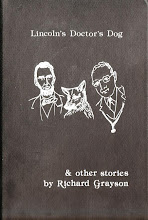
Of the many ambitious new writers whose works I receive, I could point to one Florida-based author, Richard Grayson, who seems genuinely posed for flight with a recognizable voice and content his own. A couple of years ago Grayson brought out a collection of sketches whimsically called Lincoln's Doctor's Dog, since he had read that the best selling books of recent times dealt with three subjects – presidents, animals, and diseases – and as a combination, well, a sure thing. Over the past few years he has brought out an impressive number of stories written in a widely experimental range of forms in small magazines. They are important efforts by virtue of their innovative voices and treatments of anxiety. Grayson is able to create a full range of masks from behind which the artist peers out to make his criticisms of artificial modern life. Among young writers born in the mid-point of our century, he holds an important place.

Many readers where drawn into his penultimate publication, commissioned by the Florida Arts Council, the flamingo-colored Eating at Arby's, which I thoroughly enjoyed last year. Grayson sounds a genuinely original voice in this slim volume that punctures the pretensions of never-never land life in what passes as America's idyll. The book is written in a deceptively simple, primitive style which invites our judgment on vacuity as the substitute for human contact. Florida may never be the same again after his portrayal of it in its plasticity and gaud. Underneath the shiny surface, the absence of human values becomes apparent, and Grayson looks everywhere in the exploding population of immigrant – the old, the ethnic, the outcast – for signs of some spirituality:
"Let's make friends with those Haitian refugees. Let's take them with us to eat brunch at the Rascal House."

"Oh Manny," cried Zelda. "You are so silly. Haitian refugees do not come here to eat brunch at the Rascal House. They come here for freedom. You cannot get freedom at brunch at the Rascal House."

"Zelda, you are right. I made a silly mistake . . . someday I hope those Haitian refugees will have brunch at the Rascal House. We should give them free Danish and onion rolls so they know they will be welcome here in South Florida."

"Oh, Manny, you are being silly again. Even in South Florida there is no such thing as a free brunch."

Perhaps the echoes here of Albee and Ionesco will be a bit strong for critics who might term Grayson derivative, but for those who are familiar with the peculiar anxieties of contemporary life – and especially Jewish life, for Grayson comes directly from an observant tradition – his aim is right on focus.

His newest work, I Brake for Delmore Schwartz, is particularly impressive as a collection of pieces written and rewritten over a period dating back to the mid-seventies. To my mind, Grayson is best when he distances himself what only appears to be personal involvement but probably isn't. Nonetheless, when he is clearly creating fictional portraits of other disturbed people of all backgrounds, he is very sharp, and some of his characters will burn themselves into your memory. Did I say characters? One of the best in the new collection puts the narrative on the cold – yes, cold – that killed William Henry Harrison after the shortest term on record as U.S President back in 1841. In some respects, the story is typical of Richard Grayson – the unexpected insight into a cliché, a commonplace of the mind that we have never seriously thought about before. His best voices --- whether a two-page sketch of this pompous cold that saved a nation from an incompetent or a full-length picture of the gloomy artist who would brake – and probably break, too – for a broken figure like the poet Delmore Schwartz – these voices matter.

Grayson has written, "It's the pedestrian realities that are unchanged in my fiction, while the emotions go through great metamorphoses." It is these emotions that make the challenge of writing about writers a promise, never a discouragement.

Friday, May 6, 1983

Brooklyn Literary Review reviews Richard Grayson's EATING AT ARBY'S: THE SOUTH FLORIDA STORIES


The Brooklyn Literary Review has published a review of Richard Grayson's Eating at Arby's: The South Florida Stories on page 306 of issue 5 (1983):

Book Review

Eating at Arby's
by Richard Grayson
(Grinning Idiot Press)


by Bob Tramonte


It has always been my feeling that the best writers are linguists within their native tongue. They are able to bend and use every subtlety, nuance and tick of the language they were born to. This is certainly true of Richard Grayson in Eating at Arby's. In this tastefully wicked and funny tale, he combines the metre and sound of a first-rade reader to strip the pretensions of brain-bleaching vacationland mania and moronizing addlepated materialism. Imagine a writer able to do all that while you're laughing your cojones off!

Try to visualize if you will, Mr. Rogers scoring in Needle Park or Big Bird standing on Pacific Street looking for a trick. That's vaguely what Manny and Zelda are like. They remind us of the children and drunks God watches over as they stumble into every horror Miami has to offer, their innocence and ignorance unscathed. I had the unmitigated cheek to hand Eating at Arby's to three perfect strangers and got the following responses:
"IT MAKE ME CALL MY COUSIN SHIRLEY" - Tony Livotti.
"IT MADE ME JUGGLE LENTILS" - Hans Henning.
"COULDN'T PUT IT DOWN, READ IT WHILE SITTING SHIVA" - Irving Baumrind.

Frankly, I couldn't agree more with these three people. After my first reading, I scrambled eggs with my best wing-tipped shoes!

Brooklyn Literary Review reviews Richard Grayson's I BRAKE FOR DELMORE SCHWARTZ


The Brooklyn Literary Review has published a review of Richard Grayson's I Brake for Delmore Schwartz on page 307 of issue 5 (1983):

Book Review

I Brake for Delmore Schwartz
by Richard Grayson
(Zephyr Press)

by Tom Lane


Here is a slim collection of fifteen short stories, the fifth collection to be published by Richard Grayson. The style is largely experimental and occasionally novel.

Grayson respects the traditional approach to writing fiction: the well-wrought stories wherein every word counts. However, his education, two years of fiction writing at Brooklyn College culminating in an MFA, emphasized the experimental, and his own fictions as a result are both structured and fragmented. Such stories as "The Autobiography of Wiliam Henry Harrison's Cold" and "Oh Khrushchev, My Khrushchev" are well structured, and appeal to the reader on the strength of their novelty. Others are fragmented and spatial like "Different Places" and "That's Saul, Folks." These stories appeal too because they capture the rhythms of modern life and play them back faithfully.

Grayson's themes are the themes of the twentieth century. The theme of isolation abounds in "Hold Me" where the author comments, "I am living in a place with strangers. Even my family are strangers now." Other themes covered include the disintegration of the family, helplessness, and sexual indecisiveness.

The writing is often confessional. Grayson approaches writing as a form of self-analysis through which he hopes not only to understand himself, but humanity as well. Here he only partially succeeds, because at the book's end the reader is left with more insights into Grayson than into the world at large. Nevertheless the writing throughout is crisp and honest, and the style versatile, making the collection worth reading.

Monday, April 25, 1983

Column in Boca Raton News reports on Richard Grayson's appearance at National League of American Pen Women Writers' Workshop in Boca Raton

On April 25, 1983, Marie Tone's column in The Boca Raton News reported on a writers' workshop in Boca Raton sponsored by the local chapter of the National League of American Pen Women:
Richard Grayson, a fiction writer of short stories, entertained the audience with wit and humor on his personal experiences in the field of fiction writing.

Tuesday, April 12, 1983

Boca Raton News article on Richard Grayson's appearance at National League of American Pen Women Writers' Workshop in Boca Raton

On April 11, 1983, The Boca Raton News reports on Richard Grayson's appearance leading a writers' workshop in Boca Raton sponsored by the local chapter of the National League of American Pen Women.

Saturday, April 9, 1983

Library Journal reviews Richard Grayson's I BRAKE FOR DELMORE SCHWARTZ: "Highly Recommended"


Library Journal reviews Richard Grayson's I Brake for Delmore Schwartz on page 839 in its April 15, 1983 issue:


Grayson, Richard. I Brake for Delmore Schwartz
Zephyr Pr., 13 Robinson St., Somerville, Ma 02145
Apr. 1983. c. 94p. LC 82-63067. ISBN 0-939010-04-6.
$9.95; pap. ISBN 0-939010-03-8. $4.95 F

Forget the title. Forget the introduction. Both are far too cute. But Grayson is a fabulous storyteller and stand-up talker. His stories are short and anecdotal and rely upon captivating the reader immediately; then they sort of swim along, like a heavy bedtime story. Yet, Grayson can make us believe we are listening to something as outrageous as the voice of a dead United States President's cold. It works. We become a party to a benign assassination as we hear the cold alternately brag and confess. Grayson can be harsh and, at times, self-indulgent and completely without taste. Yet, his intelligence and imagination are fine. Highly recommended.
—Page Edwards, formerly with MIT Libs.

Wednesday, March 23, 1983

Tuesday Evening in Greenwich Village: Reading and Publication Party for I BRAKE FOR DELMORE SCHWARTZ by Richard Grayson at B. Dalton Bookseller

A reading and book publication party for I Brake for Delmore Schwartz by Richard Grayson took place on Tuesday evening, March 23, 1983, at the B. Dalton bookstore on the corner of Sixth Avenue and Eighth Street in Greenwich Village. (We're pictured, top at right, holding a copy of the book.)

Wednesday, March 2, 1983

Publishers Weekly reviews Richard Grayon's I BRAKE FOR DELMORE SCHWARTZ


Publishers Weekly reviews Richard Grayson's I Brake for Delmore Schwartz in its March 4, 1983 issue:

I BRAKE FOR DELMORE SCHWARTZ
Richard Grayson. Zephyr Press (13
Robinson St., Somerville, Mass.
02145), $4.95 ISBN 0-939010-03-8;
hardcover $9.95 ISBN 0-939010-04-6


Most of the 15 stories here fall into three broad categories. Grayson is at his best in his most straightforward, traditional narratives, among them "That's Saul, Folks" and "Slightly Higher in Canada." Also pleasant are the author's obviously autobiographical stories, which are built of fragments of memories; he recalls his great-grandmother in "Reluctance," and an uncle dying of cancer in "Hold Me." Least successful are Grayson's more experimental pieces, many of which directly or indirectly deal with his perspectives on writing: "Y/Me" is a short diatribe on the letter "y." "Only Time Will Tell" presents an inconsequential self-interview. And in "Is This Useful? Is This Boring?" the author repeats these queries (asserting that it doesn't matter anyway), until the reader, alas, must answer both questions truthfully.
[April]

Sunday, February 27, 1983

Fort Pierce-Port S. Lucie News Tribune reports on Richard Grayson's talk at St. Lucie County Library


The Fort Pierce-Port St. Lucie News-Tribune today, February 27, 1983, reports on author Richard Grayson's March 7 talk at the St. Lucie County Library in Fort Pierce:

AUTHOR TO SPEAK AT SLC LIBRARY

Writer Richard Grayson will speak at the St. Lucie County Library, 124 North Indian River Dr., as part of the author series, on Monday, March 7, at 7:30 p.m. in the library's meeting room.

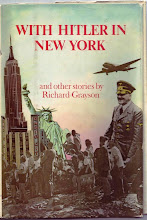
Grayson teaches creative writing at Broward Community College. The author's book titles tend to be unforgettable. He has written With Hitler in New York and Lincoln's Doctor's Dog and Other Stories.

The Florida Arts Council awarded Grayson a $3000 grant for his paperback book, Eating at Arby's: The South Florida Stories. His career began in Brooklyn, N.Y., where he was an editorial assistant with the Fiction Collective.

Grayson has published more than 150 stories in periodicals and anthologies in the United States, Canada, England, France, and Australia.

Grayson has received a scholarship from the National Arts Council to study at the Bread Loaf Writers' Conference, a fellowship from the Virginia Center for the Creative Arts, and an Ottille Grebanier Drama Award from Brooklyn College.

There is no admission charge for the lecture.

Friday, January 14, 1983

New York Times Book Review column "About Books and Authors" features Richard Grayson and LINCOLN'S DOCTOR'S DOG


The January 16 1983 "About Books and Authors" column of the New York Times Book Review features an item about Richard Grayson and Lincoln's Doctor's Dog:


New York Times
January 16, 1983
Book Review
Page 22

ABOUT BOOKS AND AUTHORS

By EDWIN MCDOWELL

An Anemic Send-Off


APRIL may be the cruelest month for poets and taxpayers, but for booksellers nothing approaches the cruelty of the first and second weeks after Christmas, when sales typically plummet by about 65 percent. Unit sales of hard-cover fiction during the last week of 1982 fell 71 percent compared with Christmas week, while sales of books on the hard-cover general list dropped 66 percent.
Given that anemic send-off into the new year, it is hardly surprising that most of the book industry can't wait for warmer weather. Look at January 1978:

According to New York Times computer-ranked sales of best sellers, sales of hard-cover fiction best sellers totaled only one-third of those of the previous month. The comparison was slightly better the following year. Last January, after an especially poor December, sales rose to 55 percent of the previous month's total. Sales of hard-cover general best sellers have followed a similar pattern over the past five years.

In some parts of the country the lag continues well into February. ''We usually don't pick up again until almost March,'' a bookseller in Philadelphia said, adding that January is a great month for browsers, ''because they have the store practically to themselves.'' Yet because sales depend on the weather as well as on the availability of big books, January has occasionally lost out to February, April or even May as the worst month for hard-cover book sales.

During slow seasons, however, there is still considerable movement in the relative position of individual titles. A good example is ''In Search of Excellence: Lessons From America's Best-Run Companies'' by Thomas J. Peters and Robert H. Waterman Jr. The book sold few copies in the major chain stores during Christmas week and ranked only No. 29 on the Times list. But now it is eighth on the list, with the chains accounting for 31 percent of total sales.

Happy Anniversary

FEW books remain on the Times best-seller list for more than a couple of months, but this week ''Jane Fonda's Workout Book'' marks its 52d week, even moving up a notch to second place. Meanwhile, although Shel Silverstein's ''A Light in the Attic'' slipped from 5th to 13th place, the book of cartoons and verse is currently celebrating its 61st week as a best seller.

Unforgettable Titles

WE reported here some months back that Richard Grayson, searching for a formula that would guarantee best sellerdom, had titled his forthcoming collection "Lincoln's Doctor's Dog & Other Stories." A number of readers noted that George Stevens published a book titled "Lincoln's Doctor's Dog & Other Famous Best Sellers" in 1939. Mr. Grayson said he had not known of the Stevens book, but he was so taken by his version of the title that he decided to stick with it.

The idea sounded good in theory: Since individual titles about Lincoln, doctors and dogs have tended to do well, one that combined all three subjects might do three times as well. Alas, that has not been the case. Sales figures for the Stevens book are not available, although it does not seem to have been a best seller. But the Grayson book, published last spring, has sold fewer than 200 copies. ''The only thing I can come up with,'' the author said after making it clear that he does not regard the sales figures as a literary judgment, ''is that Lincoln isn't as popular as he used to be.''

Mr. Grayson, who teaches creative writing at Broward Community College in Fort Lauderdale, Fla., has written four books that have sold a total of about 1,350 copies. Whether or not they are memorable as literature, their titles tend to be unforgettable: An earlier Grayson book was "With Hitler in New York," and Mr. Grayson's latest effort, a paperback for which he received $3,000 from the Florida Arts Council, is titled "Eating at Arby's." Scheduled for publication next month is a new opus: "I Brake for Delmore Schwartz."


Thursday, January 13, 1983

THE JEWISH JOURNAL interviews author Richard Grayson


The Jewish Journal has an interview with author Richard Grayson this week (January 13, 1983).

Saturday, January 8, 1983

Richard Grayson gets Honorable Mention in New York Magazine's Competition #478

Today, August 8, 1983, New York Magazine published some of the entries for its Competition #478, in which readers were asked to define invented words containing the continuous letters DGEB. Richard Grayson's entry was listed as an Honorable Mention.


Thursday, December 30, 1982

Wednesday, December 22, 1982

Library Journal reviews Richard Grayson's LINCOLN'S DOCTOR'S DOG in "Small Press Roundup: Best Titles of 1982"


In its December 15, 1982, Library Journal features a brief review of Richard Grayson's Lincoln's Doctor's Dog in its "Small Press Roundup: Best Titles of 1982":


Library Journal
December 15, 1982

LJ's SMALL PRESS ROUNDUP: Best Titles of 1982
By Susan Shafarzek

Pages 2303-2308


THE TIME is long past—if indeed it ever existed—when the small press world could be regarded simply as a haven for the beginning. True, the beginner often finds a place there, but, increasingly, so does the season talent, to whom the major publishing houses can no longer offer a venue. It appears that the alternative presses have become just that, and they are an alternative for the libraries, as well. Those interested in keeping to the front of aesthetic and literary trends will find the small press world a rewarding, supplementary source.

Not everything from the small presses is outstanding, of course. Many are still the province of the cranky and the refuge of the uninteresting, but looking over more than 300 small press books seen this year, more were found that were valuable than not. This review aims to provide a rounded sample of the best of these. (2303)

. . . .

Humor is also the hallmark of Richard Grayson's excellent collection, Lincoln's Doctor's Dog and Other Stories (White Ewe, $11.95, cloth). These range from the surreal and punning to the poignantly reflective. (2306)

_____________________________________
Susan Shafarzek, co-editor of the Washout Review, is on the staff of the Graduate Office of the State University of New York at Albany, in addition to her doctoral studies in the writing program there.