Pages

Sunday, July 29, 1979

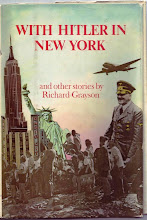
The Cleveland Plain Dealer reviews Richard Grayson's WITH HITLER IN NEW YORK & Jim Harrison's LEGENDS OF THE FALL


The Cleveland Plain Dealer today has a joint review of Richard Grayson's With Hitler in New York and Jim Harrison's Legends of the Fall:

The Plain Dealer (Cleveland)

Sunday, July 29, 1979

Section G, Page 8


Book Reviews


Two collections of short stories are disappointing


LEGENDS OF THE FALL, by Jim Harrison; Delacorte/Seymour Lawrence, 278 pp., $10.95.

WITH HITLER IN NEW YORK, and Other Stories, by Richard Grayson; Taplinger, 190 pp., $7.95.


By James R. Frakes


About some books you simply hate to say a discouraging word because the author so clearly can write a sentence and hone in on a telling detail. How's this for an opening – "Nordstrom had taken to dancing alone"? How about a man who remembers the year when he stopped finding pennies in his pocket that were older than himself?

But solid fiction is more than a collection of fine touches. Harrison's three short novels range from the incredibly bad "Revenge" (almost a parody of the hot-blooded Latin, passion-driven-cuckold genre) to the admirable clunky failure of the title story. Somewhere in between is "The Man Who Gave Up His Name" – a sharply observant but scattered and sadly pointless rehash of Cheever and O'Hara.

The stories are strung together by a roaring machoism and a skein of continuing obsessions, including fury at government interference in anything. The intrusive narrator arrogantly patronizes the reader: "It is not necessary to know too much about the wounded man . . ."; "Now we must back away from the lovers and let them rest . . . Let us perch on the log mantel."

The title story is potentially a very tough and moving account of the three sons of a Montana rancher, but the novella form can't contain the "epic" series of events. It's really not a novella at all, but a compressed tetralogy, a summary rather than a dramatization. You'll find maybe half a dozen lines of dialog in its 80 pages. Harrison can write. I wish he would.

In his collection of 28 "stories," Richard Grayson also lets his obsessions show. The style throughout is resolutely brisk, the tone is arch (not to say fey) and the model is Donald Barthelme. (I am not disarmed by Grayson's anticipating me here: "Too much like Barthelme indeed!" the story howls. 'My dialogue has resonance!'")

Stories, you see, talk back to their author. Characters try to escape from their narratives. The author appears under his own name. Instead of "tiresomely conventional" short-story forms, we get Questions and Answers, fan letters to Chief Justice Burger, classified personal mating ads, soap opera "spoofs," academic not-too-far-in jokes. Plus some funny names (Sarah Lawrence of Arabia, Adlai Stevenson Rosenthal, Placenta Smith) and puns. When lovable Hitler visits his friends in Brooklyn, he freaks out when he sees Sen. Sam Ervin doing a commercial for American Express.

Oddly, the most effective pieces are five Jewish-family stories, almost traditional, never sentimental – see especially "Slowly, Slowly in the Wind" and "Driving Slow."

This is a funny, sad, patchy volume. It shines with intelligence and even wit, but it also contains a lot of scribbling, doodling, showing off. Richard Grayson seems to enjoy Richard Grayson very, very much. But you won't be bored.


James R. Frakes is the E.W. Fairchild professor of American studies at Lehigh University.

Saturday, July 21, 1979

The Village Voice's Arthur Bell reviews Richard Grayson's WITH HITLER IN NEW YORK


In this week's issue (July 23, 1979) of The Village Voice, Arthur Bell's "Bell Tells" column has an item on Richard Grayson's With Hitler in New York:

BELL TELLS

By Arthur Bell

. . . Susan Braudy is writing a book about Sal Mineo. . .Truman Capote's Music for Chameleons will be a book in three parts. Part one: all new short stories. Part two: Conversations with Capote, which have been printed in Interview. Part three: A new work that Capote describes as "autobiographical and really something. It isn't quite finished yet." Truman hasn't seen or spoken to Lee Radziwell since he shredded her on The Stanley Siegel Show. . .

Richard Grayson, who lies through his teeth, writes from Brooklyn: "I have been reading you ever since I was a little kid." He signs his letter "respectfully." Respectful, he isn't. In his book, With Hitler in New York and Other Stories, Grayson writes about peeing next to Alan King in a movie theatre urinal, accosting Beverly Sills while she's eating a tuna sandwich, reminding Mary Lindsay that her husband supported Agnew while dancing with her, and having his foot stepped on. Beware of Richard Grayson, but read the book.

Tuesday, July 17, 1979

The Los Angeles Times reviews Richard Grayson's WITH HITLER IN NEW YORK


Today's Los Angeles Times devotes its book review to Richard Grayson's With Hitler in New York:


The Los Angeles Times

Tuesday, July 17, 1979

BOOK REVIEW


A Parade of Jewish Relatives


By Stuart Schoffman


With Hitler in New York and Other Stories by Richard Grayson (Taplinger, $7.95)


How to get a bead on Richard Grayson, the young Brooklynite who here offers 27 eccentric but noteworthy short stories? Yes, his fiction is experimental, which is to say it displays only selective respect for literary conventions and tends to be published in magazines with names like Confrontation and Bellingham Review. Genre aside, however, Grayson often resembles an astigmatic photographer who, searching desperately for the focus, twists his lens this way and that, finding a good setting only at random moments.


A telling detour en route to the stories: On the book's front flap, Grayson playfully confers responsibility for Jewish-American culture (which includes Woody Allen, Philip Roth, Al Jolson and "a certain kind of vulgarity typified by the town of Woodmere, Long Island") upon the bomb-wielding anarchist who assassinated Czar Alexander II in 1881, thus provoking the wave of anti-Semitism that swept millions of Jews to America. "So if you have any complaints about 'With Hitler in New York,'" he writes, "address them to the anarchist. . . I take no responsibility for this whatsoever."


Parlorful of Relatives


We thus anticipate a satirist but encounter instead a coy but compulsive autobiographer with a parlorful of predictable Jewish relatives, all the way up to Great-Grandma Chaikah who watches Dinah Shore. Grayson sketches his kin with the customary mix of scorn and love, but to make them as fascinating to us as they apparently are to him, he needs to work harder. And it is not enough to portray the young artist as soap-opera protagonist, as the author does in many stories. Alexander's anarchist may have made Richard Grayson inevitable, but he did not make him special


What is special, though, is Grayson's gift for dreaming up outrageous premises. In the title story, a frolicsome Fuehrer lands at Kennedy on a cut-rate Laker flight, sips an egg cream, pushes his American girlfriend into a swimming pool. "'You're a sadist, you know that?' Ellen says to Hitler."


Or consider "Chief Justice Burger, Teen Idol":

"COMING NEXT MONTH….

EVERYTHING YOU EVER WANTED TO KNOW ABOUT WARREN BURGER!

– Secret facts

– Complete judicial record

– How to make him love you."


But the Burger-as-Travolta gags go on and on, interchangeably, and next comes a piece in which Abraham Lincoln is "a big klutz" who hates to shave and complains that he's sick of flapjacks. After reading a lame spoof of those bisexual-albino-seeks-same personal classifieds, we begin to suspect that Grayson is shaking funny ingredients together like dice; by the odds, good numbers will sometimes come up.


Story as Character


The most affecting piece in the collection is a wry and self-knowing one entitled "But in a Thousand Other Worlds," in which the main character is the story itself. Rejected by the New Yorker, then the Atlantic, the story is rushed to Coney Island Hospital, where its condition is diagnosed as hopelessly unpublishable. "Richard's face was buried in his hands. 'I never gave it the care I should have,' he said."

We are hardly surprised to arrive at the rear dust-jacket flap and discover that Grayson's stories "have appeared in more than 125 literary magazines over the past seven years." Conservatively assuming one story per magazine, that comes to an average of a story every three weeks. If the author could just slow down, his talent might seem far less of a blur.


Schoffman is a regular contributor to the Book Review.

Tuesday, June 26, 1979

Daily News' Liz Smith column features Richard Grayson's WITH HITLER IN NEW YORK


Today's Daily News has a mention of Richard Grayson's With Hitler in New York in Liz Smith's column:

Daily News (New York)

Tuesday, June 26, 1979

Page 5


BABY RAVE: While Steve Martin's "Cruel Shoes" is going through the roof in book sales, let me point out another really funny book of short stories published at the same time, titled "With Hitler in New York," These tales by Richard Grayson are populated by Farrah Fawcett-Major, Sarah Lawrence of Arabia, Abe Lincoln and Hitler, to name a few.

I read Richard's book after the 27-year-old author wrote me a letter. "I live with my parents in Brooklyn. We are very poor, but we are honest and good and gossip-minded people." How could I resist?

Monday, June 25, 1979

The Evening News (Harrisburg, Pennsylvania) publishes "Torch Bearers of Literature," an article on literary magazines mentioning Richard Grayson

Today, Monday, June 25, 1979, on page 17, Harrisburg, Pennsylvania's published "Torch Bearers of Literature," an article by George Myers, Jr., about literary magazines, including X: A Journal of the Arts, which mentioned the magazine's single issue devoted to the work of Richard Grayson:
X: a Journal of the Arts, which has published issues on "geography" as well as "music," last year devoted an issue to the fiction of a single author, Richard Grayson. This month a New York publishing house has published a book of Grayson's collected fiction.

Tuesday, June 5, 1979

Ottawa Citizen Magazines Columnist Praises Short Story by Richard Grayson Published in Bellingham Review

Today, Tuesday, June 5, 1979, The Ottawa Citizen's "Magazines" columnist Richard Labonte published a column, "Small presses often produce excellent material," praising Richard Grayson's "deft short story" in Bellingham Review.

Friday, June 1, 1979

Gargoyle Magazine reviews Richard Grayson's DISJOINTED FICTIONS


The Washington, D.C.-based literary magazine Gargoyle reviews Richard Grayson's Disjointed Fictions in issue 11 (May 25, 1979):

Disjointed Fictions - Richard Grayson,
X, a journal of the arts, PO Box 2648,
Harrisburg, PA 17105. 42pp. perfect
bound, $3, 1978.


Grayson seems to crop up everywhere these days. Perhaps the most prolific short story writer in America. Of the six stories in this book, "Inside Barbara Walters" is hilarious, and "Progress" even better. Like Grayson says, "We are all children of television. My first word was Boraxo." Catch him quick, before his big new book comes out this spring from a major New York publisher.

Tuesday, May 1, 1979

Kirkus Reviews reviews Richard Grayson's WITH HITLER IN NEW YORK


Kirkus Reviews today (May 1, 1979) reviews Richard Grayson's With Hitler in New York:

Grayson, Richard
WITH HITLER IN NEW YORK
And Other Stories
Taplinger $7.95
6/15 LC: 78-20695
SBN: 8008-8406-X


Grayson has little more to offer than a lot of youthful energy in this collection; he gives each of his story ideas a good shove -- but that's about it. Hitler, for example, arrives in Brooklyn to no great effect: "Ellen's mother doesn't talk to Hitler except to say 'Pass me that salt bagel.'" -- and it's that one joke over and over. In Grayson's vignettes of normal Jewish family life, his autobiographical hand isn't so shy to show itself, but it does nothing with the raw material. Other pieces fall into a flat, modish style: "Mara wants to go to the North Sea., Helmut has too much work to do. Go alone, he tells her. But she wants to know how he will get up in the morning without her. Helmut sighs and says he can manage it. But Mara feels guilty and decides to stay home." There's the requisite self-conscious humor: a short story crticizes back its idle readers, a character named Placenta cries, "You're the narrator, you do something." What Grayson lacks most seems to be patience and follow-through; after offering an outrageous premise or a few jokes, he doesn't know what to do -- so he merely repeats them. A bit of promise, then -- but as a storytelling craftsman, Grayson has a long, long way to go.

Sunday, April 29, 1979

Minneapolis Tribune reviews First Person Intense, an anthology with a contribution by Richard Grayson

Today, Sunday, April 29, 1979, the Minneapolis Tribune published on page 12G a review of First Person Intense, edited by Sasha Newborn. The reviewer, Barry Silesky, mentioned Richard Grayson's contribution to the anthology:
As might be expected from a collection of journal excerpts, there is a good deal of self-indulgence, occasionally smacking of that late '60s, post-hippie sensibility which seeks to startle, but is more often merely tiresome. Still, however, the sheer variety of styles makes for an entertaining tour of some of the frontiers of contemporary prose. The book is given some structure through division into six sections, which correspond loosely to different points of view, or aspects of the writers' experience. The first is aptly titled "The Writer." and Richard Grayson's musing is an eloquent and ironic slice of the difficult and seldom rewarding realities of that life

Wednesday, April 25, 1979

Publishers Weekly reviews Richard Grayson's WITH HITLER IN NEW YORK


The April 23, 1979 issue of Publishers Weekly has a review of Richard Grayson's With Hitler in New York:

WITH HITLER IN NEW YORK AND OTHER STORIES
Richard Grayson. Taplinger, $7.95
ISBN 0-8008-8406-X

Grayson pokes fun at American life -- politicians, business, television and fads -- in these sharp, witty stories populated by such figures as Farrah Fawcett-Majors, "Chief Justice Burger, Teen Idol," and Sarah Lawrence of Arabia. Abe Lincoln, who isn't the least bit interested in slavery, sprawls on a couch in total apathy as Stephen Douglas makes love to Mary Todd upstairs. The degeneration of love in an alienated society is sketched in "Classified Personal," a collection of ads signed by Sappho, The Impotent Kid, Take Me I'm Yours, and other lonely hearts in search of potential mates. "In the Lehman Collection," a boy jogs 11 miles a day through the Main Gallery, a family takes a tour in their Winnebago, and a man is stabbed, unnoticed. The staccato style, laced with puns and wisecracks, is apt for these amusing if somewhat contrived satires. [June 15]

Friday, April 6, 1979

Taplinger Publishing Company's Spring 1979 Catalog features Richard Grayson's "With Hitler in New York"


Thirty astonishing stories by an exciting new writer 

Hitler and Mike get stoned and go for eggcreams in Brighton Beach. Buddy’s grandfather secretly knows that Farrah Fawcett-Majors has a foreign accent. A famous weight-lifter realizes that he’s got to live inside the body he’s built for himself. A teenage fan magazine tells ‘How to Make Chief Justice Burger Love You.’ A woman dutifully lies under the bed while her son has sex with Sarah Lawrence of Arabia. Cambodian insurgents auction off centaurs, gorgons, satyrs and griffins. A short story on a low-cholesterol diet gets arrested for solicitation. . . Welcome to the world of Richard Grayson, a gifted young writer whose short fiction, published in dozens of literary magazines, has been startling lucky readers for years. With Hitler in New York is a collection of Grayson’s finest, freshest, funniest work – thirty original visions of the way we live now. 

160 pp. 5¼x8 $7.95 8406-X May Fiction 

  - Taplinger Publishing Company Spring 1979 Catalogue, page 14

Saturday, March 24, 1979

New York Post features Richard Grayson's prize-winning "Tales of New York" story


The New York Post today (Saturday, March 24, 1979) features a story by Richard Grayson, winner of its "Tales of New York" story contest, judged by James Brady.

Thursday, March 15, 1979

Tuesday, February 27, 1979

The Smudge Review reviews Richard Grayson's DISJOINTED FICTIONS


The current (Winter 1978-1979) issue of the Detroit-based magazine The Smudge Review has a review of Richard Grayson's Disjointed Fictions by Hank Malone on pages 11-12:


DISJOINTED FICTIONS
By Richard Grayson
Released as X - A Journal of the Arts #5
Printed by Lawson Press · First Rate Offset
$3.00 · 42 Pages · Write to editor George Myers, Jr.
P.O. Box 2648 · Harrisburg, PA 17105


Disjointed Fictions is a funny, very readable, collection of "short fictions" written by one Richard Grayson, a 26 year old, well-published MFA who teaches English in Brooklyn. Mr. Grayson's premise appears to be that since he cannot write a piece of sustained fiction, like a novel, that he will instead write a book-length manuscript, building it, piece by piece, with clever fictions, ramblings, and fragments, a form popular in South America and probably best known to American readers in the work of Jorge Luis Borges.

These literary morsels and tidbits suggest a very fine talent, capable of much larger work; so the premise of an inability to sustain a longer fiction is, I think, clearly contrived for the purposes of doing this sort of thing: just jogging along in print, writing one's heart out in a wide-ranging variety of styles and fictions, relating nearly everything and everyone (especially celebrities) to himself in some very intriguing ways. It is a wildly narcissistic narrative, on the surface: very bright, wise, very "Jewish," very "New York," and often very funny, if you enjoy "put-on" and a subtle kind of surrealism that bursts occasionally in all kinds of ironically wise ways.

Disjointed Fictions is full of fun for a literate reader (comix readers beware), with lots of puns and potshots at everyone and everything. And yet, it is a strangely haunting work a well. Grayson's sense of logic is both conventional and precise, ad with this book I have discovered another fine American talent whose future work should be more than a light entertainment. Grayson is both a philosopher and a class clown, and in Disjointed Fictions there is a lot of Talmudic wisdom showing up in the wisecrack format of the Marx Brothers.

This is not a book for everyone. Sometimes the cleverness turns to lead, and the fun and absurdity becomes merely frivolous detailing On the other hand, I laughed a lot with it, and I suspect others will as well. This would be a thrilling Good Friday present to a disjointed friend. - H.M.