Showing posts with label The Authors Guild. Show all posts
Showing posts with label The Authors Guild. Show all posts
Wednesday, March 22, 2017


Thursday, April 18, 2013
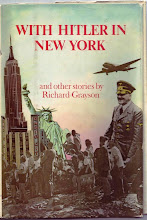
Cover of New E-book of Richard Grayson's 1979 Short Story Collection WITH HITLER IN NEW YORK

This is the cover for the forthcoming e-book of our first hardcover short story collection, WITH HITLER IN NEW YORK, originally published by Taplinger in 1979.

Wednesday, April 20, 2011
Wednesday Evening in Greenwich Village: Siva Vaidhyanathan and "The Googlization of Everything" at the Strand Bookstore

After a long day of teaching at the fabulous School of Visual Arts, we walked from our last class ending at 5:50 p.m. down Second Avenue and across East 12th Street to the Strand Bookstore to catch an interesting talk by Siva Vaidhyanathan on his new book The Googlization of Everything: (And Why We Should Worry), which he called a "scolding love letter."

Vaidhyanathan, a professor of media studies and law at the University of Virginia, had -- according to a man behind us (who also said he went three days without going online and admitted he didn't understand what Twitter was) -- been on Brian Lehrer's WNYC show this morning (well, the man actually said Leonard Lopate's show, but who knows the difference anyway?). On the air, and in person this evening, Vaidhyanathan -- also the author of Copyrights and Copywrongs: The Rise of Intellectual Property and How It Threatens Creativity -- said his book is admiring of Google but wants to make us better and more thoughtful users of Google.

Google, he said, had had an uncharacteristically bad spring, given the European antitrust complaint (he noted Google has a much higher search share, well over 95% in nations like Portugal and the Netherlands, as opposed to its 70% share in the U.S.); the settlement with the Federal Trade Commission over the Google Buzz privacy debacle; and Judge Chin's rejection of the settlement agreement between Google, the American Association of Publishers and the Authors Guild. (We thought it was curious that the professor said the Authors Guild represents "only a small number of elite authors," not people like himself; we've been a member since 1978 and we're about as non-elite as they come.)

Basically the author is trying to raise our awareness of the mechanism of the Google search (because of teaching, we weren't online much today, but we must have done thirty or forty Google searches, including at least half a dozen as we're writing this). After twenty years of Web culture, Vaidhyanathan noted, we've settled some issues (remember the old Time cover story scaring all parents that the Web would morally corrupt their kids?) but the way we use the web unthinkingly -- as we Google dozens of times a day -- needs to be examined with more critical thought.

Saying that we are not Google's customers but its "worker bees" seemed shrewd. Google's customers are its advertisers and we, the searchers, are doing the scut work which enables Google to perfect its vaunted super-duper secret algorithm (although we've heard the formula no longer includes cocaine as it used to back in the day).

Really, Vaidhyanathan said, the purpose of the algorithm and the Google search, is not to improve the flow of information but to facilitate shopping -- not that there's anything wrong with that. And the personalization of the Google search is definitely helpful to us, as when, based on our previous search history, its results for, say, "jaguar" begin with hits on South American wildlife for some and British automobiles for others.

There was an incredibly interesting question-and-answer session that ended the author's talk and preceded his book signing. It was instructive to hear the questions people asked, from the man who felt like a somewhat helpless victim of Google to the woman who wanted to know how to get off old information that she didn't want people to see (that she pays the highest property tax in her county, for example; the answer, of course, is she can't get it off and those of us with active online presences know the best you can do is get stuff on which will knock the unwanted material down past the first page of results which few get to) to the guy who wanted to know about Google's position in China in relation to its "Don't be evil" motto -- all got intelligent, fairly detailed and patient answers and raised even more interesting questions.

We look forward to reading The Googlization of Everything when this long semester ends, and we're grateful to the Strand Bookstore and Siva Vaidhyanathan for tonight's event. It's been a while since we've been out on a weeknight but we've got tomorrow off thanks to Holy Thursday. (And if you want a much more comprehensive, reliable and intelligent take on tonight's talk, see the blog of Marie Sciangula, the very smart assistant director of instructional technology at Purchase College.}
Tuesday, March 16, 2010
Late Tuesday Afternoon in SoHo: PEN American Center Annual General Meeting

At 5 p.m. today we were at the SoHo offices of PEN American Center for our annual general meeting of members. We got the privilege of joining PEN American Center in 1982, when the publication of our second hardcover book passed muster as the second of "two books of literary merit" required of members back in those days. (We are members not only of PEN American Center, the largest of the nearly 150 PEN centers around the world but we also belong, from our Arizona home, to the Los Angeles-based PEN Center USA made up of writers west of the Mississippi.)

This was actually our first general meeting. Of the 3,400 professional members (writers, translators and editors) and more associate members, there were at most 60 or 70 members present today. We assume that like most organizations of its kind, PEN American Center needs to have an annual general membership meeting, and although much of the work of the meeting is the formality of announcing the result of our election of officers and trustees, it was great to feel a part of the organization and hear some interesting stuff about the wonderful work it does, both in the U.S. and on behalf of writers all over the world where freedom of expression is under siege. Its publications are also invaluable.

PEN American Center Executive Director Steven L. Isenberg and President Kwame Anthony Appiah welcomed members and introduced a score of people on the Center's staff, whom we've always found to be amazingly hard-working, dedicated and helpful.

Anthony said that it had been "a very exciting year" for PEN: "We searched for and found a great new Executive Director, Steve Isenberg; we worked hard and in new ways to support Liu Xiaobo and other writers in prison around the world; and we created another acclaimed and well attended World Voices Festival." He then called upon three members in the front row who were the proxies in the election, and they in turn announced the results, which were not a surprise, since everyone ran unopposed, we think, but can't recall because we voted by mail weeks ago.

Anthony Appiah was re-elected to a second (maximum) one-year term as President. Also reelected were Laurence J. Kirshbaum as Executive Vice President; Jessica Hagedorn as Vice President; Maria B. Campbell, founder and director of an international literary scouting agency, as Treasurer; and our friend Roxana Robinson as Secretary. Victoria Redel was newly elected to Vice President, taking the place of A.M. Homes, whose term on the board was up. In his second year, Anthony said, he hopes to expand PEN’s campaigns to protect freedom of expression, win new financial support, and increase the visibility of PEN in the literary world and beyond. He also hopes to lead PEN through "a strategic review" of everything it does; the last one was six years ago.

Also re-elected to PEN’s board of trustees were Ron Chernow, Beth Gutcheon, Jhumpa Lahiri, Joanne Leedom-Ackerman, Jaime Manrique, Claudia Menza, Michael F. Moore, Steven Pleshette Murphy, Susanna Reich, Esmeralda Santiago, John Oakes, Walter Pozen, Hamilton Robinson, Jr., Elissa Schappell, Annette Tapert, Lynne Tillman, Monique Truong, and Danielle Truscott. Wendy Gimbel and Hannah Pakula were newly elected to the board.
Steve Isenberg then spoke about the annual fiscal report for the 2009-2010 year (he took over as executive director after the year had ended last June 30) and discussed how PEN American Center deals with the challenges of these hard economic times for everyone, which has made life difficult for all organizations dependent upon fundraising. He spoke about the many wonderful programs of the Center and then intoduced two directors.

Larry Siems spoke about the Freedom to Write Committee. In a bleak year for freedom of expression around the world, with outrageous like the continued imprisonment in China of Liu Xiaobo, Larry spoke about some successes: Secretary of State Hillary Rodham Clinton signing orders effectively ending the exclusion of Swiss scholar Tariq Ramadan from the United States and the releases, under international pressure by PEN and others, of journalist Sayed Parwez Kambakhsh, who had originally been sentenced to death for blasphemy in Afghanistan, and Ilham Tohti, a member of the Uighur PEN Center who was detained in Beijing during the unrest in Xinjiang Province.

Caro Llewellyn gave us an exciting preview of the coming PEN World Voices Festival of International Literature, of which she's director. There's a lot we can't talk about right now due to a press embargo, but we'll just say that we wish we could go to almost every event and you probably will, too. (Too bad we have to work.)

Paul Aiken, executive director of The Authors Guild (we've been a member of the Guild since November 1978, when we were eligible upon signing our first book contract), was our guest speaker. We thought he'd talk about the Google Book Settlement (which we support) but instead he spoke on e-books and the future, concentrating on the Amazon Kindle and the Apple iPad and their different models for publishers and authors. None of it was news to us (we read the excellent blog eBookNewser from MediaBistro) and we felt Paul demonized Amazon.com a little too much and treated Apple as a corporate savior for authors and book publishers, but that seems to be standard these days.

As Paul had to rush off to a parent-teacher conference, Anthony and Steven wrapped up the meeting asking for questions or comments.

One longtime member, active in the women writers' group, discussed issues of older writers who are not as technically proficient and who may not, as she does not, have a computer but who are still good working writers. We sometimes forget there are a lot of people who make valuable contributions who are not online; she probably spoke for other members present, some of whom were even older than us.

Soon the meeting was formally ended and the PEN members started enjoying the food and drink present and chatting informally.

Forgive our usual horrrible blurry photos. Although in recent months, pics from this blog have been taken by websites of Publishers Weekly and the Village Voice, we are obviously ten times the writer that we are a photographer (not that that's saying much).

Speaking of better writers, they opened the box of brochures for this year's World Voices Festival and distributed them to the members.

It was really thrilling to see who'll be coming from all over the world to speak this year. Some of our favorite writers will be there; this very term we're teaching the work of an American writer we love who'll be giving the fifth annual Arthur Miller Freedom to Write Lecture and there's a panel for high school students that features two of our friends that we definitely plan on attending.

We'd love to be the first to announce this year's PEN World Voices Festival schedule of events and participants, but Caro Llewellyn has sworn us to secrecy until Thursday's official unveiling of the schedule at the big announcement for the press at Instituto Cervantes.

But it looks to be the best PEN World Voices Festival ever, and it's one more reason we've been delighted to pay our annual dues for 28 years as a member of PEN American Center.
Subscribe to:
Posts (Atom)