Pages

Showing posts with label Warren Burger. Show all posts

Tuesday, July 8, 1980

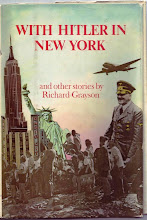
Bellingham Review reviews Richard Grayson's WITH HITLER IN NEW YORK


The Summer 1980 issue of the Bellingham Review has a review of Richard Grayson’s With Hitler in New York on pages 48-49:

Book Review by Richard Dills

WITH HITLER IN NEW YORK AND OTHER STORIES, by Richard Grayson, Taplinger Publishing Company, New York, 1979, 190 pp., $7.95 (cloth).


Richard Grayson’s fictions in With Hitler in New York are marked by comic exuberance and sympathy. But they also raise the question: can an author be too playful for his own good? Don’t misunderstand, there is a lot to like in this exceptionally readable book ; it’s just that some of the pieces lack resonance because the author at times too much enjoys the sound of his own voice. Which may explain Grayson’s fondness for puns. An example from “What Really Happened in Cambodia”:
“We’ve got to find a nook or a cranny to hide out in tonight or we’re doomed,” says one refugee to his wife.

“But I don’t see a cranny,” she cries. “And I certainly don’t Sihanouk.”

And there are plenty more where that came from. In most of his stories Grayson uses a “patchwork” device wherein the story is pieced together with bits of dialogue, revery, incongruous observation and all-purpose non-sequiturs. This technique seems particularly appropriate for comedy, as it tends to emphasize absurdity and encourage puns and one-liners. It does not work as well—with one exception—with serious pieces unless fragmentation and loss of wholeness is essential to the story.

But, to the stories.

The despair and prurient interest of the personal ads we’ve all read in The Village Voice if not in our own hometown dailies is nicely captured in “Classified Personal.” And there are some nice ironies:
Love! Love! Love! Who’s got it to give? Lonely, love-starved W/M, 21, affectionate, handsome, muscular and understanding seeks guy with boyish good looks and smooth body for lasting relationship. Write OCCUPANT, Box 44, Carteret, N.J. 07915

“Occupant” seems just about right. But, even though the rest of the 37 or so personals carry the same degree of authenticity and/or irony, the piece as a whole escaped me. With two or three exceptions, the order of the personals appear to be just as random as that of a newspaper’s. The point, of course, is that Grayson has a significantly different audience—or, if not—at least an audience with significantly different expectations. (I will argue this point.) The author, then, must be more than a typesetter.

In “‘Go Not to Lethe’ Celebrates Its 27th Anniversary,” we discover a character named Grayson Richards who portrays a character in “GNTL” named Richard Grayson. The danger of such a story—aside from cuteness—is that by reducing a life to the commercially dictated structure of the daytime soap opera, the author risks the criticism often leveled at the soaps: that they entertain by trivializing serious emotional and ethical questions. I think Grayson just gets by here because even while his story raised these kinds of questions, I enjoyed reading the story. Also, I think it’s because the story is near the end of a volume full of comic invention, and read in that context “GNTL” has a place as a bit of extended tomfoolery.

“The Princess of the Land of Porcelain,” a non-comic piece, is a different story altogether. Here, idea and technique blend perfectly. In this story, fragmentation and loss of wholeness is the point. Leslie, a career woman, cannot resolve the conflict between her desire for freedom and her need to be taken care of. Leslie and her friends share the same beliefs, the same lifestyle, almost the same life.

However, her fears and her dreams separate her from her husband, Evan, and her lover, Ken. Even so, it is hard for Leslie to change or escape, for on the face of it she has what she wants:
. . . Evan was too involved with Sari to intrude on Leslie’s business. There were private things that did not require any discussions between them. Leslie and her husband operated on trust. They both had lots of psychic space. Everyone did. Ken had his Senate page, apart from Leslie. Sari was living with a radical therapist who rather liked Evan. It was all in the open.

Open and convenient, but lacking that sense of belonging and commitment which Leslie—to her own surprise—finds she needs but with the open-spacers regard with anathema. When her lover informs her that he is leaving town, Leslie is “. . . surprised at how surprised she was.” She does not, of course, make a scene or ask him to stay, but later that night she has nightmares even though she cannot fall asleep. She lies in bed with a cold, half-awake, half-asleep, feeling guilty because she wants to be taken care of.

“The Princess from the Land of Porcelain” shows Grayson at his best as he combines material with technique to produce a story with telling sympathy. If good stories make you think and make you care, then this is one of them.

Tuesday, July 17, 1979

The Los Angeles Times reviews Richard Grayson's WITH HITLER IN NEW YORK


Today's Los Angeles Times devotes its book review to Richard Grayson's With Hitler in New York:


The Los Angeles Times

Tuesday, July 17, 1979

BOOK REVIEW


A Parade of Jewish Relatives


By Stuart Schoffman


With Hitler in New York and Other Stories by Richard Grayson (Taplinger, $7.95)


How to get a bead on Richard Grayson, the young Brooklynite who here offers 27 eccentric but noteworthy short stories? Yes, his fiction is experimental, which is to say it displays only selective respect for literary conventions and tends to be published in magazines with names like Confrontation and Bellingham Review. Genre aside, however, Grayson often resembles an astigmatic photographer who, searching desperately for the focus, twists his lens this way and that, finding a good setting only at random moments.


A telling detour en route to the stories: On the book's front flap, Grayson playfully confers responsibility for Jewish-American culture (which includes Woody Allen, Philip Roth, Al Jolson and "a certain kind of vulgarity typified by the town of Woodmere, Long Island") upon the bomb-wielding anarchist who assassinated Czar Alexander II in 1881, thus provoking the wave of anti-Semitism that swept millions of Jews to America. "So if you have any complaints about 'With Hitler in New York,'" he writes, "address them to the anarchist. . . I take no responsibility for this whatsoever."


Parlorful of Relatives


We thus anticipate a satirist but encounter instead a coy but compulsive autobiographer with a parlorful of predictable Jewish relatives, all the way up to Great-Grandma Chaikah who watches Dinah Shore. Grayson sketches his kin with the customary mix of scorn and love, but to make them as fascinating to us as they apparently are to him, he needs to work harder. And it is not enough to portray the young artist as soap-opera protagonist, as the author does in many stories. Alexander's anarchist may have made Richard Grayson inevitable, but he did not make him special


What is special, though, is Grayson's gift for dreaming up outrageous premises. In the title story, a frolicsome Fuehrer lands at Kennedy on a cut-rate Laker flight, sips an egg cream, pushes his American girlfriend into a swimming pool. "'You're a sadist, you know that?' Ellen says to Hitler."


Or consider "Chief Justice Burger, Teen Idol":

"COMING NEXT MONTH….

EVERYTHING YOU EVER WANTED TO KNOW ABOUT WARREN BURGER!

– Secret facts

– Complete judicial record

– How to make him love you."


But the Burger-as-Travolta gags go on and on, interchangeably, and next comes a piece in which Abraham Lincoln is "a big klutz" who hates to shave and complains that he's sick of flapjacks. After reading a lame spoof of those bisexual-albino-seeks-same personal classifieds, we begin to suspect that Grayson is shaking funny ingredients together like dice; by the odds, good numbers will sometimes come up.


Story as Character


The most affecting piece in the collection is a wry and self-knowing one entitled "But in a Thousand Other Worlds," in which the main character is the story itself. Rejected by the New Yorker, then the Atlantic, the story is rushed to Coney Island Hospital, where its condition is diagnosed as hopelessly unpublishable. "Richard's face was buried in his hands. 'I never gave it the care I should have,' he said."

We are hardly surprised to arrive at the rear dust-jacket flap and discover that Grayson's stories "have appeared in more than 125 literary magazines over the past seven years." Conservatively assuming one story per magazine, that comes to an average of a story every three weeks. If the author could just slow down, his talent might seem far less of a blur.


Schoffman is a regular contributor to the Book Review.

Wednesday, April 25, 1979

Publishers Weekly reviews Richard Grayson's WITH HITLER IN NEW YORK


The April 23, 1979 issue of Publishers Weekly has a review of Richard Grayson's With Hitler in New York:

WITH HITLER IN NEW YORK AND OTHER STORIES
Richard Grayson. Taplinger, $7.95
ISBN 0-8008-8406-X

Grayson pokes fun at American life -- politicians, business, television and fads -- in these sharp, witty stories populated by such figures as Farrah Fawcett-Majors, "Chief Justice Burger, Teen Idol," and Sarah Lawrence of Arabia. Abe Lincoln, who isn't the least bit interested in slavery, sprawls on a couch in total apathy as Stephen Douglas makes love to Mary Todd upstairs. The degeneration of love in an alienated society is sketched in "Classified Personal," a collection of ads signed by Sappho, The Impotent Kid, Take Me I'm Yours, and other lonely hearts in search of potential mates. "In the Lehman Collection," a boy jogs 11 miles a day through the Main Gallery, a family takes a tour in their Winnebago, and a man is stabbed, unnoticed. The staccato style, laced with puns and wisecracks, is apt for these amusing if somewhat contrived satires. [June 15]