Pages

Thursday, February 15, 2007

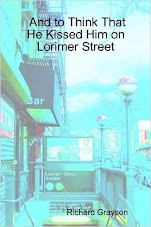
New York Brain Terrain reviews Richard Grayson's AND TO THINK THAT HE KISSED HIM ON LORIMER STREET

Michelle Lin reviews Richard Grayson's And to Think That He Kissed Him on Lorimer Street at New York Brain Terrain on February 15, 2007:

I was a frequent peruser of the Daily Cal , the school newspaper, and The Heuristic Squelch, the campus humor magazine, during my first two years in college. Squelch was often too raunchy and perverted for my tastes, but I loved their fake news round-ups and the letters from the editor. One particular letter from the editor that stands out in my mind is the one addressed to the freshman in fall 2000: "College," the editor opined, "is like a hypercolor t-shirt. It starts out with a brilliant pink burst of excitement, before slowly fading away to a blur of resentment and apathy." The editor also instructed the freshmen, "If you're one of those students who asks questions in lecture every day, just remember, there's a special circle in hell for you people."

Richard Grayson's recent collection of short stories reminds me of The Heuristic Squelch, both in its smart humor and its ability to induce belly-aching laughs. Composed alternately of semi-autobiographical pieces and humorous shorts, Grayson weaves a picture of Brooklyn (and New York) that is rarely seen in New York literature nowadays.

A native of Canarsie himself, Grayson's characters inhabit the outlying middle-class neighborhoods in Brooklyn and Queens: Flatbush, the Rockaways, Bensonhurst, Brighton Beach, Canarsie, and the like. His characters are wonderfully diverse, much like the city itself, ethnic, immigrants, LGBT--you'll not find a single straight upper-class WASP in the book (not that there's anything wrong with that). The strengths of this book, I felt, lay in its humorous shorts.

A particular one that stands out in my mind is "Diary of a Brooklyn Cyclones Hot Dog," a tale of a lesbian Uzbekistani teen whose job is to dress up as Nathan's Relish Hot Dog. During each game, there is a race between Ketchup, Mustard, and Relish, and, much like the Trix Rabbit who never gets to eat Trix, Relish is never allowed to finish first in the race. However, like the Trix Rabbit, Relish starts out every race absolutely determined not to finish last, but some unfortunate incident befalls her each time.

The semi-autobiographical short stories, while well-written, were a bit too confessional for my tastes; however, they are still interesting reads. Grayson's handling of his characters' sexuality is deft and never overbearing. Highly recommended.

Thursday, February 8, 2007

Saturday Night on the Lower East Side: Words + Music with Gayle Brandeis & Kelley McRae at Bluestockings


This was posted to Richard Grayson's MySpace blog on February 7, 2007:

Great reading and performance at Bluestockings


This evening I went to one of my favorite bookstores, Bluestockings on the Lower East Side. The incredibly cool publicist Lauren Cerand (I've been to eight or nine events she's done, and every one has been terrific -- I wish I could afford her services myself!) had told me about WORDS + MUSIC, featuring Gayle Brandeis, an acquaintance I met on the website Readerville, reading from Self Storage, her new novel.

The book has gotten great reviews, and Gayle read an early section of the novel, dealing with an auction for the contents of abandoned self-storage units. The descriptions were so evocative, I am really looking forward to reading Self Storage.

The music for the evening was provided by Kelley McRae. I liked her "Johnny Cash" song and also a new song, "It's Another Beautiful Day," which seemed to be about the South Williamsburg neighborhood. You should check out Kelley's music, too.

I took the First Avenue bus to 14th Street, and after buying some groceries, went to get the L train home to Brooklyn. I go to the front so I can get out of the Lorimer Street exit on the Lorimer Street stop (most people get off at Union Avenue).

I'm at this station a lot, and I always seem to see, where I like to stand, by where the second car of the train will stop, a certain rodent. Nobody else was around, and as I was getting to my usual waiting place, I found myself saying (aloud -- yes), "Where is my rat friend?"

At that precise moment, the rat came out of the hole in the wall beside me and scurried down the end of the platform into another hole.

Okay, maybe it's a bunch of different rats. But I like to think I've been seeing the same guy for months.

Sunday, January 7, 2007

The Philadelphia Inquirer reviews AND TO THINK THAT HE KISSED HIM ON LORIMER STREET by Richard Grayson


Today, January 7, 2007, Susan Balée reviewed Richard Grayson's AND TO THINK THAT HE KISSED HIM ON LORIMER STREET for the Sunday Philadelphia Inquirer:

Richard Grayson is a funny guy from Canarsie, Brooklyn, and he's been writing short fiction for decades. He's also a lawyer and a teacher, which doubtless does a better job of paying the bills. Which isn't to say he's not a wonderful fiction writer - he is - but his kind of metafiction, mixing his memories (numerous main characters are named Richie Grayson) with his inventions about pansexual borough dwellers dealing with minor and major crises, read like stand-up comedy routines. Only a few of the tales in this book (including the title story) are fully realized short stories in a traditional sense.

At first I wished he'd pen more of the longer, less autobiographical stories, but when I got into the rhythm of his riffs, I changed my mind. Here's his kind of shtick, from "In the Sixties": At the beginning of the Sixties women were girls and girls were chicks. By the end of the Sixties girls were women and chicks were poultry... . In the Sixties... I raised money for a black classmate indicted for murder. I raised money for a Chinese friend to have an abortion. I raised money for Chicano migrant workers I had never met, or expected to meet. Most of the money I raised originally belonged to other people's parents. This is very funny stuff, but it's a comic monologue rather than a story with the traditional elements of plot, characters, setting, and so forth.

Grayson has hit upon a good formula, though, to generate a piece of writing: the annotated list. Hence, he has "Seven Sitcoms," "Branch Libraries of Southeastern Brooklyn," "The Lost Movie Theaters of Southeastern Brooklyn and Rockaway Beach," and so on. But like Grandma's beef brisket, a little of this goes a long way. In these tales of places that mostly aren't there anymore, the main feeling induced in the reader is nostalgia. Unfortunately, if you're not from Brooklyn, much of it is nostalgia for something you never knew in the first place.

Still, in his memories of places he knew as a kid (Mill Basin library, for example, "where I first looked up 'homosexuality' in all the encyclopedias and dictionaries and where I watched the clock so I could go back home in time for Mom to think I'd actually been at Hebrew school, the place I was supposed to be"), we do learn a great deal about Richard Grayson, and he's an interesting guy. A bisexual kid who spent most of his teen years housebound by panic attacks, Grayson read and wrote (and watched TV - hence, "Seven Sitcoms") to survive. Finally, antidepressants helped him regain his sanity and get out of the house.

The fluid sexuality of the characters in these tales adds to their appeal, though mostly the gay main characters suggest Grayson at different ages, from uncertain virgin to gay role model for his young neighbors, Ryan and Sam: I don't get looked at much in any way anymore, definitely not by guys their age. Tempus fugited so fast it seemed like one day I went to bed looking like Chip and woke up the next morning looking like Uncle Charley.

Grayson's expertise on himself, his era, and his homeplace (Brooklyn) convince me that he should shape some of this material into a memoir and forget the metafiction for a while. Memoir is the genre in which Grayson, already an amply credentialed writer, could probably land a decent contract with a publisher people have actually heard of...

Richard Grayson has a fresh, funny voice...
______________________________
Susan Balée's comparative essay on playwrights David Hare and Tom Stoppard is forthcoming in the Michigan Quarterly Review.

Thursday, December 14, 2006

Book.of.the.Moment reviews Richard Grayson's AND TO THINK THAT HE KISSED HIM ON LORIMER STREET

On December 13, 2006, Book.of.the.Moment on MySpace reviewed Richard Grayson's And to Think That He Kissed Him on Lorimer Street:

About Richard Grayson's collection: His sense of humor is unlike any I've encountered before, and he expresses his wit through his creation of a diverse group of characters. "And to Think That he Kissed Him on Lorimer Street" introduces characters such as a teenage lesbian from Uzbekistan, and a black gay college student who debates poisoning his Pakistani roommate's therapy monkey. Grayson skillfully expands on his memories of the past with a pop culture study of sorts..weaving his past memories into his observations and experiences in the here and now. All this is done with a wit that caused me to laugh out loud.

Monday, December 11, 2006

Matt Bell reviews Richard Grayson's WRITE-IN: DIARY OF A CONGRESSIONAL CANDIDATE IN FLORIDA'S FOURTH CONGRESSIONAL DISTRICT

Matt Bell reviewed Richard Grayson's WRITE-IN: Diary of a Congressional Candidate in Florida's Fourth Congressional District on his blog on December 4, 2006:

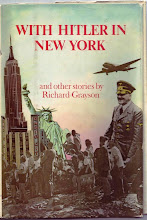
In 2004, Richard Grayson (author of With Hitler in New York and And To Think He Kissed Him on Lorimer Street) ran as a write-in Democratic candidate for the U.S. House of Representatives against a firmly entrenched Republican incumbent. His opponent, Republican Representative Ander Crenshaw, is almost abstract in his role as antagonist, having enough funding, support, and staff that defending his seat barely requires he even take notice of Grayson, who has no staff, no funding, and, at least, initially, no support. It's to Grayson's great credit that although he always knows what the outcome will be in his race for the House, he still puts an admirable amount of effort and time into reaching each potential supporter he comes across.

Grayson originally chronicled his race online for McSweeney's Internet Tendency (where you can still read the entire manuscript), and has republished his diary in book form. Here's an excerpt from the first entry from Grayson's book:
I'm the only registered Democrat in the race. But, unable to afford the nine-thousand-dollar filing fee to get the official party designation, I'm a write-in candidate. Under Florida's bizarre election laws, write-in votes count only if they're for "qualified" candidates like me.

If I weren't a candidate, Congressman Crenshaw's name wouldn't be on the November ballot. There just wouldn't be an election. Four of Florida's twenty-five House members were elected this afternoon when they did not get a primary or write-in opponent.

Over 90 percent of Americans live in congressional districts that are essentially one-party monopolies. Of Florida's twenty-five House seats, seven are safe for Democrats, and sixteen are safe for Republicans.

The Fourth is the most Republican district in the state. But I'm hoping to give anyone opposed to Crenshaw's positions a chance to vote for someone else.

In the last Congress, Crenshaw voted for more Bush tax cuts and the war in Iraq. He supported oil development in the Arctic National Wildlife Refuge, limiting the Patients' Bill of Rights, and banning "partial-birth" abortion. Crenshaw voted against campaign-finance reform.

As of March, his campaign committee had $612,691 in cash.

Mine had bupkis.

Grayson writes with a self-deprecating wit and a keen eye for the realities of both our overall political situation and that of Florida's Fourth District, where his campaign takes place. Times move fast, and after the semi-uplifting Democratic victory this past November, it may be hard to remember exactly how bleak things felt for progressive or Democratic voters in late 2004, but Grayson's diary, written in the heat of the moment, manages to chronicle not only the desperate backdrop of that election but also the awakening sense of progressive community that was nearly destroyed by the spirit-crushing reelection of George W. Bush and his Congress. Grayson writes much like he ran for the House, in that he isn't so much trying to convert us as voters as much as he is trying to show us that we do still have options when he vote, despite what our political situation seems to allow.

When asked what he'll do to support traditional marriage, Grayson says he'll kill Liza Minelli. His favorite part of living in Florida's beautiful Fourth District? "The hurricanes." He tells the same reporter that he's "too lazy to be in Congress," because "it's a lot of work." Openly transgressive when answering reporters and filling out lobbyist group questionnaire, Grayson couches every answer in a wit that's as cynically sarcastic as it is big-hearted, leading to the confusion of his interviewers and friendly recognition on the part of this reader, whose contradictory feelings of cynicism and optimism from 2004 were both crushed and vindicated by the final results of that election.

Clocking in at just over one hundred pages, Grayson's Diary of a Congressional Candidate in Florida's Fourth Congressional District is a deceptively quick read. Still, it's bigger than it looks. I finished the book in a single evening, but have found myself returning to it to enjoy not only the absurdity of the political situations but also the fine humor of Grayson's prose and the sense of comradery that permeates every page. He so openly shares the details of his ironic, winking candidacy that it's impossible not to cheer him on. Towards the end, a voter writes Grayson a letter thanking him for trying that the voter signs "your constituent," a sentiment that I too felt by the time I turned the final page. Although Grayson lost the race, his book tells it like a victory march, celebrating every small triumph won against impossible odds.

I couldn't agree more.

Thursday, November 30, 2006

Monday Night at Mo Pitkin's: AVERY reading with Dominic Preziosi and Richard Grayson


At Mo Pitkin's House of Satisfaction on Monday, November 27, 2006, at 7 p.m. there was a reading for the inaugural issue of Avery: An Anthology of New Fiction with contributors Dominic Preziosi and Richard Grayson. It was part of Mo Pitkin's Reader's Room series.

Here's the post by editor Andrew Palmer from the Avery blog on November 29:

Andrew: Avery takes on New York

Avery pulled off a big coup earlier this month when Francis Ford Coppola's Zoetrope: All-Story cancelled a reading in Manhattan and Avery was invited to take their place. The reading went down with a healthy dose of fanfare this Monday night on the second floor at Mo Pitkin's House of Satisfaction in East Village--a small, wood-panelled, night-clubby, noirish room with three long tables stretching from a curtained stage to the back of the room. It seemed to me to be about half-full--a more than respectable turnout for a new literary anthology that hasn't even been published yet. Leigh Newman, one of our writers (and our informant for this reading series) hosted, I nervously said a few words about Avery, and then I gave up the floor to our two readers for the night--Avery contributors Dominic Preziosi and Richard Grayson, both of whom I was meeting for the first time.

Dominic held us in thrall with his Avery story about a man and a woman in a hauntingly familiar semi-post-apocalyptic Manhattan. The first sentence is "In the aftermath of everything we meet up with the one-eyed priest." Now we're listening!

Richard read, in an appropriately neurotic, hyper-self-conscious voice, his Avery story about, about . . . . it seems to be about trailing off, about starting things and never being able to finish them--whether it's a PhD thesis or sexual intercourse or a hamburger. In any case it's hilarious, and everyone laughed a lot. My favorite part is where the narrator--oh I'll just quote it:
When I was young, Rilke admonished me nearly all the time. That “You must change your life” written so earnestly.
But mostly I was tired and preferred to close my eyes.
You must, Rilke would say.
But I just can’t now, not right now, I thought.
You must change, he said.
Tomorrow. Tomorrow I’ll do it.
Change your life, he kept saying.
Yes, yes. But not at this minute.
Your life, Rilke said.
So I reached for my pills, the little red triangular ones, the ones that helped me sleep. I swallowed two of them without water, and Rilke became silent.

Brilliant, Richard. Thanks again, really many many thanks, to Richard and Dominic for providing the meat of the entertainment on Monday--and of course to Leigh for hosting. (If you're in New York you need to check out the weekly Reading Room series at Mo Pitkin's.) We got the word out to a few more people, made a couple more connections, and had a wonderful time.

Monday, November 20, 2006

Flatbush Life and Kings Courier cover Richard Grayson's AND TO THINK THAT HE KISSED HIM ON LORIMER STREET


Flatbush Life and Kings Courier report on Richard Grayson's And to Think That He Kissed Him on Lorimer Street was the subject of an article today (November 20, 2006):

'Lorimer Street' Writer Turns the Pages on Brooklyn

by Helen Klein


Here [is]autobiography seen through the lens of fiction, fiction created through the maze of past life re-imagined – not Proust, considerably less dense, for one thing, but certainly not the unProust.

This is not to say that the stories in Lorimer Street are inaccessible to anyone who did not share Grayson’s college days or his clearly not-forgotten youth. To the contrary, in some ways they are an evocation of the quintessential school days, the bittersweet portrait of the artist as a young man. Not coincidentally, the son of the narrator of the story after which the book is named, asks his father, “Hey, Dad, how’d you like a chance to relive your past?”

Not only do the stories fictionalize a past life, they evoke a Brooklyn of times gone by, a Brooklyn fading in memory as the old-timers move to Florida or die, leaving behind the vanished movie theaters and other borough landmarks recreated in Grayson’s book, written by him while he lived thousands of miles away.

Joyce may have been the first writer who dramatized the need to articulate his memories of his home from a vast distance; he is certainly not the last.

“It’s very much so that you have to leave a place to write about it,” agreed Grayson, who cited emotional distance as well as chronological distance as important elements in shaping memories for the translation into fiction. But, he pointed out, leaving does not mean abandoning. Throughout his adult life he has left the borough and returned, living in different neighborhoods for a month or a season at a time.

Which may be one reason why, unlike Joyce, Grayson doesn’t confine himself to the past. One of the stories in his most recent collection centers on a man taking his son to a concert at the Williamsburg hot spot, Northsix. Another is entitled, “Diary of a Brooklyn Cyclones Hot Dog.”

“There are a lot of writers who’ve written about Brooklyn,” mused Grayson during a phone interview that felt, many times, more like a conversation. “It’s different for every person because the borough is such a treasure trove of different experiences.”

Grayson’s Brooklyn was one not only defined by the movie theaters and branch libraries, but by the buses, which he rode, criss-crossing the borough. “I always liked to explore Brooklyn,” he recalled. “I used to collect bus transfers so I would ride every bus line from one end to the other, so I actually did see a lot of Brooklyn.”

Grayson has already written about the tension between the Brooklyn of 30 or 40 years ago and the Brooklyn of today, in the book’s title story, which, he said, “Is really about two Brooklyn’s. The narrator is probably around my age and he lives with his wife and his teenage son from his first marriage.”

While the story is set in Williamsburg, circa 2005, it features recurrent flashbacks to Canarsie in the 1960s, a time when Brooklyn was a borough defined by the middle-class families who had moved from cramped apartments in older buildings into newly built homes somewhat distant from subway lines, such as the one lived in by the Grayson family in Flatlands.

Now, he stressed, the borough is different. There has been a new wave of middle class immigrants, Grayson noted, as well as a massive dose of gentrification. “It’s shedding its destitute art student image,” he remarked, in a reference to a Post article. “It’s not the Brooklyn I grew up in.”


Wednesday, November 8, 2006

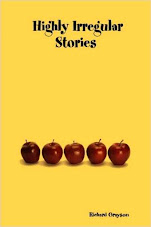
The Outsiders' Book Review from Underground Literary Alliance Reviews HIGHLY IRREGULAR STORIES & AND TO THINK THAT HE KISSED HIM ON LORIMER STREET


The prolific author Jack Saunders reviews Richard Grayson's two Dumbo Books short story collections for the Underground Literary Alliance's Outsider Writers' Book Review:

Richard Grayson: Highly Irregular Stories; And To Think that He Kissed Him on Lorimer Street and Other Stories
Reviewed by: Jack Saunders


Jack Saunders has met Richard Grayson, and Richard has met Jack.


Highly Irregular Stories (2006) and And to Think That He Kissed Him on Lorimer Street and Other Stories (2006), by Richard Grayson. Dumbo Books of Brooklyn, 72 Conselyea St., Brooklyn, NY 11211-2211. dumbobooks@yahoo.com

And to Think That He Kissed Him on Lorimer Street and Other Stories is Richard Grayson’s 10th volume of fiction. Or metafiction. Or autobiography. Or stand-up comedy. Or short form narrative. He’s published two other books. What are they? Nonfiction? Reportage? I always think of Jonathan Winters saying he is in gar-bahj, when I hear re-por-tahj.

I believe you could call the writing avant-garde. It’s out ahead of the pack. The avant-garde is a tradition, like any other. Like commercial fiction, or literary fiction. It’s anti-commercial. Anti-literary. The literary is a set of conventions an iconoclast wants to bust up.

An iconoclast is aware of his place in the scheme of things. He knows the history of what he’s doing. He is aware, or self-aware, and self-awareness leads to irony.

Irony lends itself to short pieces. You don’t want to be long-winded. That’s for novels, a more expansive form, where you can stretch out. In one sense, you could say the avant-garde leads the way. In another, profounder sense, you could say it doesn’t go anywhere, it just is. It is what it is. Take it or leave it. As it is. This makes reviewing a collection of short pieces either very easy or very hard.

What is the author trying to do, and is he succeeding, on his own terms? Larry wrote the other day that he found himself at looking at books in a rummage sale, and found he was reading them to see what bias they had; not to see what the book was about or to read for enjoyment or to get taken up by it.

What happens when we approach books like that? How do we not approach books like that?

Do collections of stories become something in the aggregate they were not, separately, as lone stories, in magazines that pay in copies and go belly up, or self-published chapbooks, issued in editions of hundreds of copies? Are they clever, amusing, cute? Do they hold up? Do we see a design to the works, over time? A pattern? Is a collection of them more impressive, more authentic, does it have a gravitas scattered fragments cannot demonstrate? Are we impressed? Are we surprised? Did we disremember? Do we see things we didn’t see the first time through?

You can buy the books from lulu.com for $12.95 or $16.95. Highly Irregular Stories is a collection of four chapbooks, which are out of print, and rare. A copy of Eating at Arby’s was recently listed online at $350. It’s good to see the stuff back in print. The stories in And to Think That He Kissed Him on Lorimer Street haven’t been collected before. It’s nice to see them in one spot.

What is One Life in the Short Form Narrative Business like? We get a good feel for it, in these two collections, which span three decades.

What is America like? It’s like Richard Grayson says it is, it’s how Richard Grayson sees it. He’s a Jew from Brooklyn, I’m a cracker from Delray Beach. We have different accents, different life-experiences, different expectations, about life. I’m older than he is, and was in the Air Force for eight years. I boxed. I went ten rounds with Bukowski. I fought the Creature from the Black Lagoon underwater, at Wakulla Springs.

Now I just sit around and watch my boot turn blue, from mildew.

But his America rings true, to me, a deep and eclectic literary sensibility in a pop-culture milieu of glitz and flash, the shallow and the hyped, pinball-machine moths, attracted to the light, the noise, the buzz. Love-bugs, smashed on the windscreen. In the throes of their mating ritual. Up around Gainesville on a two-lane blacktop. Harry Crews afraid to leave his writing studio because he might miss something. And Harry Crews ain’t afraid of death or taxes.

A reader said he kept my books on the back of the crapper, and he started every day with a good old country shit and a belly laugh.

That’s a good thing to do with Richard Grayson’s books. Keep them on the back of the crapper and read them every day. They will make you laugh. The stories are short enough you can read one at a sitting.

My theory is that we are attracted to a writer’s voice, and every time we find a writer we like, we buy everything by him or about him we can find, regardless of genre. If he’s any good, he has invented his own genre, conflated one or more genres into a form of his own, which we recognize, because of his distinctive voice.

Bud Powell had small hands. Mary Lou Williams had hands that looked like $10 worth of spareribs in 1937. They’re not going to sound the same. Why should they? If the short pieces have a unity of form, a consistency of vision, a continuity of effort, a tone, an outlook, when do they begin to be less self-contained short pieces and constituent parts of a longer work composed of short pieces, if they do? If they do, was it an accident?

Public taste is fickle. A writing career is a tradeoff and a crapshoot. You can make a fortune writing but not a living. Not even the living you’d make at more mundane tasks. You have to have a sense of humor about it.

A sense of black humor, like the old comics Lenny Bruce, Mort Sahl, and Shelley Berman. The writers Woody Allen, Richard Brautigan, and Terry Southern. Would you choose writing for a career? You don’t choose it, it chooses you. What if you choose it and it doesn’t choose you?

Can you be funny about that? For 30 years? It’s not as easy as Richard Grayson makes it look.

The stories in the second book are newer and darker than the stories in the first book. Branch libraries are closed, movie houses shut down, neighborhoods gentrified, people moved away, friends died, what was not there, then was new, and ugly, is now shabby, with people hanging on, because they have no choice. There are constants. The stock market rises and falls, real estate goes up, people have careers, careers have an arc, not all careers have the same arc.

Richard Grayson once observed to me that writers advise you to do what they did. If they teach writing, they advise you to teach writing. If they are some other kind of professional, they advise you to be some other kind of professional. He was a lawyer. Journalists advise people to write for newspapers or magazines. Or television. I was a paraprofessional. A technical writer. Not an engineer or a programmer. On a par with a draftsman or a logistician (supply specialist). A white collar job, but not a full-fledged profession.

What is true is you need a job that pays enough so you can live comfortably, and are not so tired by your work that you are too tired to write, after work. And that can mean too tired emotionally. Then you just do your job and write before and after work. Or during work.

Maybe you’ll have a year off now and then, when you win a grant, inherit some money, or, in my case, once, are able to draw 49 weeks of separation pay, unemployment, and extended unemployment benefits, plus social security, or, another time, cash in the retirement you rolled over into an annuity when your last corporate employer laid you off and live on that for a year. Or mortgage the house you inherited when your grandfather died and run up the balance on a line-of-credit home-equity loan.

I’m always curious about how a writer supported himself when he wrote the books, and think that should go in the books. I think a reader has a right to know that.

Did he kiss a Stalinist’s ass in Macy’s window?

I enjoyed reading these books and I think you will too. I think they’re worth going to some trouble to find out about and buy. And tell your friends about.

And tell the author about them, if you liked them.

Sunday, September 17, 2006

Blogcritics.org Reviews HIGHLY IRREGULAR STORIES by Richard Grayson

On September 16, 2006, Nancy Gail reviewed Highly Irregular Stories for Blogcritics.org:

Highly Irregular Stories is an anthology of four Richard Grayson chapbooks. Although not for every taste, selections are intriguing enough to keep the reader turning pages until the end.

"Inside Barbara Walters" examines what might have happened if a young girl had not had a flash of inspiration when it came time for show-and-tell in second grade. Having left her stamp collection at home, young Barbara reached into her backpack and grabbed her Curious George book. After that, all she had to do was mention her interest in reading and the day was saved.

"Progress" takes the relationship between a young man and a stranger and brings it full circle. Ricky is prevented from buying the wrong shirt in Bloomingdale's and ends up going home with Eric Cornell. While Eric fixes dinner for the two of them, he suddenly remembers a neighborhood association meeting he must attend. For some reason, he has gotten himself named in charge of the tree parent committee. Ricky is left at Eric's place to fend for himself. When Ricky calls a pharmacy for a sleep aid, a young teenager named Rico delivers it.

"17 Fragments in Search of a Story" is exactly what the title implies. An author talks about himself and the book he is trying to write in 17 parts. While there is a natural flow to the sections, the ending is not one readers are going to forget.

"Eating at Arby's" was the longest selection and the one I liked least. A retired couple moves to Florida (where else?) and discovers life is not quite what they imagined. In a bizarre move, Grayson takes their day-to-day banter and turns it into an irritating form of repetition. It makes the two main characters sound like idiots. However, I found the reference of wanting to take a trip to Columbia amusing.

"The Governor of the State of Depression" looks into the life of a politician and shows the glamour of a life in public office is not always what people think.

Grayson is hardly a typical author. He takes real life issues in society and uses them freely in every story he writes. With the varied selection, readers will find at minimum one thing they like even if they consider the rest to be junk.

Sunday, September 10, 2006

Judd Lear Silverman Reviews Richard Grayson's AND TO THINK THAT HE KISSED HIM ON LORIMER STREET

On his eponymous blog, Judd Lear Silverman reviewed Richard Grayson's And to Think That He Kissed Him on Lorimer Street on September 9, 2006:

If you're not familiar with the writer, Richard Grayson, you should be, especially those who love the short story form. Besides spending time on bogus runs for political office and publicity stunts that have graced People and Page Six in the Post, Grayson's been writing prolifically for years, and his first anthology, With Hitler in New York, was recently reissued. Other humorous writings have included the collections I Break for Delmore Schwartz, Eating at Arby's: The South Florida Stories, and Narcissism and Me, as well as a novella, The Silicon Valley Diet. [Some of these stories have also been reprinted in Highly Irregular Stories (Dumbo Books).] But his recent collection, entitled And to Think That He Kissed Him on Lorimer Street, is perhaps the best collection to start with, reflecting not only his gifts as a satirist but his ability to keep the mind so busy it doesn't know that the heart has been touched. Like a reality TV junkie, Grayson mixes seeming fact with fiction, borrowing names, places and people from his own life and shaping them into odd and effecting commentaries on the passage of time, family relationships, sexuality, race relations, and America's pathological preoccupation with celebrity. Some stories are quick brushstroke sketches of people and a particular time. Others are journeys told in vignettes stretching spans of 20-30 years. Friendships are explored in sideways glances, showing how the most unlikely of alliances can turn into lifelong relationships. Numerous stories (perhaps one too many for the same collection) are subdivided by real estate locations: old movie palaces, libraries, and shopping centers, where seemingly innocuous events are recalled that by the end of the story add up to a whole lifetime of experience. Grayson shape shifts from gay to straight, white to black, male to female, kid to aging wit. Grandparents and childhood buddies play recurrent and important roles, but discerning fact from fiction in Grayson's work is tricky until one considers these stories in the aggregate. In the biography of the great Italian filmmaker, Federico Fellini, the maestro is quoted as saying that the truth of his life is not in the facts reported by birth certificates, death notices and journalistic reportage, but in his art, his dreams, his films--it is in the revelation of the imagination that the real artist is known. Likewise, the truth of Grayson is in these tales, invented and reinvented versions of his life and experience. The facts may not be verifiable, but the affection and care he displays in his description of life's travels and the people in his life are real, resulting in stories that are affecting and sharply observed. Recommended.

Monday, August 7, 2006

Bookgasm Reviews HIGHLY IRREGULAR STORIES by Richard Grayson


Ken Davis has reviewed Highly Irregular Stories at Bookgasm:

With HIGHLY IRREGULAR STORIES, I can’t think of adjectives that more accurately describe this collection of Richard Grayson’s writings than the first two of his title, although unorthodox, quirky, peculiar and highly entertaining also come to mind.

This book is purportedly an accumulation of stories originally published in the 1970s and ’80s in four separate chapbooks (DISJOINTED FICTIONS, EATING AT ARBY’S, THE GREATEST SHORT STORY THAT ABSOLUTELY EVER WAS and NARCISSISM AND ME), all long been out of print. I wouldn’t exactly describe the contents as stories, at least in the traditional sense anyway. Many of them might be better described as vignettes or sometimes as just snippets of a fictional conversation. Heck, “Some Sad News” is a mere 180 words. By comparison, this review is roughly 450. I didn’t find any exquisite plots or character development, but I was too busy enjoying myself to care.

Grayson is a literary performance artist. His words are avant-garde and so uniquely different than anything else I’ve ever read., as the book is chock full of the offbeat. Take the narrator in the 147-word “Ordinary Peepholes,” who spies the scrawled message on a subway “FOR A GOOD LAY CALL 969-9970.” He recognizes the phone number as his sister’s and the handwriting as his father’s. Or how about the very subtle but delicious irony in “I Saw Mommy Kissing Citicorp,” in which the Chairman of the Federal Reserve Board who oversees the ebb and flow of cash in this nation has trouble with an ATM and can’t withdraw $200.

The entries from EATING AT ARBY’S were by far the most entertaining, written in the style of the old Dick and Jane readers, but updated to feature the liberal thinkers Manny and Zelda. These two don’t discuss how fast Spot can run, opting instead for more adult subject matter. For example, in “Strange Experience,” Zelda comes home and announces, “Look what I have got, Manny. I have some cocaine.” Manny replies, “So that white powder is cocaine. I have heard a lot about it from many people.”

Manny and Zelda are taken to a gun range by their friend José in “Fun with a Gun.” Zelda warms to the idea of firearms and says, “Manny, I want to shoot that gun. That gun will become our friend, just like José is our friend.” The topics of murder, homosexuality and outrageous electric bills also are tackled by the pair. Sasson Jeans and the Arby’s salad bar at Arby’s also make hilarious repeat appearances.

I highly recommend this book and reading in general. So do Manny and Zelda. In “Shopping in the Mall,” Zelda says, “I read a book once. It made me think.” Manny replies “Thinking is fun. I like to think.” – Ken Davis

Saturday, July 15, 2006

Kirkus Discoveries Reviews HIGHLY IRREGULAR STORIES by Richard Grayson

Kirkus Discoveries reviewed Highly Irregular Stories by Richard Grayson on July 14:


HIGHLY IRREGULAR STORIES
Author: Grayson, Richard


Review Date: JULY 14, 2006
Publisher:Dumbo Books (178 pp.)
Price (paperback): $12.95
Publication Date: 2006
ISBN (paperback): 1-4116-5796-9
Category: AUTHORS
Classification: FICTION

An audacious and wickedly smart comedic writer brings his full weight to bear in a collection of his early work.

Grayson, no stranger to experimentation, here assembles four of his most engaging chapbooks, which merge nicely as an eclectic anthology of intriguing short stories. The author, who breaks nearly every literary rule in an obsessive effort to be unique, is both maddeningly and hilariously self-aware. “Narcissism and Me” leaps dizzyingly between the author’s presence and the actual story like a snake eating its tail, while “Sixteen Attempts to Justify My Existence” reads like a blog from another planet, and “I Saw Mommy Kissing Citicorp” waxes poetic on the rise and fall of 1980s greed. No business is safe, either, as Grayson mocks traditional publishing’s buzzed-based marketing with caustic sarcasm in “The Greatest Short Story That Absolutely Ever Was.” In “The Facts Are Always Friendly,” the action is narrated through a series of terse, date-stamped factual statements. Grayson opens up in the meatier “Eating at Arby’s,” a clever spoof written in childlike prose. It details the absurd dichotomies of South Florida as a pair of retirees fall prey to consumerism, political exiles and even gunplay on their way to the mall. With a keen eye for highlighting the high anxieties of the modern world, and many of the sensibilities of a sensitive urban writer, Grayson is occasionally compared to Woody Allen. But Grayson’s stories here recall no one so much as Richard Brautigan, who walked a similar line between wit and warmth in his more eccentric novels. Though certainly unconventional, Highly Irregular Stories are refreshing because of their aloofness, which allows the author to indulge his peculiar point of view.

An iconoclast sways to his own beat, making beautiful music along the way.

Monday, July 3, 2006

QueerType on Richard Grayson's WITH HITLER IN NEW YORK


Jameson Currier writes about "With Hitler in New York" at his blog QueerType on July 2, 2006:

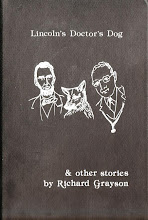
Three Discoveries: During the spring, works by three writers came to my attention that I can highly recommend, one is Richard Grayson's surreal and thought-provoking short story, "With Hitler in New York," which was also the title of a collection of his short stories that were published in the late 1970s and which has been recently reissued. In the story, Hitler becomes a stand-in for the alienation and discrimination many Germans felt in the decades after the war. The story is readable on-line via a link on Grayson's Web Site. (http://www.richardgrayson.com/) Grayson also has an impressive political background (in the 1980s he was a Presidential candidate), but it is his short fiction that intrigues me most. His other collections worth exploring are Let Slip the Dogs of War, Lincoln's Doctor's Dog and Other Stories, and his most recent collection, And to Think He Kissed Him on Lorimer Street.

Saturday, July 1, 2006

Literary Kicks reviews Richard Grayson's AND TO THINK THAT HE KISSED HIM ON LORIMER STREET

Levi Asher reviewed Richard Grayson's And To Think That He Kissed Him On Lorimer Street at his blog Literary Kicks (LitKicks) on June 29, 2006:

Richard Grayson's And To Think That He Kissed Him On Lorimer Street allows the touching moments to sneak up on the reader. This is a surprising collection of assorted writings by a veteran Brooklyn author who once published a diary of a New York City congressional campaign and has produced numerous other books with intriguing titles like The Boy Who Fell To Brooklyn and I Brake For Delmore Schwartz (a long list of the author's books can be found here). I really like the first story in this collection, in which a good-humored narrator chaperones his teenage son to a loud punk concert at the Northsix club in Brooklyn. His son is openly gay, and the title of the book is explained when the trio amass at the L Train subway entrance on Lorimer Street and the father averts his eyes, wondering at his own amazing tolerance, while the two boys kiss goodnight. Elsewhere, Grayson's book gives us a tour of Brooklyn neighborhoods, a list of bad sitcoms nobody else remembers, and many other scattered ideas. The book has more sprawl than focus, but then so does the borough it proudly represents.

Monday, June 26, 2006

Kaye Trout Book Reviews reviews HIGHLY IRREGULAR STORIES by Richard Grayson

Kaye Trout's Book Reviews has reviewed Highly Irregular Stories by Richard Grayson:

Wednesday, June 21, 2006
HIGHLY IRREGULAR STORIES by Richard Grayson


Dumbo Books of Brooklyn
72 Conselyea Street, Brooklyn, NY 11211
http://dumbobooksofbrooklyn.blogspot.com
www.richardgrayson.com
Genre: Fiction/Humor
Rating: Unusual
ISBN: 1411657969, $12.95, 177 pp, 2006

Highly Irregular Stories is, indeed, a most appropriate title for this compilation of prior writings: Disjointed Fictions, Eating at Arby’s, The Greatest Short Story That Absolutely Ever Was and Narcissism and Me.

Richard Grayson opens with: "The anarchist’s bomb that killed Czar Alexander II in St. Petersburg in 1881 led to the Russian pogroms and the anti-Semite May Laws of 1882. To these events we Americans owe countless things: the comedy of Woody Allen and Lenny Bruce; the popularity of psychoanalysis . . ."

It’s interesting that Woody Allen and psychoanalysis are first among his list and that’s just what I was feeling as I read this book. Grayson has taken that Woody Allen-type New York humor about a self-deprecating, neurotic, talented man one step further into the twilight zone.

As I’m not a New Yorker and never could fully appreciate Woody Allen’s humor, I’ll let the book stand on its own. My experience of reading Eating at Arby’s about Manny and Zelda in downtown Miami brought back memories of learning to read with Dick and Jane. It almost has the same rhythm and meaningful depth. We were just missing "See Spot run."

But to be fair, I would like to quote from "Myself Redux" which I particularly enjoyed: one, for the historical perspective and two, for the Kurt Vonnegut-flavor of humor:

""On Wednesday, the thirteenth day of October in the year many people call 49 B.C., Caius Julius Caesar, a Roman general, crossed the ancient watery boundary between Cisaplin Gaul and Italy known as the River Rubicon, thus making immortal the phrase "to cross the Rubicon," meaning "to take a decisive and irrevocable step."

Precisely two millennia later, on Wednesday, the thirteenth of October in the Christian year 1951, my Jewish parents took a decisive and irrevocable step in a room of the Quality Courts Motel outside Corning, New York. Within a week, the embryo that was to become the person writing these words was as large as one of Caius Julius Caesar’s fingernails. A tube formed within the embryo. This enlarged at a certain point, and then it began to pulsate. Eventually this pulsating tube developed into a four-chambered organ which circulated the fluid known as blood throughout my body.

On Sunday, October 17, 1971, 185 years and one day after the establishment of the United States Bureau of the Mint, I decided that my four-chambered pulsating organ had been broken because I had found the 18-year-old female whom I described as my "girlfriend" in bed with my 16-year-old brother, their four-chambered organs pulsating rapidly.

One week later, on the twenty-sixth anniversary of the establishment of the United Nations, I attempted to stop the pulsating of my four-chambered organ by making a three centimeter incision with a razor blade across my left wrist.

The following Monday, October 25, 1971, known that year as "Veterans Day" due to federal legislation enacted to give citizens a three-day holiday weekend, I found myself in the offices of the clinical psychologist Marilyn Wertheim, crying into a tissue.""


The story goes on to tell us: his girlfriend becomes pregnant, his brother is killed when hit by a bus, he marries his girlfriend, she has the baby, he doesn’t know whether he’s a father or an uncle, the baby dies, and they annul the marriage. There’s more but that will give you an idea of the beginning.

So, if you’re a Woody Allen fan and using the same stuff as Richard, you just might enjoy this book and a trip into the twilight zone.

Richard Grayson is a prolific writer and to appreciate who he is, what he has accomplished and what he has written, I refer you to his website: www.richardgrayson.com.

Reviewed by Kaye Trout - June 21, 2006 - Copyright