Pages

Showing posts with label 32801. Show all posts

Saturday, December 6, 1997

Richard Grayson column in Orlando Sentinel on Soap Opera Careers


Richard Grayson has a column in the Orlando Sentinel today (December 6, 1997) on getting career advice from soap operas:
I was a kid when I first noticed that characters in daytime dramas could go from being construction workers to brain surgeons as rapidly as the plots dictated.
Bruce Sterling, a character on the old CBS soap Love of Life, metamorphosed in the space of a decade from high-school principal to paper-company executive to college dean to newspaper editor to the mayor of his city.

If Russ Mathews on Another World could leave town one day as a drugstore clerk and return a few months later as a fully qualified physician, I figured I could pull off career changes just as easily.

I got into my first career as a college English instructor somewhat by accident. I had been working in a library when I was asked to take over the night class of a professor who had died suddenly. I was terrified the first time I faced my students, yet the dread I felt before each class soon turned into sweet anticipation as I became more comfortable as a teacher.
But after a decade as a college English instructor, I began to burn out. At my Florida community college, each year I taught 12 courses and graded about 150 student essays every week.

I didn't want to be doing this for the rest of my working life, but teaching was the only real profession I knew. Could I switch occupations as easily as the folks on As the World Turns did?
Well, not quite. I learned that it was helpful to pick a new career that was somewhat related to the old one. When computers were introduced at our college, I took to them right away. Soon I knew six computer languages and numerous software programs and got a job training public-school teachers to use the new technology.

Training people how to use computers wasn't all that different from teaching students how to write essays, after all. But after several years as a computer trainer, I wanted to try something completely different.

When I watched Trevor on All My Children transform himself from a cop to a lawyer so painlessly, I figured I could do it, too - although I knew that it would take me three years of law school, not the three months in which Trevor went from arresting crooks to defending them in court.

At law school, I met other older students who were downsized by corporations or who left careers in the military or journalism, and we encouraged and supported each other in our transitions.

Since graduation, I've worked as a lawyer involved in education and computer-technology issues. I've been a lawyer for three years now, and, as much as I enjoy legal work, I'm again beginning to get restless - even if I'm no longer so young. Ever since Marty on One Life to Live exchanged her life as a pianist for a new one as a surgeon, I've found myself surfing Web sites of medical schools to learn about their admissions policies.

Sunday, October 26, 1997

Richard Grayson Op-Ed Column in Orlando Sentinel: "McCollum's Dangerous Bankruptcy Bill"


Richard Grayson has an op-ed column in the Orlando Sentinel today (Sunday, October 26, 1997), "McCollum's Dangerous Bankruptcy Bill," opposing legislation introduced by U.S. Rep. Bill McCollum (R-FL) that would change the nation's bankruptcy laws in a way that would hurt consumers and favor the credit-card industry.

Saturday, April 12, 1997

Richard Grayson column in Orlando Sentinel discusses bribing Brooklyn road test examiners


Richard Grayson's column in the Orlando Sentinel today (Saturday, April 12, 1997) discusses bribing Brooklyn road test examiners.

Friday, January 24, 1997

Richard Grayson Op-Ed Column in Orlando Sentinel: "Welfare vs. Jackpot of Hypocrisy"


Richard Grayson has an op-ed column in the Orlando Sentinel today (Friday, January 24, 1997), opposing Florida State Rep. Jorge Rodriguez-Chomat's bill that would deduct past welfare payments from Florida lottery winnings.

Saturday, July 8, 1995

Richard Grayson Advice Column in Orlando Sentinel


Richard Grayson has an advice column in the Orlando Sentinel today (Saturday, July 8, 1995).

Sunday, April 18, 1982

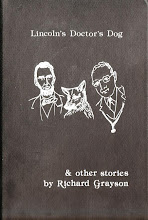
Orlando Sentinel reviews Richard Grayson's LINCOLN'S DOCTOR'S DOG


Today's Orlando Sentinel-Star reviews Richard Grayson's Lincoln's Doctor's Dog:


Orlando Sentinel

April 18, 1982

Books


Grayson is more than Bellow clone

____________________________________
Lincoln's Doctor's Dog and Other Stories

By Richard Grayson

White Ewe Press: Adelphi, Md., $11.95


BY J.F. HOPKINS

Special to Sentinel Star


"Lincoln's Doctor's Dog" is the title story of a collection of 22 fictions by a highly gifted young Florida writer and English professor at Broward Community College named Richard Grayson. I say fictions rather than stories, the conventional word. Most of what Grayson writes is not conventional. (These 22 fictions/stories originally appeared in 22 publications.)

In the last piece in the book, the author confesses – I think we may assume the narrator is speaking for the author – that he yearns to be part of The New Yorker world. Unfortunately for Grayson, I am not a New Yorker editor. As such, I would have gladly accepted, among other contributions, "A Sense of Porpoise" and "Here at Cubist College."

Early in the book, I thought of Saul Bellow. It wasn't a matter of influence. I find his work and Grayson's unalike. It was something else that brought Bellow, usually cited as our most cerebral fiction writer, to mind. Grayson has a splendid command of language, he is steeped in literary history, is highly intelligent. All things that have been said of Bellow. But the 1976 winner of the Nobel Prize for Literature never seems burdened by a feeling that he is but laboring in well-plowed fields, that the road to originality lies in constant experimentation.

Grayson is obsessed with avoiding those well-plowed fields. Straightforward narrative is old-hat, though to show that his hands are clean he occasionally takes time out to demonstrate that he can excel at this too. As a sort of unfair litmus test for whether you will enjoy Grayson, I quote two puns and a locker room exhortation by the Coah.

1. "There is no middle ground between us. I have led a bowdlerized life, while you have led a baudelairized one."

2. "…she had ignored all small Krafft-Ebbing warnings."

3. "Every time you think, you hurt the team. Every time you think you hurt the team you're right. Gents, get out there and win this one for Edmund Wilson!"

In still another vein, and unlike anything else in the book, is "I, Eliza Custis," written as a nineteenth-century memoir by a granddaughter of Martha Washington. I didn't find it compelling reading. But only a master of prose could have made such a narrative ring true, and it does. In the concluding piece referred to earlier, a young writer blurts out to Saul Bellow: "…your books mean a lot to me." My thinking of Bellow at the beginning of the book became more explicable.

My advice to the young writer would be to emulate Bellow in one crucial respect: Let your instinct be your guide. Don't worry about what's been done before. If Joyce took fiction as close as it can get to Yes and Beckett to No, there is still plenty of room somewhere in between for Saul Bellow. And for Richard Grayson.

_____________________

J.F. Hopkins is an Orlando novelist and short story writer.