Showing posts with label Saul Bellow. Show all posts
Showing posts with label Saul Bellow. Show all posts
Saturday, April 2, 2016


Friday, August 12, 1983
New York Times Book Review reviews Richard Grayson's I BRAKE FOR DELMORE SCHWARTZ


This coming Sunday's New York Times Book Review features a review of Richard Grayson's I Brake for Delmore Schwartz:
The New York Times Book Review
Sunday, August 14, 1983
Page 12 (continued on page 29)
Uneasy in Brooklyn
THE ONE-STAR JEW
By David Evanier.
223 pp. Berkeley, Calif:
North Point Press. Paper, $15.
I BRAKE FOR DELMORE SCHWARTZ
By Richard Grayson.
95 pp. Somerville, Mass:
Zephyr Press. Paper, $4.95.
By IVAN GOLD
A character named Bruce Orav has been spooking David Evanier for a good part of Mr. Evanier's creative life. Orav is a writer from Brooklyn, with divorced parents (a real couple of characters) to whom he remains in emotional bondage. He has an equivocal sense of his Jewishness; a number of idiosyncratic shrinks (some of whom he abandoned, some of whom abandoned him) trail in his wake; and he is a party to a never-ending quarrel, most of its battles lost, with the recalcitrant stuff of life, in his attempt to wrestle it into some kind of fictional shape.
Orav was about to turn 30 when Mr. Evanier's earlier account of his misadventures, "The Swinging Headhunter" (1983), came to a halt, and Orav has just had his 40th birthday as "The One-Star Jew" ends, or almost ends: These 14 stories that jounce Orav (along with his wife, Susan, and stepson, Danny) through his 30's are not quite chronologically arranged. Thirteen of them have appeared previously in magazines (three in The Paris Review, of which Mr. Evanier is fiction editor), and the title story was reprinted in "Best American Short Stories, 1980," so that there would seem to be some sort of consensus—although I am not able to share it—that each Oravian chunk has enough density to stand on its own.
These first-person narratives range in size from three pages to 42. In an example of the former ("A Safe Route on Eighty-Third Street"), Orav and his wife, who remains an extremely shadowy figure in these pages, endeavor to sublet an apartment from a dotty lady on the East Side, then think better of it. The story "The One-Star Jew" is, on the other hand, a lengthy account of Orav's employment at "JFI" ("Jews for Israel"). Or more accurately, since Orav, despite his first-person narration and a liberal but arbitrary smattering of his dreams and memories, is not much more clearly rendered than his wife, it is the account of the quirks and crochets and sex lives and medical histories of the two men in their mid-50's with whom Orav works most closely. There is probably a first-rate novella to be written about office politics and personalities in a fund-raising organization, with or without the Jewish touch, but this is not it.
Fortunately, Orav's attempts to reduce his parents to subject matter are continually thwarted by these bouncy individuals themselves. Orav's short story entitled "My Mother Is Not Living," which she has read, is probably think indeed next to the woman in the flesh, eked out by Orav's painful memories of her old maternal failings—for example, the time she neglected to rescue him from the attentions of her hairdresser, who, making a house call, fondled the 10-year-old in the bathroom, under the cover of cutting his hair. And the fact that his father ("I have used my father as a guinea pig for my stories and poems most of my adult life") totes around with pride a copy of an unflattering description of himself written by Orav, and "whips it out to show to strangers," is a far more arresting piece of business than the description itself.
But the book's most splendid creation lives in the story "The Lost Pigeon of East Broadway." Widowed and crippled, the 84-year-old Annie Blocker survives quite nicely, thank you, the do-good weekly visits of Orav and Susan as well as the barbed attentions of a series of "black Home Care workers," who, if they bear her no ill will to begin with, are soon enough sucked in by her cantankerous combativeness. Annie Blocker ponders the larger questions: Is a wheelchair really any less humiliating than a walker? Can a Jewish man be a crook? (Yes, she decides, when she remembers Rabbi Louis Ribman, "king of the nursing homes.") She is bigoted, canny, loving, ungrateful, witty and obscene. Where do they come from, Orav wonders, these people still clinging to life on the Lower East Side, "these new old Jews?" The whole of this collection may or may not add up to more than the sum of its parts, but Annie Blocker is worth the admission price.

A less hefty tariff will gain you access to Richard Grayson's fifth book, "I Brake for Delmore Schwartz," whose title may have had life as a bumper sticker before it was placed on this collection of 15 short stories, all previously published in little magazines like The Smudge and Street Bagel. The stories generally revolve around a chap named Richard Grayson. This character, like Mr. Evanier's, is a writer from Brooklyn, uneasy in his Jewishness and very concerned with the esthetics and mechanics of turning things into fiction, and fiction into things.

Mr. Evanier's and Mr. Grayson's stories are full of insanity, nutty therapists, cancerous relatives, broken homes, fiction workshops, youthful theatricals at Catskill bungalow colonies and the morbid wizardry of telephone-answering machines. Writing at less than the top of the their forms, both writers appear as sensibilities in search of story, grab bags of meaningful memory, acute perceptions and mordant social comment, which neither seems able to sift through and transform into art. Yet now and again for Mr. Grayson the shticks become inspired, as in a two-page meditation on the letter "Y" ("Y/Me") in the present volume and in the story "Inside Barbara Walters" in "Disjointed Fictions" (1981).
The histories of some of Mr. Grayson's other characters, like that of Saul in "That's Saul, Folks," are artfully telescoped and given equal valence with the history of the times. That is to say, where were you, reader, when the lights went out for the city of New York? In "Is This Useful? Is This Boring?" fictional beings named Joyce Carol Oates and Donald Barthelme square off over the issue of the fragment as a viable literary form, but then they patch up their differences. The title story threatens for a while to turn into a well-made story about two friends involved with the same woman, and both fearful, in the computer age, of continuing to lead the hand-to-mouth artistic life, but it pulls back just in time. If one is not blessed with a gift for extended narrative (a problem Mr. Grayson faces squarely in "How Not To Write a Novel" in "Lincoln's Doctor's Dog and Other Stories," 1982), then why not go for the spring? And in a 24-page pamphlet, "Eating at Arby's" (1982), Mr. Grayson mastered, or invented, a style equidistant between Hemingway's short stories and Dick and Jane, a feat probably useful and, at that length, far from boring.
In "Nice Weather, Aren't We?" in the present collection, the grandfather of the character Richard Grayson has been leafing through an anthology of Jewish stories put together by a famous writer named "Ballow." "He looked at me conspiratorially. 'Personally,' he said, 'I prefer your little antidotes,'" Others may, too.
________________________________________________________________________
Ivan Gold is the author of "Nickel Miseries," a collection of stories, and "Sick Friends," a novel.
Monday, May 17, 1982
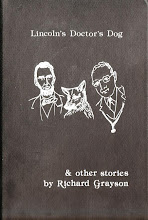
Best Sellers reviews Richard Grayson's LINCOLN'S DOCTOR'S DOG

The May 1982 issue of Best Sellers has a page 47 review of Richard Grayson's Lincoln's Doctor's Dog:

Grayson, Richard
Lincoln's Doctor's Dog & Other Stories
White Ewe Press (PO Box 996, Adelphi, Md. 20783),
187p., $11.95
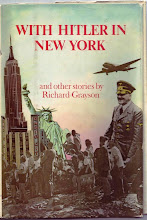
Despite my initial reservations regarding this volume when it reached me, I must confess I like Richard Grayson and his work. Yes, we are told that Grayson labored as a messenger at the Village Voice, a clerk at the Brooklyn Public Library, a delivery man for the Midtown Florist and the Canarsie Laundry; but Richard Grayson is a writer, currently transplanted to Broward Community College in Florida, but still a writer whose With Hitler in New York caused Rolling Stone to map it as the place "where avant-garde fiction goes when it turns into stand-up comedy."
These twenty-two fictions display a versatility which commands attention. And they are very much in the American grain -- that vein of autobiography which has been a constant from the beginning of our literary history down to the confessional mode of the recent mode of the recent past. The title tale, which is certainly captivating, pretends to be the biography of Lincoln's doctor's puppy who grows up to be elected to a state governorship and achieves fame as a lecturer. Grayson can parody human excess and human frailty, parent-child relationships, and recreate a 1960s scene with poignancy. There is even a dazzling memoir of George Washington's step-granddaughter. And in "Diarrhea of a Writer," Grayson exposes that pride and pain which are the nutrients of a writer's growth. The questions he wanted to ask Saul Bellow: "Did you ever doubt yourself? How do you know when you've written something important? Did you ever want to give up?" -- these all fade when the Nobel Laureate tells Grayson, "I'll look for you."
Richard Grayson has been found, at least by this reader, and found-out, too. From the evidence he is serious and comic, charming, given to outrageous puns, and a sharp-eyed observer of and participant in life's absudities. Permit me one academic correction -- it is Edwin (not Edward) Arlington Robinson, as found on page 75.
NICHOLAS J. LOPRETE, JR., specializes in American fiction at Fordham University, Bronx, New York.
Sunday, April 18, 1982
Orlando Sentinel reviews Richard Grayson's LINCOLN'S DOCTOR'S DOG

Today's Orlando Sentinel-Star reviews Richard Grayson's Lincoln's Doctor's Dog:
Orlando Sentinel
April 18, 1982
Books
Grayson is more than Bellow clone
____________________________________
Lincoln's Doctor's Dog and Other Stories
By Richard Grayson
White Ewe Press: Adelphi, Md., $11.95
BY J.F. HOPKINS
Special to Sentinel Star
"Lincoln's Doctor's Dog" is the title story of a collection of 22 fictions by a highly gifted young Florida writer and English professor at Broward Community College named Richard Grayson. I say fictions rather than stories, the conventional word. Most of what Grayson writes is not conventional. (These 22 fictions/stories originally appeared in 22 publications.)
In the last piece in the book, the author confesses – I think we may assume the narrator is speaking for the author – that he yearns to be part of The New Yorker world. Unfortunately for Grayson, I am not a New Yorker editor. As such, I would have gladly accepted, among other contributions, "A Sense of Porpoise" and "Here at Cubist College."
Early in the book, I thought of Saul Bellow. It wasn't a matter of influence. I find his work and Grayson's unalike. It was something else that brought Bellow, usually cited as our most cerebral fiction writer, to mind. Grayson has a splendid command of language, he is steeped in literary history, is highly intelligent. All things that have been said of Bellow. But the 1976 winner of the Nobel Prize for Literature never seems burdened by a feeling that he is but laboring in well-plowed fields, that the road to originality lies in constant experimentation.
Grayson is obsessed with avoiding those well-plowed fields. Straightforward narrative is old-hat, though to show that his hands are clean he occasionally takes time out to demonstrate that he can excel at this too. As a sort of unfair litmus test for whether you will enjoy Grayson, I quote two puns and a locker room exhortation by the Coah.
1. "There is no middle ground between us. I have led a bowdlerized life, while you have led a baudelairized one."
2. "…she had ignored all small Krafft-Ebbing warnings."
3. "Every time you think, you hurt the team. Every time you think you hurt the team you're right. Gents, get out there and win this one for Edmund Wilson!"
In still another vein, and unlike anything else in the book, is "I, Eliza Custis," written as a nineteenth-century memoir by a granddaughter of Martha Washington. I didn't find it compelling reading. But only a master of prose could have made such a narrative ring true, and it does. In the concluding piece referred to earlier, a young writer blurts out to Saul Bellow: "…your books mean a lot to me." My thinking of Bellow at the beginning of the book became more explicable.
My advice to the young writer would be to emulate Bellow in one crucial respect: Let your instinct be your guide. Don't worry about what's been done before. If Joyce took fiction as close as it can get to Yes and Beckett to No, there is still plenty of room somewhere in between for Saul Bellow. And for Richard Grayson.
_____________________
J.F. Hopkins is an Orlando novelist and short story writer.

Subscribe to:
Posts (Atom)