Sunday, July 12, 1981
Lynchburg News and Advance publishes article on Richard Grayson's appearance at the Governor's School for the Gifted at Randolph-Macon Women's College
Sunday Afternoon in Williamsburg: Giglio Party at the Mulés

Phil and Diana Mulé announce that their fourth annual Giglio Party will be held Sunday afternoon, July 12, 1981, at their home in Williamsburg.

"Sunbather and Giglio" copyright 1998 Larry Racioppo


Sunday, June 28, 1981
Harrisburg Patriot-News publishes column on Richard Grayson's "With Hitler in New York and Other Stories"

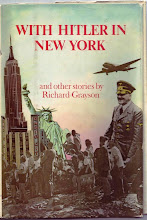
Today, Sunday, June 28, 1981, the Sunday Patriot-News of Harrisburg, Pennsylvania, published a discussion of Richard Grayson's With Hitler in New York and Other Stories in the paper's Keystoner Sunday magazine in "Printed Matter," a column by George Myers Jr.

Friday, June 19, 1981
New York Post Page Six Article on "Inveterate Prankster" Richard Grayson's Committee to Draft Rita Jenrette for Congress in Brooklyn


Sunday, May 3, 1981
Richard Grayson letter in The New York Times Book Review: "Mass Sensibility"

Richard Grayson and his brother Jonathan Grayson have a letter in the New York Times Book Review today (May 3, 1981), "Mass Sensibility":
To the Editor:
In his review of Michael Arlen's "The Camera Age" (April 12), Robert Brustein supposes that the literary sensibility and the mass sensibility never meet in today's world. He poses the question, "How many readers of this review can actually identify the lead actresses in 'Laverne and Shirley,' or the host of 'The Price is Right,' or the central characters in 'Dynasty' -- names that are bywords to millions of fellow Americans?"
In the interest of healing the great American cultural schism, we thought we'd answer Mr. Brustein's questions: (1) Penny Marshall and Cindy Williams; (2) Bob Barker (formerly Bill Cullen); (3) Denver oil tycoon Blake Carrington, his unfaithful wife, homosexual son and nymphomaniac daughter.
These were easy. Can we come back next week and try for more prizes?
JONATHAN GRAYSON, RICHARD GRAYSON, Davie, Fla.
Friday, April 10, 1981
Hollywood Sun-Tattler publishes article on Richard Grayson's winning Society of Professional Journalists First Amendment Essay Contest


The Hollywood (Fla.) Sun-Tattler today (Friday, April 10, 1981) has an article on Broward Community College English teacher Richard Grayson winning the First Amendment essay contest sponsored by the Greater Miami Chapter of the Society of Professional Journalists, Sigma Delta Chi. It also reprinted Grayson's winning essay, "Liberals and the First Amendment."
Wednesday, April 1, 1981
Delray Beach News-Journal Reviews Richard Grayson's WITH HITLER IN NEW YORK

Today's Delray Beach News Journal (Wednesday, April 1, 1981) has a review of Richard Grayson's With Hitler in New York:


Book review
WITH HITLER IN NEW YORK.
By Richard Grayson. Taplinger, 1979.
$7.95, 190 pages.
By Jack Saunders
Hannah Arendt wrote a book called The Banality of Evil. Or she wrote about the concept "the banality of evil" in her book Eichmann in Jerusalem. I don't remember. The phrase has entered the language. Like the phrase "The Ugly American" entered the language – backwards. Facts are banal. Evil is banal. Hitler is alive and living in New York.
With Hitler in New York, by Richard Grayson, is a collection of stories about what people do in this country: watch television, eat junk food, go to art museums, visit nursing homes, go to psychiatrists. With Hitler in New York is a serious book. A funny one too.
When a radio station in New York read over the air the names of men who had been picked up for patronizing prostitutes – the so-called john list – Grayson called the station and turned himself in. He wanted his name read "before I strike again."
These stories strike like lunacy.
If your bookstore doesn't have this book, it's available from the publisher (Taplinger Publishing Company, 132 West 22nd Street, New York, N.Y. 10011) for $7.95.
Grayson, who lives in his parents' spare room in Davie, just outside Ojus, doesn't have any, having given all his complimentary author's copies away.
I read a review that compared Grayson to Steve Martin and Fran Leibowitz. I'd compare him to Franz Kafka. No, I'd compare him to Nathanael West.
Man, this guy can write.
Friday, March 20, 1981

Thursday, February 26, 1981
Hollywood Sun-Tattler covers Richard Grayson's plan to draft Burt Reynolds for U.S. Senate


The Hollywood Sun-Tattler today (Thursday, February 26, 1981) covers Richard Grayson's plan to draft Burt Reynolds for U.S. Senate as a Republican opponent for Sen. Lawton Chiles (Democrat-Florida).
Wednesday, February 4, 1981
Miami Herald Feature Story on Richard Grayson & His Superstar Grandmother Sylvia Ginsberg

The Miami Herald today (Wednesday, February 4, 1981) has a feature story on Richard Grayson and his superstar grandmother, Sylvia Ginsberg.
Monday, February 2, 1981
The Miami News: Front Page Story on Richard Grayson & His Superstar Grandmother, Sylvia Ginsberg

The Miami News today (Monday, February 2, 1981) has a front-page story on Richard Grayson and his superstar grandmother, Sylvia Ginsberg.
Monday, September 15, 1980
England's IRON Magazine features two Richard Grayson stories


The English literary magazine Iron features two stories by Richard Grayson, "The Second Person" and "The Forthright Saga," in its current issue (#28, fall 1980).
Sunday, August 3, 1980
The Beaumont (Texas) Enterprise publishes article on Richard Grayson's campaign for Vice President

Today, Friday, August 3, 1979, The Beaumont Express (Beaumont, Texas) published an article, "Grayson runs for number 2," about Brooklyn writer Richard Grayson's campaign for Vice President.
Tuesday, July 29, 1980
New York Times letter by Richard Grayson: "Passengers for Sale"

Today, July 29, 1980, the New York Times features a letter to the editor by Richard Grayson, "Passengers for Sale":

New York Times
July 29, 1980
Passengers for Sale
To the Editor:
Unscrupulous people always take advantage of any new government regulation. Now that Mayor Koch has announced a ban, to begin Sept. 22, on single-passenger cars crossing the East River bridges during rush hours, how long will it be before some enterprising profiteer begins selling inflatable life-size dummies to lone motorists about to enter Manhattan from Brooklyn or Queens?
How will the police check for phony, non-human passengergs? A breathalyzer test to see if they’re breathing? And when government interference in our lives goes this far, who are the real dummies?
RICHARD GRAYSON
Rockaway Park, N.Y., July 24, 1980
Tuesday, July 8, 1980
Bellingham Review reviews Richard Grayson's WITH HITLER IN NEW YORK

The Summer 1980 issue of the Bellingham Review has a review of Richard Grayson’s With Hitler in New York on pages 48-49:

Book Review by Richard Dills
WITH HITLER IN NEW YORK AND OTHER STORIES, by Richard Grayson, Taplinger Publishing Company, New York, 1979, 190 pp., $7.95 (cloth).
Richard Grayson’s fictions in With Hitler in New York are marked by comic exuberance and sympathy. But they also raise the question: can an author be too playful for his own good? Don’t misunderstand, there is a lot to like in this exceptionally readable book ; it’s just that some of the pieces lack resonance because the author at times too much enjoys the sound of his own voice. Which may explain Grayson’s fondness for puns. An example from “What Really Happened in Cambodia”:
“We’ve got to find a nook or a cranny to hide out in tonight or we’re doomed,” says one refugee to his wife.
“But I don’t see a cranny,” she cries. “And I certainly don’t Sihanouk.”
And there are plenty more where that came from. In most of his stories Grayson uses a “patchwork” device wherein the story is pieced together with bits of dialogue, revery, incongruous observation and all-purpose non-sequiturs. This technique seems particularly appropriate for comedy, as it tends to emphasize absurdity and encourage puns and one-liners. It does not work as well—with one exception—with serious pieces unless fragmentation and loss of wholeness is essential to the story.
But, to the stories.

The despair and prurient interest of the personal ads we’ve all read in The Village Voice if not in our own hometown dailies is nicely captured in “Classified Personal.” And there are some nice ironies:
Love! Love! Love! Who’s got it to give? Lonely, love-starved W/M, 21, affectionate, handsome, muscular and understanding seeks guy with boyish good looks and smooth body for lasting relationship. Write OCCUPANT, Box 44, Carteret, N.J. 07915
“Occupant” seems just about right. But, even though the rest of the 37 or so personals carry the same degree of authenticity and/or irony, the piece as a whole escaped me. With two or three exceptions, the order of the personals appear to be just as random as that of a newspaper’s. The point, of course, is that Grayson has a significantly different audience—or, if not—at least an audience with significantly different expectations. (I will argue this point.) The author, then, must be more than a typesetter.
In “‘Go Not to Lethe’ Celebrates Its 27th Anniversary,” we discover a character named Grayson Richards who portrays a character in “GNTL” named Richard Grayson. The danger of such a story—aside from cuteness—is that by reducing a life to the commercially dictated structure of the daytime soap opera, the author risks the criticism often leveled at the soaps: that they entertain by trivializing serious emotional and ethical questions. I think Grayson just gets by here because even while his story raised these kinds of questions, I enjoyed reading the story. Also, I think it’s because the story is near the end of a volume full of comic invention, and read in that context “GNTL” has a place as a bit of extended tomfoolery.
“The Princess of the Land of Porcelain,” a non-comic piece, is a different story altogether. Here, idea and technique blend perfectly. In this story, fragmentation and loss of wholeness is the point. Leslie, a career woman, cannot resolve the conflict between her desire for freedom and her need to be taken care of. Leslie and her friends share the same beliefs, the same lifestyle, almost the same life.
However, her fears and her dreams separate her from her husband, Evan, and her lover, Ken. Even so, it is hard for Leslie to change or escape, for on the face of it she has what she wants:
. . . Evan was too involved with Sari to intrude on Leslie’s business. There were private things that did not require any discussions between them. Leslie and her husband operated on trust. They both had lots of psychic space. Everyone did. Ken had his Senate page, apart from Leslie. Sari was living with a radical therapist who rather liked Evan. It was all in the open.
Open and convenient, but lacking that sense of belonging and commitment which Leslie—to her own surprise—finds she needs but with the open-spacers regard with anathema. When her lover informs her that he is leaving town, Leslie is “. . . surprised at how surprised she was.” She does not, of course, make a scene or ask him to stay, but later that night she has nightmares even though she cannot fall asleep. She lies in bed with a cold, half-awake, half-asleep, feeling guilty because she wants to be taken care of.
“The Princess from the Land of Porcelain” shows Grayson at his best as he combines material with technique to produce a story with telling sympathy. If good stories make you think and make you care, then this is one of them.
Subscribe to:
Posts (Atom)