Pages

Wednesday, December 22, 1982

Library Journal reviews Richard Grayson's LINCOLN'S DOCTOR'S DOG in "Small Press Roundup: Best Titles of 1982"


In its December 15, 1982, Library Journal features a brief review of Richard Grayson's Lincoln's Doctor's Dog in its "Small Press Roundup: Best Titles of 1982":


Library Journal
December 15, 1982

LJ's SMALL PRESS ROUNDUP: Best Titles of 1982
By Susan Shafarzek

Pages 2303-2308


THE TIME is long past—if indeed it ever existed—when the small press world could be regarded simply as a haven for the beginning. True, the beginner often finds a place there, but, increasingly, so does the season talent, to whom the major publishing houses can no longer offer a venue. It appears that the alternative presses have become just that, and they are an alternative for the libraries, as well. Those interested in keeping to the front of aesthetic and literary trends will find the small press world a rewarding, supplementary source.

Not everything from the small presses is outstanding, of course. Many are still the province of the cranky and the refuge of the uninteresting, but looking over more than 300 small press books seen this year, more were found that were valuable than not. This review aims to provide a rounded sample of the best of these. (2303)

. . . .

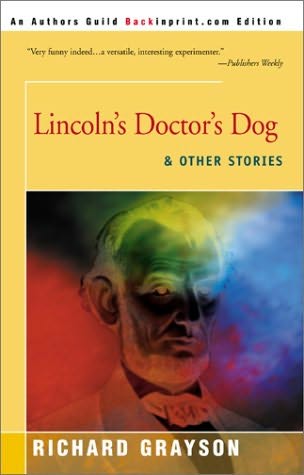
Humor is also the hallmark of Richard Grayson's excellent collection, Lincoln's Doctor's Dog and Other Stories (White Ewe, $11.95, cloth). These range from the surreal and punning to the poignantly reflective. (2306)

_____________________________________
Susan Shafarzek, co-editor of the Washout Review, is on the staff of the Graduate Office of the State University of New York at Albany, in addition to her doctoral studies in the writing program there.

Thursday, October 28, 1982

Fort Lauderdale News & Sun-Sentinel reports on Richard Grayson at Broward Community College's "The Art Explosion: New Video"


The Fort Lauderdale News & Sun-Sentinel reports today (October 28, 1982) on Richard Grayson at Broward Community College's "The Art Explosion: New Video," a monthlong "happening" sponsored by the school's Art Department. Grayson will read his story "Inside Barbara Walters," about video literacy.

Sunday, October 17, 1982

Miami Herald reports on Richard Grayson's $3000 Florida Arts Council grant to write EATING AT ARBY'S


The Miami Herald today (Sunday, October 17, 1982) reports on Richard Grayson's $3,000 Florida Arts Council grant to write Eating at Arby's: The South Florida Stories.

Thursday, October 7, 1982

Hollywood Sun-Tattler "Names and Places" column reports on Richard Grayson's EATING AT ARBY'S: THE SOUTH FLORDA STORIES


Today, Thursday, October 7, 1982, Carol Brzozowski's Names and Places column in the Hollywood Sun-Tattler has an item on Richard Grayson's Eating at Arby's: The South Florida Stories:

IT'S TRUE: JUST TELL 'EM
READ RICHARD'S BOOK


So the folks back home don't believe your horror stories about driving on I-95?

You get a few chuckles when you spin your favorite yarns about shopping at our area malls?

Fear no more! Davie resident and Broward Community College English teacher Richard Grayson has published a book entitled "Eating at Arby's: The South Florida Stories." It puts into print those daily dilemmas only we South Floridians can truly appreciate.

Richard, known for his witty sarcasm and last March a hardly serious candidate for Davie's council, had received a $3,000 grant from the Florida Arts Council to produce a series of "documentary" stories on South Florida life.

"It's a pleasure to bring great literature to South Florida," he says. "I hope the taxpayers of Florida agree that the grant money I received was well spent."

You can be the judge of that if you care to part with $3 to buy the book.

Wednesday, September 15, 1982

Fort Lauderdale News: Gary Stein column on Richard Grayson and EATING AT ARBY'S


In the Fort Lauderdale News today (Wednesday, September 15, 1982) Gary Stein's column discusses Richard Grayson and Eating at Arby's.

Thursday, September 9, 1982

Small Press Review reviews Richard Grayson's LINCOLN'S DOCTOR'S DOG


The Small Press Review has reviewed Richard Grayson's Lincoln's Doctor's Dog on page 8 of its September 1982 issue and included the book as one of the month's selections in the Small Press Book Club:

#1905
Lincoln's Doctor's Dog & Other Stories by Richard Grayson (White Ewe Press). 5½x8½; 187 pages, $11.95/cloth.


Lincoln's Doctor's Dog & Other Stories is a collection of 22 fictions by Richard Grayson, all funny, all playful and all engaged in the shift from persona to person, from voice to voice that characterizes the wit of experimental fiction. Grayson achieves some startling effects in "A Sense of Porpoise," in which a porpoise replaces a boy's dead father. The situation produces the pun, but also some fine speculations on the relationship of child to parent. "Why Van Johnson Believes in ESP" has the character of both parody and the play that is at the heart of the new narrative technique. The complications of narrative voice become even greater, often funnier, sometimes more frightening, in the autobiographical stories about growing up in New York in the late 60s and early 70s.

Wednesday, September 1, 1982

Richard Grayson to Appear at Winthrop College Writers' Conference November 11-13, 1982


Richard Grayson will be among the writers who will be staff members at the Winthrop College Writers' Conference in Rock Hill, South Carolina on November 11-13, 1982.

Sunday, August 22, 1982

Chicago Sun-Times reports on Richard Grayson's plan for Democratic ticket of Sen. Gary Hart and Chicago Mayor Jane Byrne


In its "Public Eye" column today (Sunday, August 22, 1982), the Chicago Sun-Times features a report on Richard Grayson's plan for a 1984 Democratic ticket of Colorado Senator Gary Hart and Chicago Mayor Jane Byrne.

Sunday, June 20, 1982

Louisville Courier-Journal reviews Richard Grayson's "Lincoln's Doctor's Dog and Other Stories"


Today, Sunday, June 20, 1982, The Louisville Courier-Journal published a review of Richard Grayson's "Lincoln's Doctor's Dog" alongside a review of Brian Swann's "Unreal Estate" in the newspaper's Small Press portion of the Book pages. The review is written by David G. Mudd, a student at the University of Kentucky.

LINCOLN'S DOCTOR'S DOG & OTHER STORIES By Richard Grayson White Ewe Press. $11.95 
UNREAL ESTATE By Brian Swann Toothpaste Press. $8.50 paperback  

A review by David G. Mudd  

These two collections of short stories have many likable characteristics. They offer a refreshing alternative to a hungry reader who may balk at the diet of more traditional stories offered by the popular magazines. 

Both collections are published by small presses, a good indication that the contents will be challenging. Both books are handsomely bound, the editing is meticulous, and Swann's book features four exquisite line drawings. At one point in "Lincoln's Doctor's Dog," Grayson pauses to explain the invention of its strange name. It seems that a quick study of the print market indicated that best-selling books often concern either Abraham Lincoln, doctors and medicine, or dogs. So, Grayson thought, Why not combine the three areas and capitalize? Pretty clever, eh? Grayson places cleverness above all else a little too often. 

However, he proves that he knows how to write a short story with "What Guillain-Barre Syndrome Means to Me," funny, bitter tale about a visit paid by a young woman, her son and her foreign lover to the lonely home of the boy's father. Too many of the other stories are sacrificed to cleverness and tedious one-liners. In the title story, Grayson is constantly teasing the reader. "Are you reading story to escape from your problems?" he chides. "Why aren't you out (or in) having sex?" This is funny stuff, but the whimsy continues in this and other stories until it becomes stale.

An English professor once told that the only true definition of a short story was this: "It has a beginning, a middle and an end. ... Think about it." Brian Swann doesn't want think about it. Swann's stories, all very short, seem to swoop down and catch either the initiation or the tail-end of happening, or they fall into the middle of an event, look around a then keep falling. Swann is an Englishman and it is tempting to explain away his seemingly cursory stories about landed gentry, travel and magic by saying they are veddy British. 

I think more highly of them than that. Swann's stories strike me as experiments with time and place, and with what a story can do with those two elements. Swann seems to believe that a thread of a story is more intriguing, more satisfying and ultimately closto reality than the traditional beginning-middle end formula. He be right. His stories are provacative and haunting. 

David G. Mudd is a student at the University of Kentucky.

Thursday, June 10, 1982

Richard Grayson Letter on Japanese Haiku Invading American Poetry in June-July 1982 Issue of Small Press Review

In the June-July 1982 issue of Small Press Review, Richard Grayson has published a letter attacking the invasion of Japanese haiku in American poetry magazines.

Monday, May 17, 1982

Best Sellers reviews Richard Grayson's LINCOLN'S DOCTOR'S DOG


The May 1982 issue of Best Sellers has a page 47 review of Richard Grayson's Lincoln's Doctor's Dog:

Grayson, Richard
Lincoln's Doctor's Dog & Other Stories
White Ewe Press (PO Box 996, Adelphi, Md. 20783),
187p., $11.95


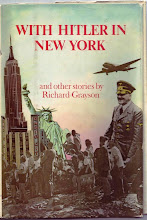
Despite my initial reservations regarding this volume when it reached me, I must confess I like Richard Grayson and his work. Yes, we are told that Grayson labored as a messenger at the Village Voice, a clerk at the Brooklyn Public Library, a delivery man for the Midtown Florist and the Canarsie Laundry; but Richard Grayson is a writer, currently transplanted to Broward Community College in Florida, but still a writer whose With Hitler in New York caused Rolling Stone to map it as the place "where avant-garde fiction goes when it turns into stand-up comedy."

These twenty-two fictions display a versatility which commands attention. And they are very much in the American grain -- that vein of autobiography which has been a constant from the beginning of our literary history down to the confessional mode of the recent mode of the recent past. The title tale, which is certainly captivating, pretends to be the biography of Lincoln's doctor's puppy who grows up to be elected to a state governorship and achieves fame as a lecturer. Grayson can parody human excess and human frailty, parent-child relationships, and recreate a 1960s scene with poignancy. There is even a dazzling memoir of George Washington's step-granddaughter. And in "Diarrhea of a Writer," Grayson exposes that pride and pain which are the nutrients of a writer's growth. The questions he wanted to ask Saul Bellow: "Did you ever doubt yourself? How do you know when you've written something important? Did you ever want to give up?" -- these all fade when the Nobel Laureate tells Grayson, "I'll look for you."

Richard Grayson has been found, at least by this reader, and found-out, too. From the evidence he is serious and comic, charming, given to outrageous puns, and a sharp-eyed observer of and participant in life's absudities. Permit me one academic correction -- it is Edwin (not Edward) Arlington Robinson, as found on page 75.

NICHOLAS J. LOPRETE, JR., specializes in American fiction at Fordham University, Bronx, New York.

BOGG Magazine reviews Richard Grayson's LINCOLN'S DOCTOR'S DOG


BOGG Magazine has a review of Richard Grayson's Lincoln's Doctor's Dog in issue #49 (1982) by editor/publisher John Elsberg:

Lincoln’s Doctor’s Dog, by Richard Grayson, White Ewe Press, PO Box 996, Adelphi, Md. 20783, 1987 pp., hdbk., $11.95.


Richard Grayson’s third collection of short stories proves that the magician’s hat is far from empty. I must confess that the lead-off story does little for me, but after that Grayson’s funnier than Steve Martin. His characters are troubled, ridiculous, and poignant with a capital P. They run the gamut from a lawyer who collects Time magazine covers, to Blanche “Spongecake” Bernstein, Patty Hearst imitators, and Sparky, Lincoln’s doctor’s dog (Sparky allows Grayson to roll that publishing canard about best sellers being books about Lincoln, doctors, or dogs, into one impossible alloy.) Grayson constantly loses control of his stories and his characters (reminiscent of Pirandello and Flann O’Brien) and they do or say things that reveal mischievous facets of their author’s personality. Or do they? Grayson is a sharpie. It’s impossible to tell how many layers we would have to peel away before we arrive at the real Grayson. We begin to believe that all of the characters are really him. We believe they are telling us the truth. That’s where the art comes in.
"Some orgasms are better than others," I tell my fiancee.

"So what?" she says.

– from “Roominations”

Grayson pumps his stories full of topical details. Everything from products (Tropicana), songs, films, t.v. shows, to news items (swine-flu shots, recipes), and all sorts of personalities (Yuri Gagarin, Van Johnson, Larry Flynt, John Gardner, Steve McQueen, et al.) to provide a cornucopia of everyday life in the US. He tops it off with outrageous puns. In this book we meet a boy who lives with a porpoise, another who goes to his first X-rated movie and falls in love with the star, still another who really gets involved with the calls he answers as a switchboard operator. But this book also contains three stories that are serious departures from anything I’ve seen in the past – “Early Warnings,” “Cross in the Water,” and “I, Eliza Custis” (the latter being the first-person story of George Washington’s granddaughter) are adventures in more traditional storytelling.
"Y'know, just living longer gives you confidence. . . That's one ting you'll find out here."
– from "18/X/1969"

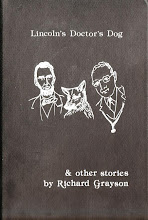
The 22 stories in this beautiful black hardback do just that: we can count on Grayson to show us how to live from day to day.

Wednesday, May 5, 1982

Kirkus Reviews reviews Richard Grayson's LINCOLN'S DOCTOR'S DOG


Kirkus Reviews has a review of Richard Grayson's Lincoln's Doctor's Dog in its May 1, 1982 issue:

Kirkus Reviews

May 1, 1982
Grayson, Richard
LINCOLN'S DOCTOR'S DOG
And Other Stories
White Ewe $11.95
5/5 LC: 81-69117
ISBN:978-0-917976-13-1


Grayson's two story collections--With Hitler in New York (1979) and this new one--together suggest the literary equivalent of a kid's messy room: cozy for the kid, junk strewn everywhere, but a little horrifying to anyone standing at the doorway. Grayson's most constant character here is himself-as-writer: "Please: you can see I'm a sick person. What would it take, a few pages in your lousy literary magazine, to make me happy? . . . If I can't have your respect, I'll settle for your pity. . . ." And pitiful indeed are many of these stories--cheap, silly, little more than names, puns, and jokes about the author's desperation for readers (hence the title). Still, there is something boorishly, oddly charming about Grayson's ability to stop in the middle of some childishly junky piece to ask, sincerely: "When I write myself into a corner, as I have done once more, do you have to give me credit for trying?" And there are two real short stories here--"A Hard Woman," "What Guillain-Barre Syndrome Means to Me"--which, though sketchy, indicate that Grayson can be a writer when he wants. For the most part, however: juvenile literary clowning, only faintly--and erratically--amusing.

The Midwest Book Review reviews Richard Grayson's LINCOLN'S DOCTOR'S DOG


The Midwest Book Review reviews Richard Grayson's Lincoln's Doctor's Dog in May 1982:


LINCOLN’S DOCTOR’S DOG, AND OTHER STORIES. By Richard Grayson. White Ewe Press (P.O. Box 996, Adelphi, MD 20783). $11.95


The voice of Richard Grayson is not consistent in his latest collections: that much is evident from the start. Some of his stories, which may be loosely classified as avant-garde fiction, seem to blatently [sic] make social commentaries without significantly drawing reader interest. Others cultivate a tongue-in-cheek humor that engrosses the reader in whatever subject is being revealed as in, for example, the unlikely tale ‘A Sense of Porpoise’, in which a man’s experiences with a live-in, talking porpoise assume Freudian overtones.

Some stories reveal Grayson’s distinct New York background and reflect some of the modern-day attitudes of the typical inner-city inhabitant caught in incongruous chains of events. Others, such as the humerous [sic] treatise ‘Lincoln’s Doctor’s Dog’, are simply drawn from Grayson’s imaginative musings.

The result: a mixed collection of droll and humerous [sic] works that New Yorkers, in particular, will appreciate.

–Diane C. Donovan
San Francisco, CA